
12V recessed bathroom spotlights
This selection is also available in our French store: Spots encastrables 12V pour salle de bain

- Tracked delivery to your country Tracked delivery
- Secure payment at checkout Multiple payment methods
- 14 days to change your mind 14-day returns
- Secure payment Secure payment
Not sure of your style? Find it in 30 seconds
A few questions, and we will show you the pieces made for you.
Frequently asked questions
How do I choose the right product?
What are the delivery times?
Can I return an item?
Can I pay in instalments?
An interior that reflects who you are
Carefully selected pieces, shipped from our warehouses. Our team advises you before you buy, so you choose with confidence.
- Tracked delivery
- Pay in instalments, where available
- 14 days to change your mind
- Advice & showroom in Lyon, France
Aim for an IP44 rating above the mirror and IP65 in the shower area, with a wide beam to avoid shadows on the face and a light around 2700 to 3000 K. The 12V bathroom downlight lowers the voltage as close as possible to the light source, which requires a transformer housed in an accessible place.
Which 12V recessed downlight to choose for a bathroom?
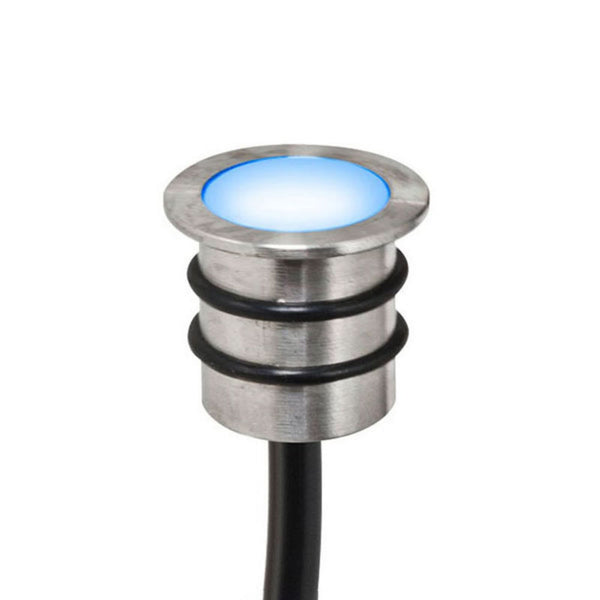
A 12V recessed downlight for a bathroom is chosen on three points: a protection rating suited to water splashes, a beam wide enough to avoid shadows on the face, and a finish that blends into the ceiling. Low voltage requires a transformer, to be planned in an accessible place.
The three deciding criteria
The protection rating first: an IP44 is enough away from splashes, an IP65 is preferable near the shower. The beam next: narrow, it draws a hard cone and creates shadows under the eyes in front of the mirror; wide, it lights the surface without glare. The finish finally: a flush downlight, level with the ceiling, wipes clean in one movement and stays discreet in a small room. The GU5.3 base, known as MR16, is the common low-voltage format: check it before ordering, as it determines the compatibility of the module.
The transformer, to plan from the survey stage
A 12V LED bathroom downlight is not connected directly to the mains: it needs a transformer upstream. House it behind a hatch or in an accessible box, never sealed into the slab. A single transformer can supply several points if the cable length stays reasonable, to be checked with the instructions of the model.
At Designix: secure payment, tracked delivery, returns and a customer service team available to confirm a diameter or a colour before ordering.
How to install downlights in a bathroom?
Installation starts with the survey: the downlights are placed outside the direct splash zones, the available depth in the ceiling is checked, then the supply is run from the transformer. Drilling is done with a hole saw at the diameter of the downlight, and the connection is made with the power off.
Survey and drilling
Mark the axes in pencil and check the spacing between two points before drilling: this is the only step that is hard to correct. Check the available thickness between the plasterboard and the top of the ceiling, a 12V downlight needs room for its body and its connector. The hole saw is chosen at the diameter stated by the manufacturer, not at random. The depth of the room also decides the place of the transformer, often the blocking point of a false ceiling.
Connection with the power off
Switch off at the circuit breaker and check that there is no voltage before touching the wires. Locate the incoming supply, connect the primary of the transformer, then the 12V outgoing cables to each downlight. The module clips into its holder, the downlight goes back up on springs into the cut-out. Once the power is restored, check for absence of flicker before closing up.
Where to place 12V downlights in the bathroom?
Two downlights above the mirror light the face without cast shadow, one point near the shower lights the wet zone, and one or two points provide circulation. Avoid aiming at the mirror head-on: the light should fall on the basin area, not into the eyes.
Around the mirror and the basin
Two points on either side of the mirror, slightly in front of its plane, are better than a central point that casts the shadow of the nose. A 12V recessed downlight for a bathroom cabinet, placed under the shelf, set back from the edge and slightly towards the rear, grazes the light across the basin. In a toilet, a single point in the ceiling, with a wide beam and warm light, is more than enough.
Shower area and circulation
Near the shower, keep the downlight away from the direct jet and prefer a matt finish whose seal stays clean. For circulation and the floor, direct the beam downwards: the aim is to make the passage safe, not to create a bright spot on the tiles. One or two points are enough in a water room of usual size.
Which light colour to choose for a bathroom or a living room?
A warm light, around 2700 to 3000 K, gives a tone close to incandescent and suits both the living room and the bathroom. Lower, the light appears cold and bluish; towards 4000 K, it leans towards clinical white, more suited to a worktop.
- 2700 K: warm white, living room, bedroom, bathroom in the evening.
- 3000 K: slightly crisper warm white, bathroom and hallway.
- 4000 K: neutral white, worktop, office, garage.
In front of the mirror, colour rendering matters as much as temperature: good colour rendering keeps skin tones natural and avoids grey. The bathroom colour temperature is therefore chosen with the use of the moment, not only with the style of the room.
12V downlight or 230V downlight: which to choose for a wet room?
The 12V downlight lowers the voltage as close as possible to the light source, which requires a transformer to house and keep accessible. The 230V downlight connects directly to the mains and simplifies installation. The choice depends mainly on the space available in the ceiling and the number of points to supply.
| Criterion | 12V downlight | 230V downlight |
|---|---|---|
| Supply | Low voltage, via a transformer | Directly on the 230 V mains |
| Safety in a wet room | Voltage lowered as close as possible to the downlight | Depends on the protection rating of the model |
| Choice of power | Several low-power points | Fewer points, higher power |
| Installation | Transformer to house and keep accessible | No transformer to plan |
| Maintenance | Check the transformer in case of failure | Replace the downlight alone |
On a renovation where the ceiling is already closed, 230V avoids opening a hatch. In a water room fitted with several points, 12V distributes the light more finely. In both cases, it is the protection rating that makes the installation acceptable in a wet zone.
How to match downlights with the decor for the kitchen and the rest of the house?
The same family of downlights can run through the house: flush and discreet in the bathroom, it works well above a worktop. Kitchen decor benefits from repeating the same colour and the same colour temperature as the water room, to avoid two lights that contradict each other.
The same design from one room to another
A round flush downlight in aluminium works as well above a basin as on a worktop. This is what makes a modern kitchen decor readable: the same slim circle repeated, with no break in style between rooms. To go further, lighting a kitchen worktop above all requires a directed beam, not a different model.
Colour and temperature: stay consistent
White matches everywhere and blends into the ceiling: white recessed downlights are the most neutral choice. A black version makes the design stand out more, useful on a light ceiling and a dark worktop. Gold finishes warm up a white-tiled water room.
Fixed, adjustable or dimmable downlight: how to choose among the variants?
A fixed downlight is enough for regular general lighting. The adjustable one is used when the beam needs to be directed towards a basin or a niche. The dimmable one is chosen with the module and the switch: an incompatible dimmer causes flicker, even on a good downlight.
Fixed or adjustable
When all the points must light the floor in the same way, the fixed one gives an even wash and is installed without adjustment. Directing the beam with an adjustable downlight compensates for an off-centre mirror or highlights a niche. Allow one orientation per useful point, not everywhere.
Dimmer and flicker
Modulating the intensity with a dimmer changes evening comfort: high light for shaving, low for bathing. Check that the module, the transformer and the switch are compatible with each other, otherwise flicker appears from the lowest intensities.
What are the drawbacks of LED lamps in a bathroom?
LED consumes little and heats little, but it can flicker with an incompatible dimmer, lean towards blue if its colour temperature is too high, and lose intensity over time. A quality model and a suitable dimmer limit these annoyances.
The real annoyances
Flicker almost always comes from the module and dimmer pairing, rarely from the downlight alone. Cold light is explained by a temperature choice too high for a relaxation room. The gradual loss of intensity remains the lot of all modules, hence the interest of a model whose module can be replaced without changing the downlight.
Maintaining a downlight in a wet room
A soft cloth is enough on the ring, without aggressive products. Once a year, look at the seal and the ring: a worn seal lets moisture through. If one point no longer lights while the others work, test the transformer before removing the downlight.
To equip the rest of the house, browse all Designix light fittings and take the time to choose a light fitting room by room: transpose the same light to the living room, downlights for the bedroom, continue in the hallway and make a staircase safe are all settled with the same logic. From the entrance of the house, keep the same colour temperature, and for the terrace, the recessed outdoor version repeats the same design.
The complete light fitting collection is worth consulting before settling on a colour: downlights with a stronger design or dimmable recessed LED downlights can be compared at a glance, and LED downlights for kitchens help decide on a continuous worktop.
Frequently asked questions
What power of downlight for a living room?
In a living room, light is spread over several points rather than concentrating high power in the same place. A low-power downlight multiplied around the sofa and the corners gives softer lighting than a single point, and allows modulation according to use.
What are the drawbacks of LED lamps?
An LED consumes little and heats little, but it can flicker with an incompatible dimmer, lean towards blue if its colour temperature is too high, and lose intensity over time. A quality model and a suitable dimmer limit these annoyances.
Can a 12V recessed downlight be installed in the shower area?
In the shower area, the downlight must withstand water splashes and stay out of the direct jet. A flush recessed model, well sealed to the ceiling, is preferred, and the beam should not be directed towards the body or the face. An IP65 rating is the usual reference for this zone.
Is a transformer needed for 12V recessed downlights?
A 12V downlight runs on low voltage: it needs a transformer that steps down the 230 V of the mains. This transformer is placed upstream, in an accessible place, and is sized according to the number of downlights connected. A 230V model does without it.
Light colour for a living room: which to choose?
For a living room, a light between 2700 and 3000 K stays warm and restful in the evening. A colder tone, towards 4000 K, makes the room crisper but less warm. The choice is made according to use: relaxation, reading or entertaining.




