Waterproof recessed spotlights
- Tracked delivery to your country Tracked delivery
- Secure payment at checkout Multiple payment methods
- 14 days to change your mind 14-day returns
- Secure payment Secure payment


Not sure of your style? Find it in 30 seconds
A few questions, and we will show you the pieces made for you.

















Frequently asked questions
How do I choose the right light output?
At what height should the light be installed?
What type of bulb?
Compatible with LEDs and dimmers?

Light changes everything
From statement chandeliers to discreet wall lights, we help you choose the right brightness, height and style for every room.
- Tracked delivery
- Pay in instalments, where available
- 14 days to change your mind
- Advice & showroom in Lyon, France
Start with the protection rating: IP44 for a sheltered damp room, IP65 where water spray is possible, IP20 for a dry ceiling. This selection brings together models from all three ratings, mostly in aluminium, round or square, with GU10 sockets or integrated LED, for the living room and hallway.
- Definition and rooms
- Layout on the ceiling
- Wattage
- Shape and colour
- Material and rating
- Installation and care
- Drawbacks
- A 40 m2 room
- Bathroom
What is a recessed bathroom spotlight and where should it go?
A recessed bathroom spotlight fits into the ceiling and its IP44 or IP65 rating makes it suitable for rooms where damp or spray is possible. In this selection, models are split between living room and hallway, in aluminium, white or black, often 10 W with a GU10 socket.
IP44 or IP65 recessed spotlights: what is the difference?
IP44 means protection against modest water spray, IP65 means resistance to water jets and dust. In other words, an IP65 spotlight goes in an exposed spot, an IP44 spotlight in a simply damp room. In the selection, aluminium dominates across all three ratings, with a finish that stays the same.
Waterproof spotlights in the living room and hallway: what uses?
In the living room, they provide accent lighting above a piece of furniture, a bookcase or a table, often 10 W with a GU10 socket. In the hallway, they mark the path and replace a central ceiling light. To compare more widely, browse recessed spotlights for living rooms, then all our lighting.
How should spotlights be laid out on the ceiling?
To lay out spotlights on the ceiling, start from the furniture or the area to be lit, then spread the points evenly, keeping the same distance between them and from the walls. The aim is to avoid dark zones as much as points that are too close together.
What spacing should be planned between two ceiling spotlights?
In general, allow around one metre to one metre fifty between two points for a standard ceiling, more if the spotlights are low powered. The useful rule is regularity: a constant gap gives an even wash, an irregular gap is immediately noticeable. Then adjust according to the room height and the number of points.
How should spotlights be aligned in a hallway?
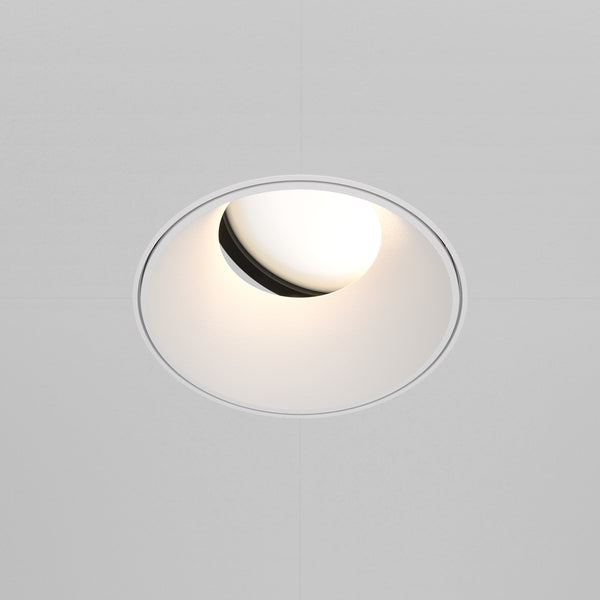
In a hallway, align the spotlights along the line of travel, at an equal distance from both walls, so the eye is guided without zigzagging. If the hallway is narrow, a single line is enough. To direct the beam towards a wall rather than the floor, look at the adjustable versions. To light a worktop, choose the kitchen spotlights.
What wattage of LED spotlight should I choose to light my living room?
The wattage of an LED spotlight for a living room is chosen according to the floor area, the ceiling height and the number of light points. This selection offers 7 W, 10 W, 12 W, 18 W and 24 W models. A 10 W suits accent lighting, a more powerful model suits an area that needs presence.
| Wattage | Share of the selection | Socket | Example models |
|---|---|---|---|
| 10 W | 54 % | GU10 | Nixo, Cervo, Wynnifred, Encora |
| 24 W | 18 % | Integrated LED | Lysa, Albora |
| 18 W | 14 % | Integrated LED | Lunel |
| 12 W | 11 % | Integrated LED | Ondsamilo, Ivyra |
| 7 W | 4 % | Integrated LED | Blanco |
10 W or 24 W LED spotlight: which for a living room?
The 10 W, by far the most common here, serves as accent and circulation lighting: it is multiplied across several points. The 24 W, offered notably on Albora square 24 W, suits a large room or a single area that needs good lighting. The socket follows the wattage: GU10 at 10 W, integrated LED above that.
GU10 socket or integrated LED: what is the difference day to day?
The GU10 is a bulb you replace yourself, whenever you want, and it accounts for a little more than half the selection. The integrated LED is a module sealed into the spotlight: it cannot be replaced, but forms a flatter unit, often protected to IP44. To adjust the intensity, compare the dimmable LED spotlights.
Round or square, white or black: which shape and colour should I choose?
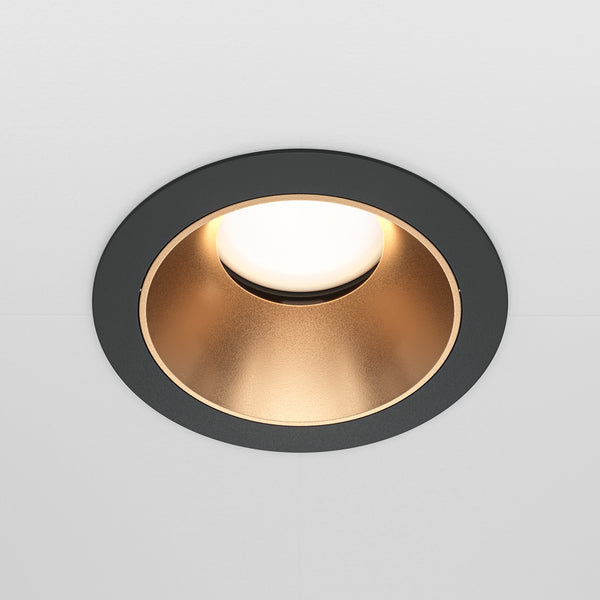
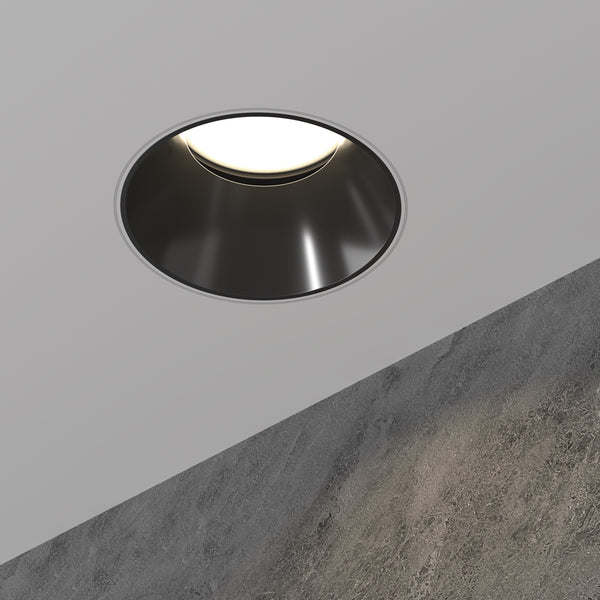
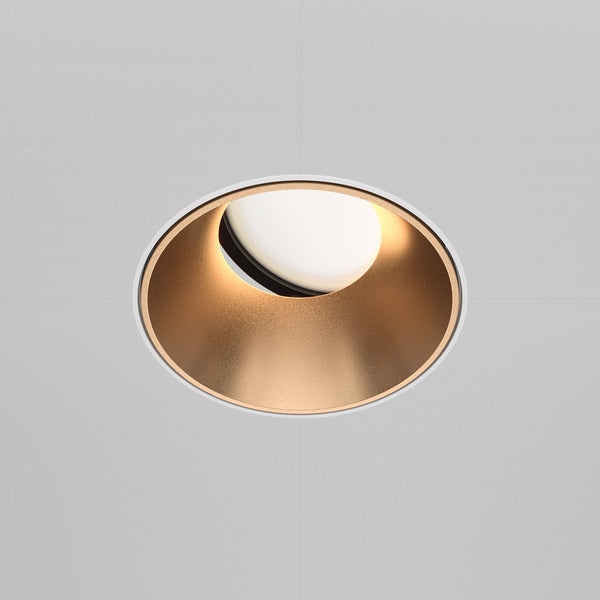
The choice between round and square depends on the style of the ceiling and the lines of the room: round softens, square aligns with a graphic composition. White blends into a pale ceiling, black creates contrast, gold brings a more dressed finish.
Round or square recessed ceiling spotlight?
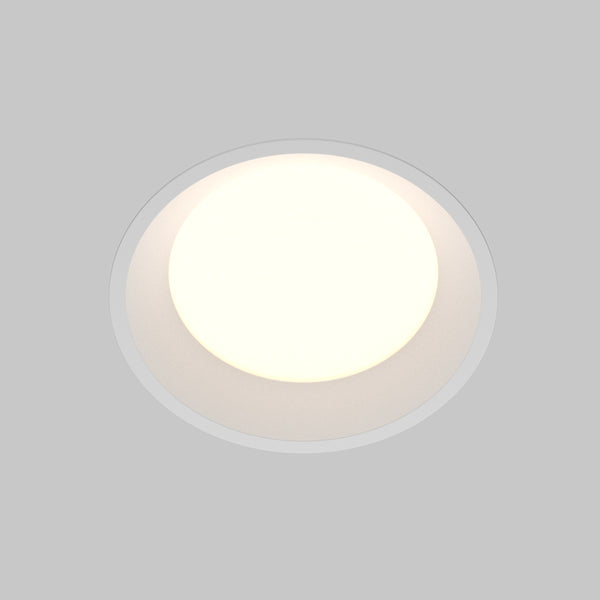
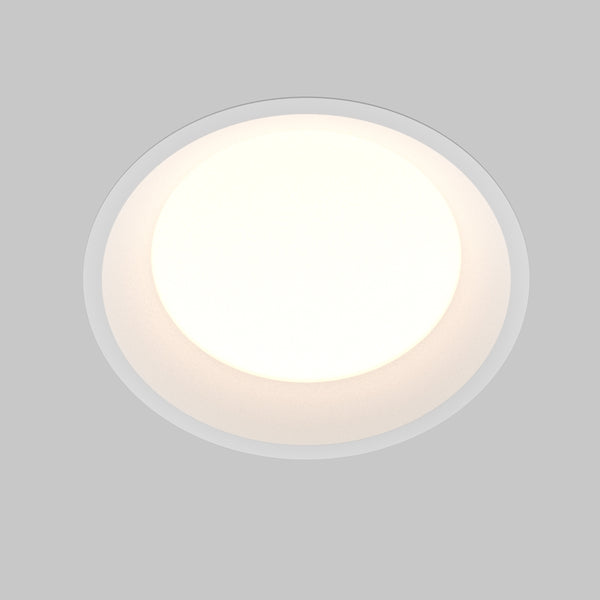
Round clearly dominates the selection and forgives old ceilings as well as rooms with soft lines. Square is reserved for clean ceilings and controlled alignments: two squares side by side draw a pattern, whereas a square alone in the middle of a ceiling looks strange. For an interior with clean lines, see the modern style spotlights and the design spotlights.
White or black spotlight in a contemporary living room?
White suits a pale painted ceiling: the trim disappears and the spotlight is forgotten. Black, as on Cervo black IP65, creates a deliberate graphic point on a white ceiling. Gold, in the minority, is reserved for carefully styled interiors: see the gold finishes.
What material and protection rating for a recessed bathroom spotlight?
Aluminium dominates this selection and brings a clean, durable finish, while plastic appears on models with a flush trim or a wide diffuser. The protection rating is chosen according to the room: IP20 for a dry interior, IP44 for a sheltered room, IP65 for spray.
| Protection rating | Share of the selection | Socket observed | Example models |
|---|---|---|---|
| IP20 | 43 % | GU10 | Wynnifred, Aurel, Calen, Naoise |
| IP44 | 43 % | Integrated LED | Lysa, Lunel, Blanco, Albora |
| IP65 | 14 % | GU10 | Nixo, Cervo, Encora, Liseris |
Aluminium or plastic: what does the material change?
Aluminium gives a rigid spotlight, with a clean reflector and a trim that keeps its shape. Plastic, often combined with aluminium on models with a large diffuser, allows wider diameters and a lighter unit. For worked metal finishes, see the metal spotlights.
IP20, IP44, IP65: which rating for which room?
IP20 is enough under a dry ceiling: living room, hallway, bedroom. IP44 suits a damp room but one sheltered from direct jets. IP65 goes where water can splash. In the selection, IP65 remains in the minority and comes in 10 W: the Nixo IP65 spotlight is an example.
How do you install and care for a recessed bathroom spotlight?
Installing a recessed bathroom spotlight means checking the ceiling thickness, the cut-out diameter and the electrical connection. For care, a soft cloth is enough on the trim. Models with a GU10 bulb are easy to replace, integrated LED versions are changed as a whole.
Do you need a recessed spotlight cover?
A cover is not systematic: it depends on the model and the protection rating. An IP44 or IP65 spotlight is already built to limit contact with damp and spray. Before drilling, check the ceiling thickness and the cut-out diameter, which here ranges from 8.4 cm to 17.5 cm depending on the model.
How do you replace the bulb in a GU10 spotlight?
Cut the power, let it cool, then remove the bulb by turning it a quarter turn. The GU10 accounts here for more than half the references, including Wynnifred minimalist. On an integrated LED spotlight, nothing is replaced: the whole module is changed.
What are the drawbacks of recessed LED spotlights?
Recessed LED spotlights have few drawbacks, but they require good planning: the light can be directional, integrated models cannot be repaired and the result depends on the number of points. This selection is guaranteed for 5 years, which covers normal use.
Recessed LED spotlight: what lifespan and what warranty?
The lifespan depends on the module, the ventilation around the spotlight and the time it is switched on: a GU10 model is extended by simply changing the bulb, an integrated LED ages as a whole. The entire selection is guaranteed for 5 years. Light temperature also matters: warm white around 2700 to 3500 K, neutral white around 3500 to 4500 K.
LED spotlights: mistakes to avoid on the ceiling?
Multiplying points that are too close together, mixing two colour temperatures in the same room, or concentrating all the light in the centre: that is what spoils the result. A regular grid and a single colour family are better. To adjust without changing the spotlights, look at the dimmer-compatible spotlights.
How many spotlights should be installed for a 40 m2 room?
The number of spotlights for a 40 m2 room depends on the wattage chosen, the ceiling height and the use. Think in terms of areas to light rather than overall surface: spread the points across large zones, then adjust with 10 W, 18 W or 24 W models.
How should spotlights be spread in a large room?
Divide the room into groups: one above the seating area, another along the circulation path, a third near a low piece of furniture. Each group keeps its own regular grid. A 24 W model with a large diffuser, such as Lysa with flush trim, reduces the number of points needed.
Can several spotlight wattages be mixed?
Yes, provided you stay within the same colour temperature: wattages are distributed by area, whereas a difference in shade is immediately noticeable. So keep the 10 W for passages and the 18 or 24 W for main areas. For a living space, compare the LED spotlights for living rooms.
IP65 spotlights for the bathroom: what should you know?
For a bathroom, the protection rating matters most: an IP65 spotlight resists water spray, an IP44 spotlight suits less exposed areas. This selection is intended for the living room and hallway, but the IP44 and IP65 models can suit damp rooms depending on their position.
What is the standard for IP65 spotlights in the bathroom?
French electrical regulations define protection zones around the bath and the shower tray, in which the permitted equipment is restricted. The simple marker: the closer you get to water, the higher the protection rating must be. Have the position approved by your electrician before drilling.
Is it possible to put IP44 spotlights in a bathroom?
Yes, outside the most exposed zones, an IP44 spotlight can be suitable. It goes in a simply damp area, away from the shower or bath. Beyond these zones, an IP20 remains sufficient. For a discreet ceiling look in a damp room, see the white spotlights.
One last point before ordering: note the cut-out diameter and the protection rating of the model you are considering, that is what decides everything. Secure payment, tracked delivery, returns and Designix customer service support you, and you can complete your project in the lighting catalogue.
Do 1000 lumens light well?
The impression depends on the flux, the mounting height and the diffusion, not just the figure. A concentrated flux lights one precise point strongly, a wide flux lights more evenly. Here, the wattage ranges from 7 W to 24 W, and the number of spotlights matters as much as the lumen value.
Are 2000 lumens a lot?
2000 lumens represent a notable quantity of light, but the result depends on the surface, the colour of the walls and the beam angle. To avoid a point that is too intense and harsh shadows, spread the light across several spotlights rather than concentrating everything on one point.
Is a recessed spotlight cover compulsory?
A cover is not systematic: it depends on the model and the protection rating. IP44 or IP65 spotlights are designed to limit contact with damp and spray. If the spotlight is intended for use in a damp room, its data sheet states the rating to be observed.
What is the lifespan of a recessed LED spotlight?
The lifespan depends on the LED module, the ventilation around the spotlight and the time it is switched on. Models with a GU10 bulb allow the bulb to be replaced, while integrated LED versions are changed as a whole. This selection is guaranteed for 5 years, which covers normal domestic use.
What are the drawbacks of LED lamps?
LEDs use little power, but they can have a more directional light and integrated modules that cannot be repaired. The choice of socket matters: a GU10 is replaced, an integrated LED is changed entirely. The light temperature, warm white or neutral white, also changes the feel of a room.