LED Strips
- Tracked delivery to your country Tracked delivery
- Secure payment at checkout Multiple payment methods
- 14 days to change your mind 14-day returns
- Secure payment Secure payment


Not sure of your style? Find it in 30 seconds
A few questions, and we will show you the pieces made for you.


Frequently asked questions
How do I choose the right product?
What are the delivery times?
Can I return an item?
Can I pay in instalments?
An interior that reflects who you are
Carefully selected pieces, shipped from our warehouses. Our team advises you before you buy, so you choose with confidence.
- Tracked delivery
- Pay in instalments, where available
- 14 days to change your mind
- Advice & showroom in Lyon, France
Count three landmarks before buying: the available power supply, where the strip will be placed, and the light you want. A strip connected to mains power is not installed like a strip with a transformer, and an outdoor model is not chosen like an indoor recess strip. Once these three points are set, the rest (length, mounting, color temperature) is decided quickly.
What type of LED strip should you choose?
The right LED strip among the 11 in the collection depends on three things: the available power supply, where it is placed, and the light you want. One model connects directly to mains power, another requires a transformer. In a dry room, a bare strip is enough; outdoors or near a pool, you need a waterproof strip.
220V LED strip or 24V LED strip: which power supply to choose?
A 220V strip includes the conversion: it connects to the circuit like a standard light fixture, with no box to house. A 24V strip needs a transformer between the mains and the strip, so you must plan its location, in a cabinet, a trunking, or behind a baseboard. 24V is suitable for small linear runs and cut-to-size projects. 220V LED strips are better for long continuous runs. If you don't want to run additional cable, look for a plug-and-play LED strip kit.
| Criterion | 220V LED strip | 24V LED strip |
|---|---|---|
| Power supply | Connects directly to the mains circuit | Requires a transformer between the mains and the strip |
| Installation | Simple installation, few accessories to house | Requires a location to house the power supply |
| Dimming | Dimmer compatible with this type of strip | Controller or dimmer on the power supply side |
| Typical use | Indirect lighting of a room, cornice, top of wall | Small linear runs, niches, furniture, cut-to-size projects |
| Watch out for | Check dimmer compatibility | Size the power supply according to the length installed |
COB LED strip: what does it change?
A strip with classic chips shows visible light points as soon as it remains exposed. The COB LED strip groups the diodes into a continuous band: the light line is even, without gaps, which changes everything under a shelf or in a visible niche. This is the choice to make when the strip is not hidden behind an opaque profile.
What length of LED strip should you plan?
Measure the useful linear length, including cut marks, then add the cable length needed to reach the power supply. It is this total length that determines the transformer, not the room area. If you hesitate between the two families, compare 24V LED strips and their power supply with mains models before ordering.
Where to place an LED strip in the home?
An LED strip is placed where light should remain indirect: at the top of a wall, in a cornice, under a shelf, along a baseboard, or under a kitchen cabinet. It highlights volumes without replacing the general lighting of a room, and pairs well with ceiling LED lighting.
Ceiling LED strip: how to light indirectly?
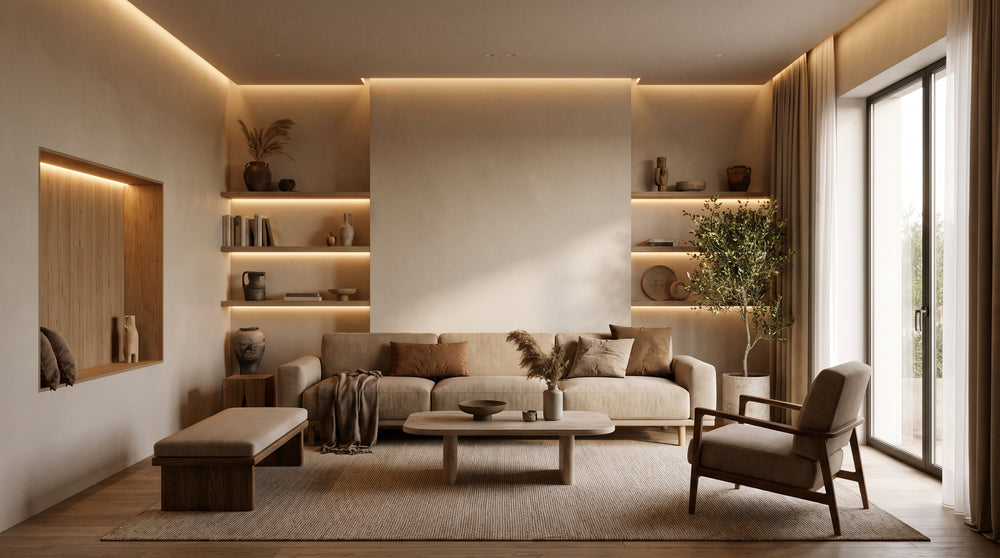
Placed at the top of a wall or in a cornice, the strip sends its light toward the ceiling, which reflects it back as a soft halo in the room. Light never comes from the front: no dazzling point, no harsh shadow. For a living room, aim for warm light; for a hallway, a slightly crisper white avoids the yellow effect on light walls.
Under a cabinet, a baseboard, or a shelf
Under a kitchen cabinet, the strip lights the worktop without casting hand shadows. Along a baseboard, it highlights the volume of a narrow room. At the head of a bed or on a shelf, it provides ambiance and replaces a nightlight. In these three cases, a strip that remains visible requires even light, so a COB strip or a diffusing profile.
Which LED strip for outdoors or a pool?
For outdoors, aim for a strip whose protection rating matches the actual exposure: waterproof for a terrace or awning, designed for immersion near a pool. The light stays warm for ambiance and white for moving around in the evening. A bare strip placed outside will not survive a wet season.
| Room or use | Protection rating to aim for | What it implies |
|---|---|---|
| Living room, bedroom, dry hallway | IP20 | Bare strip, protected from contact and solid objects |
| Kitchen, under-cabinet, wet room | IP65 | Strip protected against dust and water splashes |
| Covered terrace, awning, sheltered facade | IP65 | Resists outdoor humidity and splashes |
| Pool edge, swimming pool, immersion | IP68 | Strip designed to remain submerged |
Which protection rating for an outdoor LED strip?
Simple rule: IP20 for a dry room, IP65 for a splash zone or covered terrace, IP68 for a submerged area. The silicone or resin sheath that protects the strip matters as much as the stated value. Find the relevant models among waterproof LED strips.
LED strips for pools: points to check
Near a pool, the power supply must stay sheltered from water and condensation, never placed on the ground next to the coping. The mounting must hold on the actual surface (concrete, wood, liner), not on adhesive alone. For evening ambiance, warm white looks better than cool white, which turns the water surface blue. Pool LED strips meet these constraints, and an outdoor LED strip is enough for a simple awning.
Warm white, RGB or RGBW LED strip: which light to choose?
Color temperature decides the ambiance. A 2700K strip gives warm light close to an incandescent bulb, a 3000K remains warm but slightly crisper, practical in a kitchen. RGB and RGBW strips add color for ambiance, with RGBW also keeping a dedicated white.
| Light type | Ambiance created | Where to use it |
|---|---|---|
| Warm white 2700K | Warm light close to an incandescent bulb | Living room, bedroom, reading corner |
| Warm white 3000K | Slightly crisper warm white | Kitchen, worktop, hallway |
| RGB | Fixed or changing color, no dedicated white | Decorative ambiance, behind furniture or a niche |
| RGBW | Dedicated white in addition to color | Room where you alternate work white and ambiance |
2700K or 3000K LED strip: which to choose?
2700K warms a living room, bedroom, or reading corner. 3000K lights a worktop or hallway more clearly, without turning cool white. What stands out most is not the chosen value but the mix: two different whites in the same room create a visible break on the walls. Choose a 2700K LED strip for relaxation areas and a 3000K LED strip for work zones.
RGB and RGBW LED strips: color in addition to white
An RGB strip can only do color: it decorates, but lights poorly for reading or cooking. An RGBW strip adds a dedicated white, allowing you to alternate without changing the strip. If color is just an evening accompaniment, an RGB LED strip is enough. If the room must live in white during the day, go for an RGBW LED strip.
Do LED strips use a lot of electricity?
An LED strip consumes little per meter, but total consumption follows the installed length: the longer the strip, the more power it draws from the power supply. The product sheet indicates watts per meter, and that is the figure to compare before choosing a transformer.
How to read the consumption of an LED strip?
Two data points matter: watts per meter and installed length. Multiply the two to know the power drawn, then keep a margin on the power supply so it does not work at its limit. A strip that heats abnormally often indicates an undersized power supply.
Which power supply for the installed length?
Add up the total length, including cable, and choose the power supply accordingly. LED strips powered by transformer require this calculation before purchase, and the power supply must remain in a ventilated volume, not enclosed in a closed box. Over a long run, it is better to distribute the power supply than to concentrate everything at one point.
How to install and make an LED strip last?
An LED strip is glued or fixed to a clean, dry, smooth surface; on a raw or dusty wall, it is better to use a profile or clips. Avoid bending it, respect the cut marks, and keep the power supply ventilated to make it last.
On which surface to stick an LED strip?
The adhesive holds on a smooth, degreased surface: laminate, tile, painted metal, glass. On unpainted plaster, concrete, or raw wood, it fails with dust and temperature variations. In that case, screw an aluminum profile, cut the strip at the provided marks, then close the diffuser. A profile also adds a layer of protection that extends the lifespan.
Workshop or job site LED strip: what matters
In a workshop or on a job site, dust is the first enemy: a protection rating covering solid objects and splashes becomes necessary. Fixing with clips or a profile replaces adhesive, which does not hold on a raw surface. Finally, the power supply must be placed high or in a cabinet, away from impacts and tools.
How to match the LED strip with the rest of the lighting?
An LED strip serves as additional or ambient lighting and pairs with general lighting: a ceiling light for work light, a chandelier for a reception room, a wall light for circulation. The ideal is to align color temperatures to avoid two different whites in the same room.
With a LED ceiling light or a chandelier
The strip draws the lines (cornice, top of wall, furniture) and the main fixture provides useful light. A LED ceiling light in the center of the room takes over when you need to see clearly, while a living room LED chandelier is better suited to a reception room. Keep the same white family between the two sources: that is what makes the whole coherent.
With a LED wall light
In a hallway, stairway, or entrance, a LED wall light lights circulation and secures passages without dazzling. The strip remains as accompaniment, along a baseboard or under a handrail. For a bedroom, a living room wall light placed on either side of the bed replaces bedside lamps and frees the tables.
For the whole home, browse all home lighting and check that each room keeps the same white temperature as your strip.
Frequently asked questions about LED strips
What type of LED strip should you choose?
It all depends on the available power supply and the location: a 220V strip connects to mains power, a 24V strip goes through a transformer. In a dry room, a standard strip is enough. Outdoors, near a wet room or a pool, you need a waterproof model with the appropriate protection rating.
Which LED strip for outdoors?
An outdoor strip must be protected against humidity and splashes. Under an awning or on a covered terrace, splash protection is enough; near a pool or submerged, you need a version designed for water. The power supply stays sheltered, out of reach of splashes.
Which LED strip for the ceiling?
Placed on the ceiling, in a cornice, or at the top of a wall, the strip provides indirect lighting: it lights the upper surface which reflects soft light into the room. Choose warm light for the evening and check that the mounting holds on the actual surface.
Should you choose a 220V LED strip?
The 220V strip connects directly to the mains, without a transformer: practical for lighting a long continuous run. The 24V requires a power supply to house but is better suited to small linear runs and cut-to-size projects. The choice mainly depends on the available location.
What is a COB LED strip?
The COB strip groups the chips into a continuous band, which gives a light line without visible points. It is useful when the strip remains exposed: under a shelf, in a niche, or along a cabinet. Its light is more even than a strip with spaced chips.
Order your LED strip from Designix
Before validating, review the three landmarks: power supply, location, desired light. Secure payment, tracked delivery, returns possible, and Designix customer service to assist you if any doubt remains about choosing the power supply or protection rating.
- Secure payment
- Tracked delivery
- Returns
- Designix customer service
Choose an LED strip to plug into mains power or go for a 24V LED strip with transformer depending on the chosen location.