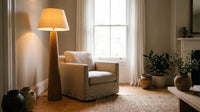
Japanese bedside lamp
This selection is also available in our French store: Lampe de chevet japonaise
- Tracked delivery to your country Tracked delivery
- Secure payment at checkout Multiple payment methods
- 14 days to change your mind 14-day returns
- Secure payment Secure payment


Not sure of your style? Find it in 30 seconds
A few questions, and we will show you the pieces made for you.


Frequently asked questions
What table size for how many people?
Which tabletop material should I choose?
Extendable or fixed?
How do I care for the tabletop?
The right furniture, in the right place
Check the dimensions with our fit checker and receive pieces made to last. Unsure? Our team will answer your questions.
- Tracked delivery
- Pay in instalments, where available
- 14 days to change your mind
- Advice & showroom in Lyon, France
A japanese table lamp is chosen first by its size: 20 cm for a narrow bedside table, 24 cm for a standard top, 34 cm for a chest of drawers or a desk. All plug in with an E27 base, diffuse warm white or cool white light and sit indoors, on a bedside table, a shelf or a worktop.
- What is a japanese table lamp
- Which size to choose
- Which light
- Where to place it
- How to match it
- Installing and caring for it
- Floor lamp or table lamp
- Salt lamp and Italian design
What is a japanese table lamp?
A japanese table lamp is a table lamp whose paper shade filters the light, held by a thin metal or iron frame. It sits on a bedside table, a shelf or a desk, plugs in with an E27 base and stays protected for indoor use.
What is the traditional japanese lamp called?
The andon, placed on a stand, and the chōchin, the portable paper lantern, both rely on a light frame and a paper shade. The bedside format takes this principle in miniature: oval shape, white tone, soft light that does not dazzle when you look up from your book. The Designix lighting catalogue gathers this family of table lamps, and the wood finishes extend its spirit for anyone looking for a warmer material. Others prefer to play with glass: light passes through more directly and the shape of the object can be seen by day.
Scandinavian japanese table lamp: what are the differences?
Both families share clean lines and a refusal of ornament. The Scandinavian style pairs paper with light wood, in natural tones and simple volumes. The japanese inspiration works more with metal, iron and glass around the same paper shade: the frame is more visible, the lamp looks more graphic. The choice therefore comes down to the dominant material and the room, softer here, sharper there.
Which size to choose for your japanese table lamp?
The model comes in 20, 24 and 34 cm. The 20 cm sits on a narrow bedside table or a shelf, the 24 cm on a standard bedside table, and the 34 cm requires a chest of drawers, a desk or a wide piece of furniture, where the lamp becomes a visible element. The japanese selection also includes Tenko.
Small japanese table lamp: for which bedside table?
A bedside top still needs room for a book, a glass of water and a phone. Measure the free width before choosing: a small bedside format leaves space for the rest, while a taller model takes over the whole surface. A lamp that overhangs the edge of the furniture tips over at the first movement.
20, 24 or 34 cm: how to decide?
Take three measurements: the width of the furniture, the height of the bed and the distance to the wall. The bottom of the shade should stay above the mattress to light the page rather than the bed base. To equip a whole room, browse all the bedside lamps and equip a bedroom.
| Size | Furniture | Room | What it changes |
|---|---|---|---|
| 20 cm | narrow bedside table, shelf | bedroom, office | compact format, sits near the bed without getting in the way |
| 24 cm | standard bedside table | bedroom, living room | fits common bedside tops |
| 34 cm | chest of drawers, desk, wide furniture | bedroom, living room, office | fills the surface and stands out in the room |
Which light for a japanese table lamp?
The bulb is chosen with an E27 base, with two families of temperatures: warm white from 2700 to 3500 K, with a yellow tint, for reading and relaxing, and cool white from 4500 to 6500 K, whiter, for working. The paper shade softens the light in both cases.
Warm white 2700 to 3500 K: for which moments?
This is the evening temperature: reading in bed, waking up slowly, dinner, conversation. The yellow tint tires the eye less at the end of the day and the paper diffuses it without a dazzling point. An LED bulb in this range is more than enough; to adjust the power, look at the LED versions, which heat up less in a small space.
Cool white 4500 to 6500 K: in which rooms?
On a desk, a worktop or an ironing board, the whiter light helps distinguish details and stay focused. The same lamp then changes role: it no longer lights the mood but the task. The table lamps in the selection work for both uses, the bulb making the difference.
| Temperature | Appearance | Use | Room |
|---|---|---|---|
| Warm white (2700 to 3500 K) | yellow tint, soft | reading, relaxing, before bed | bedroom, living room |
| Cool white (4500 to 6500 K) | sharper white | work, precise activity | office, worktop |
Where to place a japanese lamp: bedroom, living room or office?
The models in the collection are designed for the bedroom, the living room and the office. On a bedside table they serve as reading light, on a console or a shelf they create a soft accent light, and on a desk they complete the work lighting without taking up the surface.
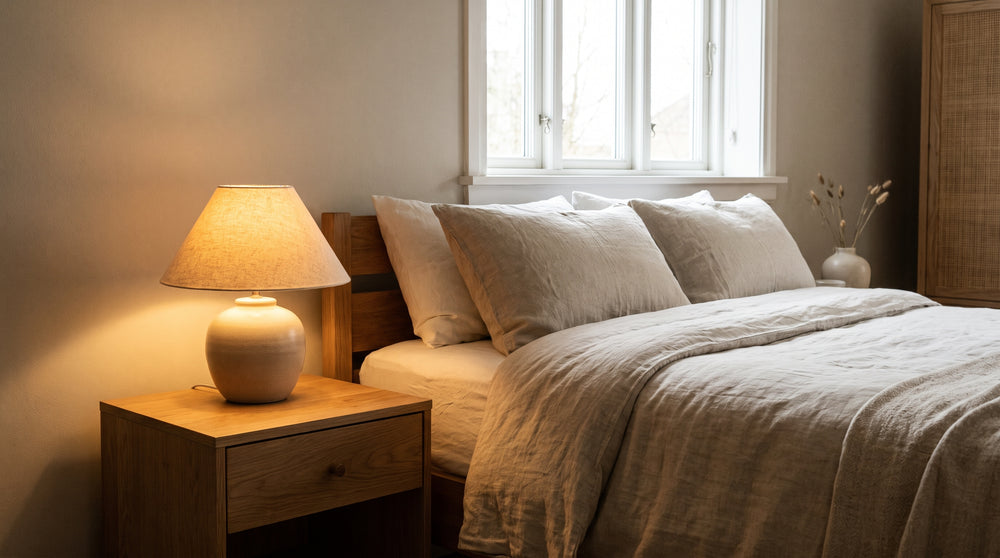
Asian style bedside lamp in an adult bedroom
Two identical lamps on either side of the bed give a balanced room. If space is lacking on one side, a single lamp is enough, provided its light reaches the mattress. To compose a coherent adult bedroom, keep the same shade height on both sides. When the top is too small, a wall light frees the bedside table.
A japanese lamp on a desk: accent or work light?
On a worktop, it complements the ceiling light: placed next to the screen, it lights the keyboard and documents without casting a shadow on the page. A cool white bulb is more useful there than a warm white one. Check that the cable reaches the socket before fixing the position.
How to match a japanese table lamp with a traditional japanese home?
In a traditional japanese home interior, natural materials and indirect light are reused: paper, wood, low lines and light tones. An oval, white table lamp fits in without a break, while a contemporary or busier decor holds it back as a point of contrast.
Which codes to take from a traditional japanese home?
Paper, raw wood, low furniture and the empty space left around objects. A lamp placed alone on a clear shelf has more presence than three crowded objects. The wood finishes and the rattan models extend these codes without imitating them.
Japanese style in a contemporary or jungle interior
In a denser room, green plants, rattan, glass, the white oval lamp becomes a calm point. Its round shape answers the foliage without adding a pattern. If you are looking for a more striking piece, design pieces and an original lamp widen the search for the same object.
How to install and care for a japanese table lamp?
The lamp plugs into a socket or a power strip, with an E27 bulb, and stays indoors: the IP20 rating indicates that it must not receive water splashes. The paper shade is dusted dry, without product, and the manufacturer's warranty is two years.
How to connect several lamps to a single power supply?
A power strip or a socket rail plugged into the existing supply is enough, each lamp keeping its switch. Spread the lamps along the rail rather than chaining them, prefer low-consumption bulbs and do not add more demanding devices. A visible cable makes it easy to switch off. All the bedside lamps in the selection work on this principle.
What does IP20 mean for a bedside lamp?
IP20 protects against solid objects larger than 12 mm and against no liquid: the lamp lives in a dry interior. Keep it away from a sink, an often-open window or a damp room. For the paper, a soft cloth or a feather duster, never a wet sponge or detergent.
To measure the real footprint before ordering, the Lampe de Chevet Japonais Charme Lumineux comes in 20, 24 and 34 cm, with an E27 base and IP20. You can also see this paper shade model, in warm white or cool white depending on the bulb chosen.
Floor lamp or japanese table lamp for the living room?
A floor lamp lights from the ground and covers a wide area, such as a reading corner. The japanese lamp, more compact, sits on a console or a shelf and creates an accent light near an armchair. The two complement each other in the same living room, at different heights.
The floor lights the circulation, the table lamp lights what is close: by layering the two, the room gains relief without multiplying ceiling lights. All the lamps cover these two families, and a first reference can be found in the table lamps.
Salt lamp, Italian design: how not to get it wrong?
Three families of different objects circulate under similar names. The salt lamp is cut from a block of rock salt and lights in orange to red tones. Italian design plays on glass and polished metal. The japanese lamp diffuses a light filtered by paper.
How to recognise a real salt lamp?
The block is cut, never moulded: the surface stays irregular, the veins show against the light and the piece feels heavy for its size. Check the stand, the cable and the socket before buying, then place the lamp on a stable surface, away from moisture. Its orange to red light is about mood, not reading.
Italian or japanese design bedside lamp: two intentions
On one side a sculptural object, which you look at even when switched off. On the other a soft, filtered light, designed for waking up and reading in bed. The choice depends on what you prioritise: the presence of the object in the room or the quality of the light. Come back to japanese inspiration through a more modern model or the affordable models in the selection.
Frequently asked questions
What is the traditional japanese lamp called?
The traditional japanese lamp is called the andon when placed on a stand, and the chōchin when it is a portable paper lantern. Both rely on a light frame and a paper shade that filters the light. This is the principle taken up by japanese table lamps, in a reduced format for a bedside table.
How to recognise a real salt lamp?
A real salt lamp is cut from a block of rock salt, never moulded: its surface stays irregular, its veins show against the light and the block feels heavy for its size. Check the stand, the cable and the socket, then place it on a stable surface, away from moisture.
How to connect several lamps to a single power supply?
The simplest is a power strip or a socket rail plugged into the existing supply, each lamp keeping its switch. Spread the lamps along the rail rather than chaining them, prefer low-consumption bulbs and avoid adding more demanding devices. A visible cable makes it easy to switch off.
Which bulb should be used in a japanese table lamp?
These lamps plug in with an E27 base: you are therefore free to choose the bulb. A warm white temperature, between 2700 and 3500 K, suits the bedside and relaxing; a cool white, from 4500 to 6500 K, lights a desk more sharply. The paper filters the light, which reduces glare.
What is a japanese lantern table lamp?
It is a table lamp whose shade takes after the paper lantern: a light frame over which the paper is stretched, in an oval shape, filtering the light instead of directing it. It sits on a bedside table or a piece of furniture and plugs in with an E27 base, for indoor use.
Ordering from Designix
The selection of lighting is paid for by bank card via a secure payment, with tracked delivery and possible returns. Designix customer service answers questions about dimensions or bulbs before ordering, and every japanese lamp in the collection is guaranteed for two years.