
Bathroom Wall Sconce
This selection is also available in our French store: Applique Murale Salle de Bain


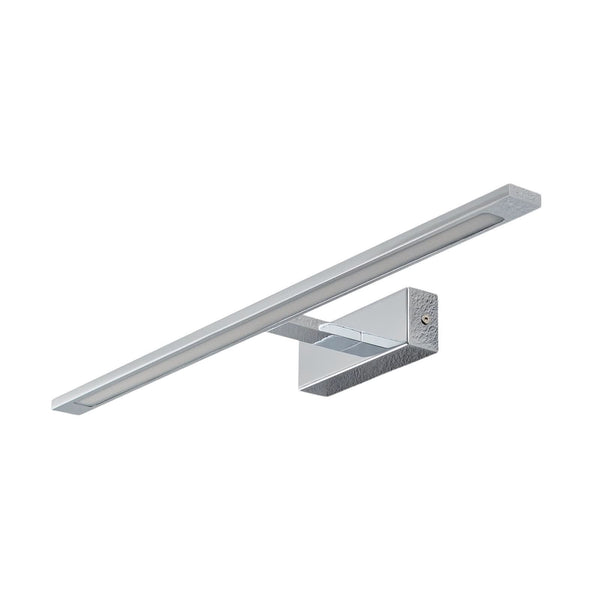


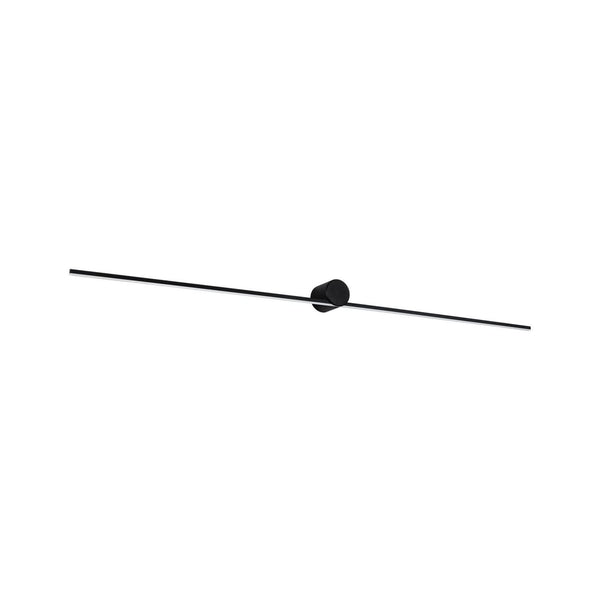

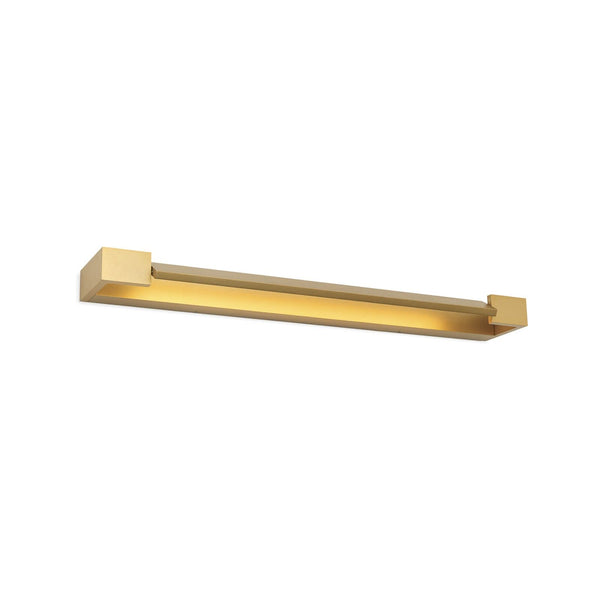


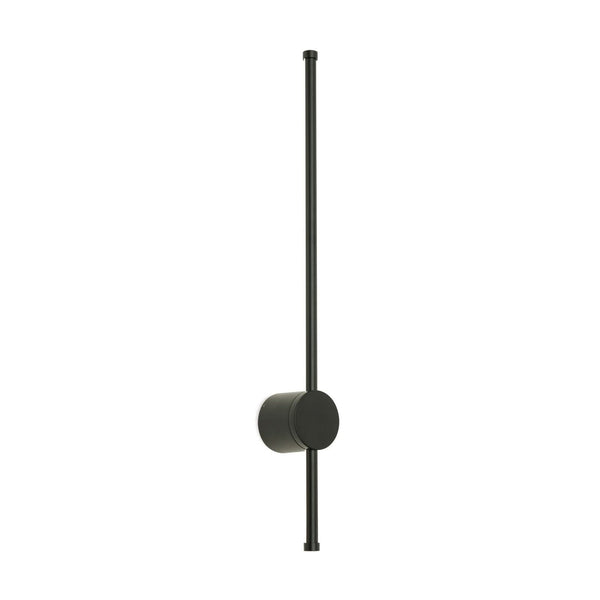









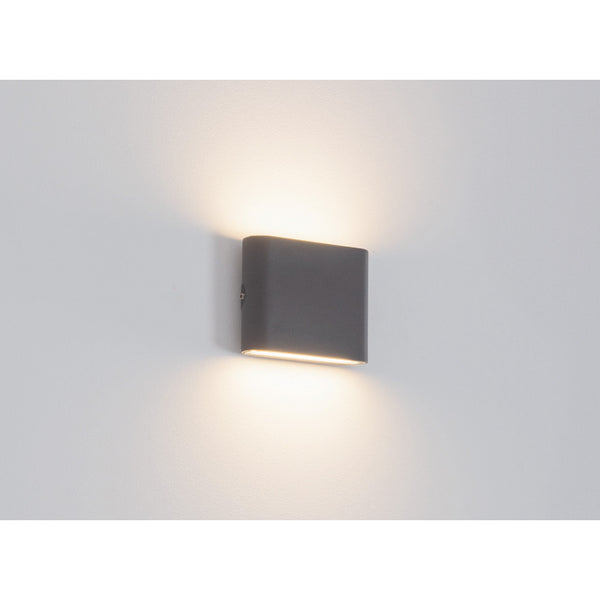
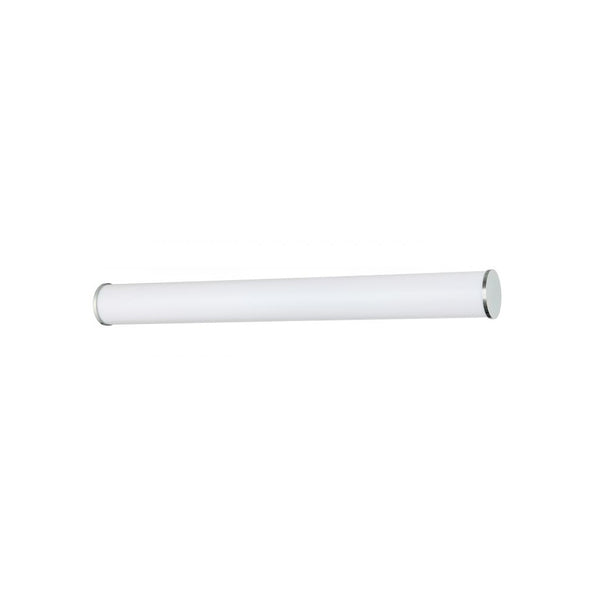
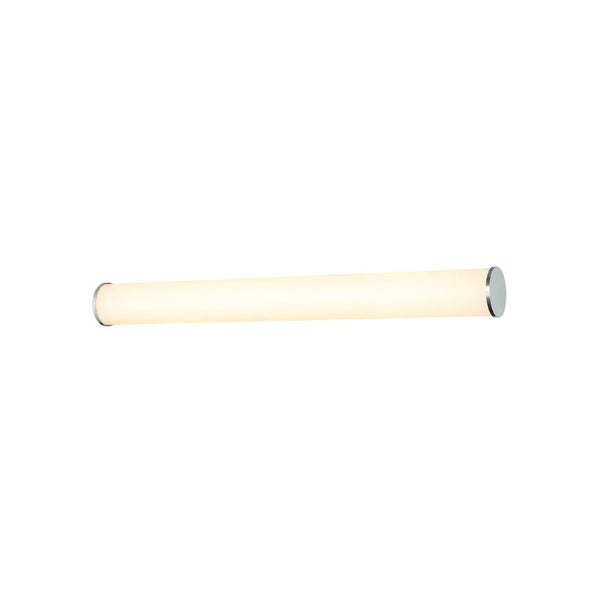


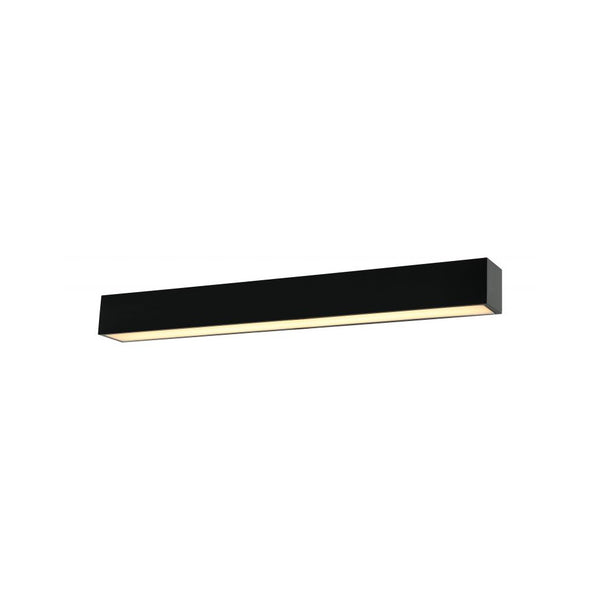






- Tracked delivery to your country Tracked delivery
- Secure payment at checkout Multiple payment methods
- 14 days to change your mind 14-day returns
- Secure payment Secure payment
Not sure of your style? Find it in 30 seconds
A few questions, and we will show you the pieces made for you.
Frequently asked questions
How do I choose the right product?
What are the delivery times?
Can I return an item?
Can I pay in instalments?
An interior that reflects who you are
Carefully selected pieces, shipped from our warehouses. Our team advises you before you buy, so you choose with confidence.
- Tracked delivery
- Pay in instalments, where available
- 14 days to change your mind
- Advice & showroom in Lyon, France
Start with the protection rating for the zone: IP20 near the mirror and in a WC, IP44 or IP45 around the bathtub, shower and basin. Then decide the light (warm white from 2700 to 3500 K, neutral or cool white), the socket (integrated LED, G4, G9, E14, E27, GU10) and the format, tube, globe or oval, depending on the space above the basin.
- Which bathroom wall lamp to choose
- Which type of lighting
- Bulb and socket
- Where to install it
- IP rating
- Style and finishes
- Installation
- Care
- How many wall lamps
Which bathroom wall lamp should you choose?
For a bathroom, pick a bathroom wall lamp whose protection rating matches the zone: IP20 away from splashes, IP44 or IP45 near the bathtub and shower. The socket, integrated LED, G4, E14 or GU10, sets the light, metal, aluminium or glass set the style, and the tube, globe or oval format depends on the space available.
The criteria that matter, in order
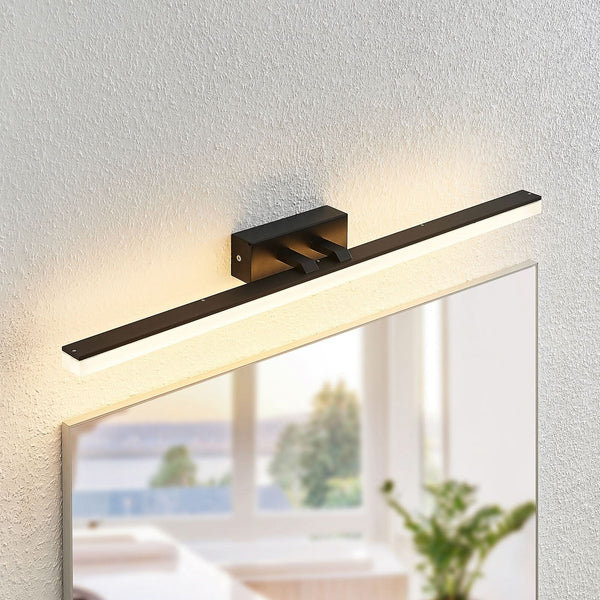
Start with the surface to light: the face in front of the mirror, the basin top, or both. A long tube wall lamp lights a wide area above a large mirror, while a globe or a small oval is enough above a narrow washbasin. Then comes the material: metal and aluminium withstand humidity, glass diffuses a soft light, acrylic and resin stay discreet on a pale wall. The black, white or gold finish comes last, once the mirror and the taps are known. Our selection of designer wall lamps and wall lights covers these formats, and metal wall lamps hold up well in damp air. To place the wall lamp within a complete room, compare with all our lighting.
A wall lamp with a switch, adjustable or fixed
An adjustable model is set after installation: the beam is aimed at the basin top, which prevents glare when you lean forward. A fixed wall lamp means calculating the height before drilling, with no second chance. As for control, most connect to the room's wall switch; a few references include a control on the bracket.
Which type of lighting in a bathroom?
Above the mirror, the light must illuminate the face without dazzling it: a warm white from 2700 to 3500 K for a relaxing room, a neutral or cool white for a sharper look in the morning. These wall lamps come with integrated LED or G4, E14, E27, GU10 or G9 sockets, with a dimmer on many of the models.
Warm white or cool white?
Warm white from 2700 to 3500 K gives a light close to the classic bulb, restful at the end of the day. Neutral white between 3500 and 4500 K stays true on skin tone, useful for shaving or applying make-up. Cool white from 4500 to 6500 K gives a very sharp look, sometimes harsh in a small tiled room. On a two-temperature model, you switch from one to the other without changing the wall lamp. Designer wall lamps mostly use warm and neutral white, and a white wall lamp finish visually disappears on pale tiles.
Do you need a powerful LED wall lamp above the mirror?
Power alone says nothing without the length of the diffuser: a 90 cm wall lamp spreads the light better than a single very powerful point, which creates a shadow under the nose and chin. Above a large double-basin mirror, two wall lamps or one long strip are better than a narrow module. The power of the models ranges from a few watts to several tens of watts.
Which bulb and socket for a bathroom wall lamp?
The socket decides the bulb and the maintenance: integrated LED for flat, even lighting with no bulb to change, G4 or G9 for small pin modules, E14 and E27 for screw bulbs, GU10 for a directed beam. A wall lamp with a replaceable socket is easier to repair.
| Socket | Bulb | Temperatures | Benefit in the room |
|---|---|---|---|
| Integrated LED | Not replaceable | Warm, neutral or cool white depending on the model | Even lighting, low profile |
| G4 | Small pin module | Warm white, sometimes cool | Compact housing in a globe or tube wall lamp |
| G9 | Compact pin module | Warm white | Slim wall lamp lighting upwards or downwards |
| E14 | Slim screw bulb | Warm or cool white | Glass globes and decorative wall lamps |
| GU10 | Pin spotlight | Warm, neutral or cool | Adjustable wall lamp, beam towards the basin |
Integrated LED or replaceable bulb?
Integrated LED cannot be replaced: when it dims, the whole wall lamp goes to recycling. In exchange, it offers a slim profile, an even look with no hot spot and no bulb to buy again. A G4, E14 or E27 socket, on the other hand, lets you change the colour temperature or the power later, and can be fixed in five minutes. A glass bathroom wall lamp with a screw bulb, such as the metal and glass wall lamp with E14 socket, is chosen for that flexibility.
Where to install a wall lamp in the bathroom?
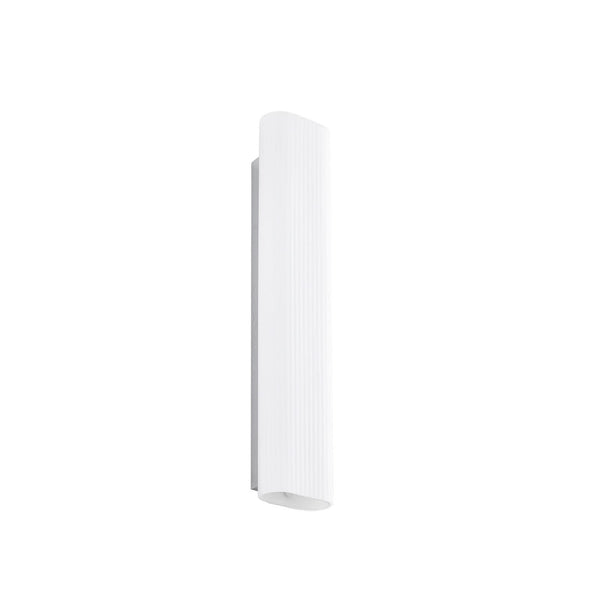
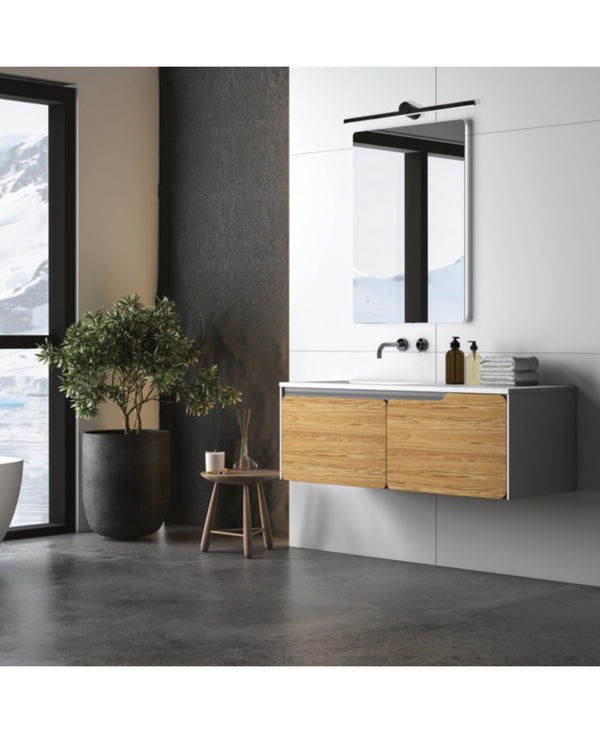
Place the wall lamp on either side of the mirror or above the basin, at eye level, to light the face without casting shadows. In a WC or small toilet, a single wall lamp is enough; in an adjoining hallway, it serves as extra light. A long tubular wall lamp lights a wide area.
Toilet wall lamp and designer WC wall lamp
In a WC, the room is small and the wall often bare: a compact wall lamp, white or black, avoids installing a ceiling light that eats up the height. A low-consumption model is enough for a few minutes of use. If the adjoining hallway is dark, a series of hallway wall lamps guides your steps, keeping the same finish family. For a tight budget on a secondary room, look at the entry-level models in cheap wall lamps.
At what height should the wall lamp be placed above the basin?
Around 1.70 to 1.80 m from the floor for a high wall lamp, at eye level, about 30 to 40 cm above the basin top. Two wall lamps framing the mirror go lower, around 1.50 to 1.60 m, at face level. Placed too high, the source casts shadows under the eyes; placed too low, it dazzles. An oval wall lamp 40 cm wide covers a single basin well.
IP20, IP44 or IP45: which water-resistant wall lamp for the bathroom?
The IP rating quantifies protection against dust and water. In a bathroom, IP20 works away from splashes, near the mirror or in a WC; IP44 or IP45 withstands splashes around the bathtub, shower and basin. The selection offers both levels.
| Zone | Water exposure | Suitable rating | Type of wall lamp |
|---|---|---|---|
| Above the basin and mirror | Light splashes | IP20, IP44 safer | Tube or panel, LED, G4 or E14 |
| Beside the bathtub and shower | Frequent splashes | IP44 or IP45 | Globe, oval or designer, G4 or LED |
| Toilet and WC | Damp air, no splashes | IP20 | Compact wall lamp, white or black |
| Adjoining hallway or entrance | Damp atmosphere | IP20, IP44 near the outside | Indoor or outdoor wall lamp |
| Outside near the bathroom | Rain and splashes | IP44 | Aluminium wall lamp, LED |
Can a water-resistant outdoor wall lamp be used in a bathroom?
Yes, provided the socket and colour temperature suit indoor use: an aluminium model designed for a facade often stays warm white, which works in front of a mirror. The long format of outdoor wall lamps fits well above a wide mirror. It is a solution when you want a discreet black bathroom wall lamp that is genuinely water-resistant.
What the rating really protects
The first digit concerns solid bodies and dust, the second water. An IP44 stops splashes from all directions, an IP45 adds a low-pressure water jet. Neither makes the wall lamp submersible: it should not be placed in the bathtub or the shower. The certificate matters less than the seal and the quality of the waterproofing where the cable passes.
How to match the wall lamp with the bathroom style?
Match the wall lamp to the rest of the room: a black or metal finish goes with a dark-framed mirror, a white or gold finish brightens a pale basin. Glass diffuses, acrylic and resin stay discreet, and two symmetrical wall lamps balance a large mirror.
Black, white or gold?
Black stands out on pale tiles and echoes dark taps and the mirror frame. White fades away and keeps the room bright. Gold models warm up a stone basin or a wooden top, provided they stay discreet against the other accessories. A globe wall lamp in clear glass suits understated interiors, and a graphic piece is placed alone rather than in a pair.
Chic country wall lamp or a rawer feel
A chic country wall lamp in metal and clear glass goes with a white wall, a wooden wall shelf and a stone basin. With no all-wood model in this selection, you get close to that feel with pale finishes and globe or oval shapes, which recall workshop lights. A bohemian or original feel comes instead through green, resin or an unexpected silhouette: the original IP45 Oryn wall lamp in resin, glass and metal takes on that role in a toilet or an entrance. For a consistent look across the whole house, compare with the models in bedroom wall lamps and living room wall lamps.
How to install a bathroom wall lamp?
Turn off the power at the circuit breaker, locate the cable outlet and drill the tiles with a tile bit in non-hammer mode. Fix the bracket, connect the earth, neutral and live wires, then screw on the diffuser. A dimmable model is controlled by a compatible switch.
How does it wire up with a switch?
The simplest way is to connect the wall lamp to the wall switch already in the room. If the circuit does not exist, a line must be run from the consumer unit, which requires an electrician. Before drilling, check that the back box falls behind the wall lamp bracket: a few centimetres of misalignment will show. Identify the live, neutral and earth on the terminal block, and follow the markings.
Which adjustments after installation?
An adjustable wall lamp is set once the power is back on, aiming at the basin top rather than the mirror, to avoid reflections in your eyes. On a dimmable model, test the low range in the evening: that is when you judge whether the light is soft enough for a night-time wake-up. Tighten the bracket screws on tiles before refitting the diffuser.
How to care for a bathroom wall lamp?
Switch it off, then clean with a slightly damp microfibre cloth: glass and acrylic tolerate soapy water, metal and aluminium are fine with a mild, non-abrasive product, resin is dusted dry. Check the screws are tight and, on a model with a G4, E14 or E27 socket, replace the bulb when it dims.
How many wall lamps and which other sources to light a bathroom?
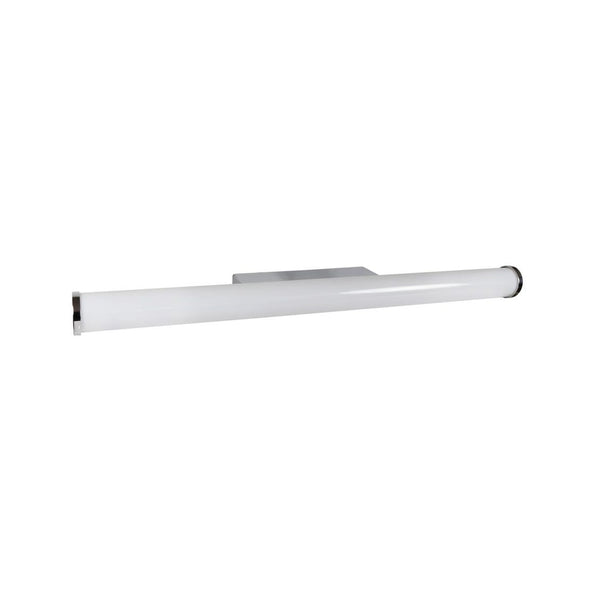
Count one wall lamp to light a basin or a toilet, two in symmetry for a wide mirror. The wall lamp lights the face and the basin top, while a bathroom ceiling light or a bathroom mirror light provides general lighting. The long tube format suits wide mirrors.
One or two wall lamps around the mirror?
Two wall lamps framing the mirror give symmetrical light, with no shadow on one side of the face: this is the choice for mirrors over 80 cm. A single wall lamp above is enough on a narrow mirror or a single basin. Two short modules often cost less than one long strip, while lighting better. A 31.5 cm IP45 Luminance globe wall lamp is placed as a pair around a medium-sized mirror.
How to share the lighting between wall lamp and ceiling light?
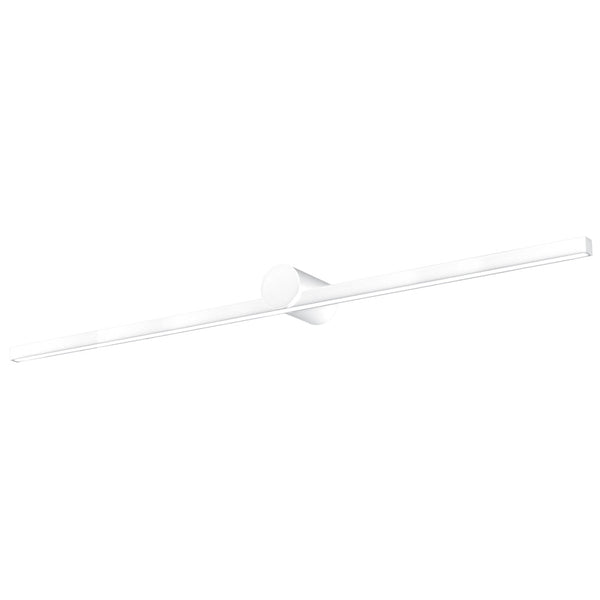
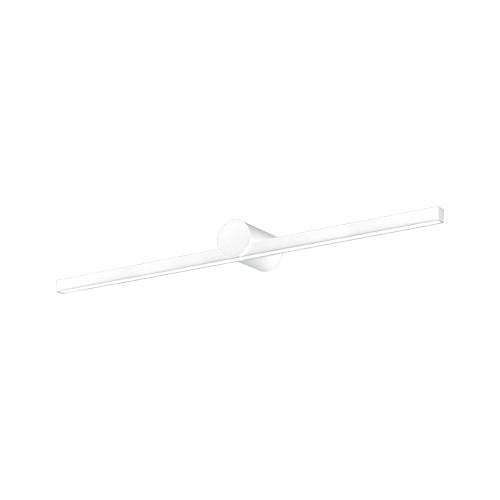
Keep the wall lamp for precision, the ceiling light for general ambience. A ceiling light or a dining room light placed in the room does not replace the wall lamp in front of the mirror: the light falls from above and hollows out the features. Above a large double-basin mirror, a 90 cm LED strip such as the IP44 Zambelis bathroom wall lamp covers both basins in one piece. A linear model adjustable in length, like the dimmable Qilo wall lamp, adapts to a vanity top that changes. To equip the rest of the house, browse the lighting for the whole home and the indoor wall lamps.
Frequently asked questions
Which bathroom wall lamp should you choose?
A wall lamp suited to the zone: IP20 near the mirror and in a toilet, IP44 or IP45 around the bathtub, shower and basin. For light, a warm white from 2700 to 3500 K or a neutral white, with integrated LED or a G4, E14, GU10 or G9 socket.
Toilet wall lamp or designer WC wall lamp: which to choose?
In a toilet or WC, a single wall lamp is enough: a compact, understated model, white or black, with integrated LED or a G4 or E14 socket for soft light. IP20 works away from splashes, IP44 if the room stays damp.
Can a water-resistant outdoor wall lamp be installed in a bathroom?
Yes, a model designed for outdoor use with an IP44 or IP45 rating works near a bathtub or shower, since its resistance to splashes exceeds that of an IP20. Check the socket and colour temperature, designed for outdoor use, before installing it.
How to choose an original wall lamp?
Look for a shape that breaks away from the classic tube or globe, in resin, glass or metal, with an E27 socket or an LED to keep flexibility. Watch the format: a graphic piece is placed alone, rather in a toilet or an entrance than around a mirror.
Which powerful LED wall lamp for a large bathroom?
Look at the power and above all the length of the diffuser: a 90 cm strip lights more widely than a single very powerful point. Above a large double-basin mirror, two wall lamps or one long linear model are better than a narrow module.
Ordering a bathroom wall lamp on Designix
Identify the zone to light, note the available mirror length, then compare the sockets: this trio decides the model. A linear wall lamp for a wide mirror, a globe in a pair around a medium mirror, an IP44 or IP45 model if the wall lamp is near the shower. Once the direction, rating and colour temperature are set, installation comes down to one drill hole and three wires.
Secure payment, tracked delivery, returns available and Designix customer service to help you choose: most models come with a two-year warranty.




