Modern outdoor wall lights
- Tracked delivery to your country Tracked delivery
- Secure payment at checkout Multiple payment methods
- 14 days to change your mind 14-day returns
- Secure payment Secure payment


Not sure of your style? Find it in 30 seconds
A few questions, and we will show you the pieces made for you.



















Frequently asked questions
How do I choose the right product?
What are the delivery times?
Can I return an item?
Can I pay in instalments?
An interior that reflects who you are
Carefully selected pieces, shipped from our warehouses. Our team advises you before you buy, so you choose with confidence.
- Tracked delivery
- Pay in instalments, where available
- 14 days to change your mind
- Advice & showroom in Lyon, France
Choose a modern outdoor wall light by use before form: a terrace wants spread light, an entrance a clear point on the lock, a path a flow directed at the ground. Then come the IP rating according to the wall exposure, the wattage, the light colour and the finish.
Which modern outdoor wall light should you choose for each area to light?
The choice is made first by use. A terrace needs soft, spread light, an entrance a clear point that lights the lock, a path a flow directed at the ground. The shape follows: tube or rectangle for long facades, square or round for smaller surfaces.
Which model for a terrace or an outdoor lounge?
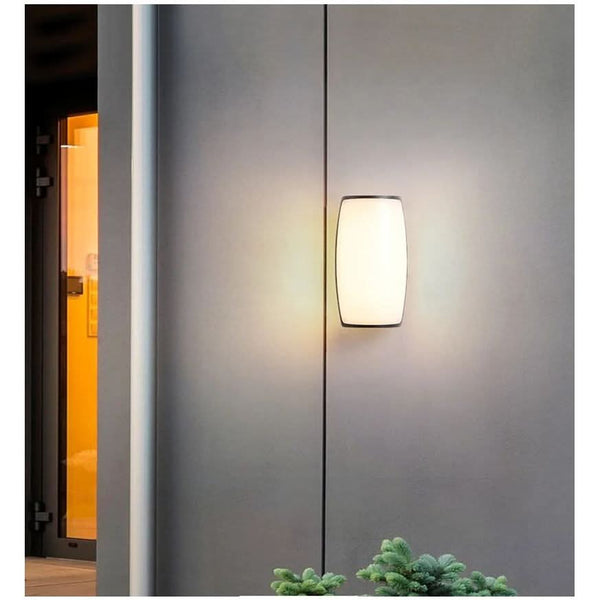
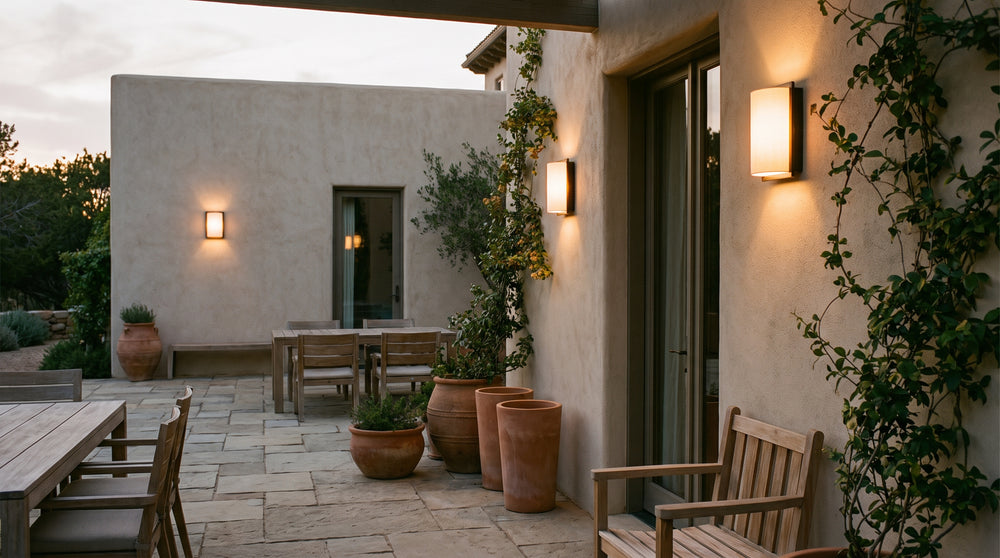
On a terrace, you look for a low, enveloping halo rather than a floodlight. Tube shapes, such as the Lumina 32 cm wall light, stretch the light along the wall without dazzling seated guests. The terrace wall lights gather this wide diffusion. A 15 to 18 W module in warm white covers a wall of several metres, and black aluminium blends into a railing.
Which model for an entrance, a gate or a path?
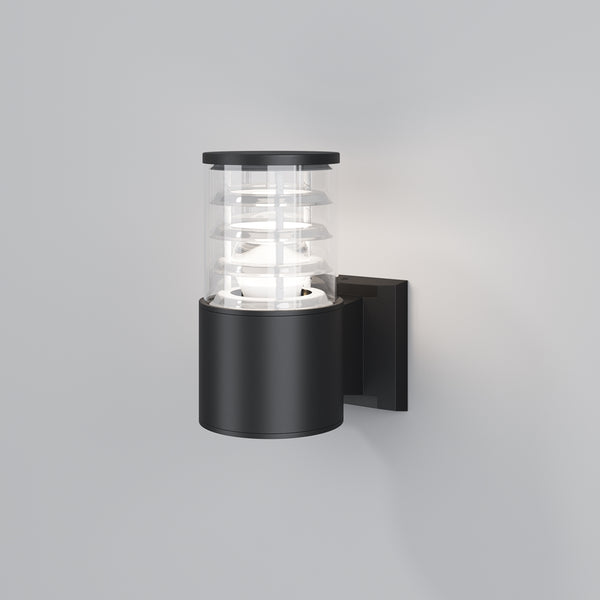
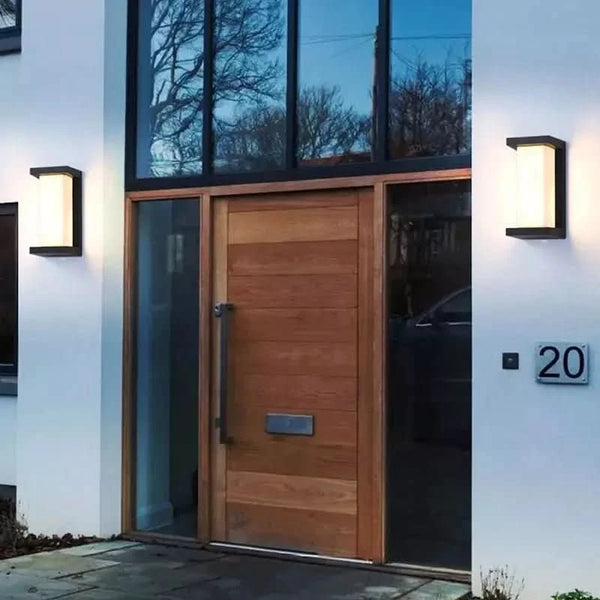
An entrance wants a clear, low point: the source is brought down towards the lock and the threshold. The Toril path wall light, at 130 mm, narrows the flow onto the ground; a small 10 cm square format does the same job on a post. On a gate, an equipped model changes the gesture, you no longer move forward by touch. The design terrace wall lights also cover this understated register.
Which IP rating for an outdoor wall light?
The IP rating indicates resistance to dust and water. IP44 and IP45 suit under a canopy or a covered terrace, IP54 on a lightly exposed facade, IP65 on a facade that takes the rain, IP67 in very wet locations. The collection covers these four levels.
IP44 and IP45: what they withstand
These two ratings protect against splashes and average dust, not driving rain. They are reserved for a sheltered wall, under a roof overhang or a porch. IP45 adds water jets from all directions, useful if a sprinkler passes in front of the wall. The E27 socket models are common in this class, such as the ZenEclat Japanese light.
IP65 and IP67: when they become necessary
As soon as rain hits the wall, aim for IP65: it is the most common level here, to look for among the IP65 rated models. IP67 adds resistance to temporary immersion, for poolside areas and constantly damp zones. The Éclat modular light runs from the small module to the large wall light.
| Location | Rating to favour | Corresponding resistance |
|---|---|---|
| Under a canopy, sheltered wall | IP44 or IP45 | Water splashes, no direct rain |
| Covered terrace, porch | IP54 | Dust and water splashes |
| Facade exposed to rain | IP65 | Dust and water jets, hose cleaning |
| Poolside, very wet area | IP67 | Temporary immersion, permanent humidity |
E27 bulb or integrated LED: which solution outdoors?
The E27 socket lets you choose the bulb and replace it alone; the integrated LED module sets the wattage and colour at the factory, with less maintenance. Both exist in the collection, from 6 W to 60 W depending on the models, in warm white, neutral white or cool white.
The E27 socket: choosing and replacing your bulb
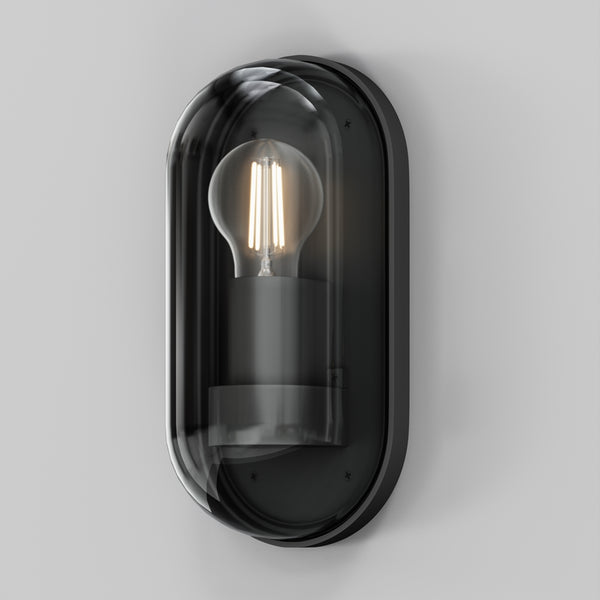
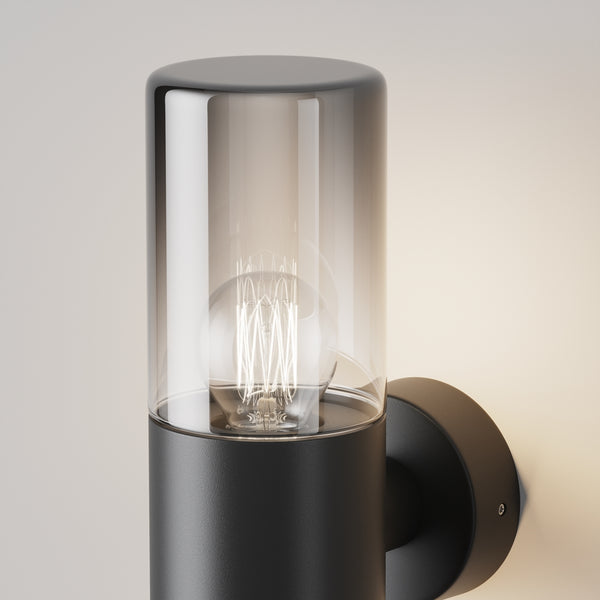
With an E27 socket, brightness and shade are decided after purchase, and a burnt-out bulb is changed in minutes. It is the logical choice when several walls must share the same shade. A protective glass softens the source and shields the bulb from rain. The vintage style outdoor wall lights often use this principle.
The integrated LED module: light set at the order
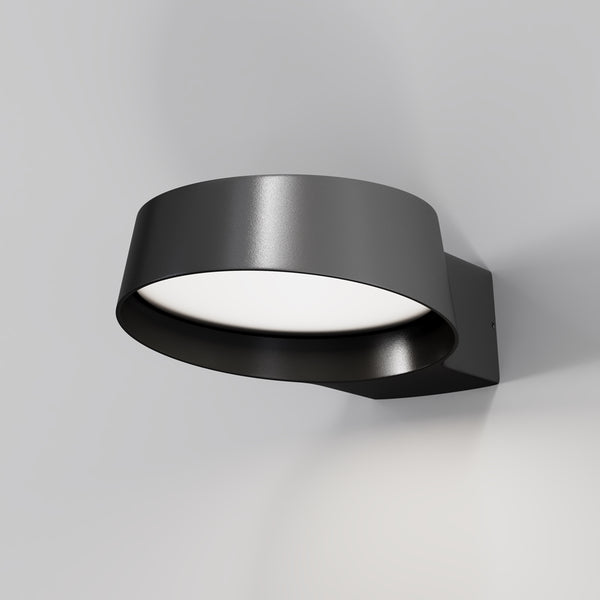
The LED module is chosen at the order: the wattage is decided once, and nothing is replaced afterwards. A slim housing such as the LuminoCercle round LED wall light, at 10 cm, belongs to this family. It is the most discreet solution on a facade and the simplest to maintain, with no bulb to plan for. The LED outdoor wall lights gather these references.
| Criterion | E27 socket | Integrated LED |
|---|---|---|
| Choice of light | You choose the bulb and its colour | Set at the order |
| Replacement | Bulb changed separately | Integrated module, nothing to change |
| Available wattages | Depending on the chosen bulb | From 6 W to 60 W depending on the models |
| Collection examples | ZenEclat Japanese light, CharmeRétro vintage wall light, Oryn Art Deco wall light | Halo round wall light, ÉclatModerne Italian design, LuminoCercle |
Which light temperature for a facade or a terrace?
Warm white, from 2700 to 3500 K, stays close to indoor lighting and suits facades and terraces. Neutral white, from 3500 to 4500 K, lights an entrance soberly. Cool white, from 4500 to 6500 K, gives a sharper rendering on passage areas.
Warm white 2700 to 3500 K: the ambience closest to indoors
A warm white facade looks welcoming: stone, wood and render take on a warm shade, and the light connects to that of the living room seen from the window. It is the dominant shade of the selection, present on the Halo round wall light. If several light points share a wall, keep them in the same range: a mix of warm and cool is immediately noticeable.
Neutral white and cool white: passage areas
Neutral white, from 3500 to 4500 K, lights an entrance without tinting it and stays readable on steps. Cool white, from 4500 to 6500 K, gives a sharper rendering on a gate or a path, where you want to make out a face or a lock. These shades pair well with motion detection. They appear in the design wall lights.
| Ambience | Temperature range | Where to use it |
|---|---|---|
| Warm white | 2700 to 3500 K | Facade, terrace, lounge surroundings |
| Neutral white | 3500 to 4500 K | Entrance, path, functional lighting |
| Cool white | 4500 to 6500 K | Passage, gate, areas needing good light |
How do you install an outdoor wall light on a facade?
The wall light is fixed to a solid, sound support, at working height: shoulder height for an entrance, lower to light a step. The connection is made to an existing power point or a dedicated conduit, and the cable entry must stay watertight.
Height and position: where to place the wall light
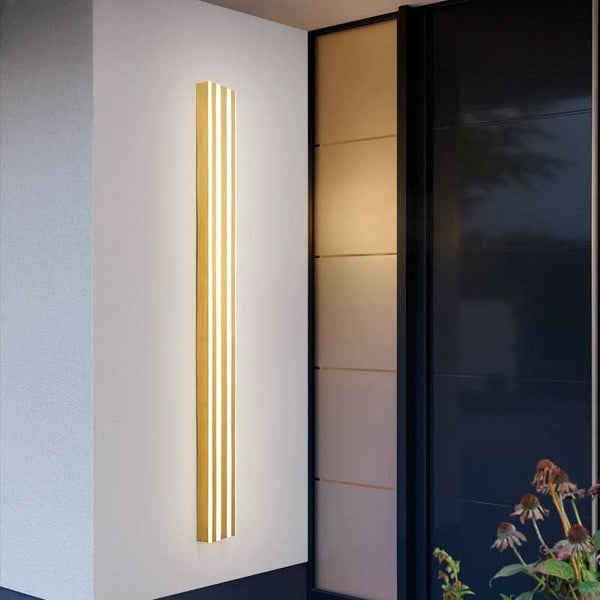
Around 1.80 m for an entrance, the source falls at face height and lights the lock. For a step or a path, go down to about 60 to 80 cm from the ground so the flow sweeps the stone. A large format, up to 240 cm on the Luminaire Extérieur Moderne | Eclat, is placed rather mid-wall on a tall facade: the piece structures the wall as much as it lights it.
Connection and watertight cable entry
The wall light connects to an existing power point or a dedicated conduit, never to an outdoor extension lead. The cable gland and the cable entry ensure the watertightness of the entry point, and the conduit outlet in the wall deserves the same care. For the dimmable references, check the module compatibility before fitting. The final connection is validated by an electrician.
How do you match an outdoor wall light with a modern decoration?
An outdoor wall light is seen from inside: it must echo the vocabulary of the room it extends. A living room with clean lines calls for a black or white aluminium model, a bright kitchen a white or gold finish. The outdoor light complements the indoor lighting without competing with it.
Modern living room decor: the light seen from the window
From a sofa, the terrace wall light draws a silhouette on the wall: a slim, flush housing keeps a discreet line. A neutral-toned interior supports black or grey, a brighter decor prefers white. The black finishes and the white wall lights cover both directions. The Sentinel model illustrates this understated format.
Modern kitchen decoration and courtyard light
When the kitchen opens onto a courtyard, the wall light takes over as soon as night falls. A modern kitchen decor in light wood and white calls for a white or gold finish, with a warm white to extend the room's ambience. The LED kitchen wall lights provide markers inside, which the watertight wall light extends outside.
Modern living room chandelier and outdoor wall light: two distinct roles
In a dining room, a modern chandelier is chosen wider and lower than a living room model. In a kitchen, prefer a closed model that is easy to clean, placed above the worktop or the table. For a WC, a wall light or a small compact chandelier avoids a cluttered effect.
A modern living room chandelier makes a high, decorative point indoors; the outdoor wall light lights a vertical surface and a passage. The two do not compete if the outdoor one stays warmer and lower in intensity. In a small room that opens onto a courtyard, a discreet model is enough: see the wall lights for toilets and the LED wall lights for living rooms.
Should you choose an outdoor wall light with a motion sensor?
The sensor switches the wall light on as you pass, which suits an entrance, a gate or an outdoor corridor, and avoids leaving the light on permanently. Without a sensor, the wall light is controlled by a switch or dimmer and serves more as ambient lighting.
Integrated sensor: entrance, gate and passage
The gesture changes everything: you arrive with your hands full, the light comes on by itself and goes off after you pass. The motion sensor wall lights are placed near a door or a gate, and the LED versions with detection avoid the bulb to change.
Without a sensor: continuous ambient light
To light a terrace during a meal, detection becomes a nuisance: the light goes off after a few minutes. A model controlled by a switch keeps a stable ambience, and some references accept a dimmer to lower the intensity late in the evening. Not all offer this function, to be checked before fitting.
Which materials and colours hold up best outdoors?
Aluminium is the most common material, often combined with metal, glass or acrylic. Black and white dominate the finishes, followed by gold, grey, bronze and transparent. Glass and acrylic diffuse the light, aluminium and metal carry the structure.
Aluminium and metal: what carries the structure
An aluminium housing holds its shape and keeps a fine line even in a large format. It is the dominant material of the selection, often reinforced by metal or iron on the fixings. The black metal wall lights show this crisp structure, and the grey finishes become more discreet on a light render.
Glass, acrylic and resin: what diffuses the light
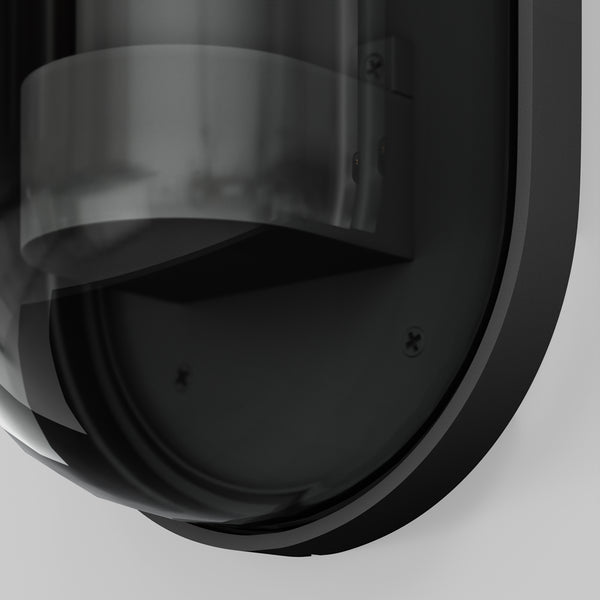
Glass softens the source and lets the bulb show on an E27 model. Acrylic and plastic diffuse more widely and accept curved shapes. Resin allows sculpted volumes, as on the Oryn wall light. To browse the whole range, go through all Designix lights.
How can you be sure of your choice before ordering?
Three points are checked before ordering: the IP rating according to exposure, the desired wattage and light colour, then the installation height. The references in the collection are guaranteed for 2 years or 5 years depending on the models, with secure payment, tracked delivery, returns and Designix customer service.
The three points to check
First note the wall exposure to set the IP rating, then the wattage and shade: from 6 to 60 W depending on the models, in warm, neutral or cool white. Then measure the height and the available format, from 8 cm to 240 cm depending on the references. A short format suits an entrance, a long module a tall facade. The watertight selection settles the question of water.
Warranty, payment and delivery
The warranty is 2 years or 5 years depending on the references, to be found on the model page. Payment is secure, delivery tracked, and a return remains possible if the format does not suit the wall. Designix customer service helps check a rating, a wattage or a socket compatibility. To place a model within the whole range, see the full lighting range.
Frequently asked questions about outdoor wall lights
Which IP rating for an outdoor wall light?
It all depends on the wall exposure. IP44 and IP45 are enough under a canopy, IP54 on a covered terrace or a lightly exposed facade, IP65 where rain hits directly, IP67 in very wet areas. The collection covers these four protection levels.
Modern black IP44 outdoor wall light with E27 connection: how do you choose it?
This combination corresponds to a facade wall light with an E27 socket, protected from splashes but placed out of direct rain, in a black or bronze finish. You choose the bulb and its light colour. The ZenEclat Japanese light and the CharmeRétro vintage wall light follow this logic.
How do you install an outdoor wall light?
You choose a solid, sound support, note the working height, then connect the wall light to an existing power point or a dedicated conduit. The cable entry must stay watertight and the screws suited to the wall material. An electrician validates the connection.
Warm white or cool white to light a terrace?
Warm white, from 2700 to 3500 K, stays close to indoor light and suits terraces and facades. Neutral white, from 3500 to 4500 K, lights an entrance soberly. Cool white, from 4500 to 6500 K, gives a sharper rendering on passage areas.
Do you need a motion sensor on an entrance wall light?
The sensor switches the wall light on as you pass, which avoids leaving the light on permanently and secures an entrance or a gate. For continuous ambient light, a model without a sensor, controlled by a switch or dimmer, will be more suitable.