Spot
- Tracked delivery to your country Tracked delivery
- Secure payment at checkout Multiple payment methods
- 14 days to change your mind 14-day returns
- Secure payment Secure payment


Not sure of your style? Find it in 30 seconds
A few questions, and we will show you the pieces made for you.






















Frequently asked questions
How do I choose the right light output?
At what height should the light be installed?
What type of bulb?
Compatible with LEDs and dimmers?
Light changes everything
From statement chandeliers to discreet wall lights, we help you choose the right brightness, height and style for every room.
- Tracked delivery
- Pay in instalments, where available
- 14 days to change your mind
- Advice & showroom in Lyon, France
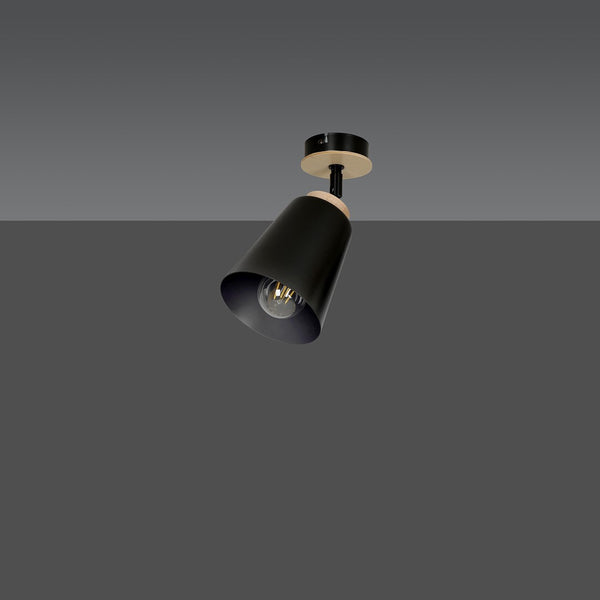
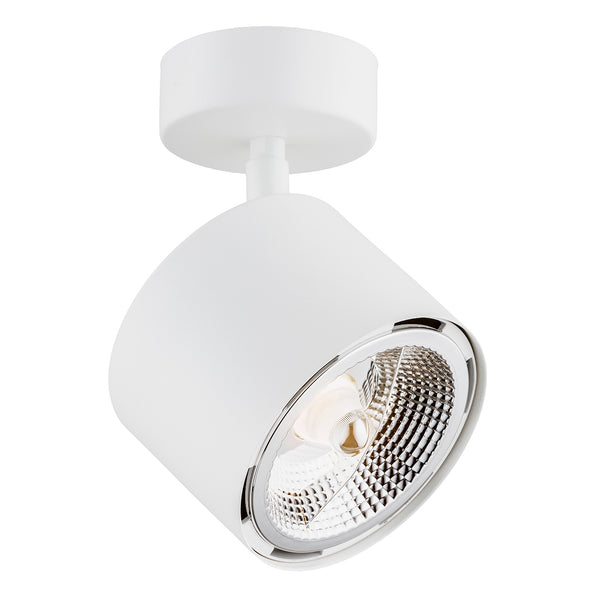
A spotlight lights a precise area rather than the whole room: you choose it based on use (worktop, wall, passage), type of installation (recessed, adjustable, on track) and socket (GU10, E27 or integrated LED). This collection brings together ceiling spotlights for the living room, kitchen or hallway, mainly in aluminium, black or white.
How to arrange ceiling spotlights in a living room?
Start from uses, not from the ceiling: one spotlight per area to light, aligned with the worktop, the passage or the coffee table. Keep a regular grid between points and move the first one away from the wall, to avoid shadows. Better several directed spotlights than a single very powerful one in the centre.
Living room ceiling spotlight layout
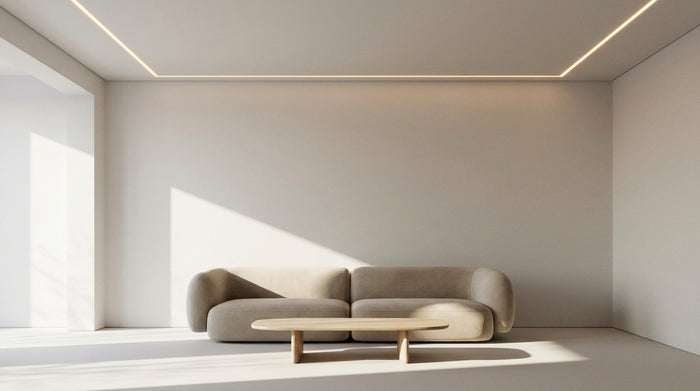
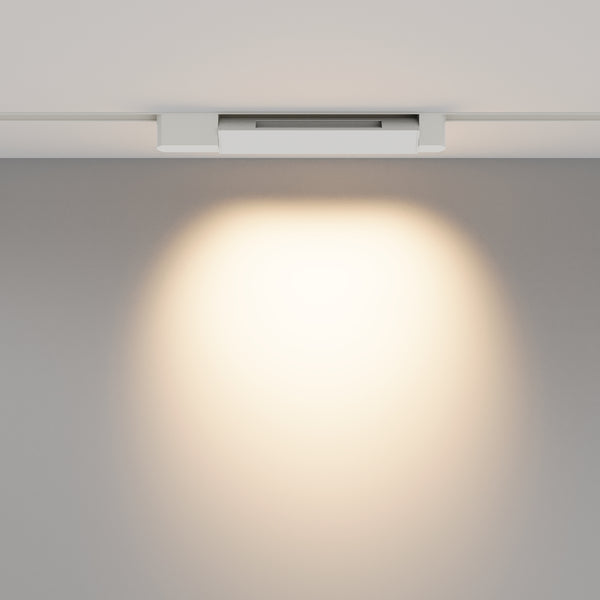
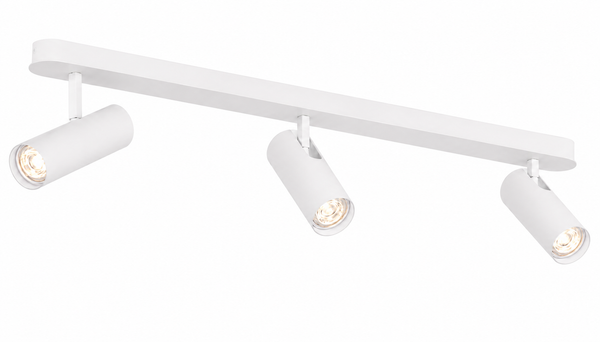
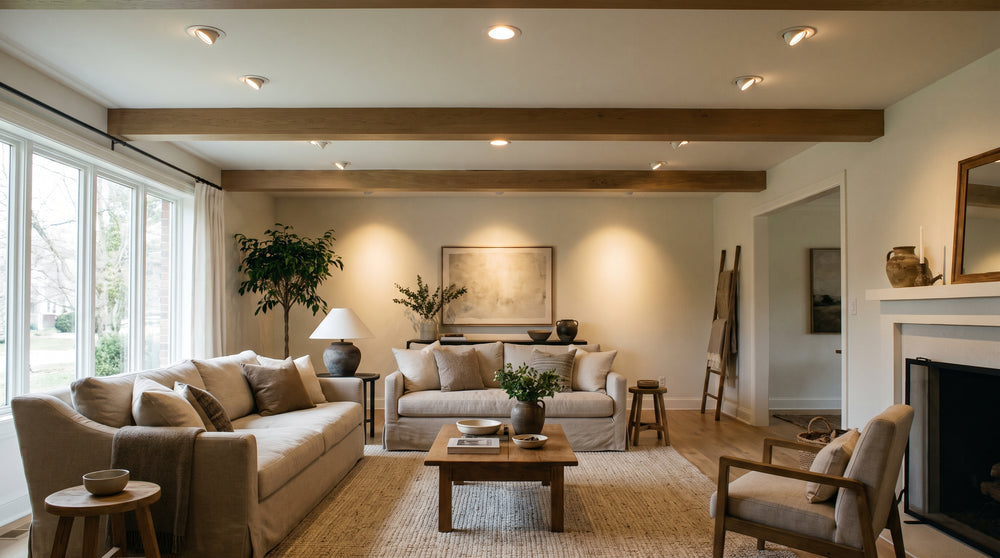
First draw the room plan and mark the lived-in areas: sofa, coffee table, feature wall. Place one spotlight above each area, aligning the points on the same line or in a square. For a living room, adjustable spotlights for the living room allow you to direct the light towards the wall or a painting. The white adjustable track spotlight Lunano groups several points on a fine line, ideal for a low ceiling.
Should you light the wall or the centre of the room?
Lighting the wall creates indirect light that softens the room and highlights a painting or a bookshelf. Directing spotlights towards the centre lights the living area but can create shadows if you stand underneath. Alternate: two spotlights towards the wall, one towards the coffee table. Adjustable spotlights offer this flexibility.
What distance between two ceiling spotlights?
There is no single distance: it depends on the ceiling height and the beam opening. The main point is that spotlights are placed in alignment with the areas to light, with a regular grid from one point to the next, to avoid light gaps on the ceiling.
Spacing spotlights without leaving a dark area
The wider the beam, the more the points can be spaced. For a standard ceiling, keep a regular grid and check that between two spotlights the light overlaps slightly. LED spotlights offer a homogeneous beam, while models with a GU10 socket allow you to change the bulb to adjust the opening.
High ceiling, low ceiling: what changes
On a high ceiling, you can space them further apart and direct the spotlights downwards; on a low ceiling, favour a tighter grid and flush-mounted models. Power is not everything: better to multiply the points than to increase the watts. Some models are compatible with a dimmer to modulate the intensity.
Ceiling spotlight layout: how to prepare your installation?
The layout is the installation plan for the spotlights: it notes the position of each point, its distance from the wall and the space between two spotlights, before drilling. A drawn layout avoids misaligned holes, dark areas and a complete redo of the ceiling.
Ceiling spotlight layout: what to draw on the plan
Reproduce the ceiling to scale, place the spotlights symmetrically with respect to the room axis, and check alignment with the furniture. For a recessed model, measure the available depth and the cut-out diameter. Recessed models require a precise layout, unlike spotlight tracks which are surface-mounted.
Recessed or surface-mounted: two ceilings, two layouts
Recessed is prepared hole by hole, with a cut-out adapted to each model. The track is fixed to the ceiling and the spotlights slide on it: the layout is limited to the length of the track and its orientation. Adjustable LED spotlights combine both approaches.
Modern living room ceiling spotlight: which models to choose?
A recessed spotlight flush with the ceiling or a linear adjustable track of spotlights, in black or white depending on the ceiling colour. The models in the collection are mainly in aluminium, with GU10 socket or integrated LED. Orientation matters more than the shape of the fixture.
Track or recessed spotlight for a contemporary living room?
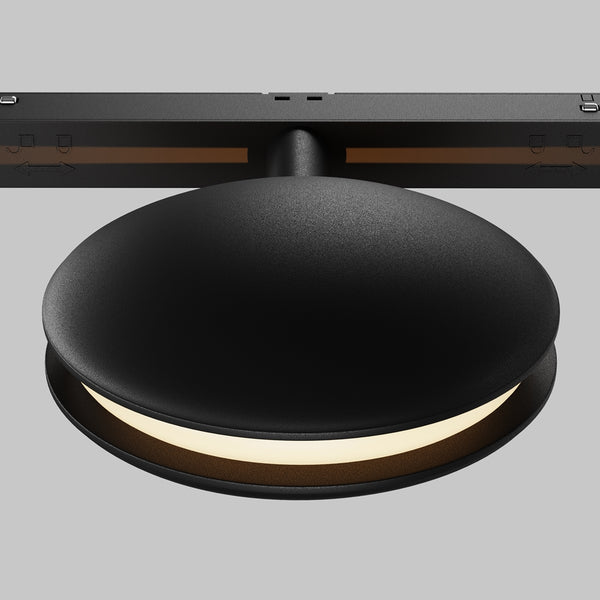
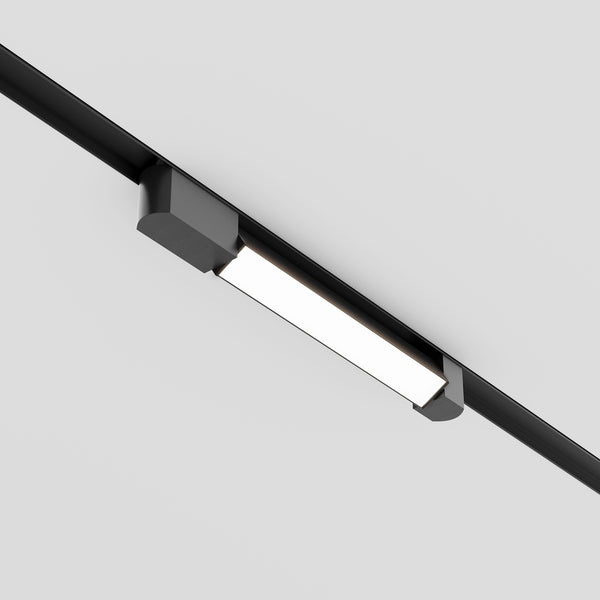
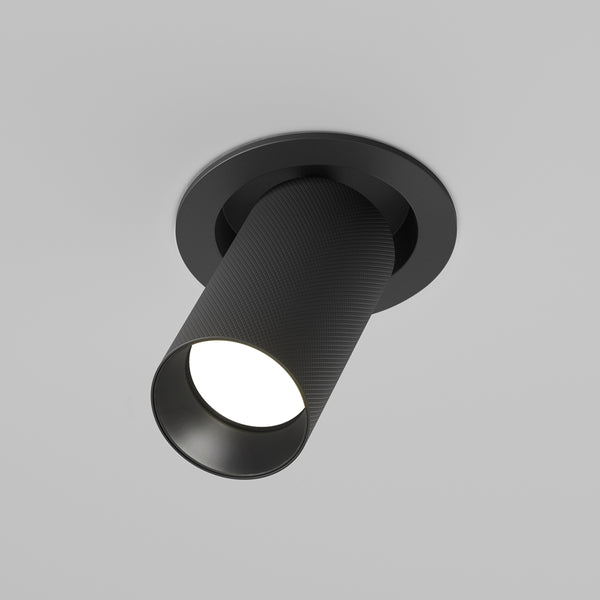
The track creates a graphic line and moves if you rearrange; the recessed one disappears into the ceiling for a cleaner look. For a living room, the black linear track Druella brings a contemporary signature, while the round recessed spotlight with diffusing lens Zensamaro goes unnoticed. Both are adjustable.
Black or white colour: which to choose on the ceiling?
Black blends into a dark ceiling or creates contrast on a light wall; white disappears on a white ceiling. The collection mainly offers black and white models. For a minimalist interior, white finishes are discreet; for an industrial style, the black version makes an impression.
Which spotlight to light a kitchen and a worktop?
An adjustable spotlight directed towards the worktop rather than towards the floor or the room opening. In a kitchen, favour recessed adjustable models and tracks, which allow you to adjust the beam after installation, without dazzling an open kitchen seen from the living room.
Kitchen spotlight: directing light onto the worktop
Place the spotlights above the worktop, not in the centre of the room, and direct them towards the surface where you cut. Spotlights for the kitchen, recessed or surface-mounted, avoid the shadow cast by your body. The double cone wall spotlight Stilo adjusts precisely.
Open kitchen: avoiding reflection and glare
In an open kitchen, a poorly directed spotlight creates a reflection on the cabinets or glares from the living room. Choose a beam directed towards the worktop and a GU10 socket to adjust the angle. Low-power LED spotlights for kitchens are enough over a worktop.
Recessed, adjustable or track spotlight: what are the differences?
The recessed one blends into the ceiling and takes up no volume, the adjustable one allows you to aim at a specific wall or surface, the track groups several points on a line that can move. The choice is therefore based on the desired look and flexibility of use, not on power alone.
Recessed spotlight: what it brings to the ceiling
It frees up volume and gives a clean ceiling. In return, it is installed once and for all and requires a precise cut-out. Recessed LED spotlights are mainly in aluminium and GU10. The cylindrical surface-mounted spotlight Noro offers an alternative without drilling the ceiling.
Spotlight track: one line, several light points
The track groups several spotlights on the same bar, movable and individually adjustable. It suits rooms where you want to adjust the lighting without redoing the ceiling. Spotlight tracks come in several lengths and in black or white, with linear models such as the Candella track.
| Room | Recommended spotlight type | Common socket or technology | Point to check |
|---|---|---|---|
| Living room | Recessed or track, adjustable | LED or GU10 | Orientation towards the wall or an object |
| Kitchen | Recessed adjustable or track | LED or GU10 | Beam directed onto the worktop |
| Hallway | Surface-mounted or recessed | GU10 or LED | Regular alignment along the passage |
| Entrance | Surface-mounted or spotlight ceiling light | GU10 or E27 | Colour matched to the wall and ceiling |
| Dressing room | Recessed or surface-mounted | LED or GU10 | No shadow cast in front of the storage |
| Bathroom | Only IP44 models from the collection | GU10 | Protection rating suited to the area |
Which socket and light temperature to choose?
Three solutions coexist: integrated LED, which cannot be replaced, the GU10 socket, which is changed by unscrewing the bulb, and the E27 socket, which is wider. In terms of ambience, warm white, between 2700 and 3500 K, dominates this selection, neutral white remains a minority.
GU10, E27 or integrated LED: what changes in use
Integrated LED offers a homogeneous beam but nothing can be replaced; GU10 unscrews to change the temperature or power; E27, wider, mainly equips surface-mounted spotlights. In this collection, integrated LED, GU10 and E27 coexist depending on the models. Integrated LED models simplify maintenance.
Warm white or neutral white: which ambience in which room?
Warm white (2700 to 3500 K) suits the living room, bedroom and living areas; neutral white (3500 to 4500 K) is more suited to an office or kitchen where clarity is needed. The collection is dominated by warm white, with a few models in neutral white. Dimmable LED spotlights allow you to adjust the intensity.
| Socket or technology | Share of the selection | Replaceable bulb | To remember |
|---|---|---|---|
| Integrated LED | 50% | No | Homogeneous beam, nothing to change afterwards |
| GU10 | 33% | Yes, unscrewable bulb | Most flexible solution for changing the temperature |
| E27 | 13% | Yes | Wider socket, mainly on surface-mounted models |
How to install and maintain a spotlight?
Almost all spotlights in the collection are IP20: they are installed in dry rooms, living room, hallway, kitchen or dressing room. A few models in IP44 accept proximity to water. Check the protection rating on the product sheet before choosing the final location. The collection has 1845 products; the models shown here are only a selection.
IP20 and IP44 spotlight: where to install them?
IP20 for dry rooms, IP44 for a bathroom or a sheltered outdoor area. Cut the power before any work and respect the cut-out depth for a recessed one. Bathroom spotlights are the only ones in the collection that withstand humidity. All our light fixtures indicate their protection rating.
Maintaining a spotlight without damaging the finish
Dust dry an aluminium or brushed steel body, without abrasive products. For an integrated LED, no special maintenance. The warranty period is indicated on each product sheet. The cylindrical surface-mounted spotlight Noro is cleaned with a simple soft cloth. Find the modern style spotlights for easy maintenance.
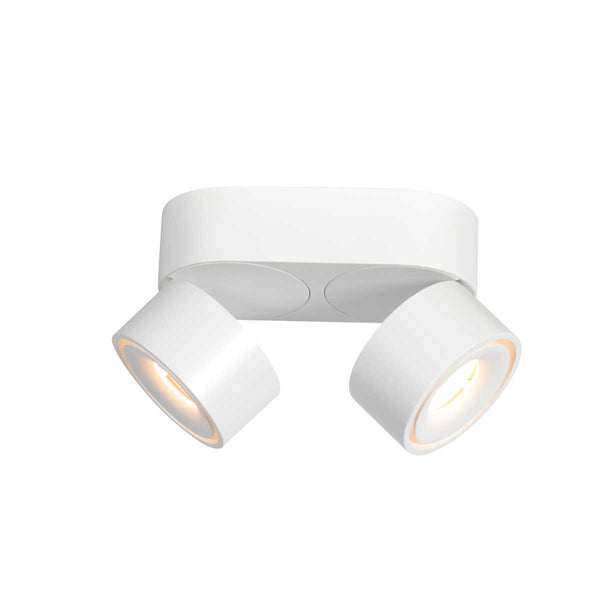
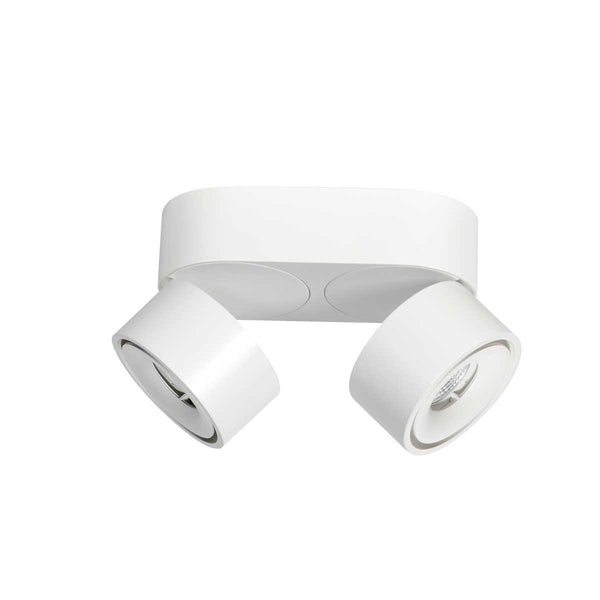
Delivery is tracked, payment is secure, and you have a Designix customer service to assist you. Returns are accepted. To choose your spotlight, rely on the product sheet: dimensions, socket, protection rating. A model like the LED spotlight Mirranaro (two adjustable heads, IP20) suits a kitchen or hallway.
Discover the complete lighting catalogue to equip each room, or browse adjustable spotlights if you want to adjust the beam after installation.
Frequently asked questions
How to arrange ceiling spotlights?
Start from uses, not from the ceiling: one spotlight per area to light, aligned with the worktop, the passage or the coffee table. Keep a regular grid between points and move the first one away from the wall. Better several directed spotlights than a single very powerful one in the centre.
What distance between two ceiling spotlights?
There is no single distance: it depends on the ceiling height and the beam opening. The main point is that spotlights are placed in alignment with the areas to light and that the grid remains regular from one point to the next.
What is a spotlight?
A spotlight is a light fixture that concentrates light on a precise point, instead of diffusing it throughout the room. It is fixed to the ceiling or wall, recessed, surface-mounted or on track, and is directed towards a worktop, a wall or an object.
GU10 spotlight or integrated LED spotlight: which to choose?
GU10 unscrews: you can change the bulb or the light temperature later. Integrated LED offers a homogeneous beam but nothing can be replaced. In this collection, integrated LED and GU10 dominate, E27 remains a minority.
Can a spotlight be installed in a bathroom?
Only models with an IP44 protection rating are suitable near water; the vast majority of spotlights in the collection are IP20, reserved for dry rooms. Check the rating indicated on the product sheet before fixing the fixture.