
RGB Spotlights
This selection is also available in our French store: Spots RGB












- Tracked delivery to your country Tracked delivery
- Secure payment at checkout Multiple payment methods
- 14 days to change your mind 14-day returns
- Secure payment Secure payment
Not sure of your style? Find it in 30 seconds
A few questions, and we will show you the pieces made for you.
Frequently asked questions
How do I choose the right light output?
At what height should the light be installed?
What type of bulb?
Compatible with LEDs and dimmers?

Light changes everything
From statement chandeliers to discreet wall lights, we help you choose the right brightness, height and style for every room.
- Tracked delivery
- Pay in instalments, where available
- 14 days to change your mind
- Advice & showroom in Lyon, France
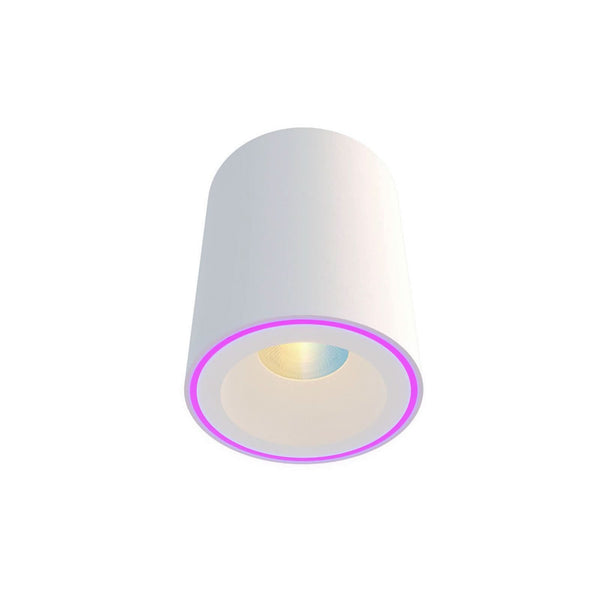
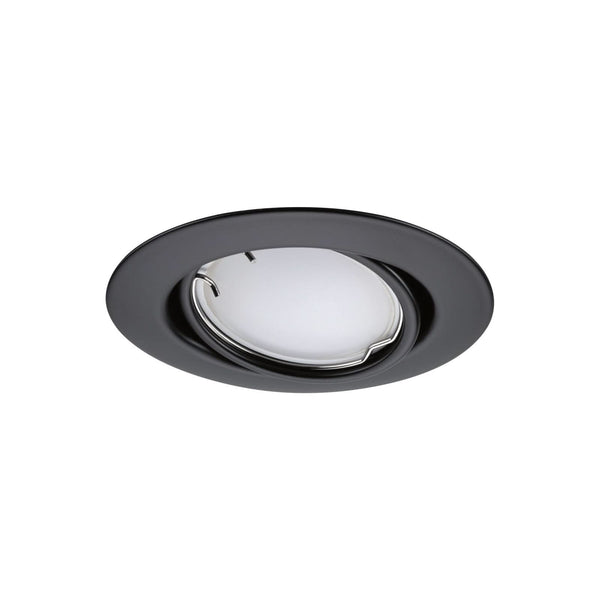
First check the clearance above the ceiling and the cut-out diameter, then choose the light: a recessed RGB spotlight is not fitted like a wall light. In this selection, the round spotlight with a ribbed reflector measures 5.4 cm high by 8.5 cm in diameter, the chrome finned model 4.5 cm high by 5.2 cm.
Which RGB spotlight should you choose for a living room or kitchen ceiling?
The first criterion is not colour but size: measure the free space above the slab before ordering. The round spotlight with a ribbed reflector needs 5.4 cm high under 8.5 cm in diameter, the chrome finned one 4.5 cm high for 5.2 cm in diameter and 9.2 cm per side.
Recessed RGB spotlight: the dimensions to check before drilling
A recessed spotlight takes up space in the ceiling. Allow a clearance greater than its height, otherwise the spring does not fold back and the housing hangs down. The cut-out diameter matches the stated Ø: transfer it to the template before sawing. Also check that no conduit or joist runs directly above. For a thin lining, look at the recessed models for a living room of low height, and compare the two references in the table below.
Warm white or cool white: which temperature for which room?
Around 2700 to 3500 K, the light leans towards amber and relaxes a room in the evening. Between 4500 and 6500 K, it whitens the tones and makes reading and cutting clearer. The round spotlight with a ribbed reflector covers both ranges, which leaves the choice open at the time of installation. Fitting on dimmable spotlights also allows the intensity to be lowered late in the evening.
RGB IP65 spotlight: in which rooms can it be installed?
The IP65 rating allows a spotlight outdoors, on a terrace, in a kitchen and in a bathroom: it resists dust and water jets. An IP20 remains reserved for dry rooms such as the living room or hallway. The ribbed reflector spotlight is IP65, the chrome finned model is IP20.
What IP65 really protects on a terrace
The 6 covers dust, the 5 low-pressure water splashes. That is enough under a canopy, on an open terrace or near a sink. It does not mean waterproof: a pressure washer or water pooling above the seal exceed the intended protection. For an exposed outdoor area, look at the LED spotlights intended for a damp room and their rating before drilling.
RGB pool spotlight and ground spotlights: what you need to know
A light point immersed in a pool falls under a different protection rating, and no submersible spotlight appears here. Ground spotlights recessed into a terrace require, for their part, drainage under the housing. If your need is facade or garden lighting, the IP65 round spotlight with a ribbed reflector is the suitable reference in the selection.
| Room | Rating chosen | Recommended temperature | Why |
|---|---|---|---|
| Living room | IP20 or IP65 | Warm white 2700-3500 K | Accent light without glare |
| Kitchen | IP20 high up, IP65 near the sink | Cool white 4500-6500 K | Better rendering on the worktop |
| Hallway | IP20 | Warm white | Short passage, soft atmosphere |
| Bathroom | IP65 | Cool white | Damp area, water splashes |
| Terrace and outdoors | IP65 | Cool white | Resists dust and water jets |
How do you install recessed spotlights in the ceiling?
The installation comes down to five steps: switch off the power, mark out with the template, cut the ceiling, connect the spotlight to the circuit and then clip it in. The clearance above the ceiling must exceed the height of the spotlight, namely 5.4 cm for the ribbed reflector model and 4.5 cm for the chrome finned one.
The cut-out and the height clearance above the ceiling
- Switch off the circuit breaker for the lighting circuit and check that there is no voltage.
- Mark the position in pencil, using the supplied template.
- Cut with a hole saw to the diameter stated on the spotlight's data sheet.
- Connect the power supply to the terminal block, with the power off.
- Fold back the springs and push the spotlight in until it touches the slab.
Suspended ceiling or solid ceiling: what changes
A plasterboard suspended ceiling lets your fingers through the cut-out: wiring is done without dismantling, provided you keep 5.4 cm or 4.5 cm depending on the model. A solid ceiling means pulling the conduits beforehand and planning the arrival in the right place. In both cases, test the lighting before clipping in permanently, and look at the recessed kitchen spotlights if the room is damp.
How do you wire spotlights in series or in parallel?
In parallel, each spotlight starts from the power supply and keeps the same voltage: this is the wiring to use for a ceiling. In series, the voltage is shared between the spotlights and a fault cuts the line; this wiring is not suitable for recessed spotlights powered from the mains.
How do you wire spotlights in series?
Series wiring connects the output of one spotlight to the input of the next. Each module receives a fraction of the voltage, which switches off or weakens the whole set as soon as one point fails. It is found on low-voltage light strings, not on a domestic 230 V network. For a hallway, it is better to turn to hallway spotlights wired in parallel.
Why parallel wiring remains the standard for ceilings
In parallel, all the spotlights receive the full voltage and remain independent: if one fails, the others still light. The connection is made in a box or on a connector block, before being pushed back into the slab. Switch off the power and have the connection checked at the consumer unit if you are not comfortable. The LED spotlights designed for the living room lend themselves well to this line layout.
How should spotlights be laid out on the ceiling?
Spotlights are aligned with the axes of the room rather than at random: a row along the walls, a line above the worktop or the table. The spacing stays regular and the spotlights are kept away from partitions to avoid cast shadows.
Aligned rows or a grid: which layout should you choose?
A long room, hallway or kitchen, benefits from a single centred row: the eye follows the line and circulation remains clear. A square living room can take a regular grid, provided you keep the same distance between each point and do not place a spotlight in a corner. Adjustable LED spotlights make up for an imperfect alignment by redirecting the beam.
How many spotlights in a kitchen?
Think in zones rather than in numbers: a line above the worktop, one or two points near the sink, circulation lighting in the centre. Regularity matters more than quantity, an irregular gap is immediately visible on the ceiling. For a work room, see the LED spotlights for the kitchen and their temperatures.
How do you wire an RGB LED and what happens if you reverse it?
On an RGB setup, you identify the common wire and then the three channels, red, green and blue, before connecting the controller. Wired the wrong way round, an LED does not light: current only flows in one direction. A channel reversal, on the other hand, gives a wrong colour, without damaging the spotlight.
Red, green, blue: how to identify the common and the channels
The common arrives on the marked terminal, the other three each supply a colour. Identify the module before cutting the wires: a wrongly identified terminal block will swap red and blue. The controller is placed between the power supply and the spotlight. Work with the power off, then test each colour before closing the ceiling again.
Does an LED wired the wrong way round burn out?
A polarised LED only conducts in one direction: reversed, it stays off, without damage in most cases. Switch off the power, reverse the two wires and start again. On a reversed channel, the colour changes but the spotlight works. For progressive control, compare the dimmable LED versions.
Which spotlight colour for which atmosphere?
The colour of a spotlight comes down to two things: the finish visible on the ceiling, white, silver or black, and the light temperature, warm for the evening, cool for a work room. RGB control adds the choice of hue from a remote control, a dimmer or an app.
Connected RGB spotlight: control by remote or app
The controller receives the command and modulates the three channels separately, which allows a colour to be fixed or changed. Part of the selection is described as connected, to be checked on the model's data sheet. The ribbed reflector spotlight accepts a dimmer: the intensity is then adjusted from a compatible switch. See also the dimmable recessed spotlights.
White, silver or black finish: which to choose on the ceiling?
On a white slab, white and silver erase the trim ring and leave only the source visible. Black frames the spotlight and highlights a dark ceiling or a graphic decor. The ribbed reflector spotlight comes in white, silver and black, the chrome finned one in silver. Browse the black spotlights and the white recessed spotlights to decide from the photos.
| Model | Material | Rating | Temperatures | Power | Dimensions | Dimmer |
|---|---|---|---|---|---|---|
| Ribbed reflector spotlight (Don) | Metal and plastic | IP65 | Warm white and cool white | 4.7 W | H 5.4 cm, Ø 8.5 cm | Yes |
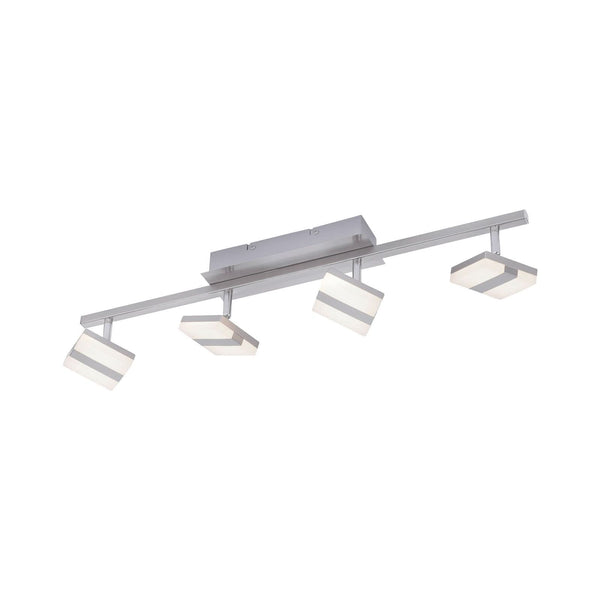
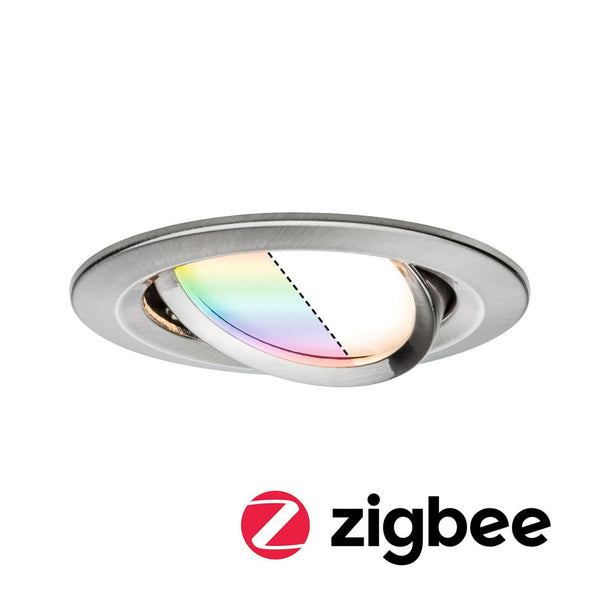
| Chrome finned spotlight (SA-09) | Aluminium | IP20 | Not stated on the data sheet | 3 W | H 4.5 cm, Ø 5.2 cm, 9.2 cm per side | No |
Which mistakes should you avoid before ordering an RGB spotlight?
Before confirming, check the height available above the ceiling, the protection rating for the room and the desired light temperature. Both references are guaranteed for 2 years, the order is paid securely with tracked delivery, returns possible and Designix customer service.
Check the height, the rating and the temperature before confirming
Three oversights come up again and again: a ceiling void too shallow for the 5.4 cm of the ribbed reflector spotlight, an IP20 placed near a shower, a light that is too cool in a bedroom. Also note the material, metal and plastic on one side, aluminium on the other, because it changes how the trim ring looks. The IP20 chrome finned spotlight suits a dry ceiling, the IP65 model a damp room.
Delivery, returns and warranty: what surrounds the order
The warranty covers 2 years on both models. To broaden the comparison, browse all Designix light fittings or the range of contemporary-style spotlights, then place your order.
The LED is the light source; RGB is a way of mixing three coloured channels. An RGB LED combines three chips, red, green and blue, whose relative intensity is modulated by the controller to compose the hue.
Frequently asked questions about RGB spotlights
How can I control an RGB LED?
An RGB spotlight is controlled by a remote control, a dimmer or an app depending on the module installed. The controller receives the command and modulates the red, green and blue channels separately. In this selection, the ribbed reflector spotlight accepts a dimmer: the intensity is then adjusted from a compatible switch.
What is the difference between RGB and RGBW?
RGB mixes three channels, red, green and blue, to compose colours; the white obtained by mixing is often tinted. RGBW adds a dedicated white channel, which gives a more neutral white and avoids having to run the three channels to light normally. An RGBW spotlight is therefore more comfortable for everyday lighting.
Does RGB consume a lot?
Consumption follows the stated power of the spotlight, not the number of colours: the models in this selection are rated at 3 W and 4.7 W. A colour module adds control electronics, but the difference remains small compared with the general lighting of the room. The actual expense depends mainly on how long it is switched on.
12 V RGB spotlight: do you need a transformer?
A spotlight rated at 12 V cannot be connected directly to the mains: it needs a transformer or a driver that steps the voltage down. The driver's power must cover all the connected spotlights, with a margin. Both references in this collection are recessed LED spotlights, to be checked on the data sheet before connection.
Can an IP65 RGB spotlight stay outside all year round?
IP65 protects against dust and water jets, which suits a terrace or a sheltered outdoor area. It does not cover immersion: a light point immersed in a pool falls under a different protection rating. The ribbed reflector spotlight in the selection is IP65 and can be installed on a terrace, provided it is mounted out of the water.




