Black spotlights for bathroom
- Tracked delivery to your country Tracked delivery
- Secure payment at checkout Multiple payment methods
- 14 days to change your mind 14-day returns
- Secure payment Secure payment


Not sure of your style? Find it in 30 seconds
A few questions, and we will show you the pieces made for you.




Frequently asked questions
How do I choose the right light output?
At what height should the light be installed?
What type of bulb?
Compatible with LEDs and dimmers?
Light changes everything
From statement chandeliers to discreet wall lights, we help you choose the right brightness, height and style for every room.
- Tracked delivery
- Pay in instalments, where available
- 14 days to change your mind
- Advice & showroom in Lyon, France
Plan for two distinct zones: an IP44 recessed spotlight above the shower and mirror, IP20 models on the rest of the ceiling. The black housing is chosen to match the tiles and fittings, never for the amount of light. This selection brings together black spotlights, recessed or adjustable, with GU10 sockets or integrated LED, in metal and plastic.
Which type of black bathroom spotlights is best suited to a bathroom?
For a bathroom, an IP44 recessed spotlight is the most suitable: it protects the fitting from water splashes and is installed above the shower or washbasin. An adjustable spotlight, whose head pivots, lights a mirror or a specific surface. IP20 models are reserved for the dry areas of the room.
Recessed or adjustable spotlights: what is the difference for a bathroom?
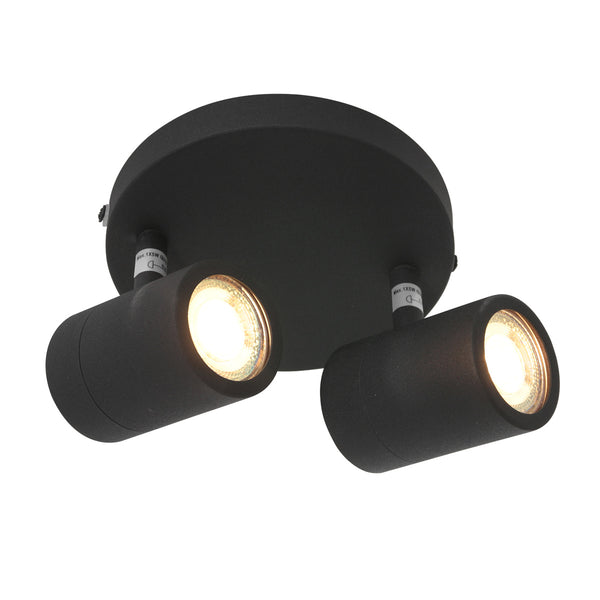
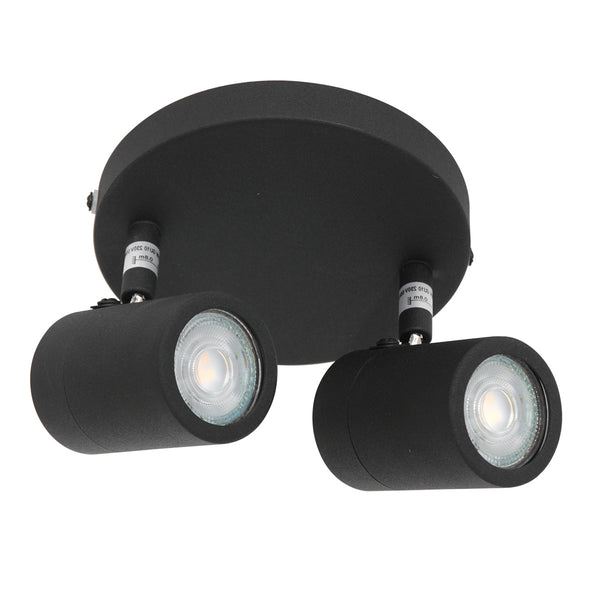
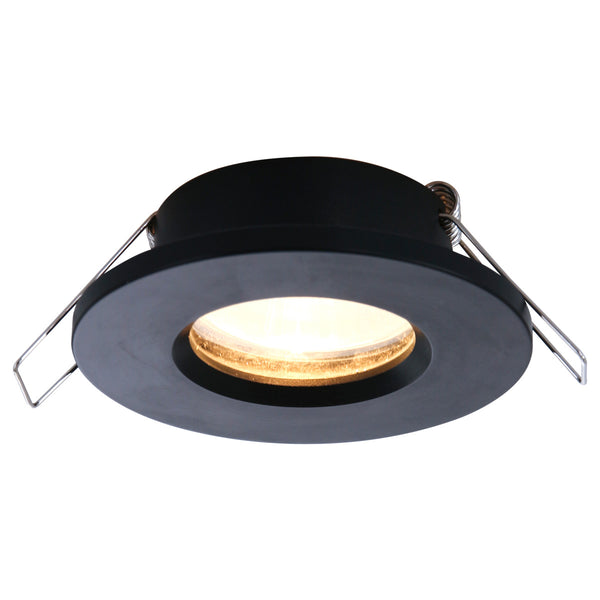
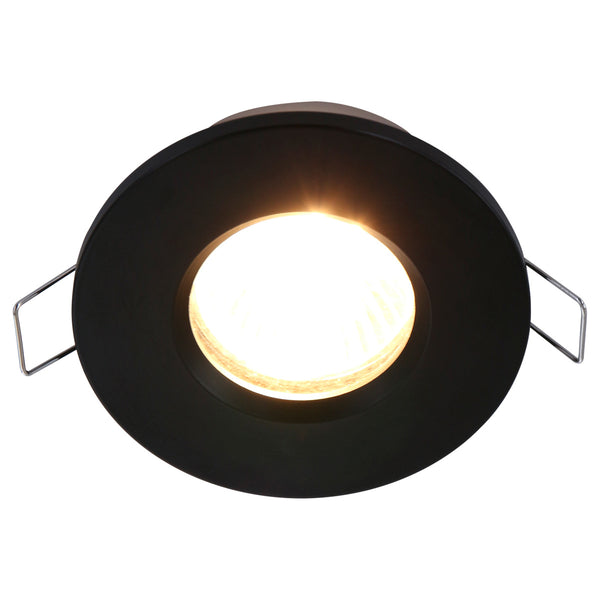
The recessed model is held in the ceiling by fixing springs and shows only a trim ring: the Lisio black recessed spotlight with springs fits into a 10 cm diameter cut-out. The adjustable model keeps a movable head: the Cylia black adjustable spotlight with two tubes sends two distinct beams, useful along a wall or on either side of a mirror. For strictly downward light, go for recessed spotlights.
IP44 bathroom pendant or recessed spotlight: which to choose on the ceiling?
A pendant hangs down into the room and is easy to clean, but it eats into the height available above the washbasin. A recessed model stays flush with the ceiling and frees up space. Under a low ceiling or in a narrow room, black adjustable models and recessed versions remain the easiest to live with.
Which spotlight colour for a bathroom?
Black creates a sharp contrast on a white or beige wall and highlights the lines of the ceiling; it blends into a dark bathroom or a dark wood decor. As the housing colour does not change the light emitted, it is chosen mainly to match the tiles and fittings.
Black spotlights for a white or wood bathroom: what contrast?
On light tiles or a wooden cabinet, the black housing draws a clean line on the ceiling and frames the lit areas. It is the same principle as the same selection in white, but with a more graphic marking: white disappears, black underlines.
Black spotlights for a black and white bathroom: how to balance?
On a dark ceiling, a black spotlight fades away and leaves only the light visible. What matters most is the protection rating and the bulb temperature. On very dark tiles, a ribbed or faceted glass brings useful relief, at the cost of slightly more regular cleaning.
Which shapes and styles of black spotlights for a designer bathroom?
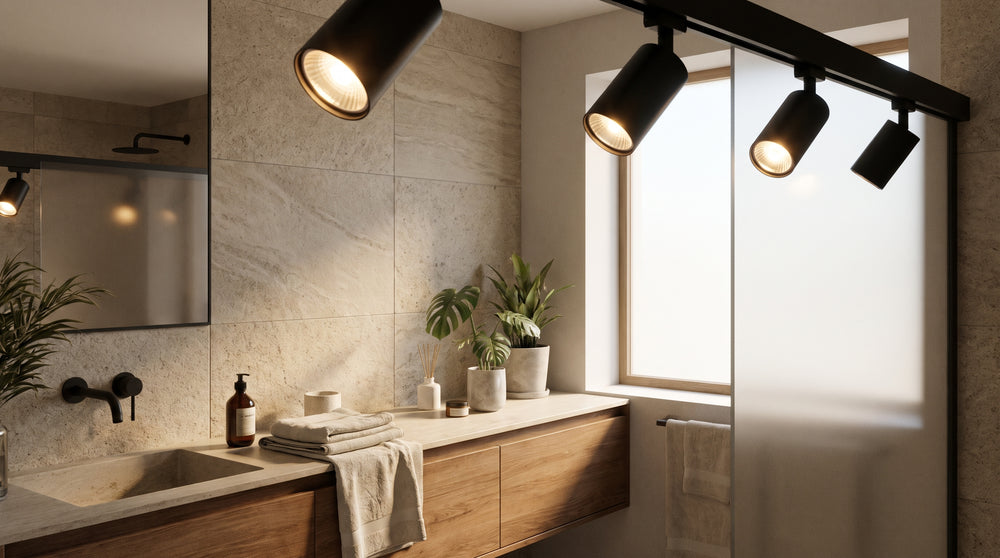
The black spotlights in the collection play on the round shape, the square or the cylindrical tube. The round recessed model is hardly noticeable on the ceiling, the square in faceted glass adds a pattern, the two adjustable tubes version structures a wall or a large room. The dominant style remains modern and contemporary.
Round, square or tube: which shape of black spotlight to choose?
Round works when you want to forget the fitting. The square, like the Facetta black square spotlight in faceted glass, marks a clean geometry on a smooth ceiling. The cylindrical tube, like the Noria black adjustable LED spotlight, stands out and can be directed.
Which glass finish for a designer bathroom spotlight?
Ribbed glass, as on the Sigrid black IP44 recessed spotlight, diffuses light in fine lines and partly hides the source. Faceted glass scatters it into more pronounced shards. For a warmer decor, gold finishes or grey housings open up other matches.
Which IP protection rating to choose for a bathroom spotlight?
IP44 means the fitting resists water splashes: this is the rating to favour around the shower, bath and washbasin. IP20 is suitable for the dry areas of the room, away from any water point. The black spotlights in the collection have a wattage of 10 or 12 W.
| Model | Protection rating | Socket | Recommended zone | Mounting |
|---|---|---|---|---|
| Lisio | IP20 | GU10 | Dry areas of the bathroom | Recessed, fixing springs |
| Sigrid | IP44 | GU10 | Close to the shower and washbasin | Recessed, ribbed glass |
| Cylia | IP44 | GU10 | Bathroom and living room | Two adjustable tubes |
| Facetta | IP20 | GU10 | Dry areas, bathroom wall | Square recessed, faceted glass |
| Noria | IP20 | Integrated LED | Living room, bedroom, kitchen, dry bathroom | Cylindrical adjustable |
IP20 or IP44: what does each rating protect against?
IP20 protects against solid objects larger than 12.5 mm, with no water resistance: to be reserved for dry areas. IP44 adds protection against splashes, which covers splashes from a washbasin or shower. The housing colour makes no difference to this rule.
Where to place an IP44 spotlight around the shower and washbasin?
Above the shower, mirror and vanity top, an IP44 model remains the right base, recessed or as a wall light. The rest of the ceiling, further from water points, accepts an IP20. To compare the available options, see the range of black spotlights.
Which dimensions and wattage for a black bathroom spotlight?
The recessed models in the collection fit into compact cut-outs: around 8.5 to 10 cm in diameter for 4 to 7 cm in depth. The two-tube model measures around 24 cm wide by 15 cm high. Check the available depth before drilling, especially under a false ceiling.
| Model | Material | Wattage | Light temperature | Dimensions |
|---|---|---|---|---|
| Lisio | Plastic and metal | 10 W | Not specified on the sheet | ø 10 cm (D 4 cm) |
| Sigrid | Plastic and metal | 10 W | Not specified on the sheet | ø 8.5 cm, height 7 cm |
| Cylia | Plastic and metal | 10 W | Warm white 2700-3500 K | Width 24 cm, max height 15 cm |
| Noria | Metal and aluminium | 12 W | Warm white 2700-3500 K and cool white 4500-6500 K | Length 11.6 cm |
| Facetta | Plastic and metal | 10 W | Not specified on the sheet | Height 7 cm |
Which recess diameter to plan for in the ceiling?
First locate the depth between the plasterboard and the slab: 4 cm for the Lisio, 7 cm for the Sigrid and the Facetta. The cut-out diameter follows the trim ring, around 8.5 to 10 cm. Always recess while keeping a few centimetres between two spotlights.
Should you choose 10 or 12 W for a bathroom?
Among the 82 black spotlights in the collection, the five models shown above stay within a similar wattage, 10 W for the GU10 versions and 12 W for the Noria with integrated LED. With a GU10 socket, the wattage then depends on the bulb you install. To widen the comparison, see the recessed LED spotlights and the recessed models in white.
Choose your cut-out and your rating before anything else: see the black spotlights in the collection.
Can a black bathroom spotlight be installed on the floor?
A bathroom spotlight is installed on the ceiling or as a wall light, not on the floor. To light the lower part of a wall or a cabinet, an adjustable model whose head points towards the feature to highlight is a better choice, with the protection rating suited to the wet zone.
Bathroom spotlight on the floor or as a wall light: which to choose?
None of the models in this selection is intended for floor use. The wall light remains the solution for a low point, provided the rating for the zone is respected. The adjustable models in white cover the same need in a light decor.
How to light a cabinet or the lower part of a bathroom wall?
An adjustable head directed towards the cabinet does the job, without adding a fitting on the floor. With a GU10 socket, the bulb you choose decides the final look, more or less diffuse. Black LED spotlights often settle the question with a single source per point.
Black spotlights in the living room, kitchen, bedroom or WC: which uses?
The same black spotlights work in the living room, kitchen, bedroom or hallway. In the kitchen, they light the worktop; in the living room, a warm white light makes the atmosphere softer than a cool white. In a small room such as a WC, a single recessed spotlight is often enough.
Light colour for a living room: which temperature to choose?
A warm white, around 2700 to 3500 K, gives a soft light for relaxing moments. A cool white, from 4500 to 6500 K, lights more sharply. The Noria accepts both depending on the bulb installed. See lighting a living room with LED and the bedroom spotlights.
Light fitting for a WC: which lighting to adopt?
In often narrow WCs, a recessed ceiling spotlight lights without cluttering and frees up the passage. An adjustable model allows you to aim at the floor or a wall. A warm white light makes the space more welcoming than a cool white. The hallway spotlights follow the same logic on circulation areas.
Dining room light fitting: chandelier or spotlights?
For a high ceiling above a table, a chandelier or an elongated pendant brings direct lighting and a vertical presence that recessed spotlights do not always replace. Check the suspension height and the size of the fitting in relation to the tabletop.
Above a table, a chandelier concentrates the light on the meal. Recessed spotlights light the whole room and can coexist with it. In an open-plan room, they avoid two sources competing on the ceiling. In the kitchen, kitchen LED spotlights and modern models for a modern kitchen decor light the worktop without casting shadows.
| Temperature | Effect | Where to use it |
|---|---|---|
| Warm white 2700-3500 K | Soft light, relaxed atmosphere | Bathroom, living room, bedroom |
| Cool white 4500-6500 K | Sharp light, marked contrasts | Kitchen, worktop, hallway |
How to install and maintain a black recessed spotlight?
A recessed spotlight is fixed into a cut-out in the ceiling, often with fixing springs, after switching off the power at the circuit breaker. The GU10 bulb is changed without any special tool. A soft cloth is enough for dust; abrasive products are avoided on glass and aluminium.
How to fit a spotlight with fixing springs in a false ceiling?
Switch off the power, cut the opening to the diameter of the trim ring, feed the cable through then spread the two springs and push the fitting until it sits flush. The Lisio and its springs is fitted this way in a few minutes, at 4 cm depth.
How to change a GU10 bulb and clean a black spotlight?
Let the fitting cool, remove the GU10 bulb with a quarter turn and fit a bulb of the same wattage. Dust the housing and the glass with a soft cloth, without abrasive product. The whole lighting selection is guaranteed for two years.
Frequently asked questions
IP44 bathroom pendant or recessed spotlight: which to choose?
An IP44 pendant hangs down into the room and is easy to clean, but it takes up the height above the washbasin. An IP44 recessed spotlight stays flush with the ceiling, lights the shower or mirror zone and frees up space. In a small bathroom or under a low ceiling, the recessed model remains the simplest.
Light fitting for a WC: which lighting to adopt?
In often narrow WCs, a recessed ceiling spotlight lights without cluttering; an adjustable model allows you to aim at the floor or a wall. A warm white light makes the space more welcoming than a cool white. The black finish matches light tiles as well as a dark decor.
Light colour for a living room: which to choose?
A warm white, around 2700 to 3500 K, gives a soft light suited to relaxing moments in the living room. A cool white, from 4500 to 6500 K, lights more sharply and suits worktops. The Noria spotlight accepts both temperatures depending on the bulb installed.
Dining room light fitting: chandelier or spotlights?
Above a table, a chandelier or a pendant concentrates the light on the meal. Black recessed spotlights light the whole room and can coexist with the chandelier. In a dining room open to the living room, they avoid two sources competing on the ceiling.
How to change a GU10 bulb on a black recessed spotlight?
Switch off the power at the circuit breaker, let the spotlight cool, then remove the GU10 bulb by turning it a quarter turn. Fit a bulb of the same wattage. To reach the holder, most recessed models are removed by gently spreading the fixing springs.
Find the right black spotlight for your bathroom
Work through it in order: the zone to light decides the IP rating, the ceiling cut-out decides the diameter, the bulb decides the temperature. To go further, browse all Designix light fittings and the desk spotlights if you are also equipping a work room.
- Secure payment
- Tracked delivery
- Returns
- Designix customer service