
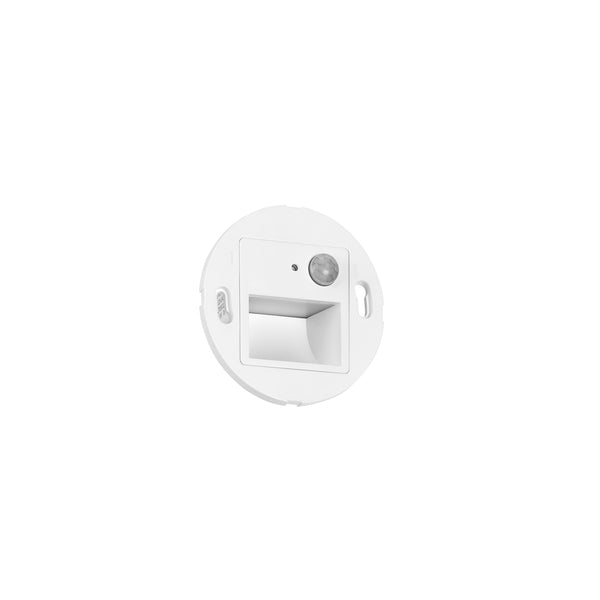
Recessed spotlights with motion sensor
This selection is also available in our French store: Spots encastrables à détecteur de mouvement

- Tracked delivery to your country Tracked delivery
- Secure payment at checkout Multiple payment methods
- 14 days to change your mind 14-day returns
- Secure payment Secure payment
Not sure of your style? Find it in 30 seconds
A few questions, and we will show you the pieces made for you.
Frequently asked questions
How do I choose the right light output?
At what height should the light be installed?
What type of bulb?
Compatible with LEDs and dimmers?

Light changes everything
From statement chandeliers to discreet wall lights, we help you choose the right brightness, height and style for every room.
- Tracked delivery
- Pay in instalments, where available
- 14 days to change your mind
- Advice & showroom in Lyon, France
A recessed motion sensor spotlights fits on the walking path: it switches on when someone passes and turns off by itself after a set time, with no switch to hunt for in the dark. Hallway, top of the stairs, entrance, sheltered passage: the choice comes down to sensor range, ingress protection and ceiling finish.
- What is a recessed spotlight with a built-in sensor?
- Where to place it: stairs, hallway, entrance, outdoors
- How to lay out ceiling spotlights
- How many spotlights in a kitchen
- How to install and adjust
- Wiring in series or in parallel
- Solar, and what it is good for
- Which finish to choose
What is a recessed spotlight with a built-in motion sensor?
A recessed spotlight with a built-in motion sensor combines the light source and the sensor that detects movement in one housing: no switch to operate and no separate sensor to mount on the wall. The passive infrared sensor triggers the light, and a timer turns it off once the area is empty again.
Recessed LED spotlight with motion sensor: what the LED source changes
The LED source opens up the choice of colour temperature, from a warm white around 2700 to 3000 K for a hallway to a neutral white near 4000 K for an entrance where you look for your keys. It also allows flatter housings, which matters when the slab leaves little depth. Depending on the model, the source is integrated or replaceable on a GU10 or E27 base: a point to check before ordering, because it decides what you will do in ten years.
Built-in sensor or separate sensor: the difference at the ceiling
A separate sensor requires a second hole and an adjustment on a remote housing. A built-in sensor keeps everything within the spotlight cut-out, sensitivity and timer included, often behind a dial accessible once the fixture is in place. To compare formats and finishes, browse the design recessed spotlights and note along the way that an adjustable model can be aimed after installation. The set joins the full range of home lighting when several rooms need to match.
Where to place a recessed motion sensor spotlight: stairs, hallway, entrance or outdoors?
Place the spotlight where you arrive with your hands full and where the switch is hard to find: top of the stairs, hallway, entrance, garage landing, sheltered passage. The sensor must see the arrival area without facing a window or a heat source, which would trigger the light without any real movement.
| Room or passage | What you expect from the sensor | Protection to favour | Colour and finish | Point to watch |
|---|---|---|---|---|
| Hallway | On at the entrance, off after passing | Model for dry interiors | White for a light ceiling | Do not aim at a window or a radiator |
| Stairs | Detection at the bottom and top of the steps | Model for dry interiors | White or black depending on the handrail | Keep the sensor off the line of the steps |
| Entrance | On as soon as the door is crossed | Model for dry interiors | Black or gold if the door is dark | The open door must not hide the sensor |
| Bathroom | Short on, quick off | Rating suited to humidity | White | Sensor clear of direct splashes |
| Covered terrace, canopy | On for passing, not for garden movement | Reinforced protection against humidity | Black or gold | Aim the sensor toward the walkway |
| Facade or path | Detection of arrivals, without continuous light | Model intended for outdoor use | Depending on the surface | Check sun exposure before choosing solar |
Recessed stair spotlight with motion sensor: light that saves hunting for the switch
The top of the steps is the most useful point: you climb with one hand on the handrail and nothing to find a button. Position the spotlight above the landing, sensor turned toward the line of the stairs rather than the wall. Adjustable models aimed at the walkway can be set after installation, which avoids redoing a cut-out if the aim is off.
Recessed outdoor motion sensor spotlight: protection rating above all
Under a canopy or on a sheltered facade, the ingress protection rating is what counts: IP44 is enough for a splashed area, IP65 is justified when rain reaches the fixture. For a hallway and stairs, the hallway spotlights give a starting point. Out in the garden, the recessed outdoor spotlights cover sheltered passages under a canopy or porch.
How to lay out spotlights on the ceiling?
Lay the spotlights out in a regular line, starting from the point of passage rather than the centre of the room: the sensor must sweep the area where you walk, not empty space. The spacing is set by the real range of the sensor and the ceiling height, not by a ready-made figure.
Recessed ceiling motion sensor spotlight: what distance between two points?
Take the range stated on the model's data sheet and divide it by two to get a spacing where the detection cones touch without overlapping. A high ceiling widens the cone on the floor, a low ceiling narrows it. The safest test is a dry run: hold the fixture up high, walk across the room and watch where it triggers.
Hallway and through-room: simple markers before drilling
Draw the axes with a pencil and ruler, starting from both ends of the hallway. Before the drill, a stud finder locates joists and rails, and a visual check confirms there are no conduits above the area. For a through-room, the recessed spotlights for living rooms are installed along the path, not around the ceiling perimeter.
How many spotlights in a kitchen?
A kitchen is handled by zones: worktop, circulation, storage. A motion sensor is only useful on the walkways, not above the work area, where automatic switch-off becomes annoying. The number of spotlights therefore follows from the surface area and the zones to cover, never from a single figure.
How many spotlights above the worktop, and why the sensor has no place there
A sensor above the worktop switches off while you peel or look for a knife: movement detection does not see a still gesture. This strip needs continuous light, controlled from the wall. The recessed spotlights for kitchens meet that need, with a consistent colour temperature from one point to the next.
Circulation and storage: when two detection points are enough
Two well-placed points at the ends of the walkway are often enough, with a timer long enough not to switch off between two trips. A third point near the storage is still useful if you come back with your arms full. For the look, the LED solutions for the worktop and the LED spotlights for kitchens can be compared on colour temperature before mixing detection and fixed lighting.
How to install recessed spotlights in the ceiling?
Installation follows four steps: mark and draw the axes, cut to the spotlight's cut-out, run the cable with the power off then connect, finally clip in and set sensitivity and timer. Before drilling, check the available thickness above the ceiling and that there is no joist or conduit where the hole goes.
Recessed motion sensor spotlight: cut-out and recess depth
The cut-out is given by the manufacturer, to the millimetre: a hole that is too wide cannot be fixed. Note the required depth too, because the sensor block and driver take up space behind the slab. In a plasterboard ceiling, the thickness between board and insulation decides the model you choose. If you want to dim the light as well as detect movement, look at the dimmable recessed spotlights.
Setting the timer and sensitivity after installation
After clipping in, cut the power, switch it back on and adjust in place: a short timer for a passage, longer for stairs. Lower the sensitivity if the room is small, or the sensor will pick up movement in the next room. Then test by walking through at different speeds, and again with the door open.
How to wire spotlights in series or in parallel?
At 230 V, spotlights are wired in parallel: each point receives the same voltage and stays independent. Series wiring, where a single loop runs through every spotlight, is reserved for very low voltage and goes out entirely as soon as one point fails. For a spotlight with a sensor, parallel remains the rule.
| Criterion | Series wiring | Parallel wiring |
|---|---|---|
| Principle | A single loop runs through every point | Each spotlight is tapped onto the live and neutral line |
| Voltage received | It is shared between the points | Identical for each spotlight |
| Failure of one point | The whole circuit goes out | Only the spotlight concerned goes out |
| Usual practice at 230 V | Not recommended | Standard method |
| Motion sensor spotlight | Not suitable | The method to use |
How to wire spotlights in series: what it really involves
In series, the voltage drops at each point and the light weakens: two identical fixtures no longer look the same. Switch off one spotlight and the whole circuit goes out, sensor included. On a 230 V domestic network, this method brings nothing and complicates troubleshooting: it is not justified.
In parallel: live, neutral and tapping from one spotlight to the next
Tapping means running from each spotlight to the next, keeping live on one side and neutral on the other. Each fixture stays individually powered, which leaves detection independent from one point to the next. Always work with the power off and check that the terminals are tight before switching the power back on.
Recessed solar motion sensor spotlight: what is it for?
A recessed solar motion sensor spotlight needs no wiring: it goes where running a line would be long or impossible, on a low wall, a terrace or a path. It then depends on how much sun the area gets and on the charge of its panel, two points to check before choosing.
Solar or mains: the criterion that decides before buying
Mains gives stable operation all year round, provided a line can be run to the point. Solar suits an isolated point, a terrace wall, a path, a garden shed, and installs without trenching. If the passage must be lit every winter evening, mains is safer. The recessed LED outdoor spotlights connect where a power supply already exists.
Exposure and location: what decides how long it lasts
The panel must receive direct sun for several hours a day, otherwise the reserve does not recharge and the light becomes unpredictable. A spot under a tree or on a north-facing facade weakens the system, whatever the quality of the product. Aim the sensor toward the walking area, and toward adjustable outdoor spotlights if the aim needs correcting after installation.
Which recessed spotlight finish to choose for the ceiling?
The finish is chosen like that of a wall light: white to disappear into a pale painted ceiling, black when the joinery or frames are dark, gold to make a visible point of it. The rest depends on the ceiling finish, not on a trend.
White spotlight: the option that blends into the ceiling
On a matt white ceiling, the white bezel blends in and the spotlight becomes a simple disc of light. It is the choice that ages best in a hallway or entrance, and it imposes nothing on the rest of the decor. The white finishes for light ceilings come in several bezel formats.
Black and gold: when the spotlight stays visible, and why that is a choice
On a dark ceiling or exposed beams, white creates a blotch. Black then underlines the line of points, in keeping with a dark handrail or window frames. The black finish models also go on a light ceiling when you want to mark the rhythm. Gold, for its part, is a statement: gold finishes for an entrance or staircase where the point is part of the decor. A metal spotlight frame remains the most understated for a very neutral interior.
Reassurance and ordering
Secure payment, tracked delivery, returns and Designix customer service: the four points that matter when validating a basket of light fittings. Before ordering, note the recess cut-out and the available depth, then compare finishes in our lighting catalogue to match the ceiling with the rest of the room.
Once the cut-out and the sensor range are checked, all that remains is to choose the finish and place your order from the Designix lighting range.
Frequently asked questions
Does a recessed spotlight with a built-in motion sensor need a switch?
No: the built-in sensor triggers the light on movement, then the timer switches the spotlight off. A switch is still useful upstream to cut the power during maintenance or to disable detection for a while, but it is not used for everyday switching on.
Recessed LED spotlight with motion sensor: what does the LED source change?
The LED source leaves more choice of colour temperature, from warm white to neutral white, and allows flatter housings than a halogen of the same use. The sensor works the same way: it detects movement, triggers the light, then a timer switches the spotlight off.
Can a recessed outdoor motion sensor spotlight be installed under a canopy?
Yes, provided you choose a model whose ingress protection rating matches the humidity of the area and aim the sensor toward the walkway, not toward the street or vegetation. Under a canopy, the spotlight stays sheltered from direct rain while lighting the arrival.
Which recessed ceiling motion sensor spotlight for a narrow hallway?
In a narrow hallway, choose a model whose detection covers the width of the passage and place it near the hallway entrance, away from the walls, so the sensor sees you coming. One well-placed point is better than several points that trigger together.
How to avoid unnecessary triggering of a recessed motion sensor spotlight?
Aim the sensor toward the walking area and lower the sensitivity if the room is small. The causes of false detection are well known: radiator, heating vent, sunny window, an animal passing. A short timer also limits lights that stay on too long.




