
Brass spotlights
This selection is also available in our French store: Spots en laiton




- Tracked delivery to your country Tracked delivery
- Secure payment at checkout Multiple payment methods
- 14 days to change your mind 14-day returns
- Secure payment Secure payment
Not sure of your style? Find it in 30 seconds
A few questions, and we will show you the pieces made for you.
Frequently asked questions
How do I choose the right light output?
At what height should the light be installed?
What type of bulb?
Compatible with LEDs and dimmers?

Light changes everything
From statement chandeliers to discreet wall lights, we help you choose the right brightness, height and style for every room.
- Tracked delivery
- Pay in instalments, where available
- 14 days to change your mind
- Advice & showroom in Lyon, France
Start by choosing the room and the socket: a GU10 spotlight lets you change the bulb yourself, while an LED module gives a fixed warm white light. Then check the IP rating, IP20 in dry rooms and IP44 in the bathroom, followed by the beam direction and dimmer compatibility. The finish, brushed, gold or aged, is decided last, once you have pictured the installation.
- What a brass spotlight is and the light it gives
- How many spotlights in a kitchen
- How to lay out spotlights on the ceiling
- The types of spotlight
- Series or parallel wiring
- LED wattage for a living room
- Matching a brushed brass light
- Brass outdoors
- Chandelier or spotlight
What is a brass spotlight and what light does it give?
A brass spotlight is a metal light fitting to be mounted on or surface-mounted to the ceiling, with a brushed, gold or aged finish. Depending on the model, it runs on an LED module or a GU10 bulb with warm white light. It directs light onto a worktop, a hallway or an entrance rather than spreading it across the whole room.
| Model | Material | IP rating | Socket | Wattage | Dimensions | Recommended rooms |
|---|---|---|---|---|---|---|
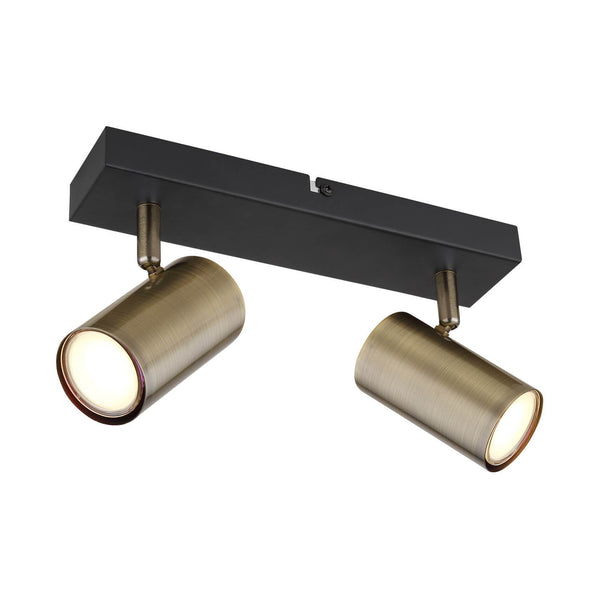
| Tomares black and brass spotlight | Steel and aluminium | IP20 | LED | 3 W | L 10 cm / D 58 cm | Kitchen, hallway, living room, entrance, dressing room |
| Kalkanessa LED spotlight | Aluminium and plastic | IP44 | GU10 | 7.5 W max per bulb | H 8 cm / Ø 7.9 cm | Bathroom |
| Robby LED spotlight | Brass | IP20 | GU10 | 35 W max | L 6 cm / D 26 cm / H 12 cm | Kitchen, hallway, living room, entrance, dressing room |
What is the quality of brass like?
Brass is a dense alloy that keeps its shine and takes a matt or polished finish. In this selection, it dresses a surface-mounted spotlight; on other models, aluminium, steel or plastic carry the structure and the gold finish provides the visual match. It needs gentle care, without abrasives.
Brushed brass spotlight or gold brass spotlights: which finish to choose?
Brushed finishes reflect a matt light that shows few fingerprints. Gold reflects more and stands out on the ceiling, which suits a bright room and is less noticeable against a dark background. Metal spotlights bring these metal finishes together, to compare side by side depending on use.
Aged brass spotlights: what effect in a room?
The aged finish takes on a darker, matt patina that suits interiors with character and coloured walls. It pairs well with matt black, as on the Tomares black and brass spotlight, 58 cm long, in warm white around 2700 to 3500 K.
How many spotlights in a kitchen?
There is no single number: it all depends on the floor area, ceiling height, colours and the zones to be lit. Spread the points to avoid shadows on the worktop, then complete the circulation areas. Socket type and wattage then guide the choice, without trying to light everything with a single fitting.
Should the worktop be lit in addition to the ceiling spotlights?
Yes, in most cases. A ceiling spotlight placed behind you casts your shadow onto the worktop. Two or three points aimed at the worktop solve the problem. That is the role of adjustable spotlights, whose beam can be directed without touching the rest of the room.
Which light colour to choose for kitchen spotlights?
Warm white, around 2700 to 3000 K, remains the usual reference for a home kitchen: it does not make food look blue and stays pleasant in the evening. A more neutral white, around 3500 K, works if you cook a lot and want clear visibility. For adjustable lighting, look at the dimmer-compatible models.
How to lay out spotlights on the ceiling?
Spotlights are laid out along the lines of circulation or in regular rows, avoiding placing them too close to the walls and aiming them at useful areas. Spacing is set according to ceiling height and beam angle. For a hallway, a simple alignment is enough; for a living room, it is better to cross the points.
What spacing between ceiling spotlights?
Generally, points are spaced about one to one and a half metres apart for a standard ceiling height, tightened under a worktop. Below two metres forty, the spacing narrows; above three metres, it widens to avoid overly tight pools of light. The rule remains the use of the room, not the tape measure alone.
How to place spotlights in a hallway?
Align them along the axis of the passage, never across its width. A narrow hallway takes a single row; beyond one and a half metres wide, two balanced rows give a better result. Hallway spotlights cover this type of installation, including recessed versions.
What are the different types of spotlight?
A spotlight can be recessed into the ceiling or surface-mounted, fixed or adjustable, with one or more heads. It is also defined by its socket, GU10 or LED module, and by its IP rating, which determines the rooms it can go in. Three families meet here: the adjustable IP44 recessed model, the two-head surface-mounted one and the black and brass one.
Recessed or surface-mounted spotlight: which to choose?
A recessed spotlight disappears into the ceiling and suits rooms where the fitting should be hidden, provided there is space above. A surface-mounted one fixes to a solid ceiling, with no cut-out, and can therefore also be fitted to a concrete support or a slab with no void. The Robby two-head adjustable surface-mounted spotlight falls into this second case.
What is the difference between a fixed and an adjustable spotlight?
A fixed one lights straight below it and suits circulation areas. An adjustable one turns towards a wall, a shelf or a worktop, which allows the distribution to be corrected after installation. The Kalkanessa round IP44 adjustable recessed spotlight can be adjusted in this way in a bathroom.
| Criterion | What to check | Why it matters |
|---|---|---|
| IP rating | IP20 in dry rooms, IP44 in the bathroom | Avoid moisture in wet rooms |
| Socket | GU10 or LED module | Make bulb replacement easier |
| Wattage | 3 W, 7.5 W max per bulb or 35 W max depending on the model | Match the intensity to the room |
| Direction | Fixed or adjustable, one or two heads | Target a worktop or a hallway |
| Dimmer | Compatibility stated on some models | Adjust the light to suit the moment |
| Dimensions | Length, depth, height or diameter | Check the footprint before installation |
How to wire spotlights in series or in parallel?
The connection depends on the type of power supply and the spotlights. GU10 spotlights on mains power are generally wired in parallel, so that each stays independent; some LED modules run through a driver. Identifying the wires and switching off the power remain essential, and if in doubt an electrician should approve the diagram before switching on.
Do brass LED spotlights need a transformer?
Not systematically. A GU10 bulb connects directly to the mains and needs no transformer; an LED module, on the other hand, may require a driver suited to its voltage. The question is therefore settled model by model, by reading the label on the fitting rather than relying on its outward appearance alone.
Can a dimmer be installed on brass spotlights?
Only if the fitting and the dimmer are compatible, which is not the case for all of them. In this selection, dimmer compatibility is stated on one recessed model. Dimmable LED spotlights bring together the references designed for this setup.
Which LED spotlight wattage to choose to light my living room?
Wattage is chosen according to use and floor area, not only in watts. In this collection, there is a 3 W LED module, a spotlight that takes a maximum of 7.5 W per bulb and another up to 35 W maximum. Check the socket, the direction and dimmer compatibility before deciding, then multiply the points rather than the wattage.
How many spotlights are needed for a 40 m2 room?
For a room of this size, think in zones: a few points above the sofa, a few along the circulation areas, some accent lighting near a piece of furniture. A high ceiling requires more points than a low one. LED spotlights for the living room show the formats suited to this type of room.
Is 1000 lumens enough to light well?
It depends on the surface, the height and the colour of the walls. Around 1000 lumens suits a reading spot or an area of a few square metres, not lighting a whole large room on its own. For a large volume, several less powerful sources are better than a single very powerful one.
What is the average lifespan of an LED spotlight?
It varies with the quality of the module, the ventilation around the fitting and the time it is switched on. A correctly designed LED spotlight generally lasts longer than a conventional bulb, but its power electronics count as much as the LED itself. A model with a GU10 bulb simply needs a bulb change when the time comes.
Which colours go with a brushed brass light?
Brushed brass goes with black, white and gold tones. A black and brass spotlight creates contrast, while a white or gold model is more discreet. In the same room, finishes can be mixed if the material and style stay consistent, for example around a worktop or an entrance.
Can gold and black spotlights be mixed in the same room?
Yes, provided the same family of shapes and materials is kept. A black body with a gold ring acts as a bridge between the two. Black adjustable spotlights and White spotlights offer two starting points for this kind of match.
Brass spotlight and white ceiling: what effect?
The warm metal stands out clearly against a white ceiling, which highlights the line of the fitting. It is a readable choice that requires careful alignment, since the slightest offset shows. Against a dark ceiling, the same spotlight blends in more and becomes more discreet.
Is brass a good material for outdoor lights?
Brass is durable and resistant to wear, but our brass spotlights are intended for indoor use: IP20 for dry rooms and IP44 for the bathroom. For outdoors, you need a fitting specifically designed for moisture and bad weather, which this selection does not offer.
What are the drawbacks of LED lamps?
An LED often costs more to buy, is sensitive to poorly dissipated heat and depends on the quality of its power supply. Its light is more directional than a filament bulb, which requires several points to cover a room well. In return, it uses little power and lasts a long time when the fitting is suited to it.
How to care for a brass spotlight?
A soft cloth is enough to dust the surface. Avoid abrasives, scouring pads and acidic products, which scratch the brushed finish or remove the patina of aged brass. For the bedroom as well as the living room, switch off the power before handling a fitting.
Looking for a brass chandelier rather than a spotlight?
This page presents brass spotlights to be mounted on or surface-mounted to the ceiling, not chandeliers. If you are looking for a brass chandelier or a brushed brass light for the centre of a room, explore the all Designix lights collection: you will find other shapes and other uses there, without mixing the two families of lighting.
For a hallway or an entrance, a row of contemporary range spotlights remains simpler than a central fitting. For a living room, recessed spotlights for the living room and the black LED version combine well with accent lighting.
Frequently asked questions
How to wire spotlights in series or in parallel?
The wiring depends on the power supply and the fitting. GU10 spotlights on mains power are most often wired in parallel, so they work independently; an LED module may require a driver. Switch off the power, identify live, neutral and earth, then have the diagram approved by an electrician.
What is the quality of brass like?
Brass is a solid alloy that takes a brushed, gold or aged finish and keeps a warm look. It needs gentle care, without abrasives. In this selection, it is used on a surface-mounted spotlight and combined with steel or aluminium on other models.
What are the drawbacks of LED lamps?
An LED often costs more to buy and is sensitive to heat as well as to the quality of its driver. Its light is more directional, which requires several points to light a room. It uses little power and lasts a long time as long as the fitting dissipates heat properly.
What is the average lifespan of an LED spotlight?
It varies with the quality of the module, the ventilation and the time it is switched on. A well-designed LED spotlight generally lasts longer than a conventional bulb, but the lifespan also depends on the power supply. In this collection, one model is LED and others use a GU10 bulb, which can be replaced.
Is brass a good material for outdoor lights?
Brass resists wear well, but the spotlights in this collection are intended for indoor use. They are rated IP20 for dry rooms and IP44 for the bathroom. For outdoors, choose a fitting designed for bad weather, with a suitable IP rating, which is not part of this selection.
Every reference in the selection is covered by a two-year warranty. Secure payment, tracked delivery, returns and Designix customer service support you from choice to installation.
One last point before ordering: note your ceiling height and the room to be fitted, then compare the actual dimensions of the models. Browse the lighting catalogue and its spotlights with refined design to find the format that matches the area to be lit.




