White spot
- Tracked delivery to your country Tracked delivery
- Secure payment at checkout Multiple payment methods
- 14 days to change your mind 14-day returns
- Secure payment Secure payment


Not sure of your style? Find it in 30 seconds
A few questions, and we will show you the pieces made for you.












Frequently asked questions
How do I choose the right light output?
At what height should the light be installed?
What type of bulb?
Compatible with LEDs and dimmers?
Light changes everything
From statement chandeliers to discreet wall lights, we help you choose the right brightness, height and style for every room.
- Tracked delivery
- Pay in instalments, where available
- 14 days to change your mind
- Advice & showroom in Lyon, France
Start with the colour temperature, then the housing colour: a white spotlight at 3000 K lights a living room or hallway without harshness, while 4000 K works better above a worktop. The white body, matt or satin, is chosen according to the surface it is fixed to.
What effect does a white spotlight have in a room?
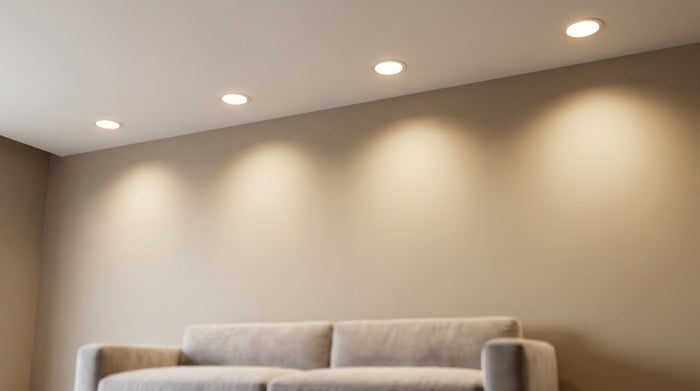
Switched off, it disappears into a white ceiling and leaves the volume intact; switched on, it draws a sharp pool of light rather than a diffuse halo. The number of points matters more than their power: too many spotlights and the ceiling becomes covered in bright patches. A matt white absorbs a little light, a lacquered white reflects it and shows fingerprints more.
When the ceiling is dark or when the light point is meant to stand out, black spotlights provide contrast. To stay discreet on a white painted ceiling, the selection of white spotlights is the most consistent choice.
How do you choose a white spotlight for each room?
Start with the use: in a living room, you want a warm ambient light and few points; in a kitchen, a crisp light that renders colours true; in a bathroom or outdoors, a high protection rating. The room decides the colour temperature, the IP rating and the number of points.
In a living room
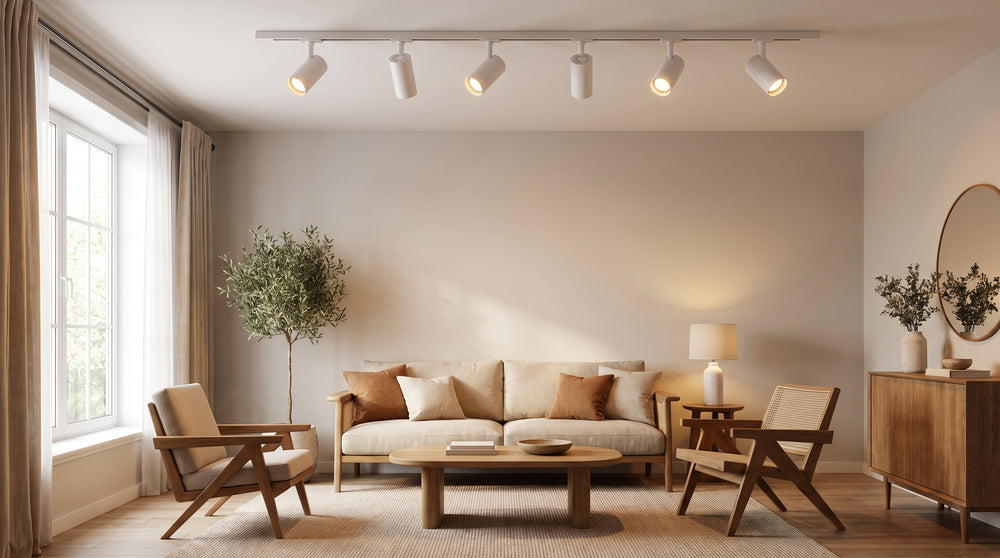
Plan for few points and stay around 2700 to 3000 K. Adjustable spotlights that graze a wall or a bookshelf give more depth than a ceiling pierced from end to end. The living room spotlight selection brings together models designed for this atmosphere.
In a kitchen
The worktop calls for 3000 to 4000 K and a spotlight body that does not cast a shadow on the chopping area. An adjustable model set back from the edge lights the worktop without dazzling the person cooking. Suitable fixings are detailed in kitchen spotlight.
In a bathroom or outdoors
Under the shower, allow at least IP44 and a position out of reach of direct splashes. The bathroom spotlight models meet this humidity requirement. Outdoors, IP65 stands up to rain: browse the outdoor spotlight selection for facades and terraces.
Recessed, adjustable or on track: which fixing should you choose?
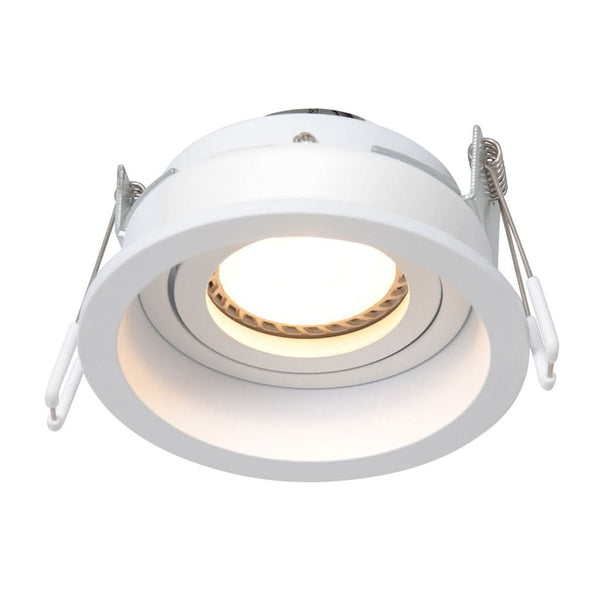
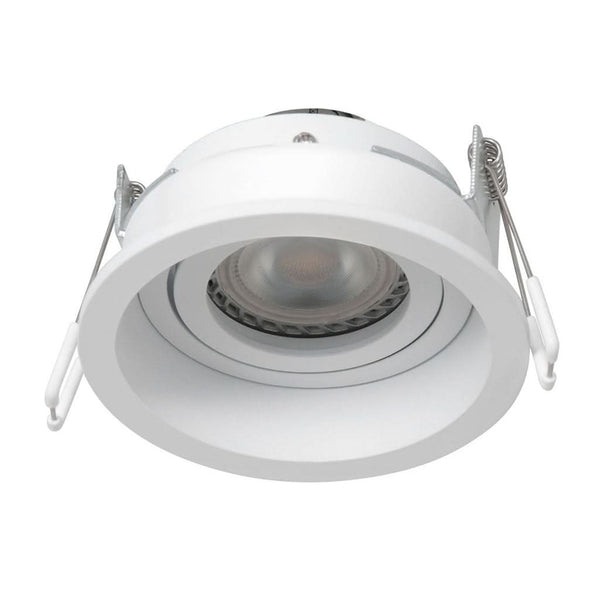
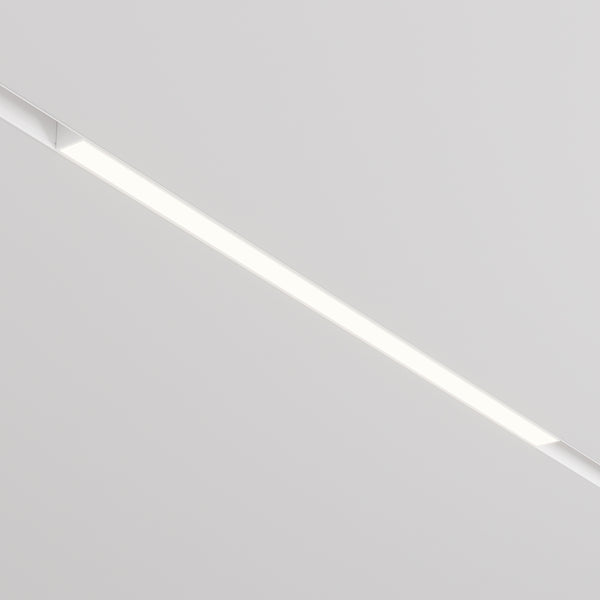
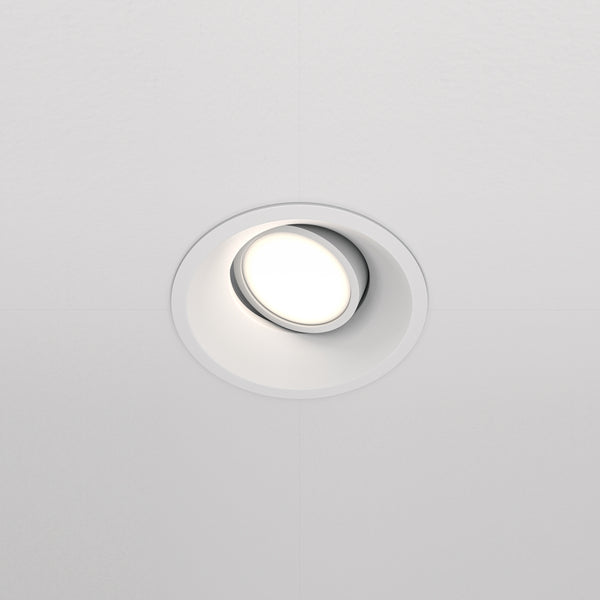
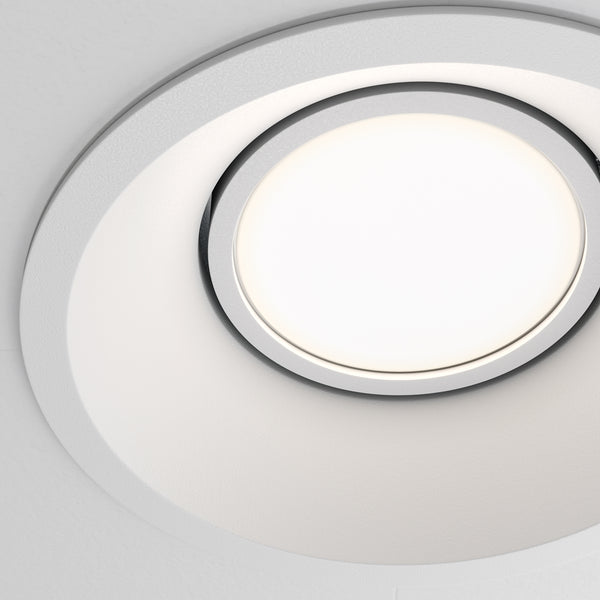
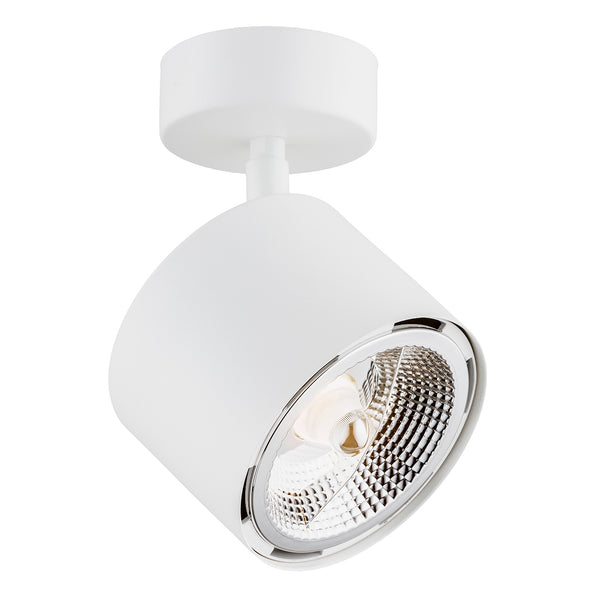
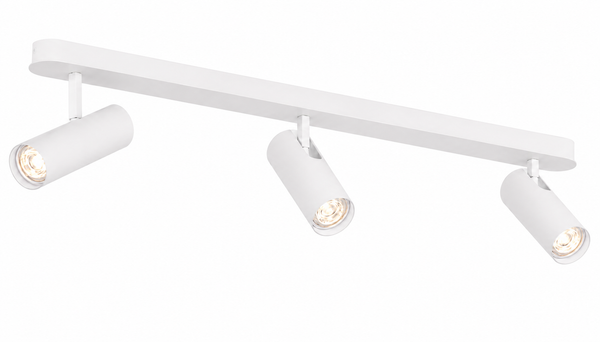
A recessed spotlight fits into a suspended ceiling or a plasterboard panel and almost disappears once switched off. An adjustable one adds a swivel joint that lets you aim it at a wall or a worktop. A track gathers several points on a single line, which helps when the ceiling cannot be drilled everywhere.
| Fixing | Where it suits | What it requires |
|---|---|---|
| Recessed | Suspended ceiling, solid ceiling | A cut-out and a recess depth to check |
| Recessed adjustable | Living room, kitchen, hallway | The same cut-out, with a tilt to set |
| On track | Concrete ceiling, workshop, shop | A track to fix and then power |
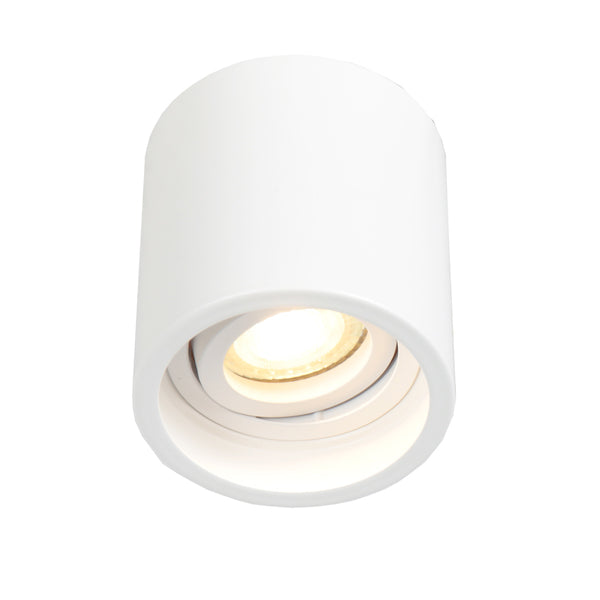
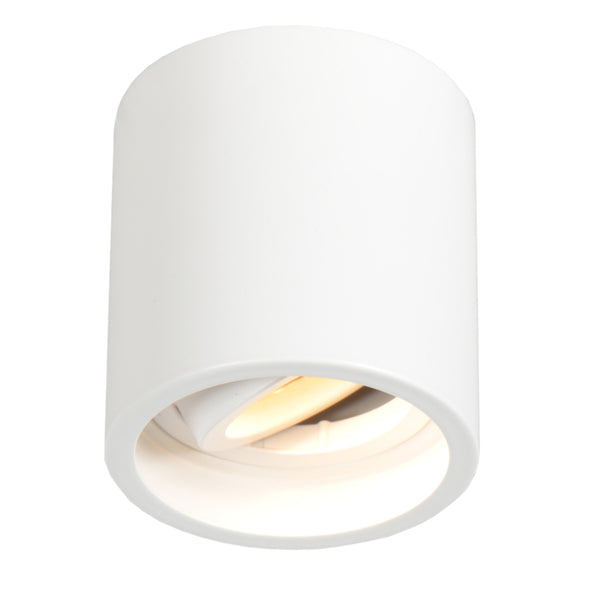
| Surface-mounted | Renovation, ceiling with no recess | The unit remains visible on the ceiling |
| Under-cabinet | Kitchen, office | A power supply close to the worktop |
| Wall light or wall projector | Hallway, facade, terrace | A cable run along the wall |
For a quick renovation, the recessed spotlight remains the most understated solution. If you need to light a wall or an artwork without drilling a series of holes, look instead at the adjustable spotlight or the spotlight track.
Which light and base for a white spotlight?
Aim for 3000 K in living areas and 4000 K in work areas, then check the base: a GU10 can be replaced without tools, while an integrated LED module is changed with the whole fitting. The protection rating is chosen according to the actual humidity of the room.
Reading kelvins
2700 K gives a warm white close to a filament bulb, 3000 K stays warm but crisper, 4000 K leans neutral. The same white spotlight therefore lights very differently depending on the source fitted inside. The LED spotlight family gathers models with an integrated source.
Choosing the base
The GU10 spotlight takes pin-base bulbs that are replaced one by one, without removing the fitting. An E27 socket remains useful for reusing existing bulbs. An integrated module avoids this step, at the cost of a complete replacement at end of life.
| Room | Recommended temperature | Protection rating | Mounting height |
|---|---|---|---|
| Living room | 2700 to 3000 K | IP20 | Ceiling, about 2.50 m |
| Kitchen | 3000 to 4000 K | IP20 | Ceiling or under-cabinet |
| Bathroom | 3000 to 4000 K | IP44 minimum | Above 2.25 m |
| Hallway and corridor | 3000 K | IP20 | Ceiling, evenly spaced |
| Covered terrace | 3000 to 4000 K | IP44 | Under an awning |
| Exposed facade | 3000 to 4000 K | IP65 | Aimed downwards |
LED or halogen white spotlight: what does the source change?
An LED module heats less than a halogen bulb, which matters in a poorly ventilated suspended ceiling and behind insulating wool. It also fixes the colour temperature once and for all: it can no longer be corrected by changing the bulb, a point to settle before buying.
On a renovation, the question of LED for a recessed spotlight comes up before the cut-out. A flat module fits where a base block will not. Models with no visible source are gathered in recessed LED spotlight, to compare with the version with a replaceable bulb.
How do you match a white spotlight with the rest of the decor?
A white spotlight blends naturally with a white ceiling, a pale wall or light wood, and stands out much more on a dark ceiling. Brass, black or dark wood require either an echo elsewhere in the room, or a matt white model to stay in the background.
If the room already has pendant lights or wall lights, make the sources talk to each other: a search for terms like "spot leroy merlin" or "leroymerlin spot" leads to the same criteria, only the references change. The overall effect benefits from staying within a single family of shapes, which the modern spotlights selection offers. For a bolder choice, designer spotlights make a feature of the fitting's shape. If you want to lower the intensity in the evening, dimmable spotlights avoid lighting at full power. The full catalogue is in our light fittings.
Before confirming a model, note three things: the cut-out to make, the depth available behind the ceiling and the base. The rest, the finish and the direction, is chosen by eye. Find the whole family on our spotlight collection.
How do you install and maintain a white spotlight?
Switch off the circuit at the breaker, locate the joists before drilling and space the points about 1 to 1.5 m apart to avoid dark areas between two pools of light. A dry microfibre cloth is then enough for routine care, with no abrasive product on a satin white.
Drilling and wiring
The cut-out is made with the supplied template, never by eye, and the recess depth is measured before the first hole. On a metal fitting, earthing must be provided for. A suspended ceiling closes around the spotlight, while a solid ceiling requires checking the thickness.
Cleaning without yellowing
White yellows mainly with accumulated heat and kitchen grease. Regular dusting limits the effect and keeps the trim crisp. Avoid alcohol and abrasive sponges, which permanently dull lacquered finishes.
Which mistakes should you avoid with white spotlights?
Three mistakes come up again and again: multiplying the points on a small ceiling, mixing two colour temperatures in the same room, and forgetting the protection rating in a bathroom. None can be properly corrected after the cut-out, hence the value of settling the plan before buying.
- Choosing the power before the colour temperature.
- Installing an IP20 above a shower.
- Mixing 3000 K and 6000 K on the same ceiling.
- Drilling without having measured the available depth.
- Placing a white spotlight against a dark ceiling without intending the contrast.
Our product pages state the cut-out, the base and the IP rating of each model. Payment is secure online, shipping is tracked and returns remain open if the shade does not match the room. Our Designix customer service answers dimension questions before ordering. Compare finishes in white recessed spotlights and the swivel versions in white adjustable spotlights.
Frequently asked questions about white spotlights
Which colour temperature should you choose for a white spotlight?
Generally 3000 K for a living room, hallway or bedroom, and 4000 K for a kitchen, workshop or garage. 2700 K suits rest areas lit in the evening. What matters is consistency: a single temperature per room, otherwise the whites stand out more than the fitting.
How many white spotlights are needed on a room's ceiling?
Allow a spacing of about 1 to 1.5 m between two points for even light, starting from the edges rather than the centre. A small room often needs only two or three points. Too many spotlights create patches and clutter the ceiling more than they light it.
Is a white spotlight suitable for a bathroom?
Yes, provided the protection rating is respected. IP44 is enough outside splash zones, IP65 is safer close to the shower. Keep the fitting away from direct jets too. The bathroom spotlight selection gathers models designed for these damp rooms.
Should a white spotlight be recessed or surface-mounted?
Recessed requires a suspended ceiling or a recess depth, and gives the most understated look. The surface-mounted version fixes to a solid ceiling, in concrete or for renovation, but remains visible. The choice therefore depends mainly on the surface, not the style.
Are white spotlights compatible with a dimmer?
Only if the fitting and the source are stated as dimmable. An LED bulb not designed for it buzzes or flickers at the bottom of the range. Check the dimmer's compatibility with the LED load, often stated in the instructions. Otherwise, a simple switch and a suitable power source are better.