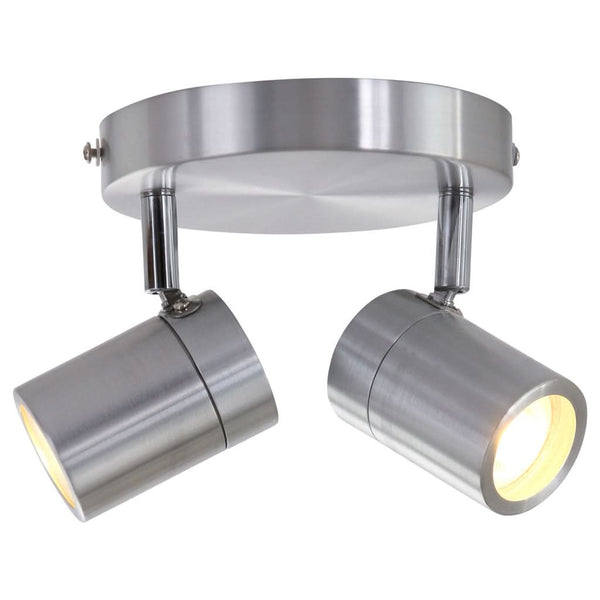
Double spotlight
- Tracked delivery to your country Tracked delivery
- Secure payment at checkout Multiple payment methods
- 14 days to change your mind 14-day returns
- Secure payment Secure payment


Not sure of your style? Find it in 30 seconds
A few questions, and we will show you the pieces made for you.








Frequently asked questions
How do I choose the right light output?
At what height should the light be installed?
What type of bulb?
Compatible with LEDs and dimmers?
Light changes everything
From statement chandeliers to discreet wall lights, we help you choose the right brightness, height and style for every room.
- Tracked delivery
- Pay in instalments, where available
- 14 days to change your mind
- Advice & showroom in Lyon, France
The double spotlight combines two adjustable light sources on a single base, mounted on the ceiling, surface-mounted or on the wall, to light two nearby areas from one point. First choose the mounting and socket, then the finish and IP rating according to the room to be equipped.
- What is a double spotlight and where to install it?
- What are the different types of double spotlights?
- How to lay out ceiling spotlights?
- Ceiling spotlight layout for the living room
- Kitchen, hallway or bathroom: which IP rating?
- Which socket and which bulb?
- How to install and wire a double spotlight?
- How to choose according to the room and style?
What is a double spotlight and where to install it?
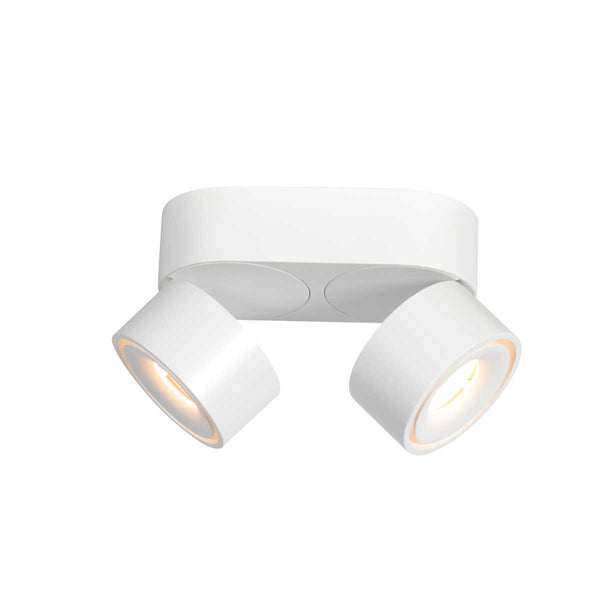
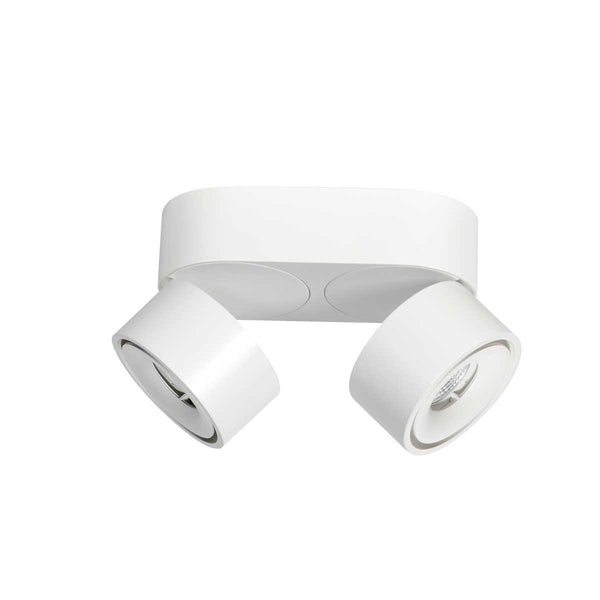
A double spotlight combines two light sources on a single base, on the ceiling, surface-mounted or on the wall, each adjustable in the desired direction. It is used to light two nearby areas: two sections of a hallway, a worktop and its surroundings, or both sides of a bed.
Adjustable double spotlight: do both heads move?
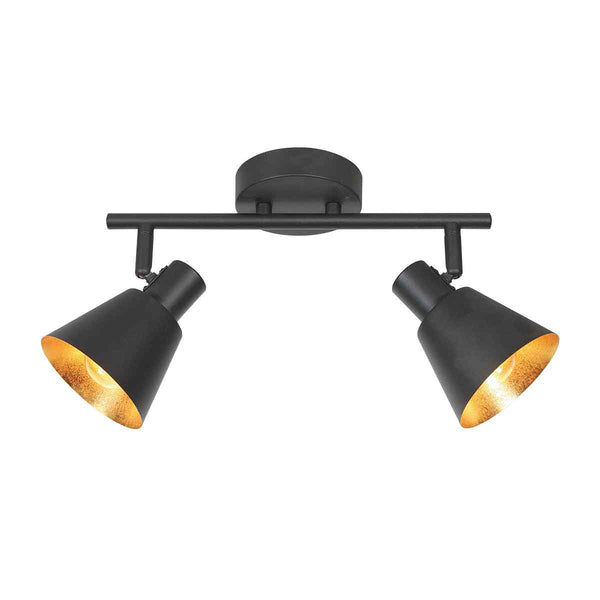
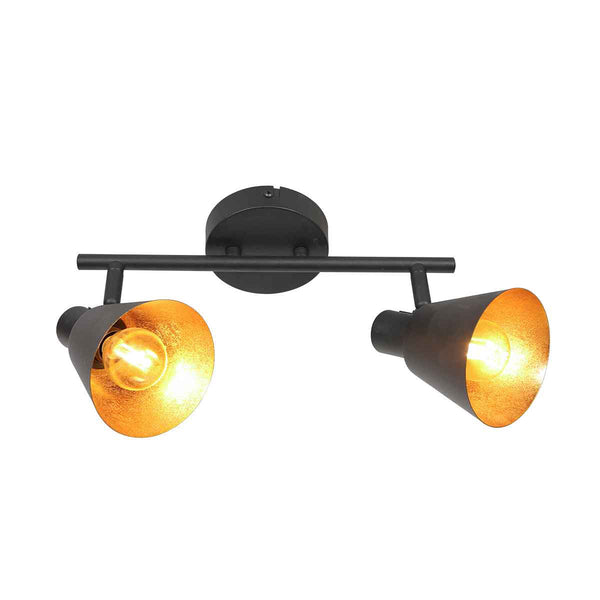
The two heads pivot separately, which allows aiming at two distinct points without drilling a second time. In this selection, the hallway is the room that appears most often, ahead of the living room and the kitchen. Metal is present on all references, often combined with plastic for the base plate. The two-light gold spotlight on a black base plate clearly shows the logic: two beams, one single mounting.
Ceiling or wall double spotlight: which mounting to choose?
On the ceiling, the two beams point downwards and cover an area on the floor. On the wall, the double wall light projects light sideways or upwards, which suits an entrance or a narrow hallway better. The adjustable models keep the advantage in both cases: the angle is set after installation, once the furniture or worktop is in place.
What are the different types of double spotlights?
There is the recessed double spotlight, which sits flush with the ceiling, the surface-mounted or ceiling double spotlight, visible under the ceiling, and the wall-mounted double spotlight. The selection also varies by socket, GU10, E27, E14 or integrated LED, and by finish.
Recessed or surface-mounted double spotlight?
The recessed one disappears into the ceiling: nothing protrudes, only the light is visible. This is the choice of recessed spotlights when the ceiling is accessible and a clean result is wanted. The recessed one stays flush, which makes it practical above a worktop. The model recessed spotlight for a worktop gives an example in black metal.
Black or white double spotlight: what effect in the room?
Black dominates largely in this selection and blends into a dark ceiling or a raw wall. The white versions fade into a light ceiling. Silver and gold, rarer, serve as a deliberate decorative detail. For a more discreet result, also look at the matte black finishes.
How to lay out ceiling spotlights?
Start from uses before drawing: each beam is placed above what it lights, worktop, table or entrance, then the points align on the same grid, at equal distance from the walls and from each other. A slight downward tilt avoids glare when walking past.
Ceiling spotlight layout: marking out before drilling
First locate the final furniture, then mark on the floor the plumb line of each head with a light mark. Laying out means checking this alignment before drilling, not after. Regular spacing and an equal margin from the walls give a calmer reading than a randomly calculated distribution.
What distance between two ceiling spotlights?
There is no single measurement: it depends on the ceiling height and the beam width. In general, keep a regular distance between the points and avoid placing a spotlight right against a wall, except for accent lighting. Recessing several points side by side then becomes simpler, as with the recessed LED spotlight.
Ceiling spotlight layout for the living room: how to light without glare?
In a living room, it is better to light the usage areas than the centre of the room: sofa, reading corner, TV unit. Two heads aimed at the walls or at a picture give indirect light, while a beam directed at the coffee table stays discreet from the seat.
Modern living room ceiling spotlight: which light to choose?
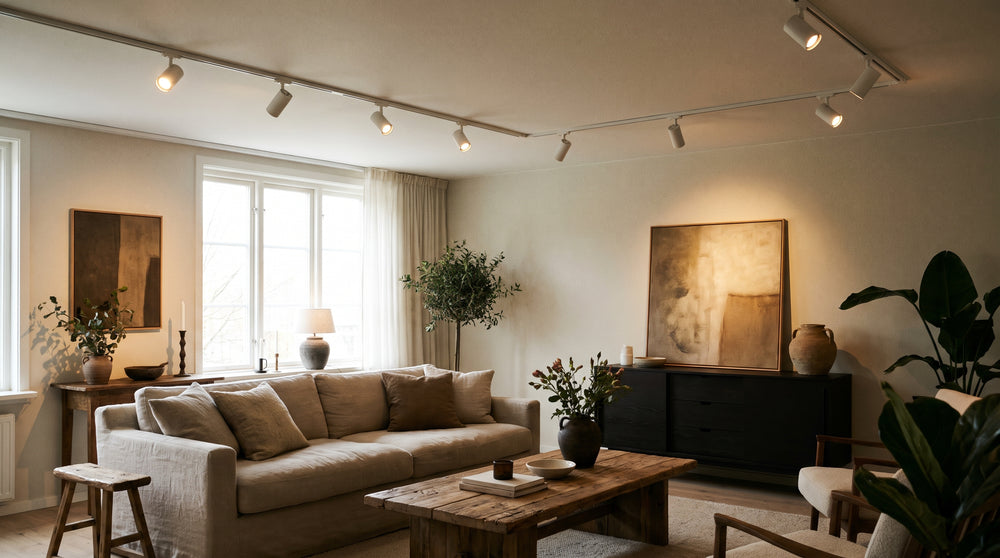
Colour temperature matters more than power: a warm white, around 2700 to 3500 K, sets a restful mood in the evening. The warm white references in the selection are mostly integrated LED modules. To multiply light points, spotlight tracks complement a fixed double spotlight well.
Should both heads point at the wall or at the floor?
Towards the wall, the light bounces back and lights the room without glare: this is the setting to keep above a seat. Towards the floor, the beam draws a sharp patch, useful on a table or a walkway. The black and gold double tube spotlight takes two E14 small globe bulbs, which leaves the choice of effect.
Double spotlight for kitchen, hallway or bathroom: which IP rating?
It all depends on the room: IP20 for a hallway, a kitchen or a living room, IP44 for a damp room such as a bathroom. In the selection, the IP44 double spotlights are precisely those intended for the bathroom, with two adjustable cylindrical heads.
| Room or use | IP rating | Sockets present | Point of vigilance |
|---|---|---|---|
| Hallway, entrance | IP20 | GU10, E27, E14, integrated LED | Aim both heads along the walkway, never towards the eyes |
| Kitchen | IP20 | GU10, integrated LED | Direct the beams towards the worktop |
| Living room | IP20 | E27, E14, integrated LED | Prefer indirect light towards the walls |
| Bedroom, office | IP20 | E27, integrated LED | Avoid a frontal beam above the bed or the screen |
| Bathroom | IP44 | GU10, integrated LED | Two adjustable cylindrical heads |
| Outdoor | Outside selection | See the dedicated collection | Check the IP rating of the luminaire before purchase |
Outdoor double spotlight: what to check before choosing
Outdoors, the question is not the number of heads but the resistance of the luminaire to water and dust. An IP44 targets water splashes in a damp room; for a facade, a terrace or a garden, a luminaire designed for outdoors is needed. The outdoor spotlights meet this use, and bathroom lighting remains the right path for an indoor wet room.
Why choose an IP44 double spotlight rather than an IP20?
An IP20 fears humidity and condensation; an IP44 withstands splashes. Above a washbasin or in a shower, this difference decides how the luminaire holds up over time. The IP44 double spotlight with two cylindrical heads offers two adjustable heads and warm white light. For bulb models from the same family, go through the GU10 bulbs.
Which socket and which bulb for a double spotlight?
The selection covers four solutions: GU10, E27, E14 and integrated LED. GU10 is the most common socket, E27 takes a wider bulb, E14 suits small globes, and integrated LED models work as a single unit, with no bulb to change.
| Socket | Bulb type | What it changes | Models in the selection |
|---|---|---|---|
| GU10 | Pins, often LED | Directional beam, simple replacement | Spotia, Kalella, Olara, Orbia |
| E27 | Wide screw base | Wider bulb, diffuse or directed light | Velmore, Vallinilo |
| E14 | Small screw base | Small globes, decorative effect | Melisande, Oeroe |
| Integrated LED | Fixed module | No bulb to change, limited heat | Cavio, Neressa |
Do LED spotlights get hot?
Integrated LED models give off little heat: the heat stays in the module and does not spread into the room as with a filament bulb. A small share of the references accepts a dimmer, to be checked before purchase. On a spotlight with a socket, the heat depends on the bulb installed.
Can a classic bulb be replaced by an LED bulb in a spotlight?
Yes, provided the same socket is kept and the dimensions are compatible: a GU10 LED replaces a classic GU10, an E27 by an E27, an E14 by an E14. On models with an integrated module, no bulb is to be replaced. For a whole set in GU10 socket, LED spotlights simplify maintenance.
How to install and wire a double spotlight?
The double spotlight is fixed on its base plate or wall light, then connected to the mains, light point by light point. Wired in parallel, the spotlights remain independent: cutting one does not deprive the others of power, which simplifies troubleshooting as well as adding a model equipped with a dimmer.
Is it better to wire LED spotlights in series or in parallel?
Parallel is the standard in domestic lighting: each luminaire receives the same voltage and works on its own. In series, all go out as soon as one point fails. For a room with several points, a parallel connection is therefore better, including on adjustable LED spotlights.
Double spotlight and dimmer: how does it work?
Dimmer and luminaire must be compatible: a limited share of the references in the selection accepts dimming. The dimmable model is designed for this, in white, for a kitchen, hallway or entrance. If you dim a whole room, compare with the dimmer-compatible spotlights before making your choice.
How to choose your double spotlight according to the room and style?
First choose the mounting, recessed, surface-mounted or wall-mounted, then the socket according to the desired bulb, then the finish according to the surface: black on a raw wall or a dark ceiling, white on a light ceiling, silver or gold for a more decorative result.
Modern or industrial double spotlight: which style for which room?
Modern and contemporary style dominates the selection, with a few industrial, Nordic or zen pieces. A clean black metal frame suits a hallway or a contemporary living room; a model with rings and light wood softens a bedroom or an office. See the modern style spotlights and, for a living room, the living room spotlights.
Which finish for a hallway or an entrance?
In a walkway, the finish matters less than the direction of the beams: light the floor and the walls, not the faces. Black goes with everything and remains the most common shade here. The black LED spotlight with two adjustable heads and the surface-mounted spotlight with two silver adjustable heads both target a hallway or an entrance, one with an LED module, the other with E27.
Secure payment, tracked delivery, returns possible and Designix customer service: the selection is guaranteed for 2 years. To compare the luminaire families before deciding, browse all the luminaires and the spotlight range. Also find the kitchen spotlights and the design spotlights for the home.
Frequently asked questions
What is the difference between a spotlight and a floodlight?
A floodlight lights wide and far, often outdoors or in a large volume. A spotlight concentrates light on a nearby surface: worktop, wall, walkway. A double spotlight gives two close, adjustable beams, whereas a floodlight covers its area with a single, more powerful beam.
Do LED spotlights get hot?
Integrated LED models give off little heat: the heat stays in the module and does not spread into the room as with a filament bulb. On a spotlight with a GU10, E27 or E14 socket, the heat depends on the bulb installed and the ventilation of the luminaire.
Double wall light: how to choose it?
A double wall light lights two areas from a single point on the wall, upwards and downwards or sideways. It is chosen for an entrance, a hallway or on either side of a bed, checking the orientation of the heads, the material and the finish of the mount.
Can a double spotlight be installed outdoors?
Outdoors, the question is not the number of heads but the IP rating of the luminaire. The IP44 models in this selection target damp rooms such as the bathroom; for a facade, a terrace wall or a garden, turn to the collection dedicated to outdoor use.
Is it possible to replace a classic bulb with an LED bulb?
Yes, provided the same socket is kept and the dimensions are compatible: a GU10 LED replaces a classic GU10, an E27 by an E27, an E14 by an E14. On models with integrated LED, no bulb is to be replaced, the module is part of the luminaire.