Square spotlight
- Tracked delivery to your country Tracked delivery
- Secure payment at checkout Multiple payment methods
- 14 days to change your mind 14-day returns
- Secure payment Secure payment


Not sure of your style? Find it in 30 seconds
A few questions, and we will show you the pieces made for you.




Frequently asked questions
How do I choose the right product?
What are the delivery times?
Can I return an item?
Can I pay in instalments?
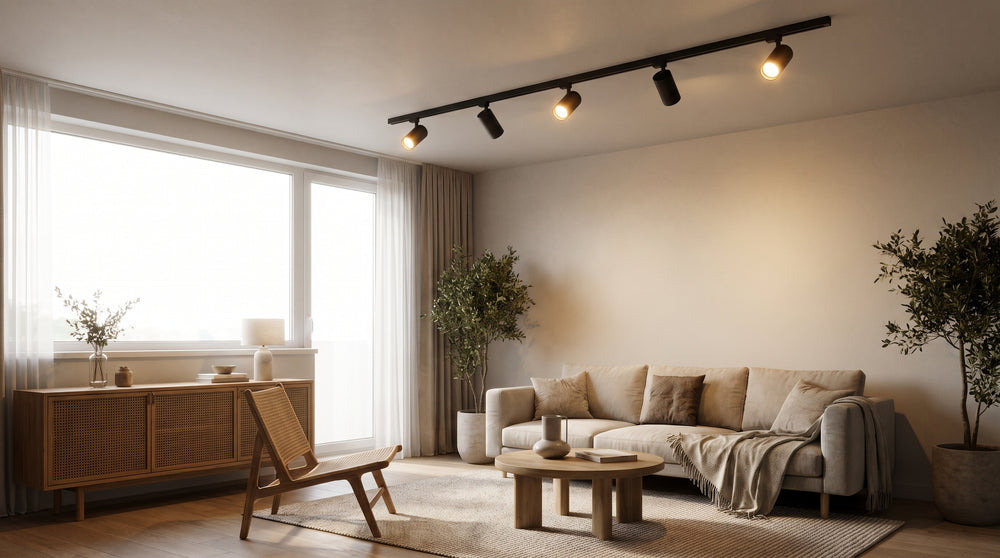
An interior that reflects who you are
Carefully selected pieces, shipped from our warehouses. Our team advises you before you buy, so you choose with confidence.
- Tracked delivery
- Pay in instalments, where available
- 14 days to change your mind
- Advice & showroom in Lyon, France
A square downlight is chosen first for its shape and size, then for its socket, GU10 in most cases and E27 for larger models, for its protection rating depending on the room, and for its colour, black or white. The layout is then planned on paper: regular lines on the ceiling, a constant gap between points, and a support checked before drilling.
- Choosing a square downlight
- Arranging the downlights
- Distance between downlights
- Layout planning
- Modern living room downlight
- GU10 or E27 socket
- IP65 or IP20
- Installation and maintenance
- Frequently asked questions
How do you choose a square downlight for your ceiling?
A square downlight is chosen first for its shape and size, then for its socket (GU10 in most of the selection, E27 for larger models), its protection rating depending on the room, and its colour, black or white, to blend into the ceiling.
The square draws a sharp line on the ceiling, where a round one is more discreet. This angular line stands out when the points are aligned, and fades when the gap between them is regular. Across our entire lighting range, square formats dominate and the materials are mainly aluminium and metal, two materials that hold their colour over time.
Black square downlight or white square downlight: which look on the ceiling?
Colour does not change the light, only the presence of the fixture. Black, the most common, marks a graphic point on a light ceiling and suits rooms with an industrial feel. White fades away and works when the ceiling should stay bare. Black downlights and white downlights combine without any problem in the same room if you keep the same range for the whole ceiling.
Fixed or adjustable downlight, how do you decide?
A fixed downlight lights straight below it: that is what you need for a regular line in a hallway or to wash a circulation area. An adjustable downlight turns towards a wall, a worktop or a painting, and then serves as accent lighting. The Pélite Carré adjustable downlight, in plastic and silver metal, H 7 cm, GU10 socket and IP20, meets this use. The adjustable downlight collection brings together other variants.
How do you arrange downlights on the ceiling?
Downlights are arranged in regular lines, parallel to the walls or to the axis of the room, keeping the same gap between each point. In a living room, the line follows the sofa or the axis of the table; in a hallway, it follows the length and lines up with the entrance door.
Arranging downlights on a living room ceiling
In a living room, the line of downlights follows the sofa or the axis of the coffee table, not the walls. Two parallel lines suit large rooms; a single line is enough when the room is narrow. If the light needs to dim in the evening, mounting on dimmable downlights avoids installing a second line. For living areas, the living room downlight selection groups the suitable formats.
Hallway and entrance ceiling downlight, the same logic?
Yes, with one extra constraint: the line must guide. The points are placed along the axis of the circulation, at a constant gap, and the last one lines up with the door. In a kitchen, the same logic applies but the points sit above the worktop rather than in the centre of the room; the kitchen downlights cover this case.
What distance should you keep between ceiling downlights?
The gap between two downlights depends on the ceiling height and the desired beam: the taller the room, the more the downlights are spaced out. The simplest reference remains a regular spacing, identical from one end to the other, keeping the points back from the walls to avoid light stuck to the surface. The beam matters as much as the height: a narrow-beam model requires a shorter gap than a wide-beam model.
A low ceiling calls for closely spaced points to avoid dark areas between two cones of light; a high ceiling supports wider gaps. Consistency matters more than the exact value: a gap that varies is immediately visible. If you hesitate between several options, first test with tape or a laser on the ceiling, before any drilling.
Ceiling downlight layout: how do you prepare your installation?
Layout planning means drawing the position of the downlights on the ceiling plan before drilling: you mark the lines of furniture, the position of the table or sofa, then distribute the points at a constant spacing. You then check that no duct or beam is in the way.
Layout planning room by room: living room, kitchen, hallway
In the living room, you start from the sofa and the table. In the kitchen, you start from the worktop and the sink, keeping the points above the work areas. In the hallway, you start from the axis and the door. The same grid can be repeated from one room to another if the volumes are similar, which gives a consistent ceiling seen from the entrance.
Checking ducts, beams and insulation before drilling
Before drilling, locate the existing electrical supplies and the position of the ducts, then check the nature of the support: solid slab, plenum or panelling do not call for the same fixing. If the ceiling cannot be drilled, two solutions exist: downlight rails, which are surface-mounted, or recessed downlights when the recess is possible. A recessed model is chosen first for the available recess: check the depth behind the slab and the drilling diameter before ordering, and prefer a narrow beam to avoid light spots. The double format, two downlights on a single plate, covers a wider area without multiplying the holes.
Modern living room ceiling downlight: which model to install?
For a modern living room, combine small square downlights, in aluminium and black or white, for a discreet line on the ceiling, and a square ceiling light with an E27 socket when you need to light a wider area. Contemporary and modern styles dominate the selection.
Slim square downlights: the Stark Spot in aluminium
At 8.4 cm per side, the Stark Spot black and its white version are the most discreet in the selection: aluminium, GU10 socket, IP65, 10 W. This size suits lines of downlights aligned on the ceiling as well as rooms where the fixture should almost disappear. The same format exists in a round version in the downlight collection.
Square ceiling light and pendant for a more dressed living room
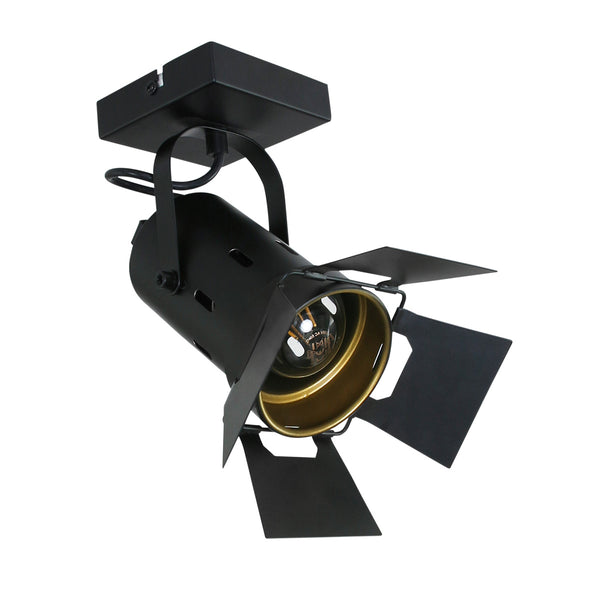
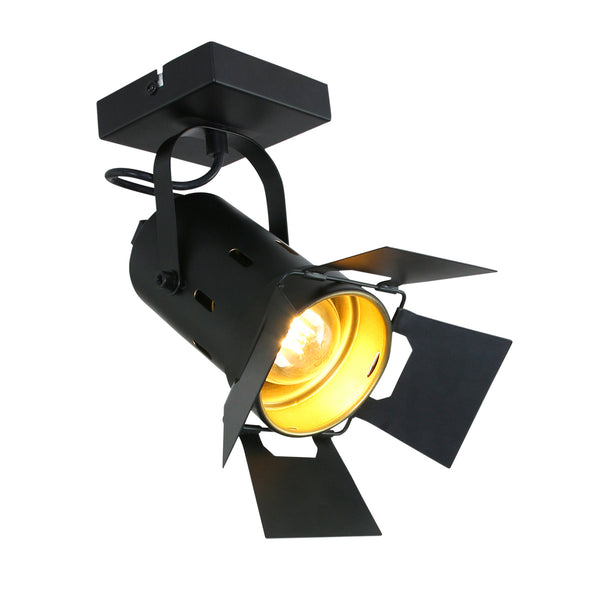
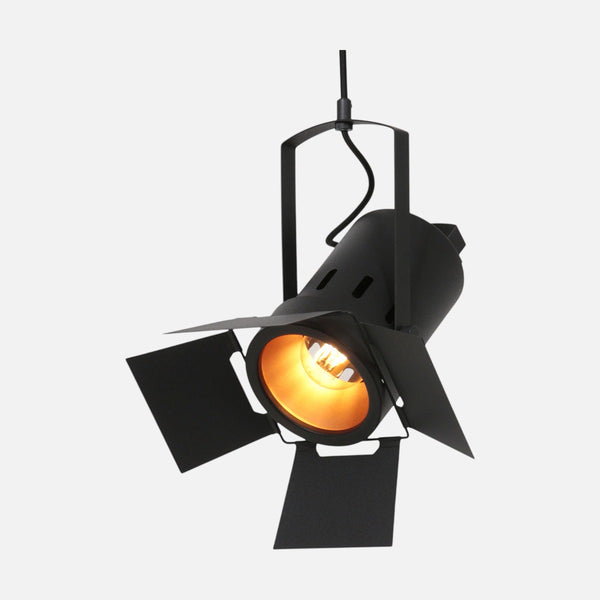
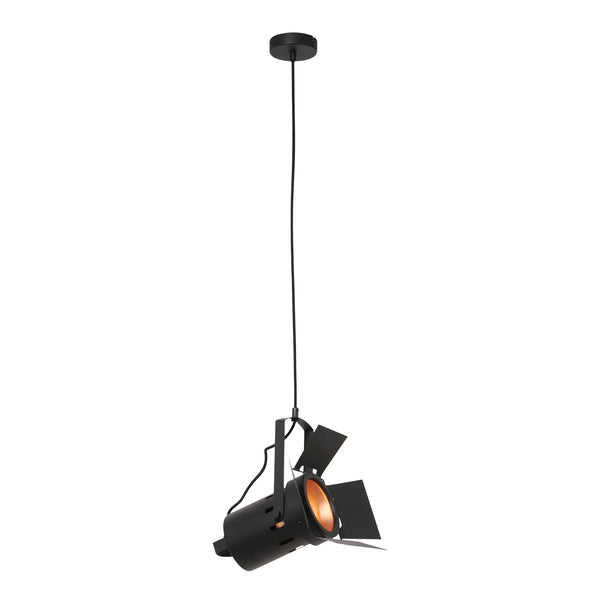
When the room calls for a wider light or a focal point, the black square ceiling light with golden interior takes over: E27 socket, 40 W, IP20, H 23 cm, in a modern and contemporary spirit. For a living room with a high ceiling, the Cinéa pendant, with an E27 socket, H 150 cm and warm white light, brings the same suspended volume with an industrial character. The modern style downlights complete the line.
GU10 or E27 socket: which to choose for a square downlight?
The GU10 socket is the most common in the selection: it equips the small square downlights with a plug-in bulb. The E27 socket concerns larger models, ceiling lights and pendants, with higher wattages (40 W against 10 W). The choice therefore depends on the format of the fixture, not on a preference.
| Socket | Bulb type | Rooms and use | Models in the collection | Wattage recorded |
|---|---|---|---|---|
| GU10 | Pin bulb, replaceable without tools | Living room, hallway, kitchen, damp rooms depending on the protection rating | Stark Spot white, Stark Spot black, Pélite Carré adjustable downlight | 10 W |
| E27 | Screw bulb, large format | Kitchen, hallway, living room, entrance, dining room | Black square ceiling light, Cinéa pendant | 40 W |
The GU10 is changed without tools, which simplifies the maintenance of a line of downlights. The E27 accepts more bulb models and is intended for fixtures that light a whole room. To go further, the selection of GU10 socket models details this format, and the LED downlight range shows the solutions with integrated source.
IP65 or IP20 downlight: which protection for each room?
The IP rating indicates resistance to dust and water. IP65 equips the square downlights in the selection intended for damp or exposed rooms, IP20 the dry interior models such as ceiling lights and pendants. In a bathroom or near a kitchen, it is better to aim for IP65.
| Protection rating | What it protects against | Recommended rooms | Models concerned |
|---|---|---|---|
| IP65 | Dust and water jets | Living room and hallway, rooms exposed to humidity | Stark Spot white, Stark Spot black |
| IP20 | Dust only, dry interior | Kitchen, hallway, living room, entrance, dining room | Pélite Carré adjustable downlight, black square ceiling light, Cinéa pendant |
Remember the simple rule: a room where water can be projected calls for a high rating, a dry room is fine with IP20. For wet rooms, the bathroom downlight selection helps filter the suitable models.
How do you install and maintain a square ceiling downlight?
Installation is done with the power off, after locating the electrical supplies and checking the support: GU10 socket models unplug to change the bulb, E27 models unscrew. Regular dusting of the fixture and the bulb is enough to keep the same look.
Ceiling installation: the points to check before drilling
Switch off the circuit at the breaker, locate the existing supplies, check the nature of the support and the available thickness. Reproduce the layout in pencil or with tape before the first hole. For a ceiling that cannot be drilled, the Designix lighting references include surface solutions and suspended formats.
Changing the bulb of a square downlight, socket by socket
On a GU10, the bulb unplugs with a quarter turn, without tools; on an E27, it unscrews. Wait for the fixture to cool, then dust the trim and the bulb: dust is the first cause of reduced output. LED solutions limit bulb changes.
Ordering from Designix: secure payment, tracked delivery, possible returns and customer service available to help you confirm a format or a socket before purchase. Browse the Designix lighting catalogue and choose the line of downlights that matches your ceiling, then check the gap between points before ordering the quantity.
Frequently asked questions about the square downlight
What is a square downlight?
A square downlight is a fixture to be installed on the ceiling or wall, whose body has an angular shape, with a GU10 or E27 socket depending on the format. It differs from the round downlight by its more graphic line, often chosen in black or white.
How do you arrange downlights on the ceiling?
Downlights are aligned in regular lines, parallel to the walls or to the main axis of the room, with the same gap between each point. In a living room, the line follows the sofa or the axis of the table; in a hallway, it follows the length up to the door.
What distance between ceiling downlights?
The gap depends on the ceiling height and the desired beam: the taller the room, the more the downlights are spaced out. The reliable reference remains a constant spacing from one point to the next, keeping the downlights back from the walls to avoid light stuck to the surface.
Can a square downlight be installed in a bathroom?
Yes, provided you choose a model suited to humidity: the IP65 rating equips some of the square downlights in the selection, while an IP20 model suits dry rooms. Check the protection rating of the fixture you are considering before purchase.
Is a black square downlight suitable for a light living room?
Yes: black is the most common colour in the selection. On a light ceiling, it draws a deliberate graphic line; if you prefer to make the fixture disappear, white blends in more. The choice is about the desired look, not a technical constraint.