Blown glass lighting: choosing the shape and the right tint
This article is also available in French: Luminaire verre soufflé
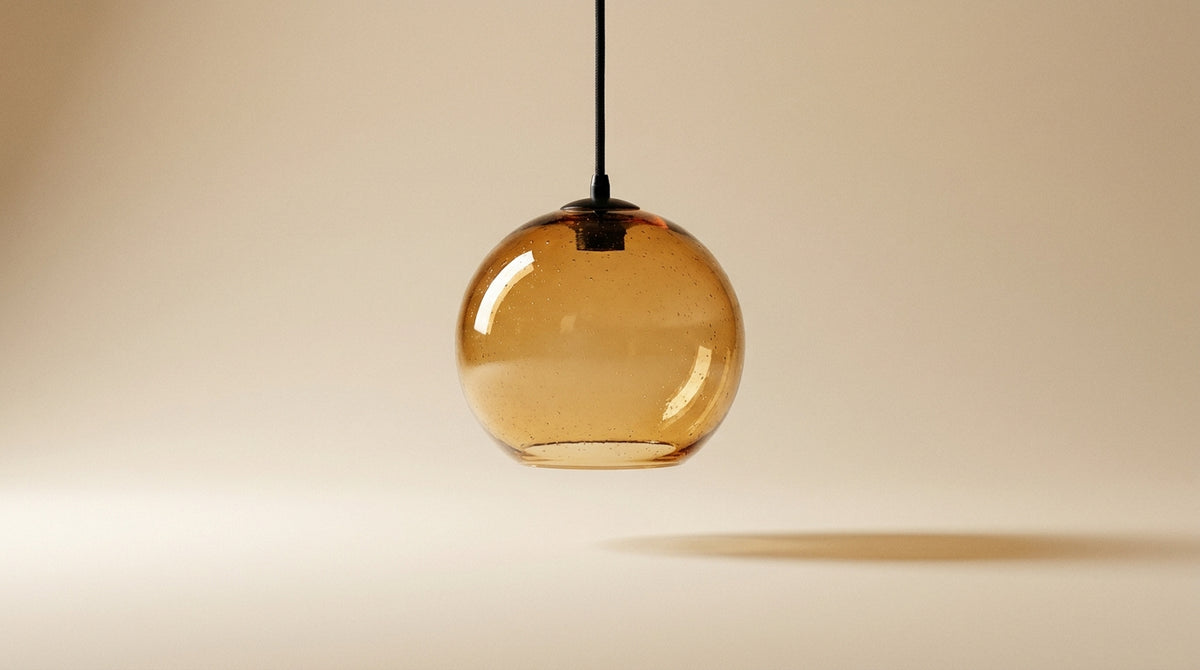
Choose the tint of the glass before the shape: it is the tint that decides the light the room receives. In a survey of 250 listings in our catalogue as of 5 November 2026, 38% carry the mention Glass and 28% the shape Ball. Start with the colour, then set the diameter and the hanging height.
What is a blown glass light, and what does it change in a room?
The glass is formed by mouth and then left to set without a closed mould. The wall stays slightly irregular and diffuses the light instead of projecting it. In the evening, the room receives a soft halo, with no harsh point, and the bulb stops appearing as a bare source.
That is the effect sought above a table: a disc of light rather than a spotlight. Our blown glass light is chosen first on this criterion, before the silhouette.
Blown glass or moulded glass: what the wall changes in the light
The difference is not visible in the photo, it is visible when lit. A blown wall varies by a few millimetres and softens the flow; a moulded, calibrated wall lets it through more directly.
| Criterion | Blown glass | Moulded glass |
|---|---|---|
| Wall | Irregular, variable thickness | Regular, calibrated |
| Light rendered | Diffuse, softened edges | Sharper, almost directional |
| Recognition | No seam, sometimes a bubble | Visible joint line, flat base |
| Natural use | Pendant above a table | Wall light, ceiling light, outdoor |
A visible bubble is not a defect
A micro-bubble trapped in the wall marks mouth blowing. It weakens nothing and is barely visible once the light is on. Hunting it as a fault means missing the finest pieces.
Blown glass pendant: which shape for which room?
The ball remains the safe choice: it lights at 360 degrees and forgives small rooms. An oval or a cylinder stretches the line above an island. Above a narrow table, a contained diameter keeps faces visible while keeping the effect.
Blown glass ball pendant: the format that goes anywhere
Round, it creates no angle and pairs as well with a raw wall as with a painted partition. It is the simplest shape to integrate into a through living room. Our selection of ball lights shows the available diameters and what each one changes at the scale of a room.
Coloured blown glass pendant: amber, smoked, blue
Smoked dims without switching off: it suits rooms that are already bright where the intensity is to be lowered in the evening. A smoked glass pendant darkens the glass but warms the halo.
Amber, for its part, tints the light itself: everything beneath it takes on a honey hue. Our guide to amber glass details the wood and colour pairings that hold with this warmth.
To compare mountings and product families, the lighting collection groups pendants, wall lights and ceiling lights in a single read.
Blown glass lights: balls, globes and tints to see lit
 Pendant light | Interlacia
 Pendant light | Nivara
 Pendant light | Ysandre
 Ceiling light | Bruna
 Living room floor lamp | Hyra
 Wall light | Sveva
See the whole selection: Alternative to Luminaire.fr: designer lighting shop | Designix
How to recognise real blown glass?
Three clues are enough: no mould seam, a wall thickness slightly uneven to the touch, and an opening polished by hand. A moulded glass shows a joint line and a perfectly flat base. Weigh the piece: blown glass is lighter than it looks.
The mould seam, the test that settles it
Run your fingertip around the light. A continuous ridge, over the whole height, betrays a two-part mould. Blown glass has none: the wall turns without a break, and the upper edge stays irregular to the eye.
Weight, regularity, opening: the three clues
- Weight: lighter than its size suggests, with no apparent leaden feel
- Regularity: slight waves in the reflection, never a perfectly smooth surface
- Opening: softened, non-cutting edge, often very slightly oval
- Finish: no trace of demoulding or joint plane
In a survey of 250 listings in our catalogue as of 5 November 2026, 38% carry the mention Glass: the material is common, blown craftsmanship much less so. Our article on glass lamps shows this variety of treatments.
At what height should a blown glass light be hung?
The usual rule places the bottom of the light 75 cm above a dining table top, a little higher above a kitchen island. In a corridor, allow 2.10 m from the floor to pass underneath without trouble. These markers shift if the piece is more than 40 cm tall.
Above a table: the right distance
Too high, the glass no longer lights the table and becomes a pale patch on the ceiling. Too low, it blocks the gaze. Measure between the bottom of the glass and the table top, not between the ceiling and the light. Our guide to choosing the dining room pendant details the long table cases.
In a corridor or hallway: the height that frees the passage
A narrow corridor copes poorly with a low light: the glass enters the field of vision and the passage feels tighter. Raise the fixing point or switch to the wall light. The corridor wall light collection solves corridors less than one metre twenty wide.
The weight of the glass matters as much as the height: a heavy light requires a checked anchor point. The tutorial to install a pendant light goes over the order of steps, from marking to final adjustment.
If you are hesitating between two heights or two tints for your room, describe your room to us from our contact page: we answer on your case, not on an average.
In which room should your blown glass light work?
Which bulb in a blown glass light, and what to pair it with?
Aim for a filament bulb or a very warm LED, around 2700 K, with a base suited to the socket. Blown glass is read above all in the evening: too cold a light cancels the work of the wall and hardens the halo. Avoid wattages that heat the room needlessly.
Base and colour temperature: the two settings that matter
In the same survey of 250 listings as of 5 November 2026, the E27 base appears on 26% of references and the E14 on 16%, the LED mention on 22%: check the socket before ordering. Our guide to bulb types explains which globe shape goes into which glass.
A filament bulb brings to the glass what a standard LED takes away: a visible hot point, which crosses the wall and makes it exist. The filament bulb collection covers the wattages and warm tints.
Glass and wood, glass and metal: the pairings that hold
Glass alone can seem fragile in a very mineral living room. Wood warms the room and black metal structures it. A solid wood base under a blown globe, or a fine metal mount, balances the visual weight of the glass.
- Light wood: oak or ash, with clear glass to keep the lightness
- Black metal: fine structure, amber glass for contrast
- Brass: warm patina, opal glass for an enveloped light
- Vintage glass: bulbous shape and discreet mount, for an interior already full
For an already installed table, the dining room lighting collection lets you align the pendant with the style of the furniture. And if the rest of the room leans towards the old, a retro lamp extends the blown glass without dating it.
The selection is commented on by buyers, and the company's Google listing remains verifiable feedback one click away: Designix reviews. For a project, the workshop is at 12 chemin Maurice Ferréol, 69120 Vaulx-en-Velin, reachable by phone or email.
In stock · shipping costs shown at checkout · up to 30% off in your cart


Ready to turn inspiration into reality?
Tell us about your room, your style and your budget, and we will show you the pieces that truly suit your project.
Get guidance in 30 seconds →