220V LED Spotlights
- Tracked delivery to your country Tracked delivery
- Secure payment at checkout Multiple payment methods
- 14 days to change your mind 14-day returns
- Secure payment Secure payment


Not sure of your style? Find it in 30 seconds
A few questions, and we will show you the pieces made for you.






Frequently asked questions
How do I choose the right light output?
At what height should the light be installed?
What type of bulb?
Compatible with LEDs and dimmers?
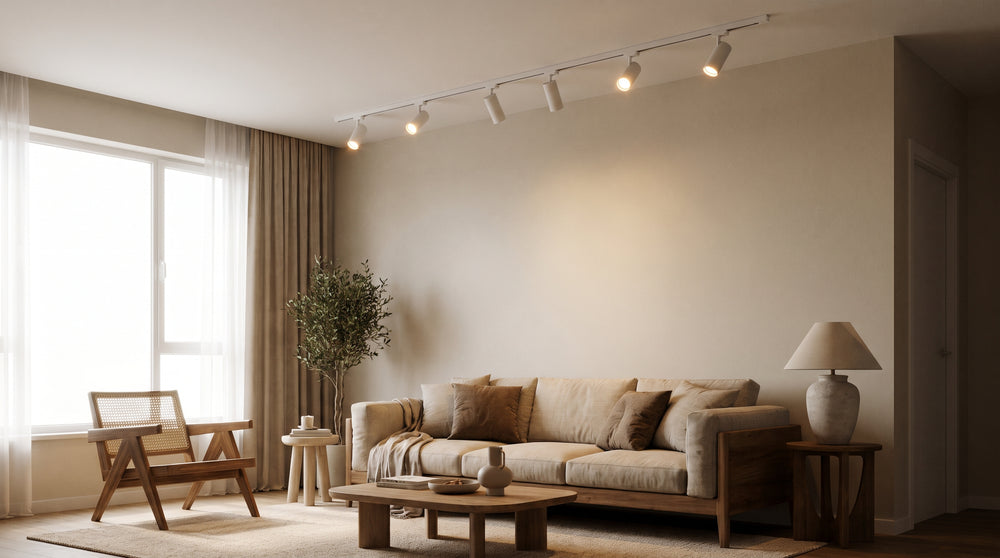
Light changes everything
From statement chandeliers to discreet wall lights, we help you choose the right brightness, height and style for every room.
- Tracked delivery
- Pay in instalments, where available
- 14 days to change your mind
- Advice & showroom in Lyon, France
To light a hallway, kitchen or living room, allow one 240V LED spotlight per point to be lit and connect it directly to the mains: no transformer to house in the ceiling. You then screw in a GU10 or E27 bulb, or choose a model with integrated lighting, then fix the base plate or tube to the ceiling.
How does a 240V LED spotlight work without a transformer?
A 240V LED spotlight connects directly to the household mains: the voltage is converted by the GU10 or E27 bulb you screw in, or by the model's integrated electronics. No transformer or power supply unit to house in the ceiling, which simplifies installation and maintenance. Replacement requires no special tool.
240V LED spotlights without a transformer: what it changes at installation
The constraint is no longer the power supply unit, but the routing of the cables and the depth available behind the ceiling. The models in this selection are made of metal and steel, mostly black, and are fixed directly to the ceiling or into a cut-out. The Novlinilo tube sits flat against the ceiling, with no housing to allow for. To compare shapes, browse our full lighting range.
240V LED lighting: screw-in bulb or integrated lighting?
Base plates with a GU10 or E27 socket are repaired bulb by bulb: you choose the light temperature at the time of purchase, warm white around 2700 to 3500K or cool white around 4500 to 6500K. Other models, such as the Otéa four-head projector, have integrated LED lighting and offer both moods depending on the setting.
What is the difference between a 240V spotlight and a 12V spotlight?
A 240V spotlight connects to the mains circuit, without a transformer, and takes a GU10 or E27 bulb. A 12V spotlight goes through a transformer, often chosen for damp rooms or shallow recess depths. 240V simplifies installation and bulb replacement.
12V spotlight with transformer: when is it preferable?
12V remains useful when the height available behind the ceiling is very low, or when the fitting must stay away from the mains. You then need to allow an accessible spot for the transformer and sometimes replace the whole unit rather than just the bulb.
Why 240V is simpler to install on the ceiling
- Direct connection to the existing lighting circuit.
- GU10 or E27 bulb replaceable on its own.
- No space to allow for near the spotlight.
How do you wire a 240V LED spotlight without a transformer?
Switch off the power at the breaker, identify live, neutral and earth, then connect the wires to the spotlight terminals or the base plate terminal block. Tighten the connections and check the marking before switching the power back on. For any work on the electrical panel, call a qualified electrician.
Recessed 240V LED spotlight: preparing the ceiling cut-out
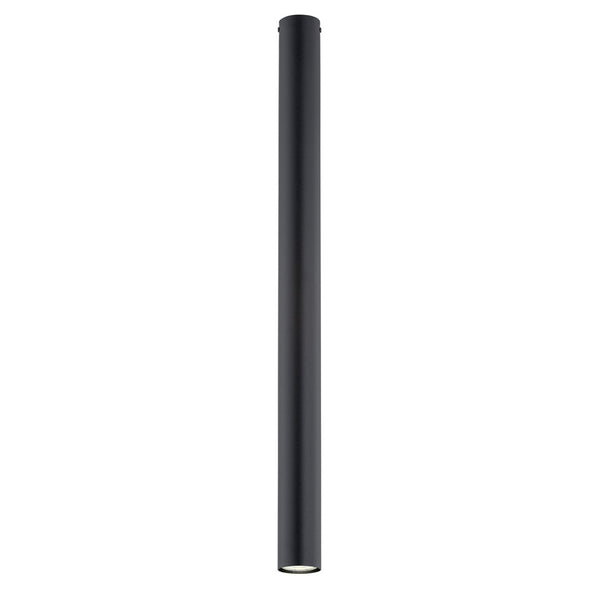
Mark the cut-out before drilling, allowing for the width of the base plate and the routing of the cables. A surface-mounted model screws on without a cut-out: this is the principle of Myrrha, a cylinder fixed to the ceiling. If you are looking for a more elaborate shape, the design formats also mount on the ceiling.
240V LED fitting: checking the circuit before connecting
Count the number of points, check that the lighting circuit can handle the total wattage, and note the position of the switch. The wattages in the selection range from 8W to 40W depending on the model.
Which 240V LED spotlight should you choose for a living room, bedroom, kitchen or hallway?
In a hallway or entrance, black tubes and cylinders line up a discreet light. In a bedroom or office, an E27 base plate takes a warm white bulb. In the kitchen and living room, an adjustable model directs the beam onto the worktop or a wall.
| Room | Models in the collection | Format and fixing | Socket | Why this choice |
|---|---|---|---|---|
| Hallway | Novlinilo, Myrrha, Callinissa | Tube or cylinder, ceiling fixing | GU10 | Light lined up along the passage |
| Entrance | Sillinella, Novlinilo | Slim tube | GU10 | Understated, space-saving format |
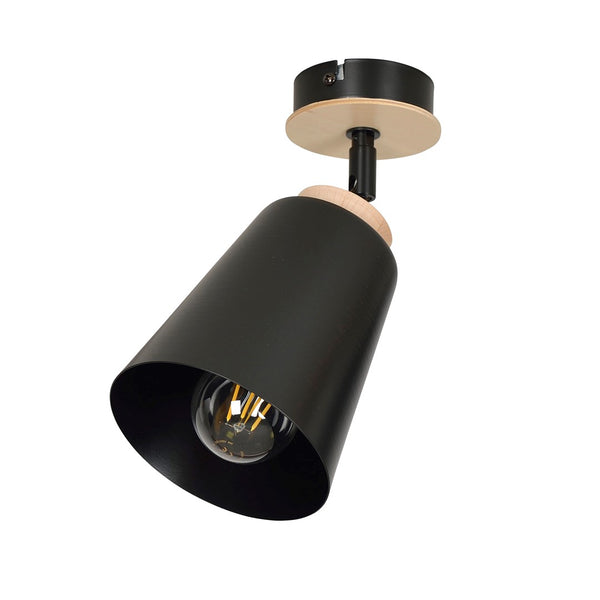
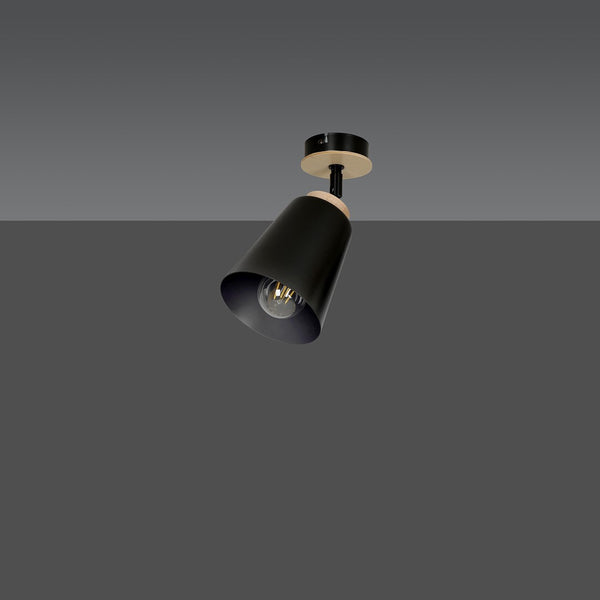
| Bedroom | Rotella, Lorlinano, Vallinilo | Wood and metal base plate | E27 | Choice of warm white bulb |
| Living room | Otéa, Rotella | Adjustable heads | Integrated lighting or E27 | Aimed at a wall or reading corner |
| Kitchen | Myrrha, Callinissa, Otéa | Recessed or multi-head | GU10 or integrated lighting | Beam directed onto the worktop |
| Dressing room, office | Vallinilo, Sillinilo | Small base plate | E27 or GU10 | Targeted lighting without taking up the surface |
The same shapes come in light colours if your ceiling is white: see the white LED spotlights.
240V LED spotlight for a hallway: why the tube format
A long tube sits flat against the ceiling and follows the line of the passage: it lights the floor without casting shadows on the walls. GU10 8W models are spaced every two or three metres. For a staircase, cross the line with staircase lighting.
240V LED spotlight for a kitchen: aiming at the worktop
Adjustable heads set the beam on the worktop without lighting the face of whoever is cooking. The Otéa projector comes in several lengths to cover a wide worktop. The spotlights designed for kitchens collection groups the models suited to this room.
240V LED spotlight, LED ceiling light or LED chandelier: which ceiling solution?
A spotlight lights by directed points: several spotlights draw an even light across the ceiling, useful in a kitchen or hallway. An LED ceiling light or LED chandelier diffuses from a single central point, for a living room. The two can coexist on separate circuits.
Powerful LED ceiling light or several spotlights for a kitchen?
A central ceiling light lights the floor and the units, but leaves the worktop in the shadow of the body. Several spotlights aimed at the worktop correct this. In an open kitchen, combine a central point for atmosphere with directed spotlights for working, drawing from the Designix lighting range.
LED ceiling lighting: how do you spread the light?
Allow one main source at the centre of the room, then secondary points spaced evenly along the areas in use. To light a living room, two or three spotlights towards the bookcase are often enough. Avoid lining up all the points on the same central line.
When should you complete your spotlights with an LED wall light?
An LED wall light provides extra light at shoulder height rather than general lighting. It complements the spotlights in a living room or hallway and can stay on alone in the evening. It connects to the same 240V network, on a wall lighting point.
LED wall light for a living room: where to place it relative to the spotlights?
Place it on a wall the spotlights do not aim at, at shoulder height or above a low unit, to create contrast rather than duplication. Models in a modern style in black metal match spotlights of the same shade.
Do you need a powerful LED wall light for a hallway?
In a hallway, a strong wall light is rarely enough on its own: it marks a point, it does not light the length. The spotlights remain the main source and the wall light goes at the end of the run or near a door. If the shade matters, compare the black LED spotlights and the light models in the same family.
Recessed, adjustable or dimmable 240V LED spotlight: which options?
Recessed, a spotlight sits in a cut-out in the ceiling; surface-mounted, it screws onto a base plate. Adjustable models direct the beam towards a wall or a worktop. A small part of the selection accepts a dimmer to adjust the light intensity.
| Socket | Models concerned | Bulb to allow for | Rooms where this socket dominates | To remember |
|---|---|---|---|---|
| GU10 | Novlinilo, Myrrha, Callinissa, Sillinella, Sillinilo, Spotia | Screw-in GU10 bulb | Kitchen, hallway, entrance, living room | Compact format, directed beam |
| E27 | Rotella, Lorlinano, Vallinilo | Standard or LED E27 bulb | Bedroom, office, living room | Wood and metal base plate, choice of temperature |
| Integrated lighting | Otéa | No bulb to change | Living room, bedroom, kitchen, hallway, dining room | Warm white or cool white depending on the setting |
Dimmable 240V LED spotlight: how do you check compatibility?
Dimmability does not depend on the fitting alone: the bulb must also be stated as dimmable, and the dimmer must accept the LED load. Check all three elements before fitting the switch. The dimmer-compatible models are rarer in the selection. The same constraint applies to recessed dimmable spotlights.
Recessed or surface-mounted 240V LED spotlight: which to choose?
A recessed model sits flush with the ceiling and suits suspended ceilings or accessible lofts. A surface-mounted model needs only a base plate, with no cut-out, and comes off more easily for maintenance. On adjustment, the selection is split between adjustable spotlights and fixed formats.
240V LED spotlight for a bathroom or outdoors: what to check
All the spotlights in this collection are IP20: they suit dry rooms and must not be exposed to water splashes. For a bathroom or outdoors, you need a higher protection rating, designed for damp and rain. The choice of fitting then moves to another range.
240V LED spotlight for a bathroom: why the protection rating matters
Around the bath and the washbasin, water can reach the fitting directly. IP20 does not protect against splashes: you need a model designed for damp rooms, with an installation suited to the zone. Look at the distance to water and the material of the fitting before choosing.
240V LED spotlight outdoors: which range should you turn to?
No spotlight in this selection is designed for outdoors. For a terrace, a facade or a garden, turn to outdoor spotlights, resistant to rain and damp. Designer outdoor spotlights also come in solar versions, with no mains connection.
How do you maintain 240V LED spotlights and what does Designix guarantee?
A dry cloth is enough for maintenance: switch off the power before removing a spotlight or changing the bulb. The selection is guaranteed for 2 years; payment is secure, delivery is tracked, returns are possible and Designix customer service answers technical questions.
Changing the bulb of a 240V LED spotlight
Switch off the breaker, let the bulb cool, then unscrew or unclip the GU10 or E27 model. Note the maximum wattage stated on the fitting and the light temperature you want before refitting. A bulb with the same socket is enough, with no transformer to check.
Designix warranty, delivery and returns
Every spotlight in the selection is covered by a 2-year warranty. Payment is secure, delivery is tracked and returns are possible if the model does not suit the room. For a project with several lighting points, the metal spotlights combine with a more decorative base plate. In a bedroom, the Rotella adjustable spotlight, with a wood base and E27 socket, takes a warm white bulb.
How do you wire a 240V LED spotlight without a transformer?
Switch off the power at the breaker, identify live, neutral and earth, then connect the wires to the spotlight terminals or the base plate terminal block. Tighten each connection and check the marking before switching the power back on. For any work on the electrical installation, call an electrician.
What is the difference between a 240V spotlight and a 12V spotlight?
240V connects directly to the mains and takes a GU10 or E27 bulb. 12V runs with a transformer, often chosen for shallow depths or damp rooms. With 240V, no unit to house in the ceiling and the bulb is replaced on its own.
Recessed 240V LED spotlight: how do you fix it to the ceiling?
A recessed spotlight is fitted into a cut-out in the ceiling, held by the fitting's springs or base plate. Mark the cut-out before drilling, check the routing of the cables, then connect and clip the spotlight in. Surface-mounted models screw onto a base plate, with no cut-out.
Can you install a 240V LED spotlight in a bathroom?
The spotlights in this collection are IP20: they are designed for dry rooms and do not withstand water splashes. In a bathroom, you need a protection rating suited to wet zones. Turn to a spotlight range designed for damp conditions.
Can a 240V LED spotlight be dimmable?
Only some models accept a dimmer, and compatibility also depends on the bulb used. Check that the spotlight and the GU10 or E27 bulb are both stated as dimmable before installing the dimmer switch.
Unsure about the number of points, the socket or the room? Designix customer service answers before you order, and the 2-year warranty covers every model in the selection. Compare the shapes, check the GU10 or E27 socket on the product page, then add to cart.