White LED spotlights
- Tracked delivery to your country Tracked delivery
- Secure payment at checkout Multiple payment methods
- 14 days to change your mind 14-day returns
- Secure payment Secure payment


Not sure of your style? Find it in 30 seconds
A few questions, and we will show you the pieces made for you.

















Frequently asked questions
How do I choose the right light output?
At what height should the light be installed?
What type of bulb?
Compatible with LEDs and dimmers?
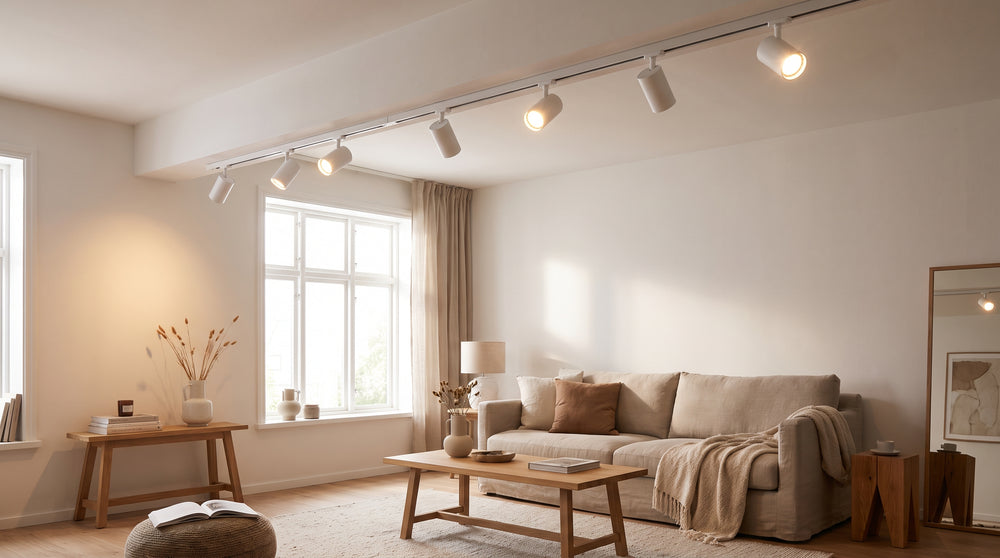
Light changes everything
From statement chandeliers to discreet wall lights, we help you choose the right brightness, height and style for every room.
- Tracked delivery
- Pay in instalments, where available
- 14 days to change your mind
- Advice & showroom in Lyon, France
Start by choosing the white temperature room by room, then the type of spotlight: 2700 to 3000 K in living areas, 3000 to 4000 K in the kitchen and bathroom, IP44 near water and IP65 outdoors. The white finish refers to the trim and body of the fixture, not the light emitted.
Which white is brightest: 2700 K, 3000 K or 4000 K?
The coolest white appears the brightest: at equal flux, a 4000 K seems brighter than a 2700 K. Kelvin only measures the tint, not the power, it is lumens that light a room. For a living room or bedroom, stay between 2700 and 3000 K.
Warm white or neutral white: which to choose?
2700 K leans towards amber and recalls the light of a halogen bulb: this is the tint that rests the eye in the evening, in a living room, hallway or bedroom. 3000 K stays warm but slightly crisper, which makes it readable above a worktop as well as in a bathroom. Between the two, the difference shows most on a white wall. For lighting a living room, 2700 K forgives a tight layout more easily than 4000 K.
Cool white 4000 K, for which rooms?
4000 K gives a frank, almost clinical white, suited to places where you want to see precisely: kitchen, laundry room, garage, office. In a bedroom, it breaks the mood and tires you at the end of the day. 6000 K, even bluer, is reserved for outdoors or a workshop. One point to keep in mind: no Kelvin replaces lumens. A spotlight rated 2700 K can light more than a 4000 K if its flux is higher.
| White temperature | Perceived effect | Rooms where it works | Key point |
|---|---|---|---|
| 2700 K (warm white) | Warm mood, close to halogen | Living room, bedroom, hallway | The most restful tint in the evening |
| 3000 K (warm neutral white) | Soft white, slightly warm | Kitchen, living room, bathroom | Good compromise between comfort and readability |
| 4000 K (cool neutral white) | Frank white, more clinical | Kitchen, laundry room, garage, office | Appears brighter at equal flux |
| 6000 K (cool white) | Bluish white | Outdoors, garage, workshop | Avoid in a living space |
White LED spotlight or colour LED spotlight: what is the difference?
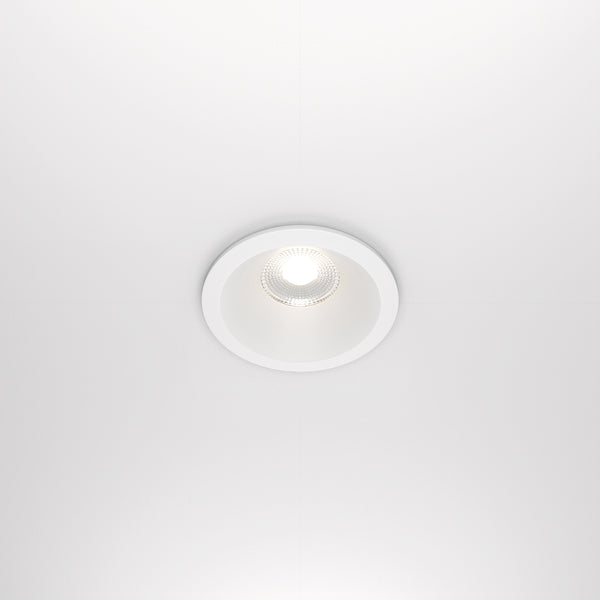
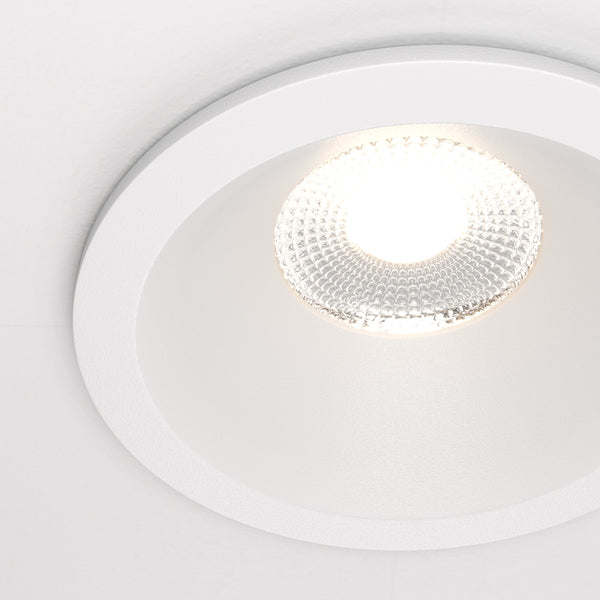
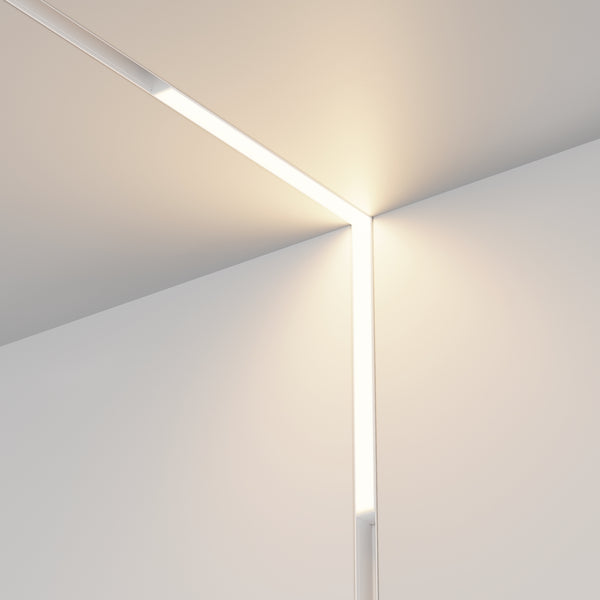
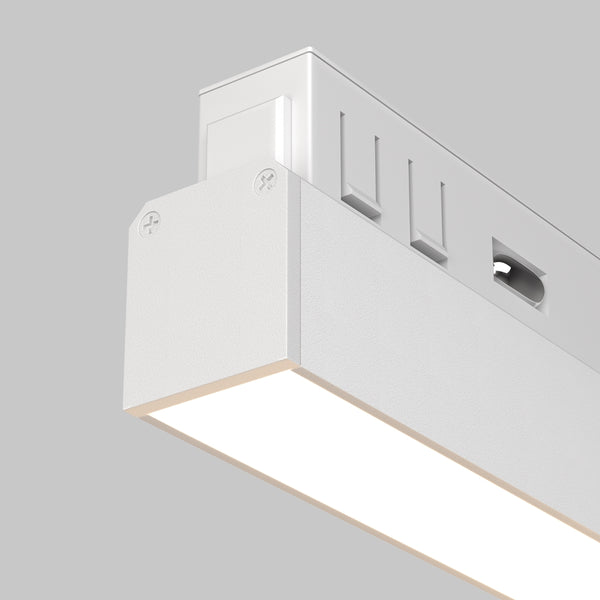
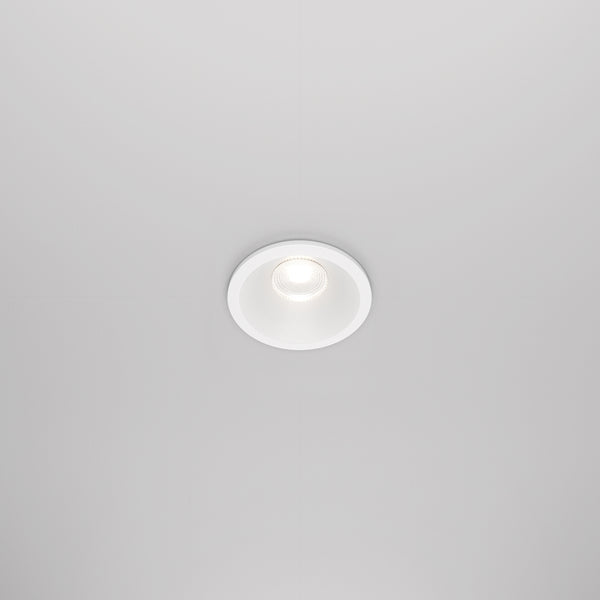
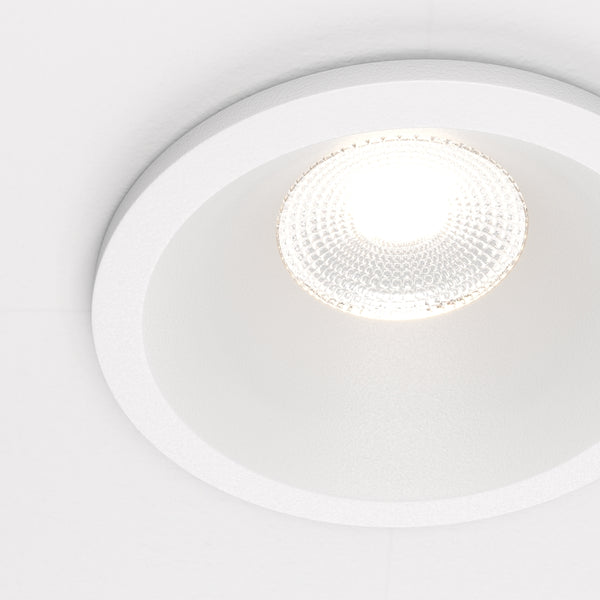
White finish refers to the finish of the fixture, so what you see on the ceiling once the spotlight is off: white trim and body. Colour LED spotlight refers to a model with changing light, controllable in tints. The two can coexist: you choose the finish for the decor first, then the light.
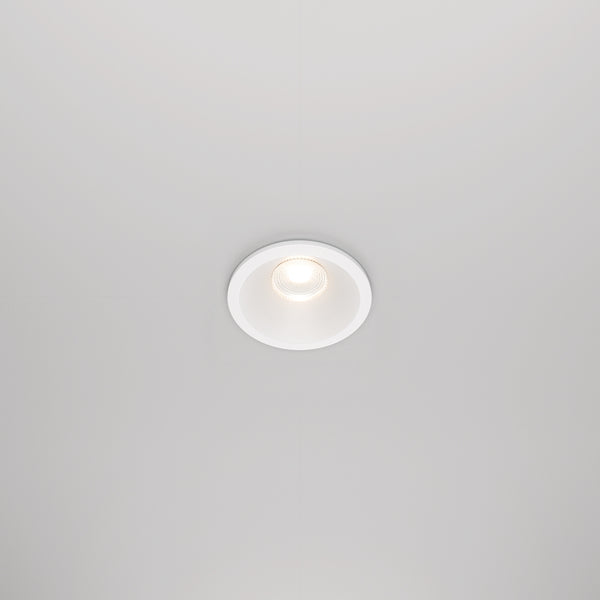
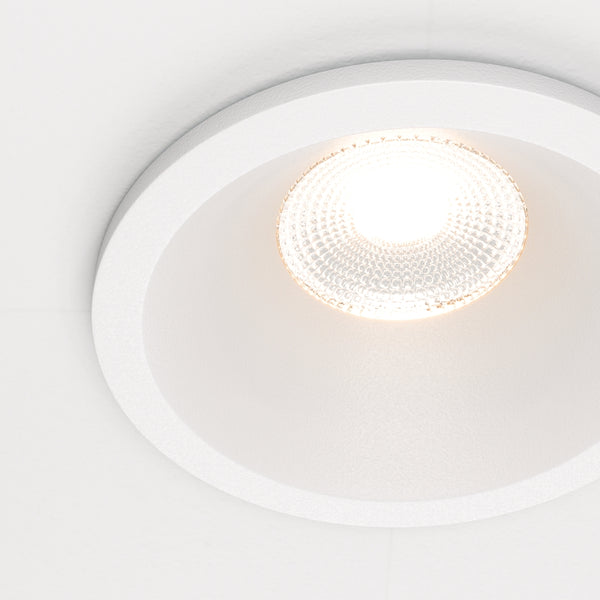
Recessed white LED spotlight: the finish that disappears into the ceiling
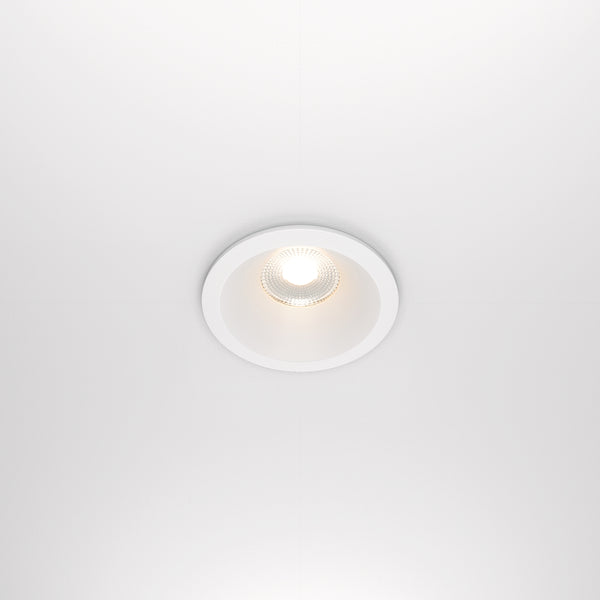
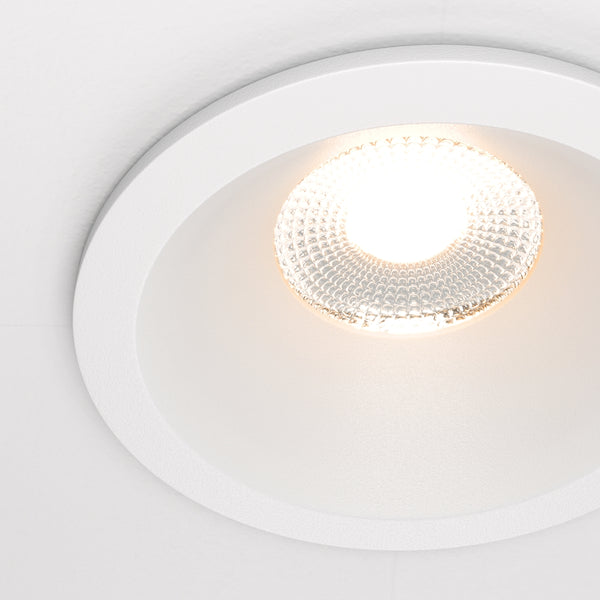
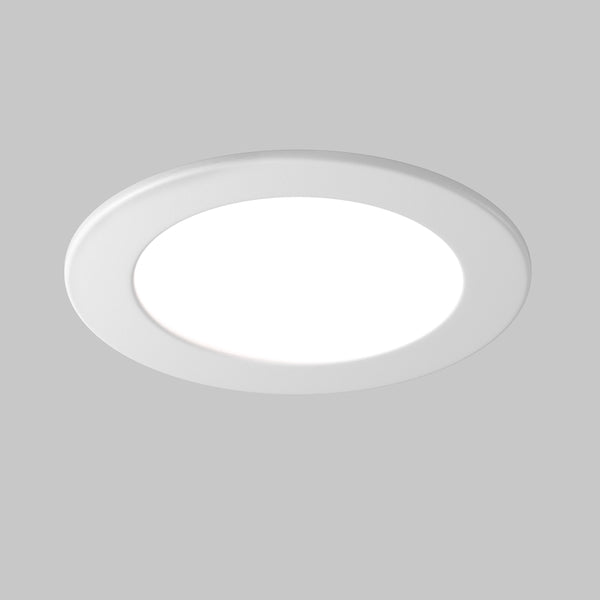
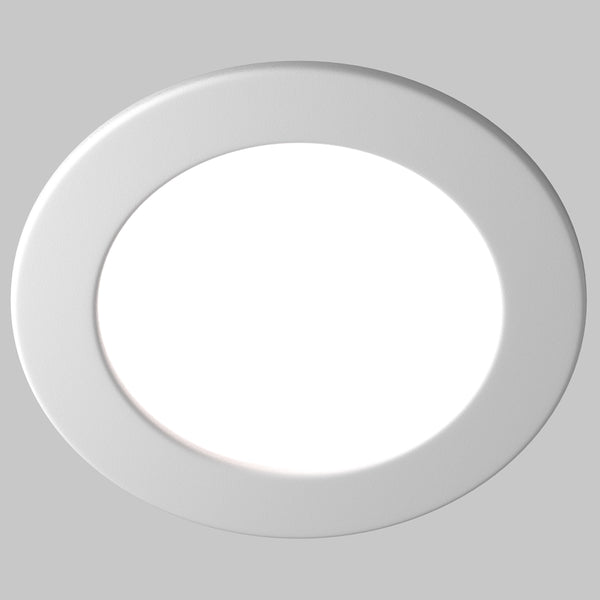
On a white or cream ceiling, a white trim fades away: all you see is the circle of light. This is what makes this finish practical in a hallway or entrance where you want a clean ceiling, without dark spots. The material also matters: a painted aluminium body holds its tint better than a thermoplastic that yellows over time. If your ceiling is dark, compare with the black finishes, which deliberately mark the line.
White finish spotlights and colour spotlights: for which use?
A colour light spotlight is controlled in tints, for a child's room, a relaxation corner or a display case. A fixed white spotlight serves everyday use: cooking, reading, moving around. Both are installed on the same ceiling without clashing. To stay in a matching decorative register, there are also gold versions and grey finishes, useful when the room mixes several metals.
Where to install white LED spotlights in the home?
They fit anywhere the ceiling must stay clean: kitchen and worktop, living room, bedroom, hallway, entrance. In a damp room or outdoors, you need a suitable protection rating, IP44 minimum in a bathroom and IP65 outdoors. The white temperature is chosen room by room.
Recessed LED spotlights for the kitchen
Above a worktop, a spotlight usefully replaces a central light that throws your shadow onto the dishes. Place the line of spotlights directly above the worktop, not in the middle of the room, and favour 3000 to 4000 K to read the colours of food. Near the sink and hob, the protection rating matters more than looks. The recessed models dedicated to the worktop gather the designs made for this area.
Adjustable LED spotlights for living room and bedroom
In a living room, an adjustable spotlight aims at a wall, a bookcase or a painting and leaves the rest of the room in half-light: two levels of light without a second fixture. In a bedroom, tilt it towards a wall rather than the bed to avoid glare. This is the role of the soft light models for the bedroom. On a terrace or path, switch to the white outdoor spotlights, made for damp conditions.
Fixed recessed, adjustable or dimmable: which version to choose?
A fixed recessed model lights straight down and stays discreet, an adjustable one directs the beam towards a wall, a worktop or a painting, a dimmable model adjusts the intensity according to the time of day. The choice depends first on what you want to light, then on the style of the ceiling.
Recessed or adjustable: which for a worktop?
Fixed above a narrow worktop, the straight spotlight is enough and costs less to install. As soon as the worktop is L-shaped, angled or bordered by a tall splashback, the adjustable one wins again: each head is tilted towards the useful area. The question to ask before ordering is simple: should the light always fall in the same place? If so, a fixed model does the job. The white adjustable spotlights cover both cases.
Is a dimmer useful on LED spotlights?
Useful in a living room or bedroom, where you want to lower the intensity in the evening without switching off. Elsewhere, it adds little. The point to check on the spec sheet: compatibility between the spotlight and your dimmer, otherwise you get flickering or a very short adjustment range. If in doubt, a model with built-in adjustable intensity avoids the debate, like the spotlights with adjustable intensity.
| Type | What it allows | Typical use | Point to check |
|---|---|---|---|
| Fixed recessed | Direct and discreet lighting | Hallway, bathroom, entrance | Recess diameter |
| Adjustable recessed | Directs the beam | Worktop, painting, wall | Tilt angle |
| Dimmable | Adjusts the intensity | Living room, bedroom, dining room | Dimmer compatibility |
| IP65 outdoor spotlight | Resists splashes | Terrace, path, facade | Actual protection rating |
How to read the spec sheet of a white LED spotlight?
Four figures are enough: the recess diameter, to compare with the hole in your ceiling, the base when the bulb is replaceable, the protection rating according to the room and the white temperature. The wattage says nothing about the effect, it is lumens that count.
What recess diameter should you plan for?
Measure the existing hole with a tape measure, including the clearance, before ordering: one millimetre out and the trim no longer hides the cut. If you are starting from a new ceiling, the diameter is decided with the size of the spotlight and the spacing between points. On the material side, aluminium and steel dissipate heat better than a thermoplastic, which matters on a non-replaceable integrated LED. The spotlights in white finish gather both options, integrated LED and replaceable bulb.
IP20, IP44 or IP65: what is needed in each room?
The protection rating describes resistance to dust and water, not the quality of the lighting. IP20 suits dry rooms. IP44 is the minimum near a bath or a washbasin. IP65 is required outdoors, on a terrace as well as a facade. Also think about the base: GU10 for a mains spotlight, GU5.3 for very low voltage supply, integrated LED when nothing is planned for replacement.
| Room | Recommended temperature | Minimum protection rating | What you are looking for |
|---|---|---|---|
| Living room | 2700 to 3000 K | IP20 | Ambient light without glare |
| Kitchen | 3000 to 4000 K | IP20 to IP44 depending on the area | Worktop lighting |
| Bathroom | 3000 to 4000 K | IP44 | Safety and readability |
| Bedroom | 2700 K | IP20 | Soft, adjustable light |
| Outdoors | 2700 to 4000 K | IP65 | Resistance to rain |
When to prefer an LED ceiling light, a chandelier or a wall light over spotlights?
Spotlights light widely but without a focal point. An LED ceiling light, a white designer chandelier or a wall light bring a pattern, a central general light or wall lighting. In the same room, the three often combine rather than exclude each other.
Powerful LED ceiling light or several spotlights: what to choose?
The central ceiling light handles a large room from a single point and becomes a decorative feature when switched on. Spotlights, on the other hand, spread the light and avoid shadow areas in a hallway or a long kitchen. In a large living area, the combination holds: ceiling light for general light, spotlights for task areas. All the families can be found in the Designix lighting universe and in the spotlights with refined design.
Living room LED wall light: what role alongside spotlights?
The wall light illuminates a wall, a painting or a headboard without touching the ceiling: it is the natural complement to a ceiling already fitted with spotlights. It creates a second, lower level of light that avoids uniform lighting. In a living room as on a staircase, this duo remains the simplest solution to evolve. To compare styles, browse all white finishes and recessed spotlights in white finish.
How to install and maintain a recessed LED spotlight?
Switch off the power at the circuit breaker, check the hole diameter before drilling, connect according to the manufacturer's diagram then clip the spotlight in. For maintenance, a dry cloth is enough: switch off and let cool before removing a bulb or cleaning the trim.
Preparing the ceiling and circuit before installation
Locate the cable entries and the position of the joists before drilling, then mark the centres with a chalk line to align the spotlights. A regular gap between points avoids shadow holes between two beams. The connection follows the manufacturer's instructions, without improvising a spur. If your ceiling is made of plasterboard, a lightweight spotlight can be installed without special reinforcement. The adjustable recessed models are installed in the same way, with an angle adjustment after fitting.
Cleaning and replacing without damaging the ceiling
Switch off the power, let cool, then wipe with a dry cloth: no abrasive product or damp sponge on the trim. To remove a spring-loaded spotlight, press gently on the clips and pull straight, otherwise you mark the paint around the hole. A GU10 or GU5.3 bulb is replaced without tools. On an integrated LED, the whole fixture is replaced, to be planned at the time of purchase.
What is a good brand of LED spotlights?
There is no brand to recommend blindly: look at the spec sheet, not the label. A good spotlight states its white temperature, its protection rating, its base or its type of integrated LED, its recess diameter and its warranty conditions. These markers are worth more than a logo.
The criteria that make the difference
The collection contains 842 white LED spotlights. A flux consistent with the power, and a light intensity that matches the surface to be lit. Between an affordable model and an exceptional one, the gap often comes down to how well the tint holds over time and the precision of the optics, not raw power alone. To place the variants, compare the adjustable models, the adjustable range and the dimmable recessed versions.
Payment, delivery and returns: what Designix offers
If any doubt remains about a temperature or a diameter, better to ask before drilling than to order a second time. The full catalogue can be found in all the lighting collections, and the layout variants in the spotlights designed for the kitchen as well as in the white outdoor spotlights.
Choose your white LED spotlight model then check the diameter of your hole before confirming.
Frequently asked questions
Which white is brightest?
The coolest white appears the brightest: at equal flux, a 4000 K seems to light more than a 2700 K. Note that Kelvin only describes the tint. The amount of light is read in lumens, not in white temperature.
Recessed white LED spotlight, what exactly is it?
It is a spotlight whose trim and body are white, to blend into a light ceiling once switched off. The finish colour has nothing to do with the tint of the light emitted, which is chosen separately in kelvins.
Colour LED spotlights and white LED spotlights, how to choose?
For a fixed, readable mood, stay with a white spotlight, at 2700 to 3000 K in living areas. To change the mood or highlight a decor, go for a colour light model. Both can coexist on the same ceiling.
LED ceiling lighting: spotlights or ceiling light?
Spotlights spread the light over the whole surface and disappear into the ceiling. The ceiling light or chandelier creates a focal point and a more marked general light. Many living rooms combine the two: spotlights for use, ceiling light for mood and style.
Can you install white LED spotlights in a damp room?
Yes, with the protection rating suited to the area. In a bathroom, allow IP44 minimum near water. Outdoors, you need a model made for damp conditions, generally IP65. The white finish does not change this requirement.
One last point before ordering: note the diameter of your recess, the room and the desired tint, then return to the lighting catalogue to compare the models that match.