
Staircase spotlights
This selection is also available in our French store: Spots pour escalier


- Tracked delivery to your country Tracked delivery
- Secure payment at checkout Multiple payment methods
- 14 days to change your mind 14-day returns
- Secure payment Secure payment
Not sure of your style? Find it in 30 seconds
A few questions, and we will show you the pieces made for you.
Frequently asked questions
How do I choose the right light output?
At what height should the light be installed?
What type of bulb?
Compatible with LEDs and dimmers?
Light changes everything
From statement chandeliers to discreet wall lights, we help you choose the right brightness, height and style for every room.
- Tracked delivery
- Pay in instalments, where available
- 14 days to change your mind
- Advice & showroom in Lyon, France
Plan on one light point every two to three steps, set close to the wall or recessed into the step and aimed at the step nosing: a staircase is marked out, not lit like a room. The grazing light guides the foot, avoids glare, and is chosen according to whether the staircase is indoors or exposed to rain.
What lighting for a staircase, and how many light points should you plan?
A staircase is marked out rather than lit: a few grazing light points set along the steps are enough to read the descent without glare. A light aimed at the step nosing is preferred, switched on at the bottom and the top of the run, with a model suited to indoor or outdoor use.
Lighting for an indoor staircase
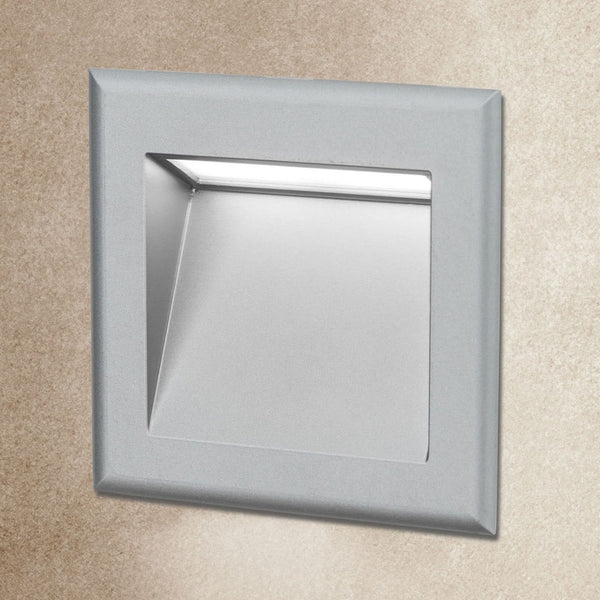
The light is set as a grazing wash along the steps. A stair spotlight placed in the wall or in the step lights the surface of the tread, not the space in front. It is this direction that makes the height of each step distinguishable at a glance, going up as well as down. The marking acts as a guide, it does not try to light the room. To see the available shapes, browse LED stair spotlights.
Lighting for an outdoor staircase
Outside, the principle stays the same but the equipment changes: rain, humidity and frost require a treated material and a waterproof connection. A porch spotlight aimed at the step lights the tread without casting light towards the street. Outdoor stair lighting is thought through together with the entrance it extends, and coordinated with entrance spotlights.
Recessed step spotlight or wall spotlight: which to choose?
A spotlight recessed into the step lights the step itself, as close as possible to the tread; a wall spotlight is fixed into the wall or the stringer, out of the walkway, and suits old steps or supports you do not want to drill. The choice therefore depends on the material and the finesse sought.
Stair step spotlight: recessing into the step
The step spotlight sits within the thickness of the wood or stone. The source is as close as possible to the foot, the result is sharp and discreet, almost invisible when going up. You must, however, accept drilling, check the available thickness and plan access to the cable. This is the choice for new or renovated staircases whose steps are thick enough.
Stair wall spotlight: fixed to the wall, out of reach of the foot
The stair wall spotlight, or recessed stair wall spotlight, is set into the wall, the skirting or the stringer. No step is touched, the light point stays out of the walkway and maintenance is simple. It suits stone or concrete staircases or thin steps. An adjustable model allows the beam axis to be corrected after installation, as offered by adjustable spotlights to set after installation.
| Type of spotlight | Where it is set | Light effect | Suitable for |
|---|---|---|---|
| Spotlight recessed into the step | In the thickness of the step | Light grazing the step, as close as possible to the tread | Wood or stone staircases you are willing to drill |
| Spotlight recessed into the wall or skirting | Wall, stringer, skirting | Side marking aimed at the floor | Steps to preserve, solid walls |
| Adjustable wall-mounted spotlight | Wall, away from the walkway | Beam adjustable up or down | Tall stairwells, landings, correction after installation |
| Wall light | Stairwell or landing wall | Broad diffusion upwards and downwards | Old staircases, walls to dress |
| Outdoor porch spotlight | Outdoor wall, riser | Marking aimed at the step | Staircases and porches exposed to rain |
Indoor stair spotlight: which light marks out without glare?
For an indoor staircase, you want a warm, low-intensity light, aimed at the step, never at the eyes: a wide-beam spotlight set close to the wall lights the surface and avoids reflection straight in the face. An adjustable model allows the axis to be corrected after installation.
Indoor stair spotlight: aim at the step
The rule fits in one sentence: the source lights the material, not the person. People often go down looking at their feet, and a light point placed at eye level creates an unpleasant halo. Set low in the wall, tilted towards the floor, it becomes invisible from the steps and the staircase gains in readability. A dimmer helps to adjust this marking in the evening, see dimmable models.
Warm or neutral light in a stairwell
A stairwell calls for a warm light, around 2700 to 3000 K, and low intensity: the contrast with the surrounding darkness is enough to guide. A neutral, cooler tone suits a service staircase or a cellar better, where you want to see clearly rather than create an atmosphere. The important thing is to keep the same tone from the bottom up to the landing, in keeping with the hallway lighting that extends the staircase.
Outdoor stair light: how to withstand rain and frost?
Outside, the light must withstand rain, humidity and frost: check the material (treated metal, stainless steel), the IP protection rating stated on the product sheet and the waterproofing of the connection. A porch spotlight aimed at the step remains preferable to a broad floodlight that glares from a distance.
Outdoor stair and porch light
The porch is the most exposed area: driving rain, splashes, sometimes de-icing salt. An outdoor stair light is fixed outside the walkway, aimed at the riser or the step nosing, and operated from the door. It lights the act of going down, it does not flood the path. A discreet wall model is better than a broad floodlight, which glares from the street and leaves areas of shadow.
Outdoor stair spotlight: material and protection rating
Three points to check on the product sheet: the material, the protection rating and the connection method. Treated metal or stainless steel withstands better than painted steel on a damp porch. The IP rating indicates resistance to water and dust, the higher it is, the more the light withstands direct exposure. The connection, finally, must stay sheltered. For the whole vocabulary of the home, see our full range of lights.
Fitting a wall light in a staircase: when to prefer it to a spotlight?
A wall light replaces the spotlight when you want to light an entire stairwell or a landing, without drilling the steps: it diffuses upwards and downwards, dresses the wall and is set away from the walkway. It suits old, stone or concrete staircases.
Indoor stair wall light
The indoor stair wall light is fixed at height, on the stairwell wall or directly above the landing. Its double diffusion lights the flight and the ceiling at the same time, which gives an ambient light where the spotlight only provides marking. It frees the steps from any drilling, which makes it valuable in older buildings. It is placed away from the walkway so no shoulder brushes it, and high enough not to be in the line of sight. The most elaborate models are found in spotlights with elaborate design.
Stairwell wall light: lighting without drilling the steps
In a tall stairwell, one or two wall lights distributed over the height avoid the dark zone in the middle of the flight. The principle is simple: each wall light lights its portion, the light overlaps and the whole stays even. For a stone or concrete staircase, or steps too thin to take a recessed spotlight, it is often the only clean solution. The stairwell wall light pairs well with the lighting of a well-lit desk corner when the landing serves a work room.
Motion-sensor stair light: useful or unnecessary?
A sensor switches the staircase on when you pass, which avoids searching for the switch with your hands full and limits consumption: useful in a night hallway, a cellar or an outdoor staircase. Indoors, a two-switch model remains simpler and sufficient.
Motion-sensor stair light: for which use?
The motion sensor has three favoured settings: the nighttime trip to the bathroom, the cellar or garage, and the porch. In these cases, the light comes on without a gesture and goes off on its own, which avoids leaving a staircase lit all night. In a family stairwell serving bedrooms, on the other hand, two switches, one at the bottom and one at the top, meet the need without extra electronics.
Motion-sensor outdoor stair spotlight
Outside, the sensor is fully justified: it welcomes the visitor and lights the descent without manual control. It still needs the housing to withstand humidity, the sensor not to be masked by a plant and the range to stay limited so it does not trigger as cars pass. A model discreetly integrated into the wall is better than a visible block. The choice of a motion-sensor stair spotlight is mainly based on the material and the protection rating.
How to install a spotlight in a staircase without damaging the steps?
First mark the step line and the cable route, then drill at the centre of the step or at mid-calf height in the wall, keeping the beam aimed at the floor. Each point must remain accessible for maintenance and replacement.
At what height should a stair spotlight be set?
In a wall or a stringer, a spotlight is placed low enough to light the step without glare, generally around the mid-calf of an adult, that is twenty to thirty centimetres above the step nosing. In a step, it is set at the centre of the surface, as close as possible to the tread. These markers are adjusted on site: test the axis from the top and from the bottom before fixing permanently.
How to power and control stair spotlights?
The cable is run through the thickness of the stringer, under the steps or in a wall chase, never surface-mounted in the walkway. The stair spotlight installation ends with the control: a switch at the bottom, one at the top, or a sensor that replaces both. The connection must remain accessible behind each point, otherwise replacing a module becomes a building site. For a staircase serving a living room, harmony with living room lighting is planned from the marking stage.
How to match stair spotlights with the rest of the home?
Keep the same light tone from the bottom to the top of the house, and choose the spotlight colour according to the surface receiving it: white disappears on a light wall, black underlines a dark stringer or handrail. Better to avoid mixing several tones on the same landing.
Black or white spotlights: which result?
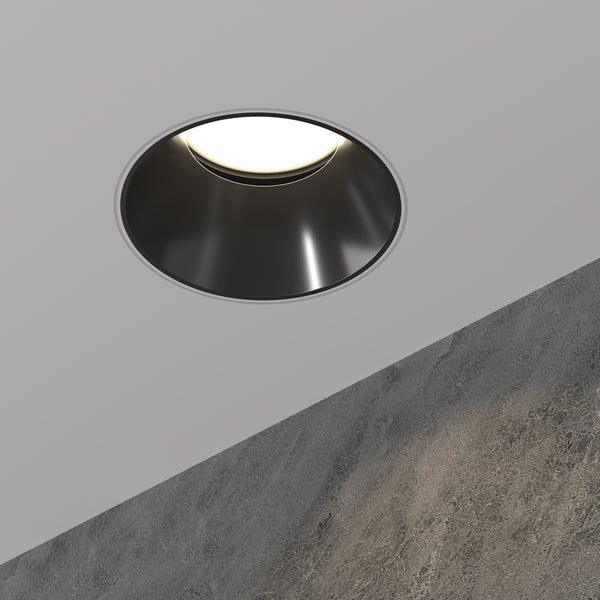
On a light wall, a white spotlight fades away and lets only the light be seen: see white spotlights that blend into the wall and, in LED version, white LED spotlights. On a dark wood stringer, a steel staircase or a graphic skirting, matte black finishes underline the line instead of hiding it. An adjustable black spotlight pairs well with a metal handrail.
Light colour for living room, hallway and staircase
The light colour for a living room is chosen at the same time as that of the staircase: if the landing opens onto the lounge, a different tone creates a break visible on every passage. So stay with a single warm tone, reserving a cooler light for utility rooms. This consistency also applies when you pick up a modern kitchen decor open to the hallway, where two light temperatures show immediately. Also think about bedroom lighting at the top of the flight.
What mistakes to avoid in staircase lighting?
The most frequent mistakes: lighting towards the eyes, multiplying light points, mixing light tones, forgetting the control at the bottom and the top, or installing an outdoor model with insufficient protection under a canopy beaten by rain. Each is corrected by aiming the beam at the step and keeping the tone uniform.
| Mistake | What it causes | Fix |
|---|---|---|
| Beam aimed at the eyes | Glare on the descent | Aim the spotlight at the step |
| Too many light points | Overlit staircase, decorative effect lost | Keep a regular marking |
| Mixed light tones | Visual break from one landing to another | Choose a single tone |
| Control on a single switch | Walking in the dark at the top or the bottom | Plan two control points |
| Poorly protected outdoor model | Rapid wear, humidity in the connection | Check the protection rating and the material |
Once the type of spotlight is chosen and the height decided, all that remains is to order: marking out a staircase with LED is done with models designed for this use, whose colour matches the wall receiving them. For a staircase serving a lounge or a living room, complete with recessed spotlights for living rooms to keep the same tone everywhere. Secure payment, tracked delivery, returns and Designix customer service: you order the right reference and exchange remains possible if the finish does not suit once installed.
Frequently asked questions about stair spotlights
Which wall light for an indoor staircase?
A wall light suits when you want to light the stairwell or the landing without drilling the steps: it is fixed at height, diffuses upwards and downwards and stays away from the walkway. Its finish is chosen according to the wall receiving it, light or dark.
Which light for an outdoor staircase?
An outdoor light must withstand rain, humidity and frost: check the material, the IP protection rating stated on the product sheet and the waterproofing of the connection. A porch spotlight aimed at the step lights without glaring the person going down.
At what height should a stair spotlight be installed?
In a wall, the spotlight is placed low enough to light the step without glare, at around mid-calf height; in a step, it is set at the centre of the surface, that is as close as possible to the tread. The beam is then adjusted towards the floor.
Can a recessed wall spotlight be installed in an old staircase?
Yes, provided it is recessed into the wall or the skirting and not into the step: this preserves the stone, the old wood or steps that are too thin. Check the available thickness in the wall and access to the cable route.
Where to set a spotlight in a staircase to avoid glare?
The spotlight is set close to the wall or in the step, aimed at the surface to be lit and never at the person going down. An adjustable model allows the axis to be corrected after installation, once the staircase has been seen from the bottom and from the top.
Which light colour to choose for a staircase?
You want a warm, low-intensity light, at the bottom as well as the top of the staircase: it guides the foot without creating an aggressive zone. The essential thing is to keep the same tone in the hallway, the entrance and the landing to avoid a visual break.




