IP44 wall lights
- Tracked delivery to your country Tracked delivery
- Secure payment at checkout Multiple payment methods
- 14 days to change your mind 14-day returns
- Secure payment Secure payment


Not sure of your style? Find it in 30 seconds
A few questions, and we will show you the pieces made for you.

































Frequently asked questions
How do I choose the right product?
What are the delivery times?
Can I return an item?
Can I pay in instalments?
An interior that reflects who you are
Carefully selected pieces, shipped from our warehouses. Our team advises you before you buy, so you choose with confidence.
- Tracked delivery
- Pay in instalments, where available
- 14 days to change your mind
- Advice & showroom in Lyon, France
Check the IP rating before drilling: an IP44 wall light withstands water splashes, so it can be installed above a sink or behind a countertop. In a hallway or corridor outside a wet zone, an IP20 model remains suitable; only IP44 is required near a water point. Ball, globe or tube shapes, opal glass, black or white metal, G9 socket or integrated LED: each product page gives the rating and actual dimensions.
What is the IP44 standard?
IP44 is a two-digit rating: the first, 4, means the light is protected against solid objects larger than one millimetre; the second, 4, against water splashes from all directions. An IP44 wall light therefore withstands splashes in a bathroom or kitchen, but should never be immersed in water.
Does IP44 protect against rain?
IP44 resists water splashes from all directions, which covers light rain in a sheltered area, but not a direct jet or immersion. For a truly exposed facade, aim for a higher rating such as IP65, indicated on the product page. On a covered terrace, IP44 holds up; in driving rain, it does not.
IP20, IP44, IP65: what are the differences for a wall light?
The first digit counts solids, the second water. An IP20 fears a single drop, an IP44 withstands splashes, an IP65 handles dust and jets. In this selection, IP44 dominates, IP20 remains for dry rooms and IP65 is for sheltered outdoor use.
| Rating | Stated protection | Suitable room or area | Models in the collection |
|---|---|---|---|
| IP20 | Solid objects over 1 mm, no water protection | Bedroom, living room, hallway and entrance outside wet zones | Quentin, Corinna, Renata, Ulara, Darienne, Galenor |
| IP44 | Solid objects over 1 mm and water splashes | Bathroom, kitchen, entrance, hallway, workshop | Sereva, Genevieve, Kaida, Wylla, Fenella, Verena, Sakura, Zefira, Tubaluce |
| IP45 | Reinforced water splashes | Wet room, bathroom | CristalLumière |
| IP54 | Dust and water splashes | Damp room or sheltered area | Indicated on the relevant model's page |
| IP65 | Dust and water jets | Sheltered outdoor use | Indicated on the relevant model's page |
Where to install an IP44 wall light in the home?
An IP44 wall light is installed where water can splash: around a sink, a bathroom mirror, along a kitchen countertop, in an entrance or hallway. It also suits a dry room, where the high rating remains a guarantee of durability and easy maintenance.
Which IP44 wall light for the bathroom?
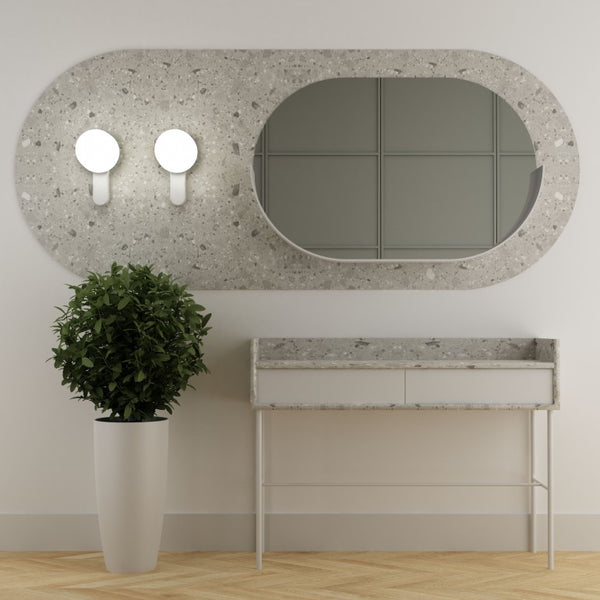
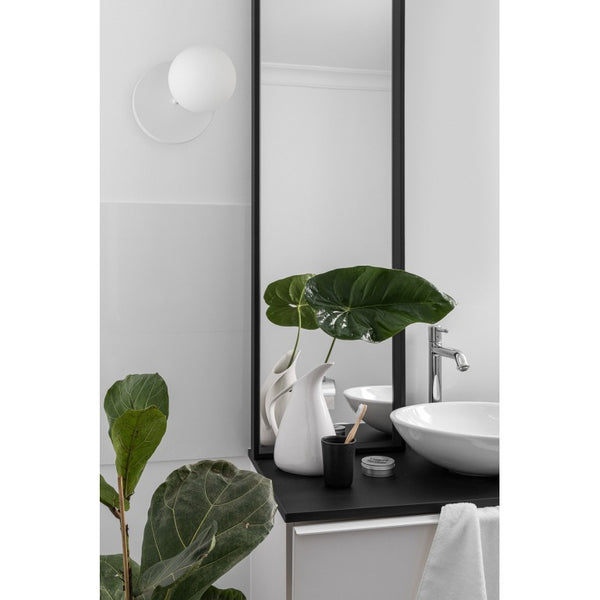
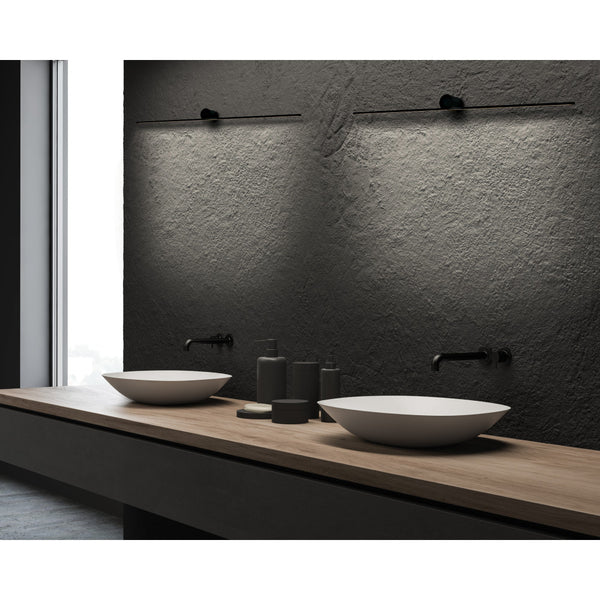
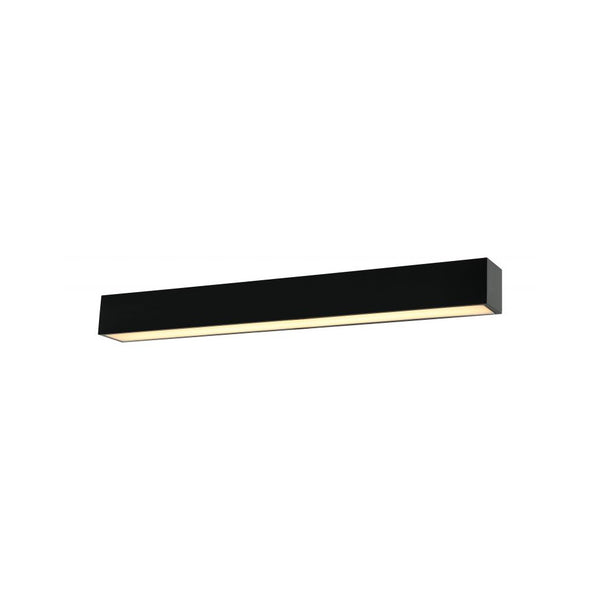
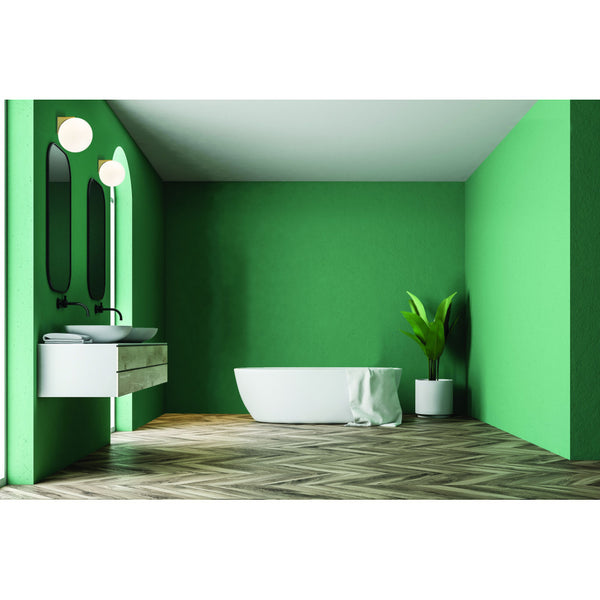
Above the mirror or beside the sink, a model with opal glass diffuses a soft light that does not reflect glare in the mirror. The IP44 selection for bathrooms brings together these short formats, placed near a splash zone. The Sereva strip, 900 mm long, lights a large mirror in a single stroke.
Can an IP44 wall light be installed in the kitchen?
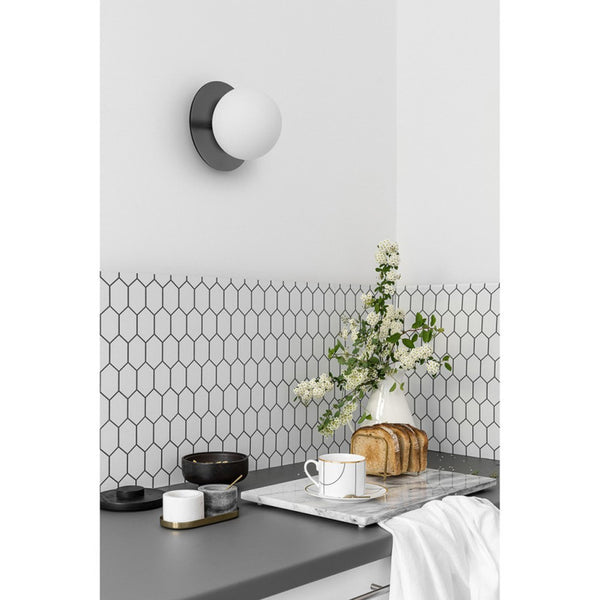
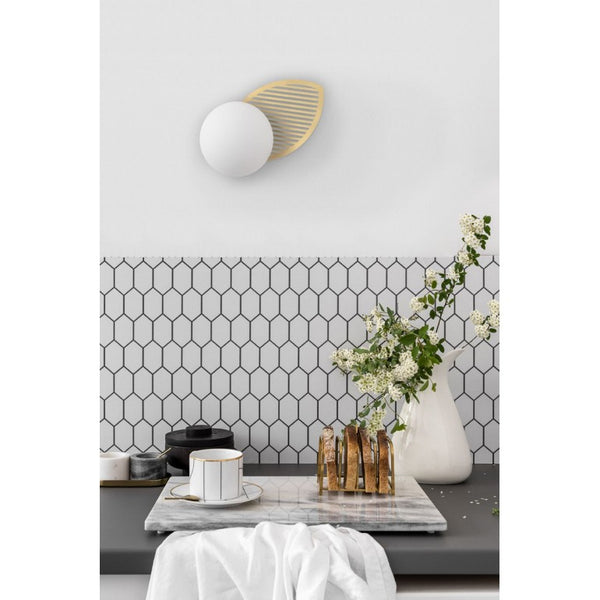
Yes, behind a countertop or near a sink, where splashes are frequent. A slim aluminium or black metal format goes unnoticed above the counter and lights the worktop without taking up space. The selection for worktop lighting groups these compact models.
IP44 wall light in the entrance and hallway.
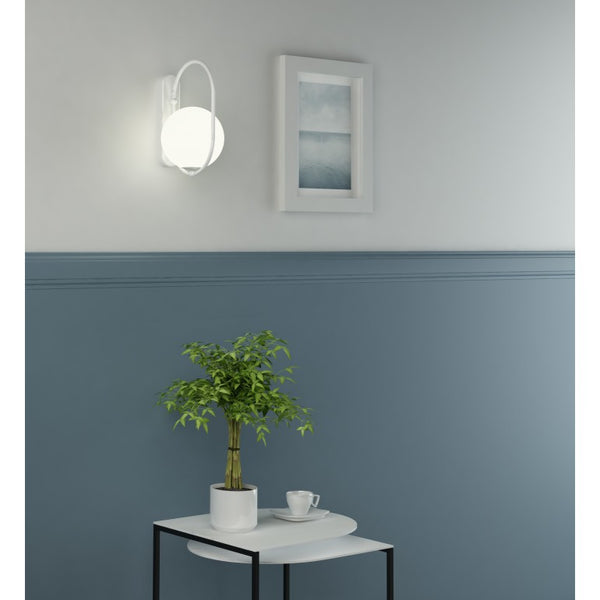
In a hallway, two or three low wall lights draw a path without lighting the whole floor. In an entrance, a model with an integrated switch avoids searching for the button in the dark. The Fenella ball mounts high on a narrow wall, and the modern models for hallways can be repeated along a wall.
Living room wall lights: what light and at what height?
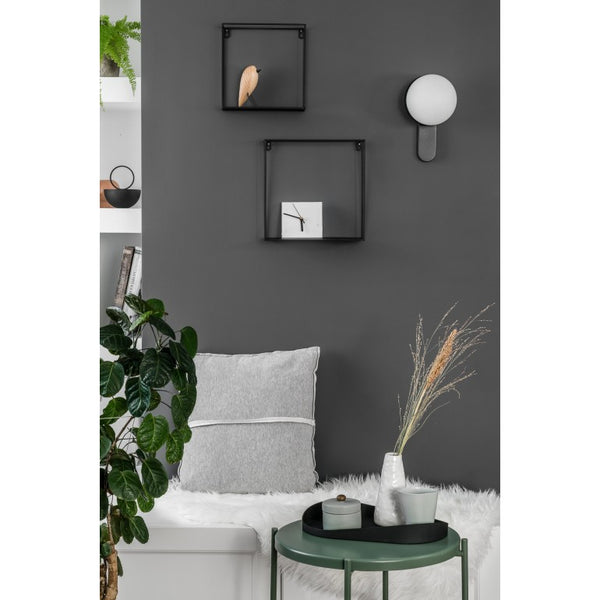
In a living room, a wall light works as accent lighting: placed around 1.70 m to 1.80 m from the floor, or at shoulder height near a sofa and a bookcase. Opal glass diffuses a soft light without glare, and a dimmer allows lowering the intensity in the evening. On a staircase, repeat a compact model at regular intervals.
Installing a wall light above a sofa or bookcase.
Place it at shoulder height of a seated person, at a good distance from books to avoid heating the bindings. Two wall lights framing a bookcase give a symmetrical wall, and a horizontal arm directs the flow downwards. The Kaida globe fulfils this role without glare, like the wall lights for the living room.
IP44 bathroom pendant or wall light: which to choose?
An IP44 pendant lights widely in the centre of the room, a wall light frees the floor and the space above the sink. In a narrow bathroom, the wall light remains easier to place and adds no obstacle around the mirror or in front of the vanity top. For a stairwell, prefer repeating small wall lights to models designed to light a staircase.
How to choose the material, shape and socket of a wall light?
Three criteria determine the result: the material (opal glass for a diffuse halo, metal or aluminium for a clean line), the shape (ball, globe, round, tube) and the socket, most often G9, then E27, GU10, G4 or integrated LED. The socket determines the bulb, its colour temperature and its replacement.
Ball, globe, round or tube shape: what it changes on the wall.
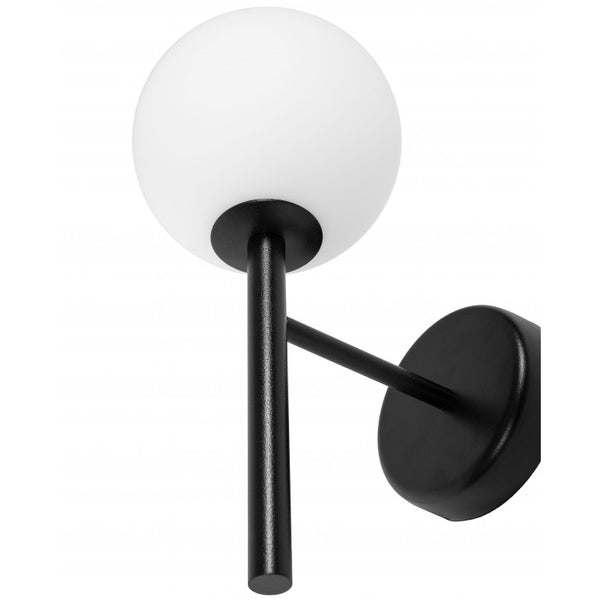
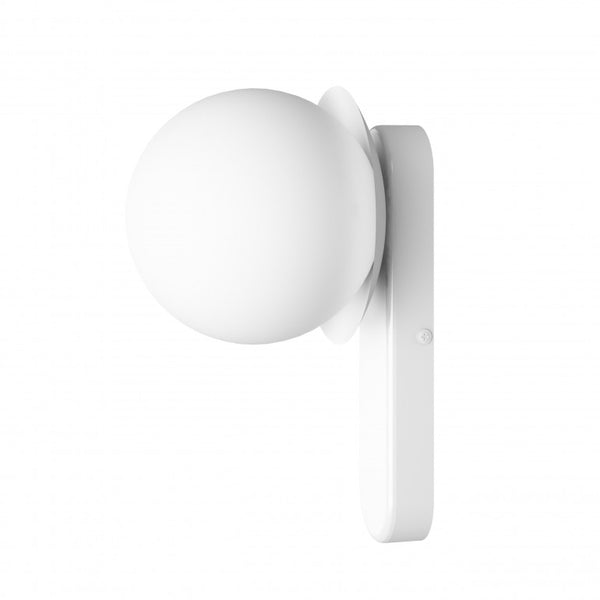
The ball and globe, often in opal glass, give a round halo and even light. The tube and round shapes lengthen the silhouette and suit long walls, above a mirror or a countertop. A black metal wall light erases the fixture and highlights the light on a pale wall.
G9, E27 or integrated LED socket: which bulb to plan for?
G9, with fine pins, dominates here and is easy to replace. E27 accepts a classic screw bulb, E27 socket models are quickly spotted. Integrated LED cannot be changed: it lasts but cannot be repaired. Check the socket on the product page before buying the bulb.
| Model | Shape | Material | Dimensions | Socket | Rooms mentioned |
|---|---|---|---|---|---|
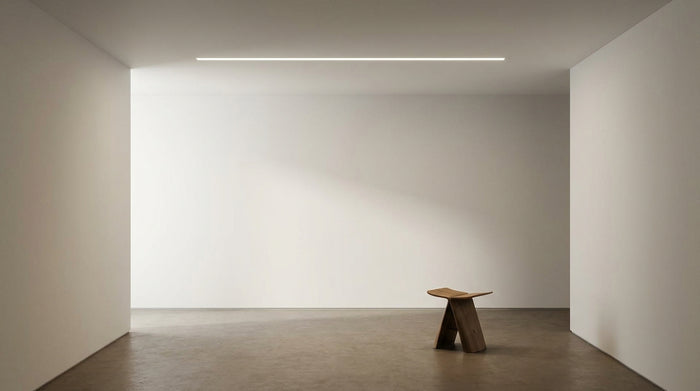
| Sereva | Linear tube | Metal | H 62 mm, W 900 mm, D 123 mm | Integrated LED | Bathroom |
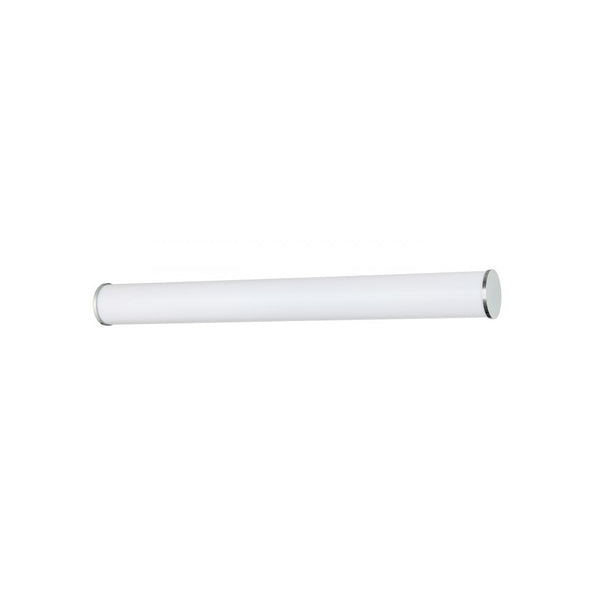
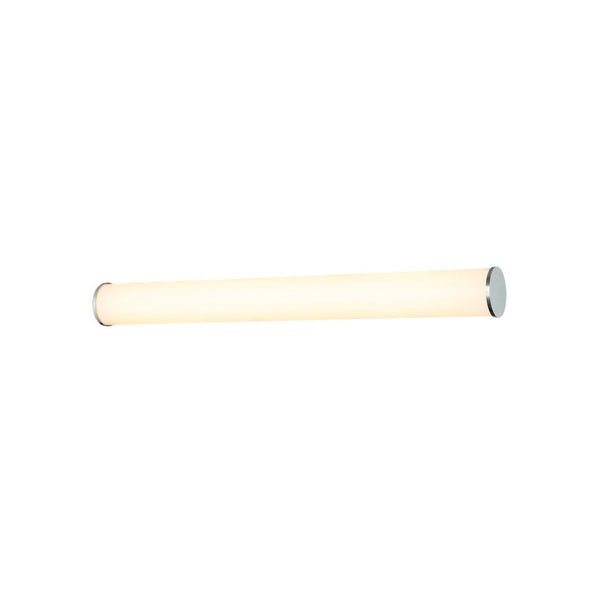
| Tubaluce | Tube | Aluminium | H 38 mm, W 550 mm, D 80 mm | Integrated LED | Bathroom |
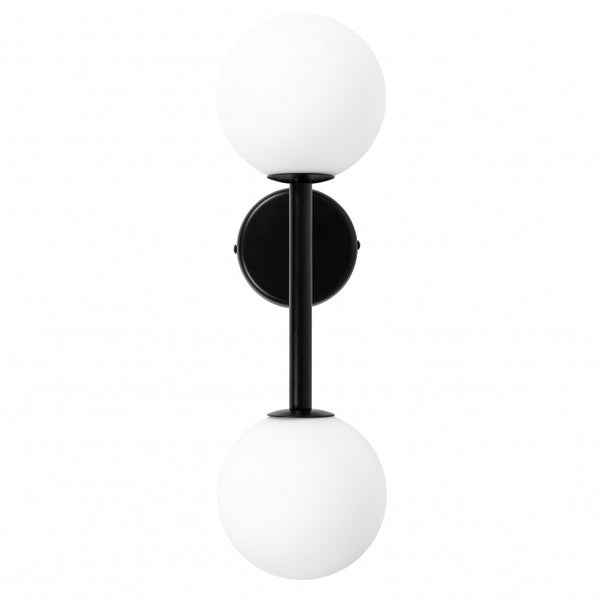
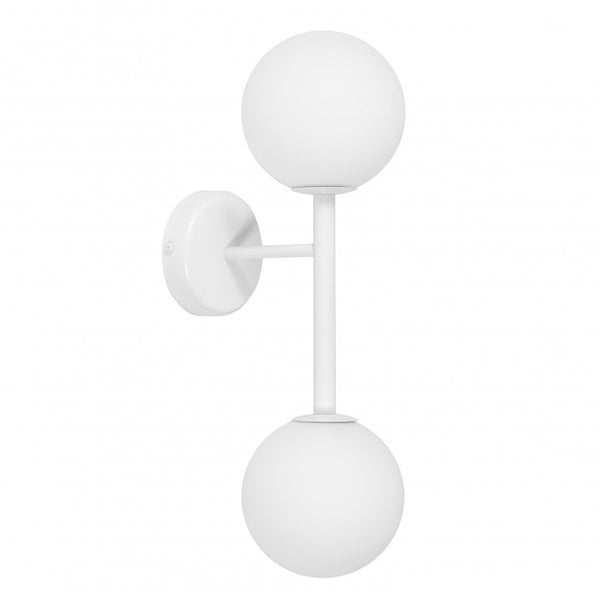
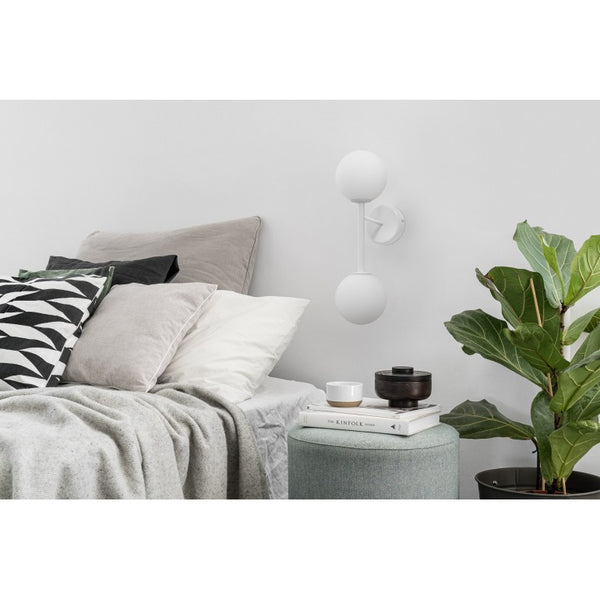
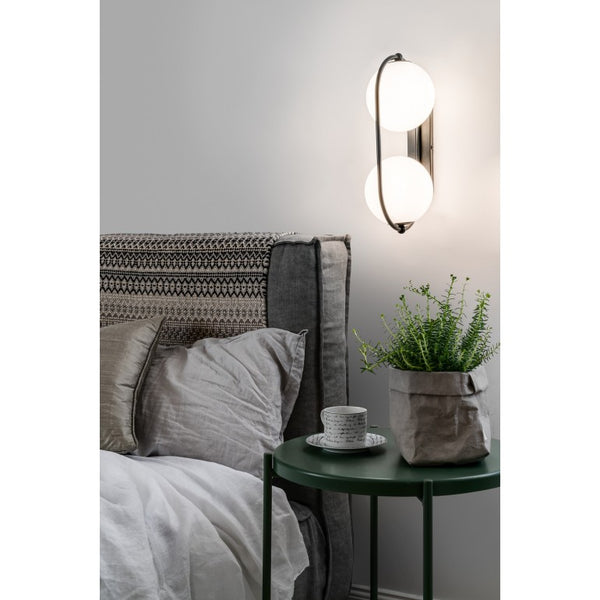
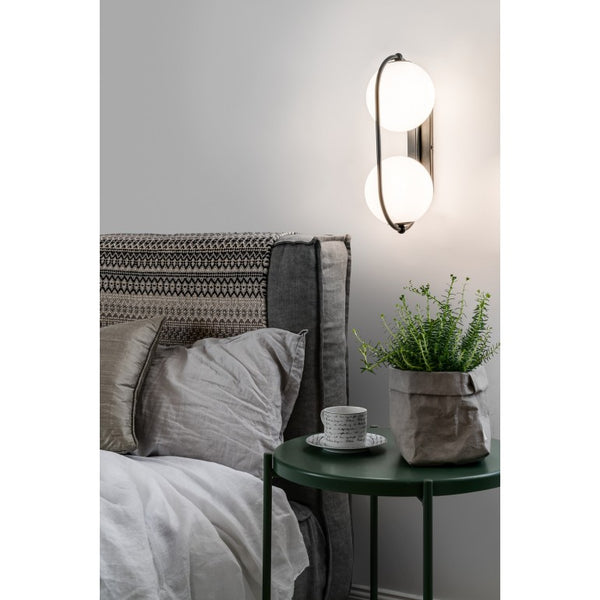
| Genevieve | Two stacked globes | Metal and glass | W 15 cm, D 23 cm, H 50 cm | G9 | Living room, bedroom, entrance, hallway |
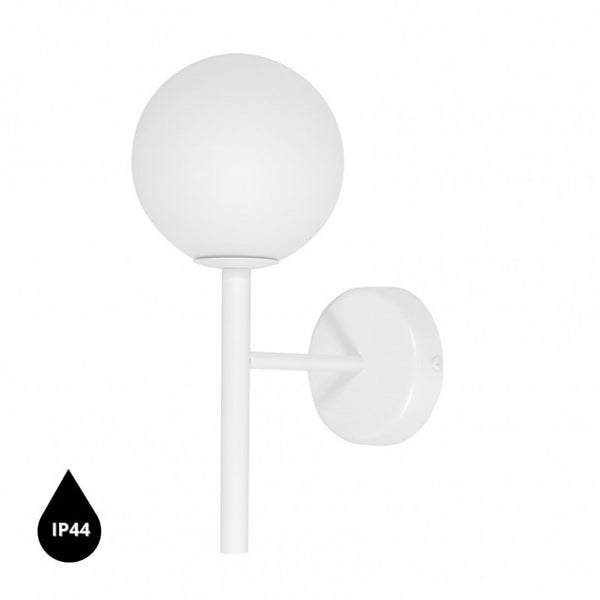
| Kaida | Globe | Opal glass and metal | W 20 cm, D 18 cm, H 20 cm | G9 | Living room, bedroom, hallway, toilet |
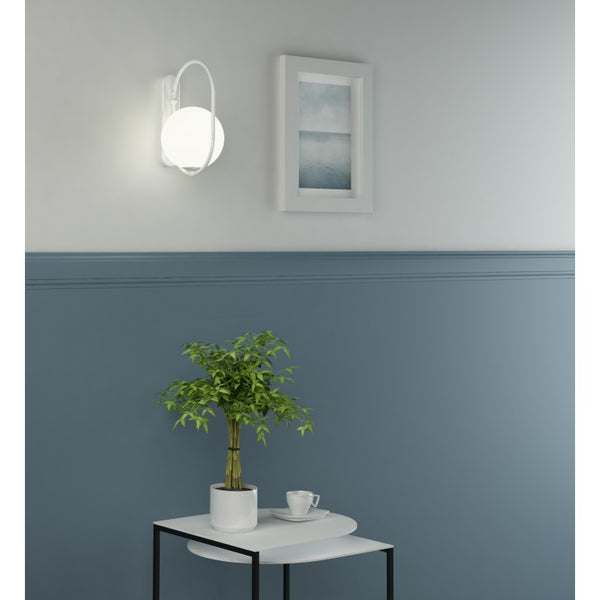
| Fenella | Ball | Opal glass and metal | W 5.7 cm, D 22.3 cm, H 38 cm | G9 | Entrance |
| Sakura | Japanese-inspired ball | Metal and glass | W 15 cm, D 17.5 cm, H 26.5 cm | G9 | Living room, bedroom, bathroom, entrance, office, hallway |
How does an IP44 wall light with a switch work?
A wall light with an integrated switch turns on directly on the wall, without going through a wall switch or a two-way switch: practical in an entrance or hallway. Connection is made on a flush-mounted box, with the power off at the circuit breaker, respecting the protection zones around the shower and sink.
Installation height, fixings and safety in a wet room.
Around a bathtub or shower, keep the light out of reach of a direct jet, about 60 cm from the edge of the basin for a bathroom mirror. Turn off the power at the circuit breaker before any connection and check the flush-mounted box. The design wall lights for bathrooms in the selection are installed this way.
Caring for opal glass and metal finishes.
A soft cloth is enough on opal glass and cut glass, without abrasive products that would dull the surface. On metal and aluminium, a slightly damp cloth followed by drying avoids marks. Avoid direct sprays on brass or gold finishes, which mark more quickly.
Unsure between several LED models for wet rooms? Compare the product pages, dimensions and socket in hand, then order the reference that fits your wall.
High-end, art deco or retro design wall lights: which style to choose?
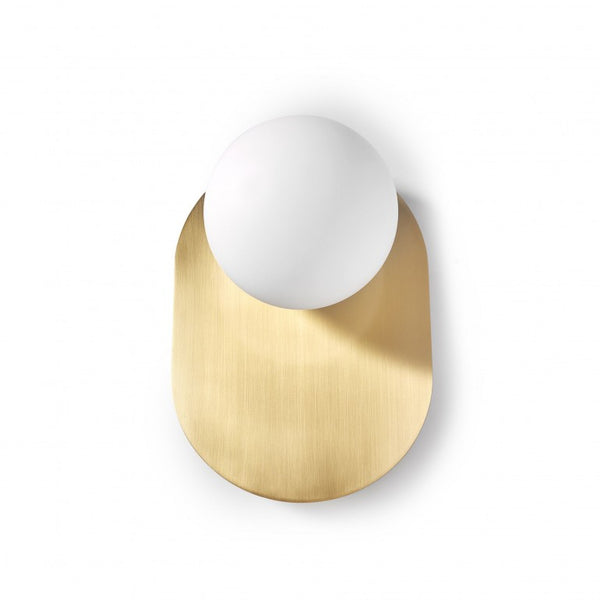
High-end is recognised by material and finish: cut glass, brass, steel, clean assemblies. The art deco or retro spirit plays on geometric shapes and gold and black contrasts, while a Japanese or minimalist style wall light relies on an opaline sphere and a fine arm.
Art deco and 1930s art deco wall lights: glass, brass and metal.
Art deco combines geometric volumes with light metals: brass, steel, sometimes cut glass that catches the light. These models are placed as accents, alone on a wall, rather than in a series. The gold and black finishes give this contrast without overloading the room.
Art nouveau, retro and wooden wall lights: which register?
Art nouveau favours soft curves and worked glass, retro favours round shapes and patinated finishes. A design wooden wall light warms a contemporary interior, while the retro spirit assumes a more pronounced silhouette. Choose a single register per room.
Dimmer wall light for an adult bedroom: which light to choose?
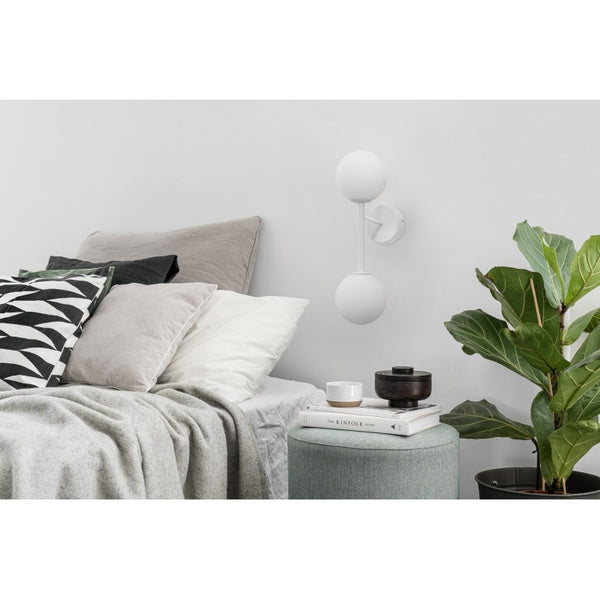
In an adult bedroom, aim for a warm light, around 2700 to 3500 K, and directed: the opaline sphere or glass globe avoids glare. A dimmer-compatible wall light allows switching from reading light to a very low ambience, on each side of the bed.
What colour temperature for an adult bedroom?
Around 2700 to 3500 K, warm white rests the eye in the evening and remains pleasant for reading. Above 4500 K, cool white wakes you up: reserve it for a hallway or a work room. The selection for bedroom wall lighting follows this direction.
Two wall lights on either side of the bed: symmetry and height.
Place them at the same height, often around 1.20 m from the floor, 50 or 60 cm on each side of the bed, for direct access without moving. An integrated switch avoids getting up and dimmer wall lights lower the intensity as the evening goes on.
What mistakes to avoid with a wall light for a wet room?
The most common mistakes: installing a model not suitable above a water point, forgetting dimmer compatibility, overestimating the format compared to the available wall, choosing a bulb incompatible with the socket, or neglecting glass maintenance. Check the IP rating, actual dimensions and socket before drilling.
- Confusing IP44 with total waterproofing: no model in the selection can be immersed in water.
- Installing a wall light that is too wide on a narrow wall; a 20 cm diameter ball is often enough.
- Buying the bulb before knowing the G9, E27, GU10 or G4 socket indicated on the product page.
- Repeating high-end pieces along a hallway instead of installing just one, as an accent.
To compose an entire room, start from the entire lighting range and cross-reference the collections. Each product page indicates the rating, material and dimensions, which allows comparing before ordering. Secure payment, tracked delivery, returns and Designix customer service accompany each order, and our teams answer if any doubt remains about the socket or height.
Now locate your spot, note the wall width and mirror height, then open the selection of IP44 wall lights to choose the model that matches. The grid displays the current price of each reference.
Frequently asked questions about IP44 wall lights
What effect does a black IP44 wall light give?
Matte or lacquered black erases the fixture and highlights the light: the sphere or tube stands out clearly on a pale wall, in a bathroom, entrance or hallway. It is the most common colour in the collection, often combined with opal glass.
Which wall lights to choose for a staircase?
On a staircase, prefer a compact and understated model, placed at shoulder height and regularly spaced, to light each step without creating harsh shadows. An opaline diffuser or a linear tube gives continuous light along the handrail.
How to recognise a high-end design wall light?
High-end is read in the material and assembly: cut glass, brass or steel, regular lines, clean finishes at the joints. These models are placed as an accent point, alone on a wall, rather than in a series along a hallway or staircase.
Can an IP44 wall light be installed in the kitchen?
Yes, IP44 is suitable behind a countertop or near a sink, where splashes are possible. Choose a slim model, in aluminium or metal, which lights without cluttering, and check the power and socket before purchase.
IP44 bathroom pendant or wall light: which to choose?
An IP44 pendant lights widely in the centre of the room, a wall light frees the floor and the space above the sink. In a narrow bathroom, the wall light remains easier to place and adds no obstacle around the mirror or in front of the vanity top.