Designer wall lights for bathrooms
- Tracked delivery to your country Tracked delivery
- Secure payment at checkout Multiple payment methods
- 14 days to change your mind 14-day returns
- Secure payment Secure payment


Not sure of your style? Find it in 30 seconds
A few questions, and we will show you the pieces made for you.



















Frequently asked questions
How do I choose the right product?
What are the delivery times?
Can I return an item?
Can I pay in instalments?
An interior that reflects who you are
Carefully selected pieces, shipped from our warehouses. Our team advises you before you buy, so you choose with confidence.
- Tracked delivery
- Pay in instalments, where available
- 14 days to change your mind
- Advice & showroom in Lyon, France
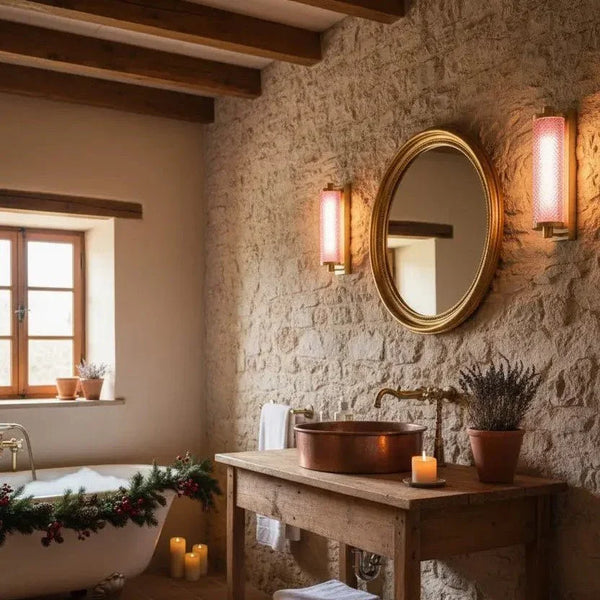
Plan two layers of light: soft general lighting for the room, and a targeted wall light around the mirror, positioned at face height. One wall light on each side of the mirror, or a single one just above, removes shadows and keeps skin tones accurate. The light colour is chosen next, between warm white and cool white.
- What is the ideal lighting for a bathroom?
- What are the lighting trends in 2026?
- How to choose a designer wall light?
- IP44, IP54 or IP65?
- Which material and colour to choose?
- Which socket and which technology?
- How to install and maintain?
- Where to place a designer wall light?
What is the ideal lighting for a bathroom?
A bathroom is lit in two layers: soft general light and targeted lighting on the mirror. Placed on each side or just above, the wall light removes shadows on the face. A warm white light (2,700 to 3,500 K) suits relaxing moments, while a cooler light helps with makeup.
Indoor bathroom wall light: which side of the mirror should it go?
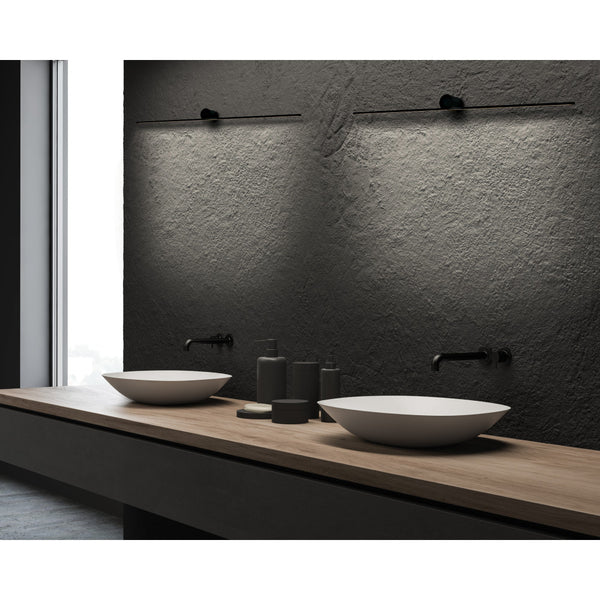
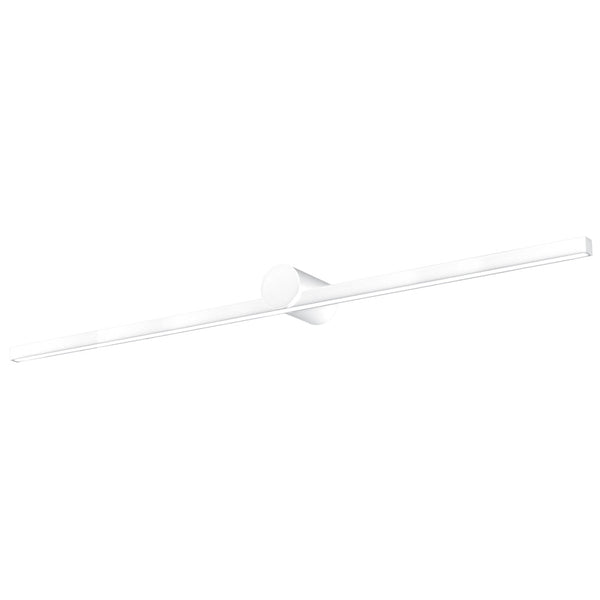
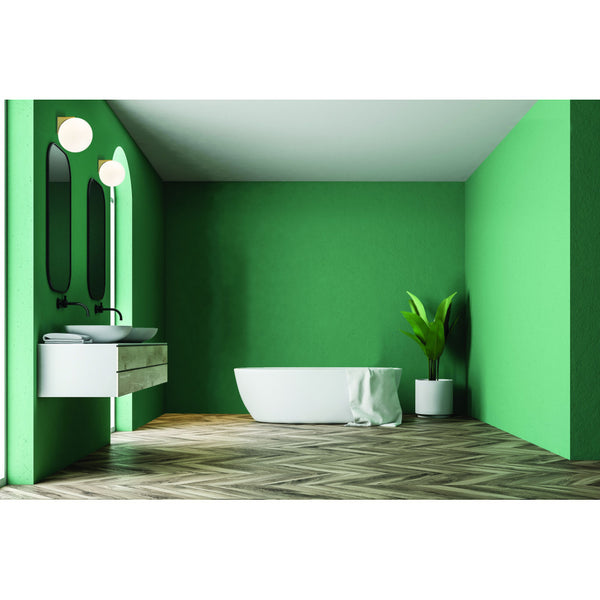
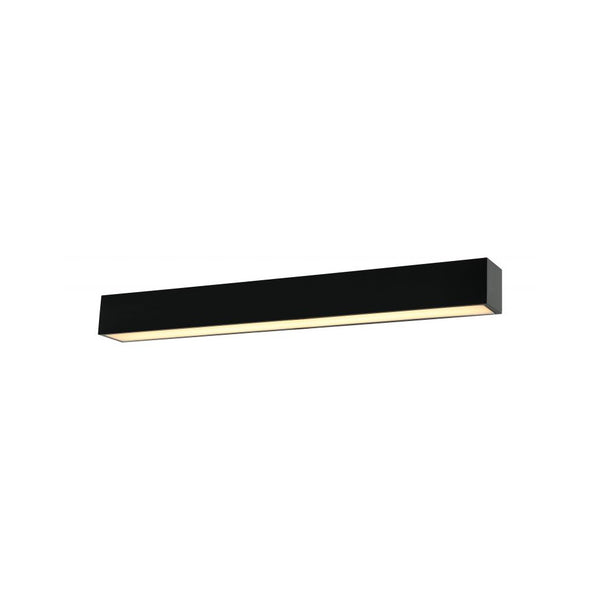
Two symmetrical wall lights, on either side of the mirror, give the most even light: the face is lit from left and right, with no shadow under the eyes. Allow around 60 to 80 cm between the two light points depending on the width of the mirror, and keep the same distance on each side. On a narrow wall, a single wall light above the mirror works, provided it shines downwards. Among the LED bathroom wall lights, horizontal tubes from 600 to 900 mm cover most single vanity units.
Warm white or cool white: which light to choose for the bathroom?
Around 2,700 to 3,500 K, the light is warm: it relaxes, and it suits evening baths and rooms without windows that need warming up. Between 4,500 and 6,500 K, it becomes cool and precise, useful for shaving or applying makeup without colour errors. A common compromise is to have warm general lighting and a more neutral mirror light.
What are the bathroom lighting trends in 2026?
Bathroom wall lights are moving towards fine lines: LED bars, elongated tubes and rings, often in aluminium or metal. Sand white and matte black dominate, while gold and brass warm up light rooms. Integrated LED is gradually replacing exposed sockets, and central modules structure large walls.
Art deco bathroom wall light: which finish for this style?
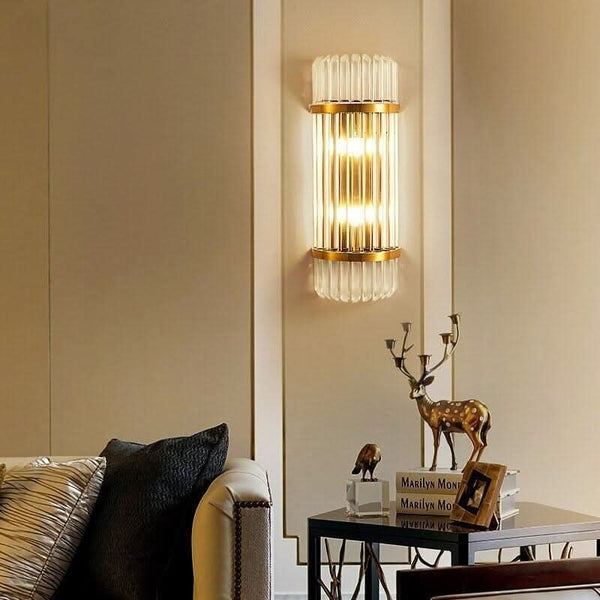
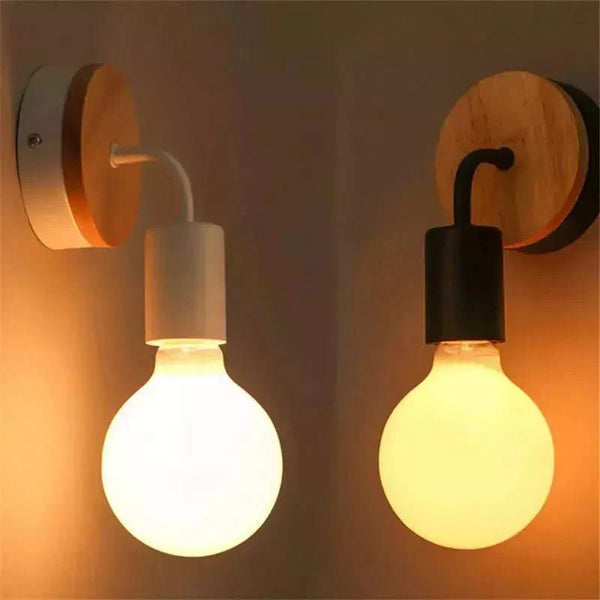
The art deco style plays on geometric shapes, rings and gold finishes. Ring, glass ball or gold central ring models give that look, and several art deco style wall lights exist in LED and socket versions. If you are looking for something more old-fashioned, look at vintage inspiration, retro models or wooden wall lights.
Tube, ring or ball shapes: which silhouette for which wall?
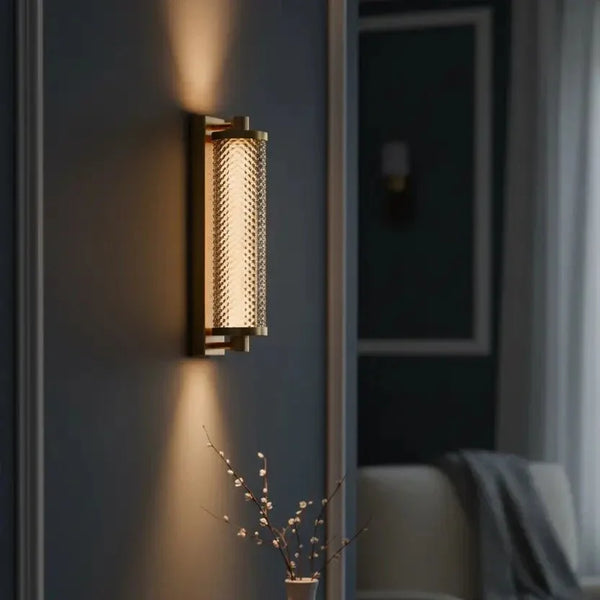
The horizontal tube highlights a wide mirror and visually lengthens a small wall. The ring and the ball take up less width and suit a narrow wall, on each side of a round mirror. Oval or original shapes are reserved for a bare wall, where they become the focal point of the room. The oval shape and round silhouette remain in the minority in our catalogue: check the dimensions before drilling.
How to choose a designer wall light for your bathroom?
Start from the wall and the mirror: a 600 mm wall light suits a single mirror, an 810 to 1,000 mm bar structures a large wall or a double vanity. Then come the light colour, the type of fixing and the protection rating.
600, 810 or 1,000 mm length: which LED bar for which mirror?
For a single mirror, a 600 mm bar is enough and stays discreet. Beyond 800 mm of mirror, an 810 mm bar balances the composition; on a large wall or a double vanity, a 1,000 mm length avoids the empty effect above the surface. Allow around two thirds of the mirror width as a starting point, then adjust according to the wall recess.
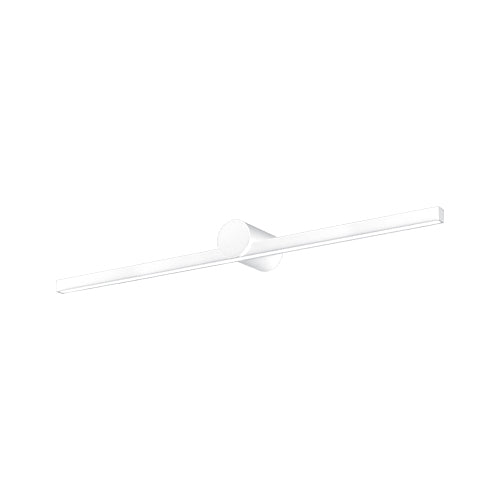
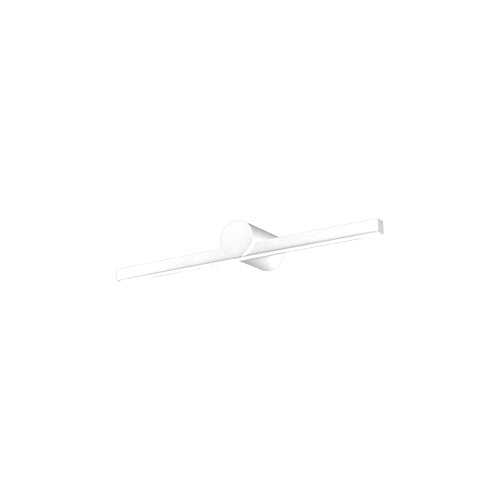
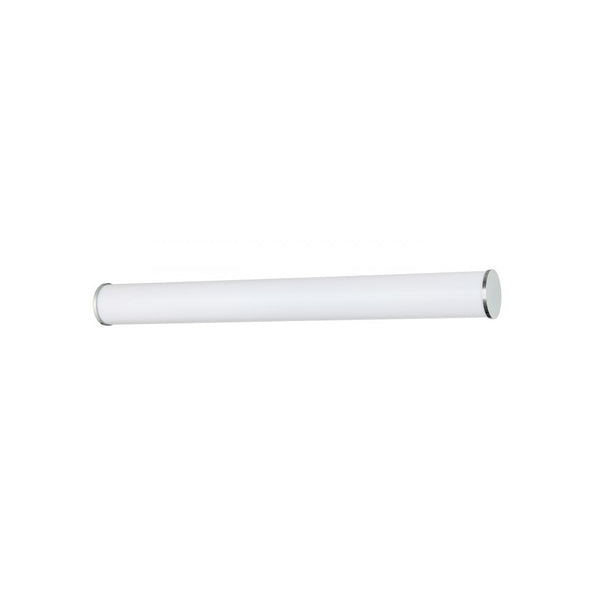
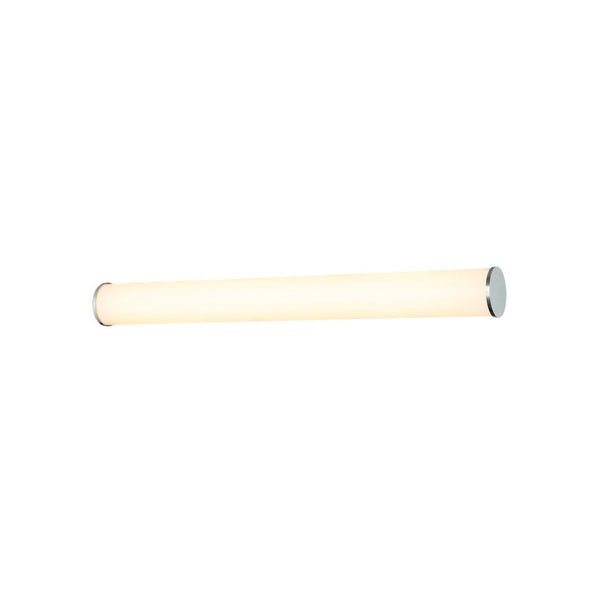
For a single mirror in sand white, the Sereva linear wall light On a large black and white wall, the Wendélia light bar And if you are looking for a shiny finish above the washbasin, the Chromius chrome wall light measures 600 mm and stays at IP44.
Which LED power for a bathroom wall light?
On a bathroom wall light, power follows length: a compact model around 7 to 10 W, a medium bar 12 to 17 W, a long bar 20 to 24 W. The number of modules spread along the bar matters as much as the total power, because it determines the evenness of the light along the mirror.
IP44, IP54 or IP65: which protection to choose in the bathroom?
The protection rating measures resistance to water and dust. Around the washbasin, an IP44 wall light is enough. Near the shower or bath, IP54 is preferred, or even IP65 in case of direct splashes. Away from water points, an IP20 model remains usable.
Near the shower or washbasin: which IP rating for the wall light?
The reasoning is simple: the closer you get to water, the higher the rating must be. Around the mirror and washbasin, IP44 models cover everyday use, including splashes from washing hands. On a shower wall or above a bath, aim for IP54, and IP65 protection if the jet can reach the light directly.
Can an IP20 wall light stay in a bathroom?
Yes, provided it stays away from splashes. An IP20 model goes on a dry wall, away from the shower, bath and washbasin, for example near the entrance or above a unit away from the water area. In this case, check above all the mounting height and the fixing, not the rating.
Designer bathroom wall lights: which material and colour to choose?
Metal and aluminium dominate, often combined with glass or acrylic for the diffuser. Sand white brightens small rooms, matte black marks a light wall, gold and brass warm up a sober bathroom. Iron and glass add a more decorative touch.
Metal, aluminium, brass or iron: what it changes day to day
Anodised or lacquered aluminium stays light and cleans with a soft cloth: it is the most common material on bathroom bars and tubes. Lacquered metal accepts the same care but shows finger marks more on glossy finishes. Brass and iron give a warmer look, with a patina that evolves gently; brass and gold finishes pair well with light tiles or a stone worktop.
Matte black, sand white or gold: which finish to match the room?
Sand white blends into a light wall and visually enlarges a small bathroom: it is the most neutral choice. Matte black creates a sharp contrast on white tiles or light concrete, and highlights the line of a bar; find these black wall lights for that graphic look. Gold brings warmth without changing the light colour, provided you keep to one gold piece per wall to avoid overload.
Which socket and which technology for a bathroom wall light?
Most models in the collection are integrated LED: nothing to change, even light along the whole length. Others keep an E27, GU10, G9 or G4 socket, handy for adjusting the colour temperature or replacing the bulb. Some models accept a dimmer.
Designer halogen or integrated LED: what to choose today?
Integrated LED cannot be replaced: the light lasts, the light stays identical from one end of the bar to the other, but you will not be able to change its temperature after purchase. A bulb model, including a designer halogen setup kept for its look, leaves the choice: you replace the bulb, switch from warm white to cooler white, adjust the power. Integrated LED suits those who want to forget about it, a replaceable bulb suits those who like to adjust.
E27, GU10, G9, G4: which socket for which need?
The E27 socket takes the most common and most powerful bulbs, handy for a single wall light. GU10, often in an adjustable spot, is used to direct light towards the mirror. G9 and G4 are more compact and suit small volumes, glass balls or rings. G4 remains the smallest of the four and is limited to lightweight lights.
How to install and maintain a bathroom wall light?
Fix the wall light at face height, on each side of the mirror or just above, away from the vanity surface. Connection is done with the power off, on a flush box or surface-mounted depending on the model. A soft cloth is enough for aluminium, glass and acrylic.
At what height and distance from the mirror should the wall light be fixed?
Place the centre of the light at eye level, around 1.70 to 1.80 m from the floor in a standard bathroom, to light the face and not the top of the head. Allow around 15 to 20 cm between the wall light and the edge of the mirror, and keep the same measurement on both sides if you install two. Mark the holes with a pencil, check they are level, then switch off the power at the breaker before connecting.
Cleaning an aluminium, glass or acrylic wall light
On aluminium and lacquered metal, a slightly damp microfibre cloth is enough; avoid abrasive products that scratch the lacquer and solvents on glossy finishes. The glass and acrylic of the diffuser are cleaned with mild soap, then dried to avoid limescale marks, common in a bathroom. Always switch off the power before handling a diffuser.
Where to place a designer wall light: bathroom, bedroom, hallway or living room?
These wall lights work just as well in a bathroom as in a bedroom, living room or hallway. Adjustable models and rings suit a headboard, long bars highlight a hallway or stairwell. The style stays the same, only the protection changes depending on the room.
Modern kitchen decor: extending the style into neighbouring rooms
A fine bar placed above a worktop echoes the line of a bathroom wall light: it is the same vocabulary of shapes and finishes. For a modern kitchen decor, choose a length close to that of your splashback and stay in the same colour family. The same reasoning applies to the toilet and to a hallway and entrance, where a compact wall light lights without cluttering.
Dining room and living room lighting: which wall lights for other rooms?
In a living room or dining room, the wall light serves as additional lighting, often alongside a central light fitting: a pair framing a console or a sideboard works well. In a bedroom, an adjustable wall light near the bed replaces the bedside lamp and frees up the bedside table. Browse bedroom lighting and living room wall lights to find the same finish in a suitable version. For a staircase, a discreet bar placed high up guides footsteps without dazzling.
Which wall light for which area of the bathroom?
| Area | Protection rating | Recommended format | Models in the collection |
|---|---|---|---|
| Around the mirror, washbasin side | IP44 | Horizontal bar or tube from 600 to 900 mm | Sereva, Caldanara, Delvino |
| Near the bath or shower | IP54 | Tube or bar from 610 to 1,000 mm | Sordanina, Obelix, Wendélia |
| Dry wall, bathroom entrance | IP20 | Compact or adjustable wall light | Orientia, Erao |
| Large wall, double vanity | IP54 | Long bar from 810 to 1,000 mm | Licea, Rovélio |
| Narrow vanity surface | IP44 | Vertical cylindrical wall light | Valérié, Chromius |
| Model | Length or height | Main material | IP | Power | Socket |
|---|---|---|---|---|---|
| Sereva | 900 mm | Metal | IP44 | 20 W | LED |
| Caldanara | 600 mm | Aluminium | IP44 | 12 W | LED |
| Sordanina | 1,000 mm | Aluminium | IP54 | 21 W | LED |
| Wendélia | 1,000 mm | Aluminium | IP54 | 21 W | LED |
| Obelix | 610 mm | Aluminium | IP54 | 10 W | LED |
| Chromius | 600 mm | Metal | IP44 | 15 W | LED |
As for sockets, a few models move away from integrated LED: Orientia is E27 and accepts a dimmer, Erao is GU10, and the small ring or ball shapes sometimes use G9 or G4. The choice therefore comes down to a fixed but even light and a bulb you replace. To widen the comparison, take a look at our selection of designer lights and gold finishes, which use the same shapes in other rooms.
Frequently asked questions
Which designer wall lights should I choose for a bathroom?
Start from the wall to dress: a fine bar from 600 to 900 mm for a single mirror, a wall light from 810 to 1,000 mm for a large wall or a double vanity. Then choose the finish (white, black or gold) and the protection rating suited to the distance from water.
Which art deco wall light for a bathroom?
The art deco style plays on geometric shapes, rings and gold or brass finishes. In the collection, ring, glass ball or gold central ring models give that look, in LED or socket versions, at IP20 on a dry wall and IP44 near the washbasin.
Can an IP20 wall light be installed in a bathroom?
Yes, provided it stays away from water splashes. An IP20 model goes on a dry wall, away from the shower, bath and washbasin. Around the mirror and near water points, an IP44 or IP54 wall light is better.
Can a wall light be installed in a shower?
In a shower, prefer a high rating: IP54, and IP65 in case of direct splashes. The fine aluminium wall lights in the collection, from 610 to 1,000 mm, exist in these ratings. Outside the cubicle, IP44 is enough.
Does an LED wall light use a lot of power?
The LED models in the collection show powers from 7 to 24 W depending on length and number of modules, with light spread along the whole bar and no bulb to change. For wall lights with E27, GU10, G9 or G4 sockets, consumption depends on the bulb chosen.
Order with confidence
Payment is secure, delivery is tracked and returns are possible if the model does not suit the wall. The Designix customer service team remains available for a question about length, fixing or socket choice. Take your mirror measurements, choose the finish, then compare the designer wooden wall lights or the black design models if you are looking for the same line for another room.