
Outdoor LED spotlights
This selection is also available in our French store: Spots d exterieur LED
No products in this selection.
- Tracked delivery to your country Tracked delivery
- Secure payment at checkout Multiple payment methods
- 14 days to change your mind 14-day returns
- Secure payment Secure payment
Not sure of your style? Find it in 30 seconds
A few questions, and we will show you the pieces made for you.
Frequently asked questions
How do I choose the right light output?
At what height should the light be installed?
What type of bulb?
Compatible with LEDs and dimmers?
Light changes everything
From statement chandeliers to discreet wall lights, we help you choose the right brightness, height and style for every room.
- Tracked delivery
- Pay in instalments, where available
- 14 days to change your mind
- Advice & showroom in Lyon, France
Start by identifying the area to be lit before choosing the model: a path is marked with low, widely spaced points, a terrace calls for adjustable spotlights aimed at the wall, a facade is highlighted with a narrow beam. The collection includes 19 spotlights: check the protection rating, material and colour temperature on each model, the three criteria that determine how long it lasts.
Which LED outdoor spotlight should you choose for each area?
A wide beam covers more surface but lights less far, a narrow beam reaches further over a small area. The spacing between two spotlights is therefore set by the beam angle of the model, never at random, to avoid shadow zones.
LED outdoor spotlights for a terrace
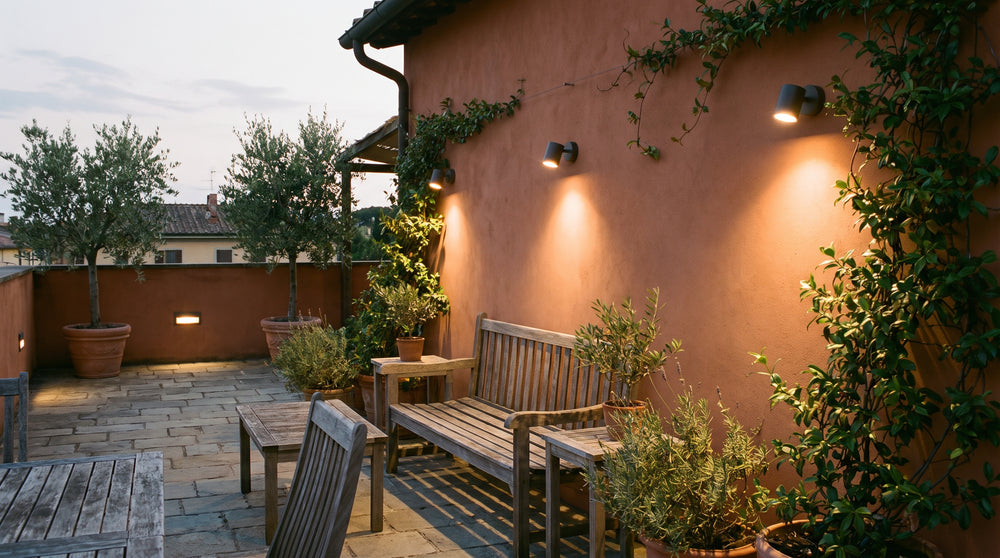
On a terrace, place the points around the edge rather than in line with the seating: the light then comes from the side and does not reach the eyes. Two or three adjustable spotlights are often enough to wash a wall, highlight a planted bed or light a coffee table. For a discreet result, recessed terrace spotlights blend into the slab and show only a circle of light. Those who prefer a visible object turn to garden spotlights with a crafted design.
Path, garden or facade: which beam direction?
A path is marked with a low, wide beam, aimed at the ground and never towards the walkway. On a facade, a narrow beam rises along the wall and reveals a texture, a porch or a house number. For an entrance, cross two directions rather than one: hard shadows disappear. Adjustable models you can aim are set after installation, once night has fallen.
| Area | Spotlight type | Installation | Result |
|---|---|---|---|
| Terrace | Adjustable spotlight | Recessed in the slab or wall-mounted | Lights furniture and wall without glare |
| Path and walkway | Low recessed spotlight | In the ground or gravel | Marks the route and reveals obstacles |
| Facade and entrance | Adjustable spotlight with narrow beam | Surface-mounted, on the wall | Highlights a wall, a porch or a house number |
| Garden and planted bed | Surface-mounted or stake spotlight | Fixed to the ground or staked | Lights a bed, a tree or a plot boundary |
Recessed, adjustable or surface-mounted outdoor spotlight: which installation should you choose?
A recessed spotlight disappears into the slab, wall or ground and lights only the target area. A surface-mounted spotlight is fixed to an existing support, with no recess to prepare. An adjustable model lets you readjust the beam after installation, which makes up for an uneven wall.
Recessed ground spotlight: what to plan before the slab
Recessing is decided before the work: a recess of the right diameter, cable routing and water drainage under the housing. In a slab or low wall, the opening is made during pouring or assembly. On a wooden terrace, avoid opening the boards: better to use a surface-mounted spotlight or one fixed around the edge, with water flowing under the decking. The details of recessed outdoor spotlights help frame the project.
Surface-mounted and adjustable spotlight: making up for an existing installation
A surface-mounted spotlight is fitted to a wall, post or bracket already in place, without touching the surface. This is the solution when the terrace has been tiled or the wall rendered for a long time. The adjustable version adds a swivel joint: the angle is corrected after fixing, which absorbs a crooked support. To set the beam direction without rework, this is the model to choose. Indoors, the same logic applies with adjustable indoor spotlights.
Which IP protection rating do you need for an outdoor spotlight?
The rating depends on the actual exposure of the light point: a spotlight sheltered under a canopy does not face driving rain like one planted in open ground. The higher the rating, the greater the resistance to water and dust. Each product page gives the rating of the model.
Understanding an IP rating: IP44, IP65, IP67
An IP rating is read in two digits: the first concerns solids, the second liquids. IP44 covers splashes and is enough under a canopy. IP65 withstands water jets and is required on an exposed facade wall. IP67 withstands temporary immersion, useful for a housing set in a slab or the ground. These markers come from trade standards: it is the product page that gives the actual value of the luminaire.
Material and durability: aluminium, stainless steel, glass
Outdoors, aluminium and stainless steel resist better than painted steel, which flakes at the corners. Tempered glass protects the LED from impacts and cleans without scratching. Seals and screws matter as much as the casing: they are the parts that give out after several winters. The finish also affects the visual match, between discreet white finishes and a more graphic matte black version.
| Exposure | Suitable rating | What it protects against |
|---|---|---|
| Under a canopy or roof overhang | IP44 | Indirect rain and light dust |
| Facade wall exposed to rain | IP65 | Water jets and splashes |
| Recessed in a slab, low wall or the ground | IP67 | Temporary immersion and run-off |
How do you install an LED outdoor spotlight?
You mark out the route and cable passages, then prepare the recess or bracket before connecting. Depending on the model, power comes from the mains or from a low-voltage transformer. Connection is done with the power off, and a dimmer should be planned from the start.
Recessing into a terrace, low wall or the ground
Three things determine success: the right recess diameter, a conduit for the cable and water drainage under the housing. Without drainage, water builds up and rises through the seals. In the ground, lay on a bed of gravel. In a low wall, give a slight outward slope and check that no screw holds rainwater.
Power supply, transformer and dimmer
Two families coexist: direct 230 V and low voltage with a transformer. Low voltage makes handled areas safer, planted beds or pool surrounds, but the transformer must be sized for the sum of the points. A dimmer is wired upstream: planning it afterwards means opening everything up again. Dimmable spotlights show how this control translates indoors.
Warm white or neutral white: which colour temperature outdoors?
Warm white creates a welcoming light, close to that of an interior, and suits terraces as well as facades. Neutral white, cooler, remains more readable for securing a path or an access. The exact colour temperature is given on each product page.
Terrace: atmosphere or safety?
Around 2700 to 3000 K, the light leans yellow and relaxes a terrace where you dine. Around 4000 K, it appears whiter and makes reliefs and obstacles clearer on a walkway. The choice follows the dominant use of the area, not a trend.
Matching outdoor spotlights with indoor lighting
On the same facade, keep a single colour temperature: two mixed shades are immediately noticeable. The same principle applies to a wall light, where you look at the material, the protection rating if it is outdoors, the shade and the way the light rises or falls along the wall. Indoors, living room lighting and staircase steps are handled with the same consistency.
Solar LED outdoor spotlight or mains-connected?
A solar spotlight installs without wiring where running a line is complicated, but it depends on sunlight and its battery charge. A mains-connected spotlight lights regularly all year round and can be controlled with a dimmer. The choice therefore comes down to the location.
Solar spotlights: for which uses?
Solar suits a planted bed, a plot boundary or a garden shed, in short a point you want to light without digging a trench. It disappoints in winter, under trees, or when the panel stays in shade part of the day: autonomy drops. Solar versions without wiring and solar garden lighting cover these cases.
What a dimmer or sensor adds
A dimmer adjusts the intensity according to the moment, strong when passing and soft on standby. A motion sensor switches on only when someone arrives, which suits an entrance or a technical passage. The two can be combined, provided you check on the product page that the models are compatible.
Which mistakes should you avoid with an LED outdoor spotlight?
The most frequent mistakes: a protection rating too low for the exposure, a beam aimed at a neighbour's window, a recessed installation without water drainage, or several colour temperatures mixed on the same facade. Checking the technical data before installation avoids redoing the work.
Glare and beam direction
A badly aimed spotlight glares more than it lights. Aim the beam at a surface to reveal, wall, planted bed or step, and not towards the eye. Lower the angle at ground level to limit reflections on tiles or a glazed door. If the light crosses a room, it also disturbs those inside.
Installation, drainage and neighbours
Anything that holds water eventually wears out the housing: recessing without a slope, a crushed seal, a cable that rises. As for neighbours, avoid beams that sweep the window opposite or the gate next door. Place the point set back and tilt it towards the ground. For the whole project, compare solutions in all our luminaires.
How do you maintain and make your LED outdoor spotlights last?
Cleaning with clear water and a soft cloth is enough to preserve the finish; remove leaves and soil around recessed spotlights so water can flow away. Checking seals, screws and the tightness of connections once a year extends the life of the luminaire outdoors.
Cleaning without damaging the finish
No abrasive product, no high-pressure jet on a housing: they attack the seal and the paint. A damp cloth, a little mild soap for stubborn marks, then drying. On glass, avoid scouring sponges that leave micro-scratches and dull the beam.
Annual checks before winter
Check the sealing of cable glands, tighten screws that have worked with temperature changes, and check that water does not stagnate around recessed housings. A point that flickers often signals moisture ingress, to be dealt with before the rainy season. To replace a damaged point while keeping the same spirit, also look at recessed indoor lighting.
Frequently asked questions
Which LED outdoor spotlight should you choose for a terrace?
Favour adjustable spotlights aimed at the wall or furniture rather than towards the eyes, and low, closely spaced points to mark the walkways. A housing recessed in the slab remains discreet; surface mounting suits if the surface is already laid.
Recessed or surface-mounted LED outdoor spotlight?
Recessed is reserved for a slab, wall or ground that can be opened, and it must let water flow away. A surface-mounted spotlight is fixed to an existing support, with no recess work. The adjustable version can be added in both cases to correct the beam direction.
Which IP protection rating for an outdoor spotlight?
The rating is chosen according to the exposure of the light point: the more the spotlight receives rain, splashes or run-off, the higher the rating must be. The exact rating of each model appears on its product page, to be checked before installation.
How many spotlights do you need to light a path?
There is no fixed number: spacing is set by the beam announced by the manufacturer and by the installation height, to avoid dark zones as well as overly marked patches. A night test, before final fixing, remains the best method.
Do LED outdoor spotlights withstand rain?
It all depends on their protection rating and their exposure: a spotlight sheltered under a canopy and one planted in open ground do not face the same constraints. The rating shown on the product page lets you check that the model matches the intended location.
Secure payment, tracked delivery, returns and Designix customer service accompany every order. First choose the installation, recessed or surface-mounted, then the protection rating according to the exposure of the light point; material, shade and accessories are decided afterwards. Browse our luminaire catalogue to compare models and their technical data.




