Blue lighting fixtures: which shade for which room?
This article is also available in French: Luminaire bleu
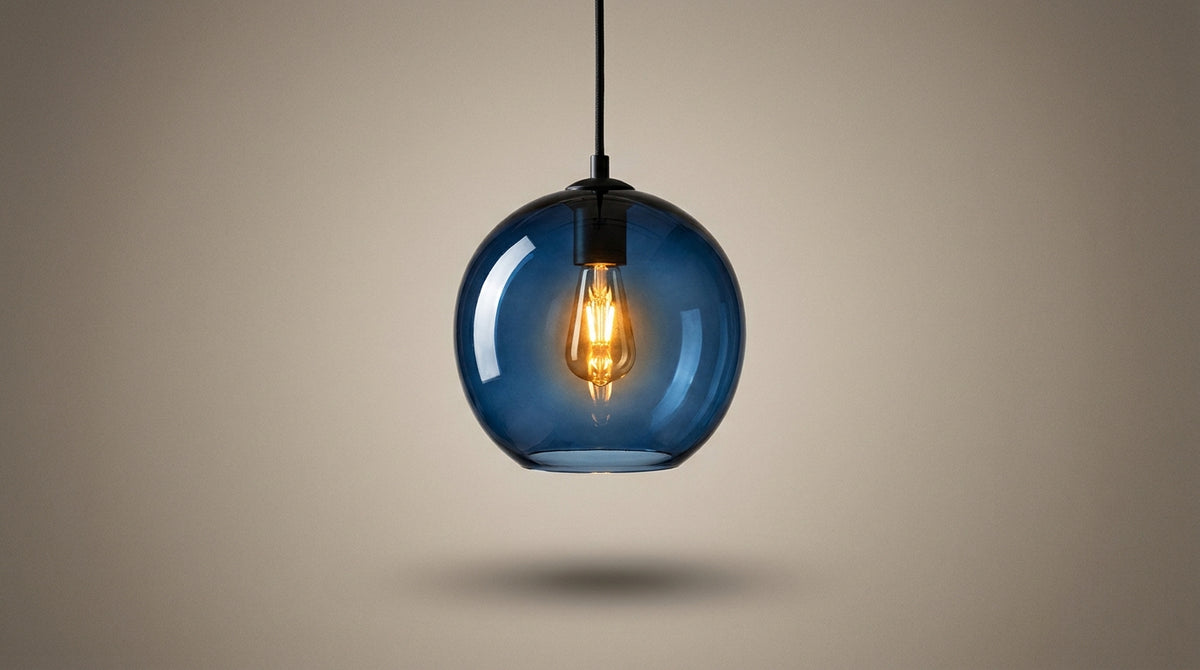
Choose the shade before the shape: sky blue in a room that lacks light, navy blue or teal where you are looking for calm. Then look at the dominant colour of the wall and floor. A blue light fixture should be checked in evening light, never from a screen photo.
Which shade of blue for your light fixture?
Sky blue brightens a dark wall, navy blue calms it. Teal, for its part, works well with brass and light wood. One rule holds: the more saturated the shade, the more generous the volume must be. To choose the light fixture, look first at its size, then at its colour.
Sky blue or navy blue light fixture: what does the shade change?
Sky blue reflects light, navy blue absorbs it. On a white wall, a sky blue blends in; a navy blue becomes the point of contrast. If you are hesitating with light shades, the comparison with a white light fixture gives you a solid reference point.
| Shade | Effect in the room | Where to dare it |
|---|---|---|
| Sky blue | Lightens, visually enlarges | Corridor, hallway, small bedroom |
| Powder blue | Softens without making a statement | Living room, dining room |
| Teal | Warms wood and brass | Kitchen, study |
| Navy blue | Absorbs, focuses attention | Bedroom, reading corner |
Teal and Majorelle blue light fixtures: where to dare them?
Teal works almost anywhere, Majorelle blue requires a neutral wall. Three uses hold up:
- Teal wall light: in a corridor or hallway, it colours the wall without darkening it.
- Royal blue pendant: above a table, provided it is the only strong colour in the room.
- Majorelle blue table lamp: on a light piece of furniture, it acts as a signature.
Blue also pairs very well with warm tones. An orange light fixture placed in the same room creates a sharp contrast, provided the rest stays neutral.
For a first blue room, the blue wall light remains the easiest format to commit to: small surface, immediate effect.
Does a blue light fixture give off blue light?
No. A blue shade filters the bulb's light, it does not colour it. The beam that comes out stays white, only cooler if the blue is dense. What decides the actual tint of a room is the colour temperature of the bulb, expressed in kelvins.
Does the colour of the shade change the light?
A blue fabric shade absorbs part of the spectrum. The halo on the ceiling leans towards grey, the beam downwards stays neutral. A translucent blue glass shade, on the other hand, really projects coloured light onto the wall.
Material therefore matters more than colour. On a survey of 250 references from our catalogue as of 11 November 2026, metal is declared on 82% of the listings and glass on 38%. An opaque metal shade directs the light without tinting it; coloured glass diffuses it in blue.
- Colour temperature: 2700 K for a warm white, 4000 K for a neutral white.
- Material: opaque metal or diffusing glass, two opposite results.
- Density of the blue: a pastel filters little, a deep blue darkens the halo.
A navy blue lit at 3000 K stays warm. The same blue under a cool bulb turns grey. The full reference guide is here: warm or cool light.
Blue light and sleep: what really matters
A blue light fixture does not emit blue light. Sleep is about the bulb and screens, not the colour of the shade. The subject is detailed in our article on blue light.
One last practical point: the colour of a light fixture does not attract insects. What attracts them is the light itself, as explained in light and mosquitoes.
If you are hesitating between two blues for the same wall, send us a photo of the room in evening light: we will decide with you, without jargon. The simplest is to talk about your lighting project.
Which blue light fixture for each room?
A blue wall light in the bathroom, a midnight blue bedside lamp in the bedroom, a low ceiling light in the kitchen. The room decides the mounting before the colour. In wet rooms, the protection rating comes before the shade.
In which room should blue come into your home?
Which light fixture for the bathroom?
A blue wall light in glass or painted metal, at IP44 minimum, placed on each side of the mirror. The rating matters: on the same survey of 250 references, 94% declare IP20, 2% IP44 and 3% IP65.
- IP44: the minimum to aim for around the washbasin.
- Frosted glass: diffuses without dazzling.
- Adjustable arm: avoids reflections in the mirror.
The model is chosen from our bathroom wall light selection.
The exact height and distance to the mirror are detailed in the guide to the bathroom pendant light.
Blue bedroom light fixture: why midnight blue sleeps better
A navy blue reflects little light: the lamp lights the book, not the wall. Falling asleep gains in contrast, provided you keep a warm bulb.
The blue bedside lamp sits on a bedside table, at mattress height.
If the furniture is cluttered, the blue pendant in the bedroom frees up the surface and lowers the light point to 60 cm above the bed base.
Which light fixture in a small kitchen?
A ceiling light or a light under the upper cabinets, not a low pendant. Under 2 m in width, a pendant above the island gets in the way. A design ceiling light fixed flush to the ceiling frees the worktop and keeps the colour visible.
Pendant, wall light or ceiling light in blue: which mounting should you choose?
Pendant for a table or an island, wall-mounted for a corridor or a headboard, surface-mounted when the ceiling is low. On a survey of 250 references from our catalogue as of 11 November 2026, 42% are pendants, 38% wall lights, 12% surface-mounted and 4% table lamps.
Another figure to keep in mind: blue does not appear among the four most declared colours in the survey (black 56%, gold 54%, white 43%, beige 16%). A blue light fixture is therefore a signature piece, to be chosen with full awareness.
Pendants, wall lights and floor lamps in blue from the selection
 Pendant light | Interlacia
 Pendant light | Nivara
 Pendant light | Ysandre
 Ceiling light | Bruna
 Living room floor lamp | Hyra
 Wall light | Sveva
See the whole selection: Alternative to Luminaire.fr: design lighting shop | Designix
How do you install a blue wall light?
- Height: 1.70 m to 1.80 m from the floor for everyday use, higher near a mirror.
- Alignment: line the wall light up with the edge of the mirror or the headboard, never a few centimetres from a corner.
- Orientation: an adjustable arm avoids direct glare.
- Control: wall switch or dimmer, never a visible cable.
Blue and brass: the pairing that ages well
Deep blue and brass warm each other up. A navy blue wall light on a gold socket holds up over the years without going out of fashion, whereas a very saturated blue on white plastic ages badly.
The same balance exists with black and gold: see our article black and gold for finish pairings.
In a reading corner, a blue floor lamp with an adjustable arm handles the lighting for the armchair without drilling into the wall.
In stock · shipping costs shown at checkout · up to 30% off in your cart


Ready to turn inspiration into reality?
Tell us about your room, your style and your budget, and we will show you the pieces that truly suit your project.
Get guidance in 30 seconds →