
Bronze spotlights
This selection is also available in our French store: Spots en bronze







- Tracked delivery to your country Tracked delivery
- Secure payment at checkout Multiple payment methods
- 14 days to change your mind 14-day returns
- Secure payment Secure payment
Not sure of your style? Find it in 30 seconds
A few questions, and we will show you the pieces made for you.
Frequently asked questions
How do I choose the right light output?
At what height should the light be installed?
What type of bulb?
Compatible with LEDs and dimmers?

Light changes everything
From statement chandeliers to discreet wall lights, we help you choose the right brightness, height and style for every room.
- Tracked delivery
- Pay in instalments, where available
- 14 days to change your mind
- Advice & showroom in Lyon, France
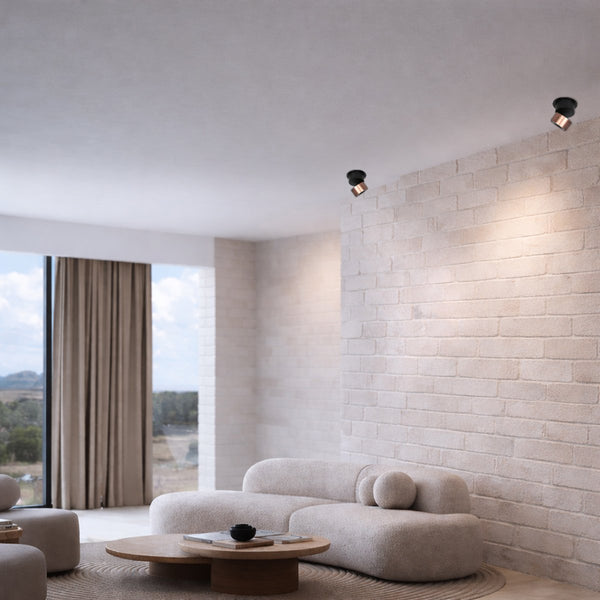
Place a bronze spotlight where the light needs to fall precisely: above a worktop, in a hallway, on a wall or near a piece of furniture. The bronze finish warms both light wood and dark surfaces. The light colour, meanwhile, is chosen with the bulb, not the metal.
- What light does a bronze spotlight give?
- Where to install a bronze spotlight in the home?
- How many spotlights in a kitchen?
- How to arrange spotlights on the ceiling?
- How to wire spotlights in series or parallel?
- Recessed spotlight, surface-mounted spotlight or adjustable projector?
- Which base to choose: GU10, E27 or integrated LED?
- How to care for a bronze spotlight?
What light does a bronze spotlight give?
A bronze spotlight directs light onto a worktop or a wall, with coppery reflections that warm the room. The source is an integrated LED, a GU10 bulb or an E27: the light colour depends on the bulb, the bronze finish only changes how the lit metal looks. Generally, a bulb around 2700 K gives a warm white for a living room or dining area, and a temperature of 3000 to 4000 K a more neutral white for a kitchen or dressing room, where you sort and read.
What is the natural colour of bronze and how does it change?
Bronze is an alloy of copper and tin: its natural shade ranges from golden brown to dark reddish brown, and it darkens over time. On a light fixture, it is most often a bronze finish applied to metal or wood.
Brushed or aged bronze: what it changes on a spotlight
The choice comes down to decor more than light. Brushed bronze, with fine grain and an even shade, suits a dark worktop or a dark splashback. Aged bronze, more matte and irregular, pairs better with light wood and second-hand furniture. To compare finishes, browse the metal-finish spotlights from the house.
Where to install a bronze spotlight in the home?
A bronze spotlight goes on the ceiling of a kitchen, a hallway, a living room, a dressing room or an entrance, recessed or surface-mounted. The IP44 models in the selection can also be used outdoors and on a terrace, where an IP20 remains reserved for dry rooms. The rest of the lighting range follows the same logic of protection rating.
| Room | Recommended format | Protection rating | To check |
|---|---|---|---|
| Kitchen | Recessed adjustable or surface-mounted above the worktop | IP20 | Align with the worktop and the walkway |
| Hallway | Surface-mounted or low-profile recessed | IP20 | Avoid glare in a narrow passage |
| Living room | Adjustable or discreet recessed | IP20 | Aim at a wall or a bookcase, not the sofa |
| Dressing room | Recessed or surface-mounted | IP20 | Light both sides of the wardrobe |
| Entrance | Adjustable surface-mounted | IP20 | Plan a point above the furniture |
| Terrace and outdoors | Recessed IP44 | IP44 | Exposure to moisture and rain |
Bronze ceiling spotlights: which rooms to place them in?
A living room gains targeted accent lighting aimed at a piece of furniture or a picture. LED spotlights for living rooms are placed around the edges, never straight in line with the seats. For a bedroom, low points aimed at the wall are better than spotlights in line with the bed.
Recessed bronze spotlights: hallway, dressing room, entrance
In a hallway, the aim is to mark out the floor without breaking up the ceiling: hallway spotlights are placed in a line, evenly spaced. In a dressing room and an entrance, the goal is different: to light two rows of clothes or a low piece of furniture. Bedroom spotlights complete this type of installation in a softer version.
How many spotlights in a kitchen?
The number depends on the area to be lit and the power of the models: an 8 W LED module or a 25 W max spotlight covers one work zone, a 2 x 8 W model covers two. Start with the worktop, then complete the room's general ambience. The collection brings together 16 models, from the integrated LED spotlight to the spotlight with an interchangeable bulb.
Lighting the worktop and the dining area
The worktop needs light falling vertically, without a shadow cast by the person cooking. The dining area is treated separately, with a more diffuse point above the table. LED spotlights for kitchens cover this type of configuration, and recessed kitchen spotlights fit in when the ceiling is being redone.
8 W, 25 W max or 40 W: which power for which use?
An 8 W LED module suits a compact zone, a double 2 x 8 W suits a longer worktop. A spotlight with a GU10 base of 25 W maximum remains flexible, since the bulb can be changed as needed. E27 models at 40 W light a wider area and suit an entrance or a living room.
How to arrange spotlights on the ceiling?
Line up the spotlights with the useful zones rather than the centre of the room: one line above the worktop, another in the walkway. Adjustable models are set after installation to aim at a wall, a piece of furniture or a worktop, without glare.
Alignment and spacing of ceiling spotlights
Spacing is set by the width of the furniture to be lit, not the bare surface of the room: start from the ends of the worktop and distribute between them. Even spacing avoids dark patches between two points. For models with a movable head, adjustable models make up for imperfect alignment after installation.
Placing spotlights around a pendant or a beam
Keep a clear distance between a spotlight and a pendant, so the two sources do not fight each other. Along a beam, align the spotlights with the beam itself or set them clearly apart. Style matters too: modern-style spotlights work well in a continuous line.
How to wire spotlights in series or parallel?
Parallel wiring feeds each spotlight independently from the same supply: if one point fails, the others stay on. Series wiring is reserved for special cases and should be checked with a multimeter. Connection to the mains is done with the power off, by a professional.
Series or parallel: what it changes at switch-on
In parallel, each fixture receives the same voltage and works on its own; this is the usual wiring for a kitchen or hallway ceiling. In series, the voltage is shared between the points and a break switches off the whole line. Dimmer-compatible versions are specified model by model, as compatibility is never universal.
What an electrician checks before connection
They check the circuit is switched off, identify the supply and the number of points planned, then check the compatibility of the bulb or module with the dimmer in place. For a new installation, recessed dimmable spotlights are prepared beforehand, before the ceiling is closed.
Recessed spotlight, surface-mounted spotlight or adjustable projector: which to choose?
A recessed spotlight blends into a ceiling and suits rooms being redone; a surface-mounted spotlight installs without cutting a recess and stands out as a decor element; an adjustable projector aims at a specific wall or worktop. The choice follows the state of the ceiling and the desired effect.
| Model | Format | Stated dimensions | Rooms mentioned |
|---|---|---|---|
| Spot James bronze, 53 cm | Linear surface-mounted, GU10 base | W 6 cm, D 53 cm, H 14.5 cm (also in 26 and 39 cm) | Kitchen, hallway, living room |
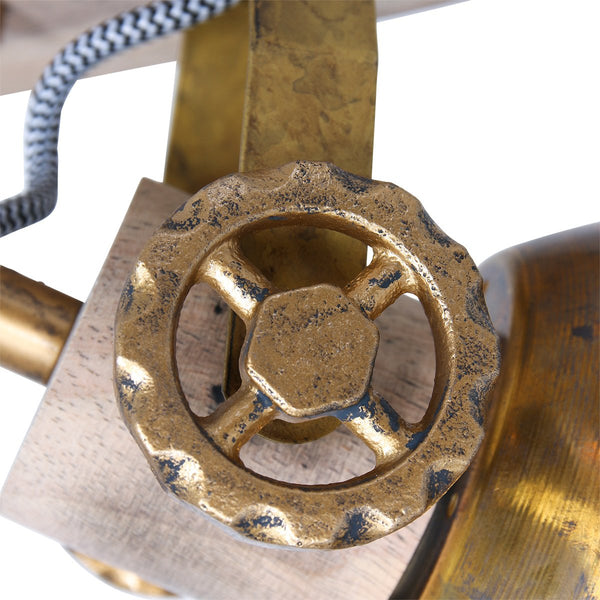
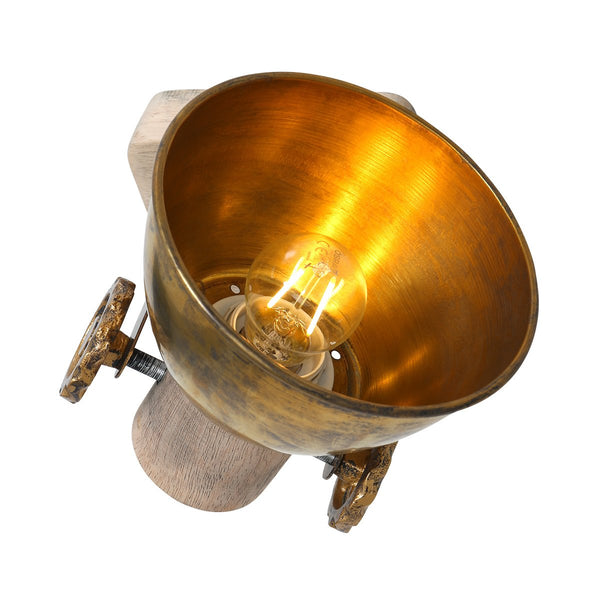
| Spot Brynora | Surface-mounted with conical cup, wood and bronze, E27 base | H 17 cm, D 24 cm | Kitchen, hallway, living room, entrance, dressing room |
| Spot Ralara | Double surface-mounted, light wood and aged brass, E27 base | H 16 cm | Kitchen, hallway, living room, entrance, dressing room |
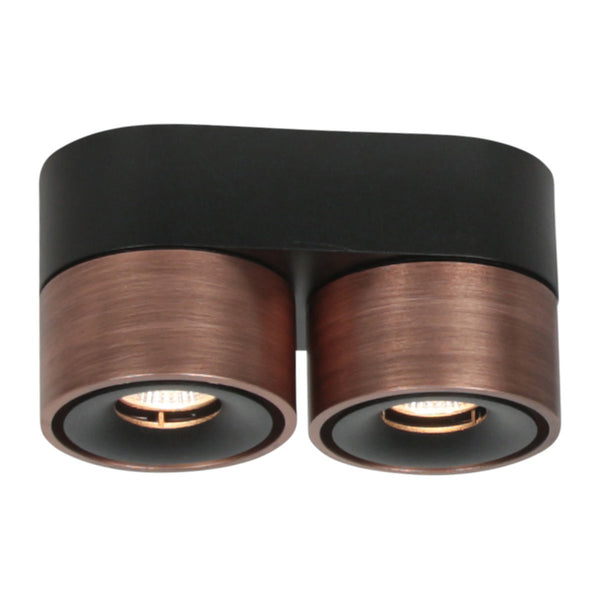
| Spot Lortorena | Double adjustable, integrated LED | H 8.3 cm | Kitchen, hallway, living room, entrance, dressing room |
| Spot Oritoraro | Single-head adjustable, integrated LED | ø 7.8 cm, H 8.3 cm | Kitchen, hallway, living room, entrance, dressing room |
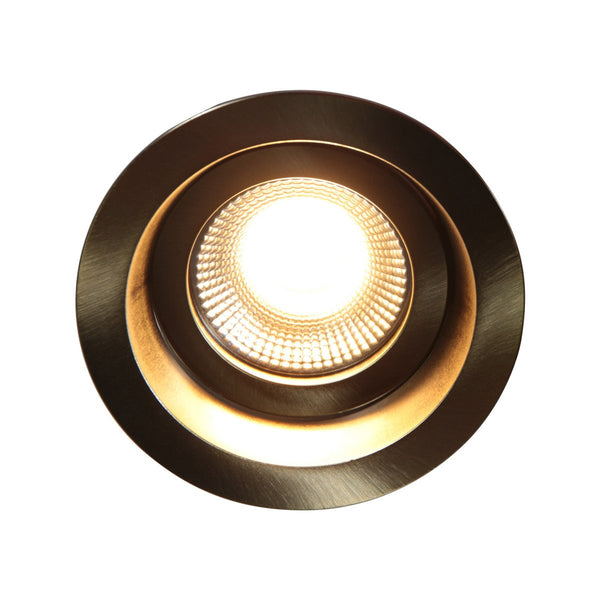
| Spot Kaltorora | Round recessed, IP44, integrated LED | Dimensions to be confirmed on the product page | Kitchen, hallway, living room, dressing room, outdoors |
Recessed: a clean ceiling and directed light
It requires a ceiling to be cut or already being worked on, and shows only a flush circle. The IP44 round recessed bronze spotlight combines this discretion with outdoor use. For kitchens, recessed LED kitchen spotlights cover the same need above a worktop.
Surface-mounted or adjustable: aiming at a wall, a piece of furniture, a terrace
Surface-mounted fits on an existing ceiling, without cutting: it is the solution when you do not want to touch the support. The Brynora, wood and bronze with conical cup is a good example, with its 17 cm height making it visible. The James bronze spotlight in 53 cm lines up several points on a single plate, useful above a worktop.
Which base to choose: GU10, E27 or integrated LED?
The GU10 base is replaced with an off-the-shelf bulb, the E27 accepts wider bulbs, the integrated LED cannot be replaced but needs no maintenance. The choice therefore depends on the ease of replacement you want and the space available in the fixture.
GU10 and E27: the bulb remains replaceable
A spotlight with a GU10 base of 25 W maximum lets you change the colour temperature without changing the fixture. The E27, at 40 W, accepts wider and brighter bulbs, often chosen for a living room or an entrance. White LED spotlights and black models offer these same bases in other finishes.
Integrated LED: fixed source, two-year warranty
The integrated LED module removes the need to replace a bulb and the bulk of one: some spotlights sit flush with the ceiling, such as the integrated LED models 8.3 cm high, while the Kaltorora measures 42 cm once installed. The two-year warranty covers the whole selection. Depending on the room, a discreet ceiling light complements these points well, as the design selection shows.
How to care for a bronze spotlight and avoid marks?
A soft, slightly damp cloth is enough for brushed bronze metal; avoid abrasive products that scratch the finish, and dust wood with a dry cloth. The models in the selection come with a two-year warranty, including outdoor installation when they are IP44.
Cleaning bronze and wood without damaging the finish
Switch off the power before any work, then wipe the cup and the plate without rubbing. On wood and metal models, never wet the wooden part. Metal spotlight specialists and the other finishes of the lighting range as a whole are cleaned in the same way.
Bronze spotlight outdoors: IP44, what to check
An IP44 rating indicates protection against water splashes, which suits a sheltered terrace or an awning. It does not replace protection against immersion. Outdoors, also check that the connection is protected and that the fixture is not exposed to direct jets.
Secure payment, tracked delivery, returns and Designix customer service: everything you need to make your choice with peace of mind. Once the work zone is identified, compare heights and bases, then order the format that matches your ceiling.
Frequently asked questions about bronze spotlights
What are the drawbacks of bronze?
The patina changes over time and remains irregular from one piece to another, giving different shades. Solid bronze is heavy, and care is limited to a soft cloth: abrasive products mark the surface.
How can you tell if it is real bronze?
On our spotlights, bronze is a finish applied to metal, wood or plastic, specified on each model's product page. Solid bronze is recognised by its weight and the depth of its patina.
Is a bronze spotlight a tanning spotlight?
No, the two have nothing to do with each other. A bronze spotlight is a light fixture whose metal finish is bronze in colour, designed to light a room. A tanning spotlight is a care device that emits UV. The confusion comes from the word bronze, not the product.
Is bronze expensive?
Bronze is an alloy of copper and tin, whose value follows metal prices and the quality of the alloy. On a light fixture, it is most often a finish applied to metal or wood, not solid bronze: the positioning depends mainly on the format and technology chosen.
What is the average lifespan of an LED spotlight?
It depends on the source and the use, not the finish of the fixture. An integrated LED module ages slowly but cannot be replaced; a spotlight with a GU10 or E27 base accepts a new bulb when the old one dims, which extends the life of the fixture.
What are the different types of spotlights?
There is the recessed spotlight, which sits flush with the ceiling, the surface-mounted spotlight, which is visible and installs without a recess, and the adjustable projector, whose head can be set. Add to these the one or two-head variants and the GU10, E27 or integrated LED bases.
What is the natural colour of bronze?
Bronze is an alloy of copper and tin: its natural shade ranges from golden brown to dark reddish brown, and it darkens over time as it patinates. On a light fixture, brushed bronze keeps a more even and lighter look than aged bronze.




