3000K light bulbs
- Tracked delivery to your country Tracked delivery
- Secure payment at checkout Multiple payment methods
- 14 days to change your mind 14-day returns
- Secure payment Secure payment


Not sure of your style? Find it in 30 seconds
A few questions, and we will show you the pieces made for you.



Frequently asked questions
How do I choose the right product?
What are the delivery times?
Can I return an item?
Can I pay in instalments?
An interior that reflects who you are
Carefully selected pieces, shipped from our warehouses. Our team advises you before you buy, so you choose with confidence.
- Tracked delivery
- Pay in instalments, where available
- 14 days to change your mind
- Advice & showroom in Lyon, France
Count on 3000K for a warm white: a slightly golden tone that does not lean blue, comfortable in the evening in a living room, bedroom or dining room. Before ordering, check one non-negotiable point, the base of your light fitting's socket, then choose the shape and light temperature that suit the room.
Contents
- What is a 3000K light bulb and what light does it give?
- 3000K or 4000K light bulb: what is the difference and which to choose?
- Which base to choose: E27, E14, G9, GU10 or G4?
- How many lumens and watts for good lighting?
- What lighting for a 20 m2 room with 3000K light bulbs?
- Can a 3000K light bulb be dimmable?
- How to wire 3 light bulbs in parallel?
- Filament, glass, globe or tube bulbs: which style to choose?
- Frequently asked questions about 3000K light bulbs
What is a 3000K light bulb and what light does it give?
3000K refers to the colour temperature of a light bulb, expressed in kelvin. At 3000K, the light is warm white: a slightly golden white, close to halogen, that does not lean blue. All the light bulbs in this collection are LED and cover this warm white range from 2700 to 3500K.
3000K light bulb colour: what to expect in the room
The result is warm without being orange. On a white wall, the tone stays natural; on light wood, it warms the tones; on beige fabric, it does not yellow them. It is the most versatile temperature in a home, the one that sets an evening mood without giving the impression of a workplace.
2700K, 3000K, 4000K: the kelvin scale
The higher the number, the whiter the light appears, then cooler. 2700K leans golden, 3000K stays warm and bright, 4000K becomes a neutral white. To compare similar references, look at the 2700K selection alongside this page, and browse the LED light bulb catalogue.
| Temperature | Perceived colour | Where to use it | Available in the collection |
|---|---|---|---|
| 2700 to 3500 K | Warm white, golden tone | Living room, bedroom, dining room, evening lighting | Yes, across the whole selection |
| 3500 to 4500 K | Neutral white | Kitchen, hallway, entrance, worktop | Yes, on part of the references |
| 4500 to 6500 K | Cool white | Office, workshop, garage | Yes, on a minority of references |
3000K or 4000K light bulb: what is the difference and which to choose?
3000K gives a warm white, 4000K a neutral white, whiter, sometimes felt as cool in the evening. The choice depends on use: warm white for the living room, bedroom or dining room; neutral white for a hallway, kitchen or workspace. Some light bulbs in this collection offer both temperatures, to be checked on the product page.
When to switch to a 4000K light bulb
Neutral white helps when the eye needs to judge a colour or read a document: worktop, workshop, office, bathroom mirror. In a living room where you watch television in the evening, it flattens the mood. So keep 4000K for work and circulation areas, and reserve warm white for relaxation rooms.
Mixing 3000K and 4000K at home: the simple rule
One room, one temperature. Mixing two whites in the same field of view creates a cooler patch that is immediately noticeable, especially on a ceiling with several light points. If you are unsure, start with warm for living rooms and neutral for passage areas. To refine, compare the living room light bulbs and the bedroom light bulbs, designed for different uses.
Which base to choose: E27, E14, G9, GU10 or G4?
The base must match the socket of the light fitting: it is the only non-negotiable criterion. E27 is the large screw base, E14 the small screw base, G9 and G4 are pins, GU10 a spot bayonet. Check the socket or the old light bulb before ordering: no other feature makes up for the wrong base.
How to identify your base in one minute
Unscrew the light bulb in place and look at its base. A wide screw thread means E27; a fine screw thread means E14; two small protruding pins mean G9 or G4 depending on the spacing; two short, thick rods with a slight quarter turn mean GU10. A flat base with a wide bayonet corresponds to GX53. Note the diameter if needed, then refer to the E27 base light bulbs and the small E14 base light bulbs.
3000K light bulb E27, E14 and G9: the formats in the collection
The three most common families here are E27, G9 and E14. E27 fits ceiling lights, pendants and table lamps; E14 slips into wall lights and candle fittings; G9 fits a wall light or a chandelier with compact sockets. For other connections, see the G4 and G9 light bulbs and check the compatibility of your light fitting.
| Base | Connection type | Typical light fitting | Format |
|---|---|---|---|
| E27 | Screw, large base | Ceiling light, pendant, table lamp | The most common |
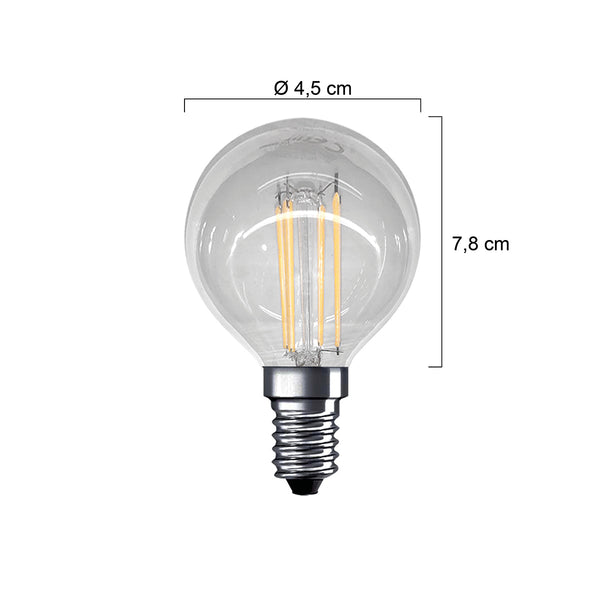
| E14 | Screw, small base | Wall light, accent lamp, candle fitting | Compact |
| G9 | Pins | Wall light, chandelier, spot | Very compact |
| G4 | Fine pins | Small decorative fitting, spot | Very compact |
| GU10 | Bayonet | Recessed or track spot | Spot format |
| GX53 | Flat bayonet | Flat ceiling light, recessed spot | Flat |
How many lumens and watts for good lighting?
The lumen measures the light emitted, the watt the consumption. There is no fixed conversion between the two: it all depends on the efficiency of the light bulb in lumens per watt. An LED needs far fewer watts than a halogen for the same light output. Trust the lumens shown, not the watts.
Why wattage is no longer the right reference
The watt indicates what the light bulb consumes, not what it lights. Two models of the same power can differ significantly in light output, depending on the chip and the diffuser. So compare lumens, then look at the shape: a globe spreads widely, a spot concentrates downwards.
Reading the lumens on the packaging before buying
Look for the value in lumens, then the efficiency in lumens per watt to decide between two references. At equal output, the least demanding is the most efficient. The 220 volt models in the house are listed in the 220V LED light bulbs, to be compared with your current installation.
What lighting for a 20 m2 room with 3000K light bulbs?
Over 20 m2, it is better to multiply the light points than to install a single very powerful light bulb: a central ceiling light in 3000K, complemented by an accent lamp near the sofa or a console. You then adjust the mood according to the moment, instead of lighting the whole room uniformly.
Living room and dining room: where to place warm white
In the living room, a high point for general lighting and a low point for reading give two levels of light. In the dining room, the pendant centred on the table is often enough, with a visible or hidden light bulb depending on the shade. To compose, start with the living room light bulbs and complete with contemporary style light bulbs if the fitting is exposed.
Bedroom, kitchen and bathroom: the uses of 3000K
Each room expects something precise from its light.
- Living room: mood and accent lighting, base and shape dictated by the fitting.
- Bedroom: soft light, no direct glare, diffuser or hidden light bulb.
- Dining room: light centred on the table, light bulb visible or not.
- Kitchen: readability of worktops, base of the spot or wall light.
- Bathroom: mirror lighting, IP20 and outside the direct water zone.
Can a 3000K light bulb be dimmable?
Yes, provided the light bulb is sold as dimmable and the dimmer is compatible. A non-dimmable LED connected to a dimmer can flicker or buzz. Check the dimmable mention on the product page and the compatibility of the wall dimmer before buying.
Dimmable 3000K light bulb E27 or E14: what to check
Three points are enough: the light bulb is stated as dimmable, the dimmer is designed for LEDs, and the dimming range matches your use (night light in the evening, full power for entertaining). The relevant models are grouped in the dimmable light bulbs.
Without a dimmer: the rooms where a simple LED is enough
Hallway, entrance, cellar, laundry room: you switch on and switch off, without ever lowering the intensity. A fixed light bulb does the job there. If style matters as much as light, the filament light bulbs offer the same warm white with a decorative result.
How to wire 3 light bulbs in parallel?
In parallel, each light bulb is connected to the same live and the same neutral: it receives the full voltage and, if one fails, the others stay on. This is the wiring of a light fitting with several sockets. Cut the power, identify the conductors and check the power allowed by the circuit.
Wiring 3 light bulbs in parallel: step by step
Switch off the circuit breaker, then identify the live, the neutral and the earth. Connect each socket to the same supply: the live on one side, the neutral on the other, never in series. Tighten the terminals and pull gently on each wire to check it holds before restoring the power. If in doubt about the circuit, call a professional.
IP20: where to install these light bulbs safely
The light bulbs in this collection are all IP20: they are intended for indoor use, protected from water splashes and fine dust. A bathroom remains possible outside the zone directly exposed to the jet. For outdoor use or a damp room, turn to the outdoor light bulbs, and find all the formats in the light bulb catalogue.
Filament, glass, globe or tube bulbs: which style to choose?
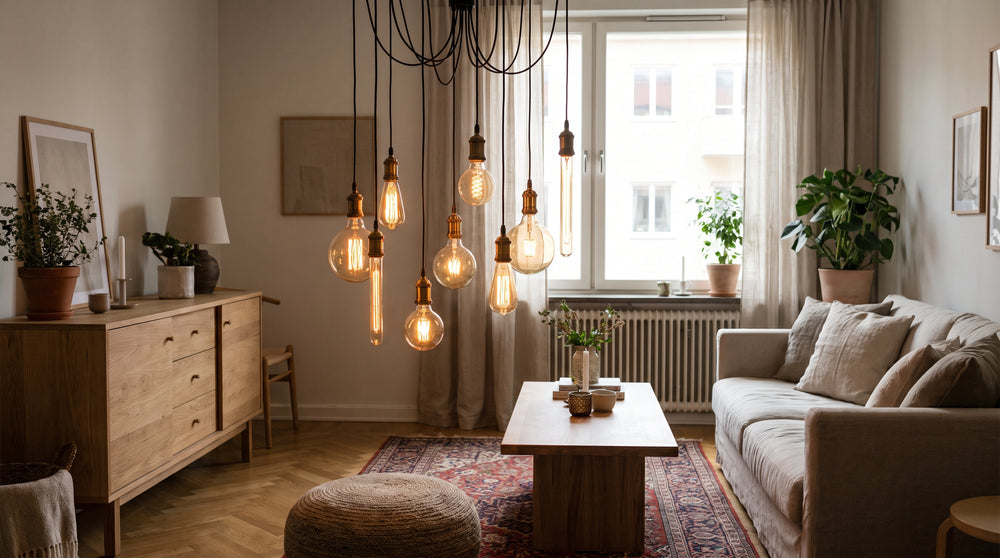
The visible filament and clear glass let the light through and shape the light bulb: ideal for a pendant or a fitting without a shade. A globe, sphere or oval shape adorns an open fitting, while a tube format or a hidden light bulb is better suited to wall lights and directional spots.
Glass, brass or metal: what the material changes
Clear glass lets the light through and shows the filament; amber glass tints it slightly. Brass and metal play on the socket or the structure and pair with golden or black light fittings. These materials are found in the glass light bulbs and the retro light bulbs.
Globe, sphere, tube shape: where to show them off
A globe is seen from all sides: it belongs in a low pendant or a cage fitting. A sphere suits a large open volume. A tube slips into a vertical wall light or a graphic fitting. For a clean result, the white light bulbs stay discreet in an opaque shade. Three models here: the E27 3000K LED light bulb for a standard screw socket, the G9 LED light bulb for a compact wall light, and the Douceur Ambrée E14 candle light bulbs for a chandelier or a candle fitting.
Frequently asked questions about 3000K light bulbs
Are LEDs economical?
An LED light bulb uses less electricity than an incandescent or halogen bulb for a comparable output, and its lifespan is longer. It heats up little and reaches full brightness immediately. The real saving depends on the efficiency in lumens per watt stated on the product page.
Is 1000 lumens good lighting?
1000 lumens is enough for a modestly sized room or for accent lighting, but not to light a large living room on its own. The result also depends on the height of the fitting, the colour of the walls and the diffusion of the shade. Multiplying light points is often more comfortable.
How many watts is 3000 lumens?
There is no direct conversion: the ratio depends on the luminous efficiency, expressed in lumens per watt. A recent LED needs far fewer watts than a halogen for the same output. So compare the lumens and efficiency shown rather than wattage alone.
Is 2000 lumens a lot?
2000 lumens is a high output for domestic use: it suits a large room or a central fitting that needs to light widely. In a smaller room, this output can feel strong, especially in warm white. A dimmer lets you reduce it according to the moment.
Which light bulbs are the brightest?
Those whose luminous output, expressed in lumens, is the highest. Wattage is not enough to decide between them: two light bulbs of the same power can emit different outputs. Also check the shape, because a globe light bulb lights more widely than a directional spot.
How many watts is 1000 lumens?
No fixed figure: it all depends on the efficiency of the light bulb in lumens per watt. The higher this efficiency, the less the light bulb consumes for 1000 lumens. On an LED, consumption remains well below that of a halogen of the same output.
Dimmable 3000K light bulb: how to choose it?
Choose a light bulb whose product page clearly states dimmable, and check that the wall dimmer is compatible with LEDs. A dimmer designed for halogens often causes flickering or buzzing. As the E27 base is the most common, dimmable models in this format are the easiest to pair.
Choosing and receiving your 3000K light bulb
Sum up three pieces of information before confirming: the base of your socket, the temperature you want for the room, and the shape that suits the fitting. Payment is secure on Designix, delivery is tracked, and returns remain possible if the format does not match. Designix customer service can confirm a base or a compatibility before ordering.
One last useful check: go back to the height under the shade and the diameter of the fitting. A wide globe does not fit everywhere, a tube is mounted vertically. Then compare the E27 LED light bulbs and the dimmable E27 LED light bulbs depending on whether or not you want to adjust the intensity, then place your order.