
Glass bulbs
This selection is also available in our French store: Ampoules en verre




- Tracked delivery to your country Tracked delivery
- Secure payment at checkout Multiple payment methods
- 14 days to change your mind 14-day returns
- Secure payment Secure payment
Not sure of your style? Find it in 30 seconds
A few questions, and we will show you the pieces made for you.
Frequently asked questions
How do I choose the right product?
What are the delivery times?
Can I return an item?
Can I pay in instalments?

An interior that reflects who you are
Carefully selected pieces, shipped from our warehouses. Our team advises you before you buy, so you choose with confidence.
- Tracked delivery
- Pay in instalments, where available
- 14 days to change your mind
- Advice & showroom in Lyon, France
Start with the base: E27 large screw for a pendant or living room lamp, E14 small screw for a bedside lamp, G9 or G4 pin base for a compact fixture. Then comes the glass shape, globe, oval or tube, its tint, clear or amber, and finally the light temperature, warm white in the vast majority of cases.
What is a glass light bulb and what light does it give?
A glass light bulb is a light source whose envelope is made of glass, clear, tinted or amber, mounted on a metal base E27, E14, G9 or G4. The glass lets light through, and most of these models shine in warm white, around 2700 to 3500 K.
What is the purpose of a glass light bulb?
It turns electrical energy into light. The current arrives through the base, passes through the filament or LED housed inside the envelope, and the light comes out through the glass. This envelope plays three roles: protecting the source, letting the flux through and carrying the visible shape of the fixture. It also makes the bulb interchangeable: you replace it without changing the pendant or the wall light. That is why LED models now dominate in all our light bulbs.
Is the glass of a light bulb an insulator or a conductor?
Glass is an electrical insulator: it is the metal part of the base that conducts the current, not the envelope. Glass does transmit heat, which explains why a filament bulb stays hot after being switched off. Clear glass shows the source, amber or tinted glass veils it and warms the rendering, a detail that matters when the lamp will be seen bare in the Designix lighting range.
What are the 4 types of light bulbs and which glass base should you choose?
Four base families structure this collection: E27 large screw, E14 small screw, G9 and G4 pins. The E27 format dominates, in filament, vintage or retro, while E14, G9 and G4 are intended for small sockets, wall lights and compact fixtures.
| Base | Socket type | Where to use it |
|---|---|---|
| E27 | large screw | pendant, living room lamp, open fixture, outdoor under cover |
| E14 | small screw | bedside lamp, wall light, string lights, refrigerator |
| G9 | pins | wall light, compact fixture |
| G4 | pins | small low voltage fixture |
Glass light bulb with E27 base: for which fixtures?
The large screw fits pendants, living room lamps and open fixtures. It is the format that leaves the most room for the bulb design: an amber glass becomes a visible element. Our E27 filament bulb Éclat Doré, measuring 6.5 x 14 cm, slips into a pendant without a shade. The amber retro 16 W Éclat d'Antan, 5 x 12.5 cm, uses the same base. These formats appear in the E27 base models.
E14, G9 and G4 bases: the small glass sockets
The E14 is a small screw, the one found on bedside lamps, wall lights and many refrigerators. The E14 candle bulbs Douceur Ambrée, 5.5 x 2.3 cm, fit inside a small shade. The G9 and G4 clip onto pins and equip compact fixtures. Our Bado LED bulb covers these three sockets. For small screws, see the small E14 sockets. The G4 and G9 bases answer the same tight housings. For low voltage, the 12V bulbs selection gathers the suitable models.
Blown, tinted or coloured glass light bulb: which shape for which effect?
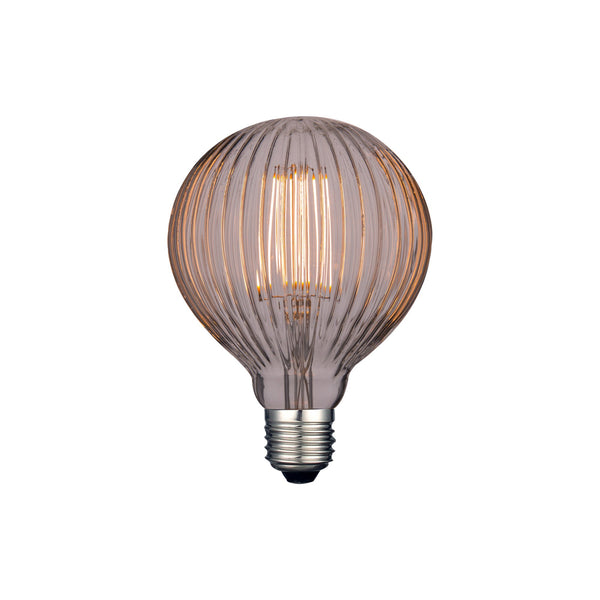
The shape mainly changes the bulb design: the globe, the most common here, fills an open fixture, the oval lengthens the silhouette, the tube slips into a linear support and the compact round format fits into small sockets. The glass can be transparent, tinted or coloured.
| Shape | Share of models | Most frequent rooms |
|---|---|---|
| Globe | 75 % | living room, dining room, bathroom |
| Oval | 25 % | living room, dining room, hallway |
| Tube | 13 % | living room, hallway |
| Compact round | 13 % | bathroom |
Globe bulb or oval bulb: what rendering in a fixture?
A globe fills the space of an open fixture: placed alone in a pendant, it becomes the visible point of the room. The oval, more stretched, suits tall fixtures and elongated shades. The Lorranara bulb, 120 cm long, plays this large format role with a metal cross. Tinted or amber glass softens the light; the amber glass models give this warm, golden rendering.
Glass tube bulb: pendant, wall light or linear?
The tube slips into a linear support or a wall light where length matters more than volume. It lights without taking up space, which makes it useful on a track or under a cabinet. The retro bulbs often favour this profile, while the modern design bulbs rely on cleaner lines, globe or compact oval.
Where to install a glass light bulb: living room, bedroom, bathroom or outdoors?
These bulbs are intended first for the living room, then the dining room, the bathroom and the bedroom. The base and the protection rating decide: all models in the collection are IP20, so reserved for dry interiors, away from water splashes.
Bulb for living room and glass globe wall light: how to match it?
In the living room, you want light that does not cut the conversation: a warm white globe, in a pendant or a wall light, does the job. If the fixture is open, the glass is visible: amber for a warm interior, clear for a more neutral rendering. The living room bulbs gather these formats, which you can browse before choosing in our lighting catalogue.
Bedroom bulb: what to put in a glass lampshade of a bedside lamp?
On a bedside lamp, the socket is almost always a small screw. A low power warm white bulb is enough, without dazzling you when you wake up. A transparent glass shade shows the filament, a tinted glass filters the light. Our round vintage LED bulb also suits protected damp rooms. See the bedroom lighting.
Warm white or cool white: which light temperature to choose?
Most glass light bulbs in the collection shine in warm white, between 2700 and 3500 K, suited to the living room, the bedroom and the dining room. Cool white, between 4500 and 6500 K, remains rare here and is mainly suited to a work area or a passage room.
Warm white 2700 to 3500 K: for which rooms?
Around 2700 to 3000 K, the light leans towards warm yellow: it is the reference for rooms where you relax, living room, bedroom, dining room, and for fixtures where the bulb is visible. The 2700K bulbs give this rendering, and the 3000K bulbs extend it one notch whiter, still comfortable in the evening.
Cool white 4500 to 6500 K: when to prefer it?
Beyond 4500 K, the light becomes whiter and more contrasted. It helps you read, cook or work, but it hardens amber glass and breaks the mood of a living room in the evening. In this collection, it only appears on some multi-base models like the Bado, which offers both temperatures depending on the chosen reference.
Filament or LED glass light bulb: what rendering and what power?
The filament, often in amber glass, gives a decorative light with visible filaments in an open fixture. The LED, the majority in the collection, offers the same warm rendering with low powers, from 1 to 6 W depending on the model, and dimmer compatibility on only part of the selection.
E27 filament bulb: the rendering of amber glass
The filament is visible: in a pendant without a shade, it draws a luminous line. The powers recorded range from 6 W on Éclat Doré to 16 W on Éclat d'Antan. The amber glass filters the light and warms it further. These models appear in the filament bulbs and the E27 LED filament bulbs.
Glass LED bulb: power and dimmer
The low powers, 1 W, 2 W, 5 W or 6 W, cover decorative use and accent lighting. Some models accept a dimmer, like the large dimmable LED filament bulbs. Dimmer compatibility concerns only part of the selection: check before installing a dimmer. The LED bulbs and the dimmable bulbs gather these references, as do the E27 LED bulbs.
Glass light bulb for lighting or glass light bulb for pharmaceutical use?
A glass lighting bulb is screwed or clipped onto a socket. A pharmaceutical glass ampoule, known as a drug ampoule, is a sealed single-use container, opened only once. Both carry the same name but have neither the same use nor the same opening method.
How to open a glass light bulb?
A lighting bulb does not open: it is screwed onto its socket, clipped onto its pins, then replaced when it no longer works. A pharmaceutical ampoule, on the other hand, is opened by breaking its pre-scored neck, with gauze or an ampoule opener, never with bare hands.
Medical glass ampoule: which search are we talking about?
Searches for vitamin glass ampoules or pharmaceutical use target a liquid container, not a light fixture. Likewise, a glass table, glass table paint or a glass table makeover concern furniture. These topics have nothing to do with the lighting on this page.
How to wire, adjust and maintain glass light bulbs?
Several bulbs are wired in parallel: each socket receives the same voltage and lights independently of the others. In this collection, all models are IP20 and only part accept a dimmer, to check before installing one. Clean the glass with the power off.
How to wire 3 bulbs in parallel?
In parallel, the sockets share the same live and the same neutral: a common wire serves each socket. Each bulb then receives the same voltage and stays independent, so a burnt-out bulb does not switch off the others. For a fixed installation, have the wiring approved by a qualified electrician, especially if the circuit must host a dimmer.
How to change and clean a glass light bulb?
Switch off the power before any handling, let it cool, then unscrew without forcing on the base: glass breaks more easily than it deforms. For dusting, a soft cloth is enough. The selection is guaranteed for two years, with secure payment, tracked delivery and returns under shop conditions. The Designix customer service team answers questions about sockets or dimensions.
Frequently asked questions about glass light bulbs
What is the purpose of a light bulb?
A bulb turns electrical energy into light: the current arrives through the base, passes through the filament or LED placed inside the glass envelope, and the light comes out through the glass. It also serves as an interchangeable part: you replace it without changing the fixture.
Which bulb to put in a fridge?
In a refrigerator, the socket is most often small format, E14. First check the socket and the appliance manufacturer's instructions, then choose a low power bulb. The E14 candle in this collection fits this type of socket.
How to choose a glass shade for a bedside lamp?
For a bedside lamp, start from the socket, often E14, then choose a low power warm white glass light bulb. A transparent glass shade shows the bulb and its filaments, a tinted glass softens the light.
Which bulb for a ribbed glass wall light?
A ribbed glass wall light is generally fitted with a small base bulb, E14 or G9, low power and warm white. The ribbed glass diffuses the light and partly hides the filament. Check the socket and the available clearance before choosing.
What is the medical term for a blister?
In medicine, a blister is a small pocket filled with fluid under the skin, often caused by friction or a burn. This has nothing to do with the lighting bulb in this collection, which is screwed onto a socket to produce light.




