Filament bulbs
This selection is also available in our French store: Ampoules à filament
- Tracked delivery to your country Tracked delivery
- Secure payment at checkout Multiple payment methods
- 14 days to change your mind 14-day returns
- Secure payment Secure payment


Not sure of your style? Find it in 30 seconds
A few questions, and we will show you the pieces made for you.




Frequently asked questions
How do I choose the right product?
What are the delivery times?
Can I return an item?
Can I pay in instalments?

An interior that reflects who you are
Carefully selected pieces, shipped from our warehouses. Our team advises you before you buy, so you choose with confidence.
- Tracked delivery
- Pay in instalments, where available
- 14 days to change your mind
- Advice & showroom in Lyon, France
A filament bulb is a bulb whose filaments are visible through a glass envelope that can be clear, smoked or gold-tinted. In this collection, those filaments are LEDs: the cap is E27 for most models and E14 for a few, the light is warm white and most references accept a dimmer.
What is a filament bulb?
A filament bulb lets you see the filaments that produce the light, behind a glass envelope that is clear, smoked or gold-tinted. In this collection, those filaments are LEDs: the look stays that of an old bulb, with an E27 or E14 cap and warm white light. The whole selection is guaranteed for 2 years.
Tungsten filament bulb, LED filament bulb: what changes
The filament of a tungsten bulb heats up until it glows; the filament of an LED bulb lets through the light of diodes placed at its base, without the same heating. Every model in this selection is LED, including the packs. So you keep the look of an old bulb without changing the socket, which lets you dress an old light fitting with E27 LED filament bulbs or equivalent models.
Vintage filament bulb or decorative filament bulb: the same look?
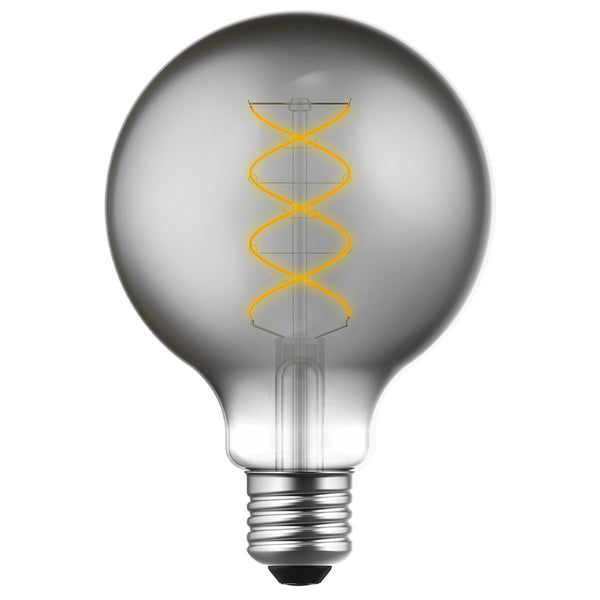
The principle is identical: the filament is visible. What changes from one reference to another is the tint of the glass and the shape of the filament, straight, spiral or looped. Clear glass shows the filament sharply, smoked glass softens it, gold-tinted glass warms the light. To compare envelopes, browse the glass bulbs in the selection. The shapes follow the same spirit, ball, globe, teardrop, oval or round, with a preview given by the amber finishes.
What is the difference between an LED bulb and a filament bulb?
A classic LED bulb hides its diodes behind an opaque diffuser; a filament bulb leaves the source visible. Both screw in as E27 or E14 and give warm white light, between 2700 and 3500 K. The choice therefore comes down to what you want to see in your light fitting, not to the cap.
How do LED bulbs and filament bulbs compare?
An LED filament bulb is an LED bulb: same technology, with a visible filament instead of the diffuser. The match between an old bulb and a new one is read on the product page, which states the wattage of the reference. You do not compare a single figure: you look at the stated wattage, the shape and the cap, then adjust if the look does not suit. 2700 K bulbs give a warmer tint, 3000 K models lean towards a slightly more neutral white.
Filament bulb or LED bulb: which to choose for each room?
In a light fitting where the source is visible, pendant, wall light or table lamp, the filament bulb brings the detail that makes the room. In a closed ceiling light or a hallway, an LED bulb with a diffuser is more discreet. The two mix without any problem in the same home: nothing forces you to pick one side. Look at the 3000 K bulbs if you want a slightly crisper white.
E27 or E14 filament bulb: which cap to choose?
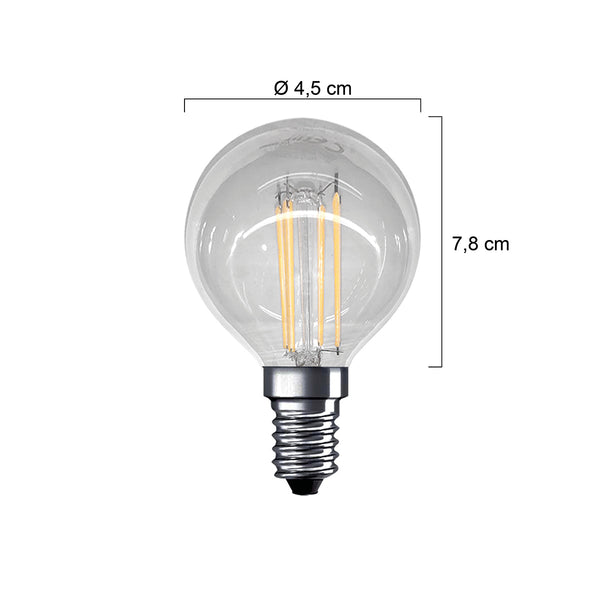
The E27 cap is the large screw cap, found on the vast majority of filament bulbs in the collection; the thinner E14 cap fits models such as the Cirene clear globe. It is the socket of your light fitting that decides: check it before ordering.
| Cap | Cap size | Models in the collection | Type of light fitting |
|---|---|---|---|
| E27 | Large screw cap, the most common | Ambra II, Filora, Éclat Doré, Rosranica, Spirala, Éclat d'Antan, packs of 15 | Pendant, ceiling light, table lamp, wall light |
| E14 | Small screw cap | Cirene | Small light fitting, wall light, bedside lamp |
How to check the cap of your light fitting before ordering?
Look at the socket: a large thread means E27, a small one E14. The diameter of the cap and that of the socket go together, so an E27 light fitting will not take an E14 bulb without an adapter. Compare with the bulb already in place if it is still there, or measure the opening of the socket. If in doubt, the product page gives the cap of each reference.
E14 filament bulb: for which light fittings?
The small cap fits compact light fittings: wall light, bedside lamp, small bedside globe. The E14 cap models remain a minority here, as the collection is mostly built around E27. If your light fitting is E14, also check the space available around the bulb: a wide ball may touch the shade or the frame.
What is the wattage of a filament bulb?
The wattages in the collection range from about 1 W for ambient packs to 16 W for amber retro bulbs, with most models between 4 and 7 W. The wattage indicates consumption: it is chosen according to the place of the bulb in the light fitting, not just the figure. Some models also show a higher equivalence, such as Cirene (4W/40W) or Rosranica (7W/60W).
| Stated wattage | Models in the collection | Recommended use |
|---|---|---|
| 1 to 2 W | 15 large dimmable LED filament bulbs, 15 unbreakable outdoor filament bulbs | Ambient light, string lights or small light fitting |
| 3 W | Pack of 15 dimmable E27 warm white filament bulbs | Soft light repeated at several points |
| 4 to 5 W | Cirene, Ambra II, Filora, Spirala | Visible light fitting, pendant or bedside lamp |
| 6 to 7 W | Éclat Doré, Rosranica | Living room, several bulbs on the same circuit |
| 16 W | Éclat d'Antan, pack of 4 amber retro bulbs | Large volume, more present light in the living room |
The lumen measures the amount of light emitted, the watt the consumption: they are two different markers. A high flux is only useful if the light fitting diffuses it well, and no bulb lights "better" than another in absolute terms: several light points are worth more than a single very strong bulb. To compare, start from the E27 cap bulbs in the selection and their stated wattage.
Decorative filament bulbs: which light and which room?
Most models give warm white light, between 2700 and 3500 K, and all show an IP20 protection rating: solid contacts and dust, but not water splashes. The ball, globe, teardrop or oval shapes are mostly found in living rooms, bedrooms and dining rooms.
Decorative filament bulb: smoked, clear or gold-tinted glass?
Clear glass shows the filament up close, when the bulb is bare and clearly visible. Smoked glass softens the light and lowers the contrast, which suits a bedroom. Gold-tinted or amber glass warms the tint and matches wooden tables as well as industrial settings. All three sit side by side in the collection, sometimes on the same light fitting. A bedroom bulb is often chosen in smoked glass, for light that does not glare.
Can a filament bulb be used in a bathroom or outdoors?
All the bulbs in the collection are IP20: they withstand dust and solid contacts, not water. In a bathroom, keep them out of reach of splashes and away from the shower. Outdoors, the unbreakable models in the selection go under an awning, a conservatory or a sheltered porch. For genuinely exposed use, compare the outdoor bulbs and check the protection rating stated on the product page.
Dimmable filament bulb: how to dim it?
Most filament bulbs in the collection are compatible with a dimmer. To enjoy it, you also need a light fitting and a dimmer switch: on a standard switch, the bulb lights normally but does not go down in intensity.
Dimmable filament bulb: what to check on the light fitting
The dimmer can be on the wall or built into the light fitting. In both cases, it is the dimmer that controls the decrease in intensity, the bulb alone is not enough. Check that the light fitting is stated as compatible, then test the low range: some bulbs go very low, others switch off before the end of the travel. This point matters if you often dim the light in the evening.
Dimmable E27 filament bulbs: which models in the collection?
The packs and several individual models are stated as dimmer compatible, in E27 cap like most of the selection, for example the Ambra II smoked glass bulb. The dimmer compatible bulbs are identified by this mention on their product page. If several light points sit on the same circuit, take models from the same family so that the dimming stays even from one light fitting to another.
How to change a filament bulb without getting it wrong?
You replace a filament bulb with the power off, once it has cooled: unscrew, then screw in the new one without forcing. In a parallel circuit, each socket stays independent and receives the same voltage; this is the usual setup of a light fitting with several points.
How to replace a filament bulb with an LED bulb?
The motion is the same: same cap, same socket, same screwing direction. Check the stated wattage and the space available around the bulb, then screw in without forcing. If the light fitting has a dimmer, take a bulb stated as compatible, otherwise the dimming will not work. All the Designix light fittings are suited to this replacement without modification.
Should the power be cut to change a bulb?
Cutting at the breaker remains the simplest precaution, especially if the light fitting is old or if you do not know the installation. Let the bulb cool before touching it: even an LED filament bulb can stay warm after being on for a while. For any work on the wiring, beyond a simple replacement, call an electrician.
How to choose your filament bulb in the collection?
The choice starts from the light fitting: E27 or E14 cap, available space, shape visible or not. Then comes the look, clear glass to see the filament, smoked or gold-tinted glass to soften the light. All the bulbs in the selection are guaranteed for 2 years.
The key models to look at first
For an open pendant, the spiral filament of the Ambra II bulb stays very readable. For a dining table, the Éclat Doré bulb combines glass, metal and an E27 cap. A large volume calls instead for the Éclat d'Antan pack, while the Cirene clear globe targets small E14 light fittings. These four profiles cover most needs.
Designix delivery, payment and returns
Designix secures payment, ships with tracked delivery and accepts returns. Customer service answers questions about cap, shape or dimmer compatibility before the order. Once your socket is identified, read the product page again: it is the best way to avoid a back and forth.
Identify your cap, choose the shape and the tint of the glass, then add to the basket. To equip a whole room, start with the living room bulbs, then complete with retro bulbs for another room to vary the shapes. The full catalogue is in all the bulbs in the catalogue, and to equip a pendant or a ceiling light, start from the light fitting before choosing the bulb.
Frequently asked questions about filament bulbs
How do I know if my light fitting takes an E27 or E14 filament bulb?
Look at the socket: the E27 cap is the large thread, the E14 the small one. The diameter of the socket matches that of the cap, so an E27 light fitting will not accept an E14 bulb without an adapter. If in doubt, compare with a bulb already in place.
Does a dimmable filament bulb work on a standard switch?
Yes: a dimmable bulb connected to a standard switch lights normally, but the intensity cannot be adjusted. To vary the light, you need a compatible dimmer, on the wall or on the light fitting. Most filament bulbs in the collection are stated as dimmer compatible.
How to wire 3 bulbs in parallel?
In parallel, the three sockets are connected to the same live wire and the same neutral wire: each bulb receives the same voltage and lights independently of the others. If one blows, the other two stay on. This setup is done with the power off and, if in doubt, by an electrician.
Why replace filament bulbs with LED bulbs?
The replacement is mainly for consumption and lifespan. The filament bulbs in this collection are themselves LED bulbs: they keep the visible filament but consume less than an incandescent bulb. So you keep the vintage look while changing the technology.
What are the reviews on LED filament bulbs?
Customer reviews are published on each product page, not on the collection page. The verifiable points here are factual: visible LED filament, E27 and E14 caps, IP20 protection rating, warm white light and a 2 year guarantee on the selection.