2700K light bulbs
- Tracked delivery to your country Tracked delivery
- Secure payment at checkout Multiple payment methods
- 14 days to change your mind 14-day returns
- Secure payment Secure payment


Not sure of your style? Find it in 30 seconds
A few questions, and we will show you the pieces made for you.



Frequently asked questions
How do I choose the right product?
What are the delivery times?
Can I return an item?
Can I pay in instalments?
An interior that reflects who you are
Carefully selected pieces, shipped from our warehouses. Our team advises you before you buy, so you choose with confidence.
- Tracked delivery
- Pay in instalments, where available
- 14 days to change your mind
- Advice & showroom in Lyon, France
Check your fixture's socket, then pick a 2700K light bulb in that base: this warm, slightly golden white flatters wood, fabric and skin, and is easier on the eyes in the evening. The whole selection is LED and warm white, with E27, E14, G9, G4, GX53 and GU10 bases.
- What is a 2700K light bulb?
- Difference between 2700K and 3000K
- Difference between 2700K and 4000K
- Which base for your fixture?
- Choosing by room
- Shape, material and finish
- Adjusting the brightness
What is a 2700K light bulb?
A 2700K light bulb gives off a warm white light, slightly golden, close to that of a filament bulb. It is the most common colour temperature in living rooms: it flatters wood, fabric and skin more than neutral white and is easier on the eyes in the evening.
2700K light bulb: what the colour temperature means
Kelvin describes the hue of the light, not its power: 2700K is the value of warm white, the lowest on the usual scale, where 4000K leans towards neutral white and 6500K towards bluish. A higher number therefore never means "brighter". In the all-base bulb range, every model is LED, and all references are listed as warm white, from 2700 to 3500K. Product pages state the exact hue when a model also accepts another white.
2700K warm white light bulb: what it changes in a room
On an oak table, 2700K light brings out the grain instead of flattening it. On a white wall, it looks cream. On light fabric and on skin, it stays soft without turning orange. In the evening, this is the finish that lets you dim the mood without switching off: hence the place of this warm white among the LED bulbs meant for relaxing rooms.
What is the difference between 2700K and 3000K?
The gap between 2700K and 3000K is small: barely noticeable on a white wall, it shows mainly on light materials and woodwork. 2700K leans creamy yellow, 3000K stays warm but a little crisper. Keep 2700K in relaxing rooms, 3000K in spaces for reading or working.
2700K or 3000K: can the difference be seen with the naked eye?
You need two fixtures side by side to tell them apart clearly, or a continuous white surface such as a worktop or an unfurnished wall. On a wooden piece or a rug, the difference almost disappears. If your whole room is already 2700K, switching to 3000K, one notch crisper, does not justify replacing everything, unless you want a more graphic look.
2700K or 3000K for the living room, kitchen or office?
The living room and dining room work very well in 2700K: that is the finish of the bulbs designed for the living room. The kitchen and office sometimes benefit from going up to 3000K, because a slightly crisper light helps when reading a worktop or a screen. In that case, do not mix the two hues on the same wall.
What is the difference between 2700K and 4000K?
4000K is a neutral white, whiter and cooler, that gives an impression of crispness and cleanliness. 2700K stays warm and suits living and resting rooms. Choose 4000K for a worktop, a garage or an office, and 2700K for the living room, bedroom and dining room.
Warm white or cool white: which one shines whiter?
The whiter one is the cooler one: around 4500 to 6500K, the light turns white, sometimes bluish. But shining whiter is not shining brighter. At equal power, a 4000K bulb and a 2700K bulb emit the same amount of light; only the perceived colour changes, and cool white often looks brighter without being so.
Which colour temperature for each room?
One rule holds: the more a room is used for rest, the more the hue drops towards 2700K; the more it is used for a precise task, the more it rises towards 3000 or 4000K. The 220V LED bulbs in the selection allow this without changing the fixture.
| Temperature | Perceived finish | Share of models | What to remember |
|---|---|---|---|
| Warm white 2700 to 3500K | Golden and warm | 100% | The finish for living and resting rooms |
| Neutral white 3500 to 4500K | Warm but crisper | 33% | When you want a less yellow light |
| Cool white 4500 to 6500K | White and cool | 10% | Not well suited to a living room |
The share sometimes exceeds one hundred percent: the same model can accept two hues.
2700K light bulb E27, E14, G9 or GU10: which base for your fixture?
The base depends only on the fixture's socket: E27 for large fixtures and pendants, E14 for small sockets and candles, G9 and G4 for slim fixtures, GU10 for recessed spotlights. Check the socket before buying, it is the only criterion that prevents installation.
2700K light bulb E27: pendants, ceiling lights and table lamps
The large screw base is the most widespread: it fits pendants, ceiling lights, floor lamps and table lamps. In the large E27 screw sockets, you will find ball, globe and tube shapes, in clear or tinted glass. Check the height available under the shade: a visible filament bulb is often longer than a standard LED.
2700K light bulb E14, G9, G4 and GU10: the small bases
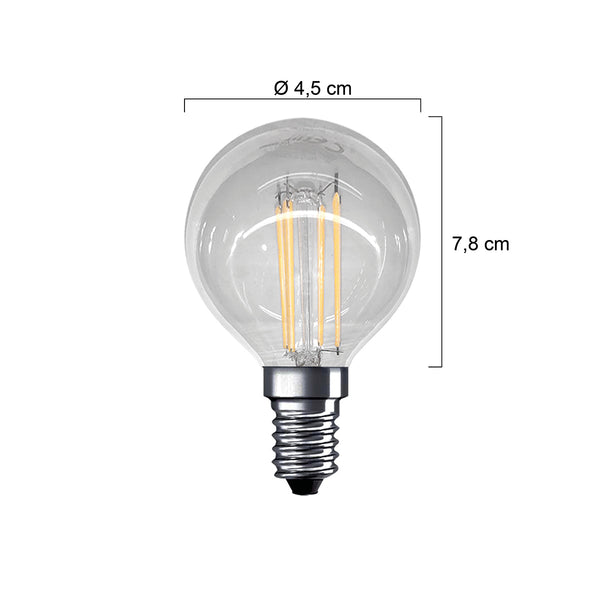
The small E14 sockets take the candles of compact fixtures. The G4 and G9 pin sockets serve wall lights and very slim fixtures, such as the G9 4.5W bulb for small spaces. The GU10, a bayonet fitting, stays reserved for recessed spotlights and tracks: see the GU10 7W spotlight.
| Base | Fixtures concerned | Share of models |
|---|---|---|
| E27 | Pendants, ceiling lights, table lamps, floor lamps | 43% |
| G9 | Small fixtures, wall lights, pin sockets | 24% |
| E14 | Candles, small lamps, compact fixtures | 19% |
| G4 | Very compact fixtures with a fine socket | 19% |
| GU10 | Recessed spotlights and adjustable tracks | 10% |
How to choose a 2700K light bulb by room?
In a living room, favour a diffuse light bright enough to illuminate without dazzling; in a bedroom, a softer intensity and a discreet model. Kitchen and bathroom call for a crisp light on worktops, while staying in warm white so as not to break the mood.
2700K light bulb for the living room, bedroom and dining room
The living room is the most frequently mentioned room in the selection, closely followed by the bedroom: plan for two or three light points rather than a single powerful ceiling light. For the bedroom, bedroom lighting favours low wattages and a light that does not fall straight into the eyes. At the table, a low pendant in 2700K flatters dishes and faces.
2700K light bulb for the kitchen and bathroom
In the kitchen, light should fall on the worktop, not on the back of the person cooking: a spotlight or a strip under the upper cabinet does more than a more powerful central bulb. In the bathroom, choose the 2700K hue for the wall light, but remember that the models in this selection are IP20, so for dry rooms and areas away from the shower. The choice of fixture matters as much as the bulb: browse all our fixtures.
| Room | Share of the selection mentioning it | What matters |
|---|---|---|
| Living room | 76% | Diffuse light, bright enough without dazzling |
| Bedroom | 71% | Soft intensity and a discreet model |
| Dining room | 57% | Good finish on the table and materials |
| Kitchen | 52% | Crisp light on worktops |
| Bathroom | 29% | Suitable socket and a dry room |
2700K filament, ball or globe light bulb: which finish and which material?
A filament bulb shows its filaments and draws a crisp point of light when visible; tinted versions soften the light and colour it slightly. The shape, ball, globe or tube, is chosen according to the cage or shade of the fixture: the fuller it is, the more enveloping the light feels.
2700K filament light bulb: the vintage effect
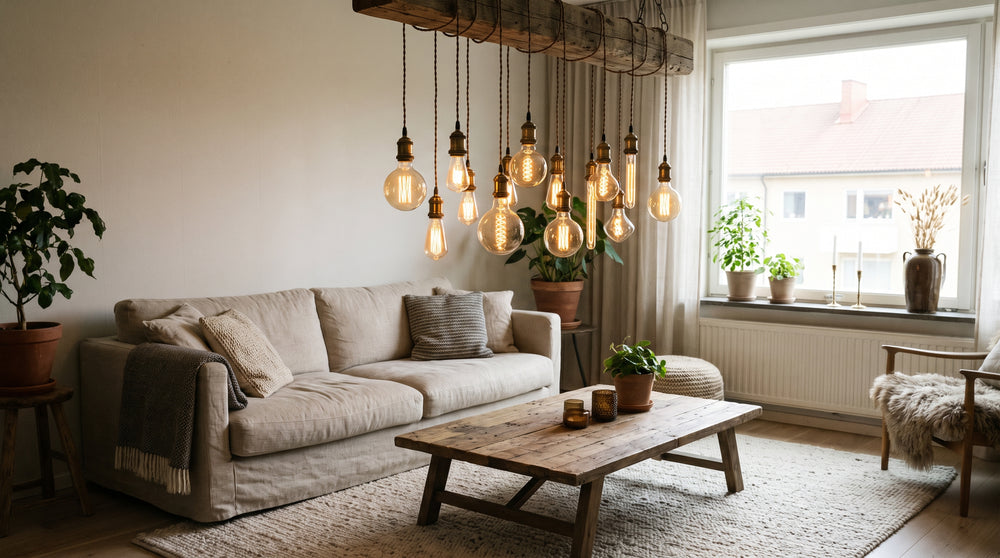
The visible filament gives a warm, slightly graphic source that is looked at as much as it lights. The models with visible filaments suit pendants without a shade and cage fixtures. Clear glass shows the filament, the amber light versions warm the hue further, and the E27 filament with a golden finish plays on metallic reflections.
Ball, globe and tube shapes: which format for an open fixture?
The ball is the most common shape in the selection, ahead of the tube and the round. A ball fills a cage or a single-socket fixture well; a tube slips into a narrow shade. Glass dominates by far, ahead of metal, iron, plastic and brass, often with a brass finish on the sockets. For an open fixture in an old style, also look at the visible glass and filaments and the retro bulbs. A compact example: the E14 candle in an amber hue.
2700K dimmable light bulb: how to adjust the brightness?
Not all bulbs are dimmable: you need a dimmer-compatible bulb and a dimmer designed for LED, otherwise the light flickers or switches off poorly. Only part of the selection accepts dimming. To lower the mood in the evening, check the dimmable mention on the product page before installing.
2700K LED bulb and dimmer: what to check together
Two conditions combine: the bulb must be listed as dimmable, and the dimmer must handle a low LED load. A dimmer designed for old filament bulbs often goes too low and makes the LED flicker or hum. Fewer than a quarter of the models in the selection are dimmable: find them in the dimmer-compatible references.
Lowering the brightness in the evening: what it changes in the room
Reducing the brightness keeps the 2700K hue and only lowers the level, which suits the living room after dinner or a bedroom. Dimming depends as much on compatibility as on minimum power: below a certain threshold, some LEDs switch off abruptly instead of fading. The Designix fixture catalogue lists the fixtures to pair them with.
How to wire 3 bulbs in parallel?
Three bulbs are wired in parallel: each socket receives the live and neutral from the same supply, which puts all three under the same voltage and leaves the others lit if one is removed. The work is done with the power off, by an electrician if the circuit does not exist yet.
Wiring 3 bulbs in parallel: the principle in one sentence
You run from the same supply to each socket, connecting the neutrals together and the lives together, without passing through one bulb to reach the next. The result: each point receives the full mains voltage and lights normally, whether the others are on or not.
Series or parallel: why the choice changes everything
In series, the voltage is shared between the bulbs: across three points, each receives a fraction of the voltage and the lighting drops sharply, and if one bulb is removed, the circuit opens. Parallel wiring avoids both problems. Always cut the power before working, and entrust the creation of a circuit to a professional. For the fixture, see all our fixtures.
Frequently asked questions about 2700K light bulbs
What colour is the light of a 2700K light bulb?
The light of a 2700K light bulb is warm white: a slightly golden white, never deep yellow, close to the finish of a filament bulb. On a white wall it looks cream, on wood it reveals the grain, and on a light textile it stays soft without turning orange.
Which shines whiter, warm or cool white?
Cool white, around 4500 to 6500K, shines whiter than warm white. Warm white 2700K leans golden and looks less bright at equal power, even when the amount of light emitted is identical. It is the perceived finish that changes, not the luminous flux.
Which LED bulb does not hurt the eyes?
A warm white 2700K bulb, installed in a fixture that diffuses the light, is easier on the eyes than a very white source aimed at them. Avoid seeing the filaments directly: prefer a shade, tinted glass or a ball shape that spreads the light around the room.
Is it possible to replace a classic bulb with an LED bulb?
Yes, as long as you match the fixture's socket: an LED bulb is chosen in the same E27, E14, G9, G4 or GU10 base as the old one. Also check the size, because a filament LED can be longer than the bulb it replaces.
Why do my LED bulbs stay lit?
A residual glow often comes from a dimmer or a switch that lets a small current through, or from induced voltage in the wiring. It does not prevent operation, but if the glow is bothersome at night, have the circuit checked or replace the bulb with a non-dimmable model.
Ordering a 2700K light bulb
Two things to check before confirming: the socket base and the space available around the bulb. For everyday use, the all-purpose E27 7.5W covers the living room as well as the bedroom; for a small space, the G9 4.5W bulb and the amber E14 candle do the job. To change the look, compare with the modern-style bulbs and the E27 LED bulbs. Secure payment, tracked delivery, possible returns and Designix customer service for any question about a base.