Dimmable LED bulbs
- Tracked delivery to your country Tracked delivery
- Secure payment at checkout Multiple payment methods
- 14 days to change your mind 14-day returns
- Secure payment Secure payment


Not sure of your style? Find it in 30 seconds
A few questions, and we will show you the pieces made for you.




Frequently asked questions
How do I choose the right product?
What are the delivery times?
Can I return an item?
Can I pay in instalments?
An interior that reflects who you are
Carefully selected pieces, shipped from our warehouses. Our team advises you before you buy, so you choose with confidence.
- Tracked delivery
- Pay in instalments, where available
- 14 days to change your mind
- Advice & showroom in Lyon, France
Start by checking the base of your light fixture: E27 for a ceiling light, a chandelier or a floor lamp, E14 for a wall light or a bedside fixture, G4 for a small module. Then check the dimmer mention on the bulb, because that is what decides whether the light really goes down.
- Do LED bulbs work with a dimmer?
- Which bulb to choose according to the base?
- Which light temperature?
- Which bulb for a ceiling light?
- Which bulb for a wall light?
- Which bulb for a chandelier?
- Which shape and which material?
- How to match the lighting of a room?
- Frequently asked questions
Do LED bulbs work with a dimmer?
Yes, provided the bulb is designed for dimming. In this selection, the vast majority of models are listed as dimmable light bulbs, in E27 as well as E14 bases, and all are IP20. A non-dimmable LED connected to a dimmer lights poorly, flickers or buzzes: check this point before buying.
Dimmable LED bulb: what dimming changes day to day
Lowering the light in the evening without changing the fixture is what justifies a dimmable bulb. In the living room, you go from a bright light for reading to a low light for watching a film. In a bedroom, the intensity goes down instead of switching off at once. The living room bulbs and those designed for the bedroom meet these two uses.
The minimum to check before buying
Two mentions matter: the bulb must carry dimmer compatibility, and the dimmer on the wall must accept LEDs. An old dimmer, designed for a halogen bulb, handles the low consumption of an LED badly. The base and the white temperature are checked at the same time. The rest of the bulb range follows the same rule.
Which dimmable LED bulb to choose according to the base: E27, E14 or G4?
The base is chosen for the fixture, not for the bulb: E27 for ceiling lights, chandeliers and floor lamps, E14 for small wall lights and bedside fixtures, G4 for small format modules. The selection covers these three families, all in IP20.
Dimmable E27 LED bulb
E27 is the most widespread base here: ceiling lights, chandeliers, table or floor lamps. Ball and globe shapes, in clear or smoked glass, are common there. The dimmable E27 LED bulbs slip into an existing fixture without modifying it, like the E27 filament bulbs when you want to see the spiral.
E14 LED bulb and G4 spot
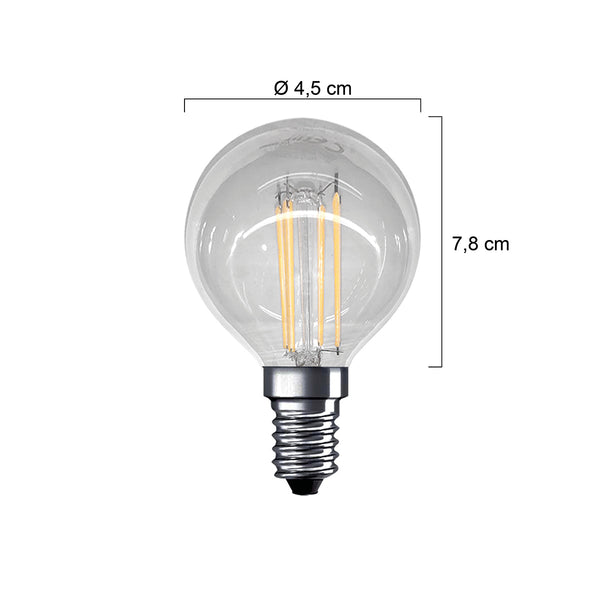
E14 equips wall lights, bedside fixtures and small fixtures. The dimmable E14 models fit as well on a wall as at bed height. G4 concerns small format modules, often associated with spots, to look for among the G4 and G9 bases.
| Base | Fixtures concerned | Temperature | Common shapes |
|---|---|---|---|
| E27 | Ceiling light, chandelier, table or floor lamp | Warm white 2700 to 3500 K | Ball, globe, drop |
| E14 | Wall light, bedside fixture, small fixture | Warm white 2700 to 3500 K | Globe, oval |
| G4 | Small format module, spot | Cool white 4500 to 6500 K | Small module |
Which light temperature for a dimmable LED bulb?
Warm white from 2700 to 3500 K dominates the selection: it gives a light close to the old incandescent bulb, suited to the living room, the bedroom and pendants above a table. Cool white from 4500 to 6500 K is rarer here and lights the rooms where you want to see clearly.
Dimmable LED bulb warm white 2700K to 3500K
This is the white of the rooms where you live in the evening. It warms a wall, a wood, a beige fabric, and pairs well with smoked glass or brass. The 2700K bulbs and the 3000K variants cover this range, from the living room to the dining room.
Cool white 4500K to 6500K: for which rooms
Cool white lights worktops, the kitchen and the rooms where you want to distinguish details. It also fits in small format on a spot. The Lueur Polaire, the Lueur Polaire in cool white, is the example in an E14 base.
| Temperature | Rendering | Rooms mentioned in the selection |
|---|---|---|
| Warm white 2700 to 3500 K | Light close to incandescence, soft yellow | Living room, bedroom, kitchen, bathroom, toilet, dining room |
| Cool white 4500 to 6500 K | White light, sharper | Bedroom, kitchen, living room, bathroom, toilet, dining room |
Which dimmable LED bulb for a ceiling light?
For a ceiling light, you look for a dimmable E27 bulb that lights the room without harshness: a globe or a ball in glass, in warm white, gives a diffuse light. The living room ceiling light is adjusted in intensity in the evening; a modern model will prefer a clean shape, in clear or smoked glass.
Living room LED ceiling light: which dimmable bulb
A living room ceiling light goes down in intensity as the evening goes on. A smoked glass ball diffuses the light without dazzling, and its socket stays discreet when you look up. The retro bulbs play this role on a fixture with an exposed socket.
Modern LED ceiling light and LED ceiling lighting
On a geometrically shaped ceiling light, a bulb with clear glass and a simple silhouette holds better than a decorative spiral. The bulb must remain dimmable, because it is the setting that makes the ceiling light comfortable every day, from breakfast to reading.
Which bulb to choose for an LED wall light?
A wall light often settles for a small format bulb: the E14 base is frequent there, in clear or smoked glass, for a grazing light that underlines the wall. In a living room, it is paired with a warm white dimmable, adjustable according to the mood.
Living room and modern LED wall light
On the wall, the bulb projects the light upwards and downwards, which draws two cones on the surface. A clear bulb lets the filament show and lengthens the shadows; a smoked finish softens them. The E14 Cirene bulb, the E14 Cirene bulb, illustrates this vertical rendering.
Powerful LED wall light: what matters on the wall
To light more, you switch to an E27 base wall light rather than a bigger E14 bulb, because the socket format does not change. The same family of shape is kept from one wall to the other so that the two cones look alike. The glass bulbs stay neutral once switched off.
Which bulb for an LED chandelier?
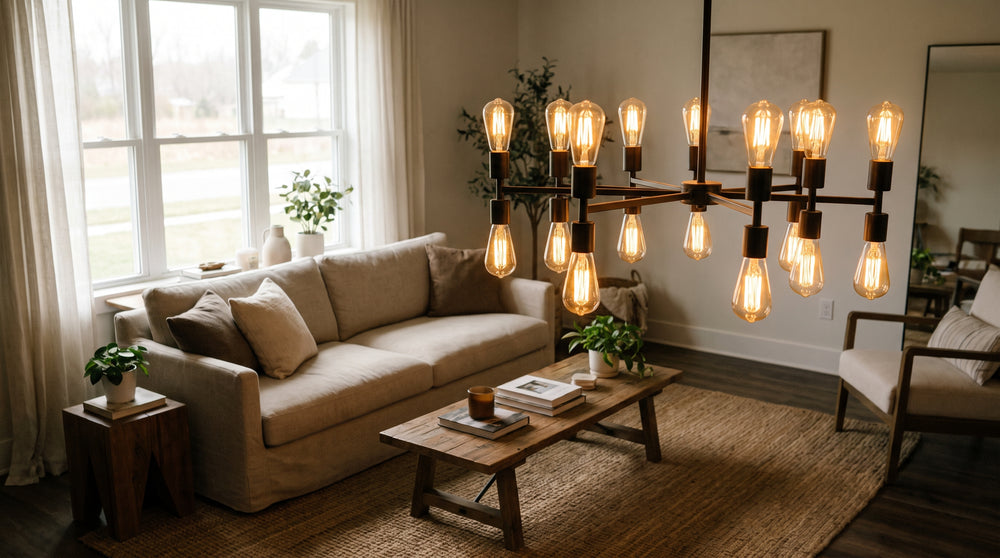
A chandelier is first read from below: the bulbs are visible there, so the shape and the colour matter as much as the light. A ball or a globe in clear or smoked glass, in warm white dimmable, gives a homogeneous living room chandelier.
Living room LED chandelier: which bulb shape
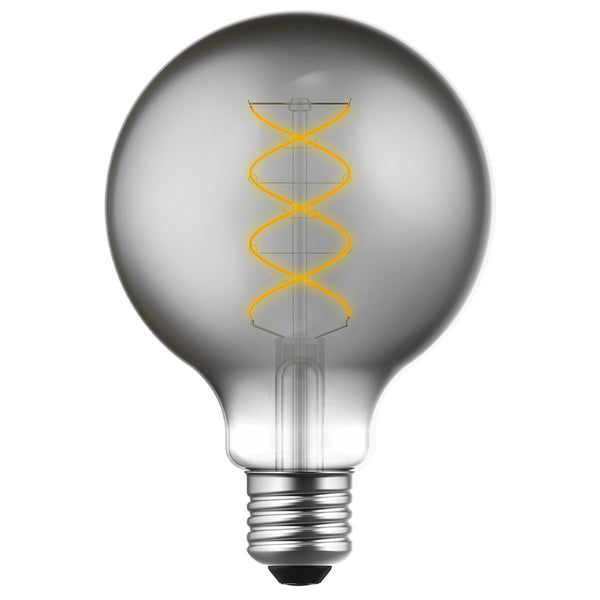
On a frame with several branches, a regular ball or a fairly wide globe holds the silhouette. A drop lengthens a slender chandelier. The Spirala smoked glass globe, the Spirala smoked glass globe, shows the filament spiral while keeping a soft light downwards.
Several light points: keep the same model
All the points of the chandelier are equipped with the same model and the same temperature, otherwise the room shows two shades. The warm white E27 round bulbs allow a chandelier with many sockets to be treated at once. The intensity setting remains common to the whole.
Which shape and which material for a dimmable LED bulb?
The shape is seen when the bulb is exposed: ball and globe for a full and diffuse rendering, drop and oval for slender fixtures. Glass largely dominates the selection, sometimes smoked, clear or coloured. Metal, iron, brass, ceramic and wood appear on the sockets and the finishes.
Ball, globe, drop: the rendering of each shape
The ball and the round give a regular light in all directions, useful under an open ceiling light. The globe, wider, lights a little lower. The drop and the oval dress a high pendant. The modern design bulbs follow the same shapes with cleaner lines.
Smoked, clear or golden coloured glass
Clear glass lets everything of the filament be seen and projects a frank light. Smoked glass filters it slightly and masks a little of the glare. Golden finishes warm a light interior. On the warm tones side, the amber colours recall the light of old bulbs.
How to match the dimmable LED lighting of a room?
You choose a single warm white temperature for the whole room, then you vary the intensity according to use: stronger in the kitchen and in the circulation areas, soft in the evening in the living room. One dimmable fixture per zone avoids lighting the same spot twice.
Dimmable LED fixture and dimmable LED lamp: harmonising several sources
A room holds with two or three sources: a ceiling light, a table lamp, a wall light. The same temperature is kept everywhere and only the intensity is varied. To find the fixtures that receive these bulbs, you start from the lighting catalogue and its ceiling lights and chandeliers for the home.
Dimmable LED bulb flickers: what to check
A flicker almost always comes from the dimmer and bulb pair: dimmer not compatible with LED, load too low, or non-dimmable bulb. The bulb is replaced before touching the fixture. If the fault remains, the dimmer is the cause.
The models in the selection are covered by a two-year warranty, with secure payment, tracked delivery and returns, and the Designix customer service answers if you are unsure about a base.
Frequently asked questions
Is it possible to replace a halogen bulb with an LED on a dimmer?
Yes, provided you also check the dimmer: the one designed for a halogen does not always handle the low consumption of an LED, which causes flickering or buzzing. Choose a dimmable LED bulb and, if needed, an LED-compatible dimmer, respecting the base of the fixture.
Why does my LED bulb flicker with a dimmer?
A flicker almost always comes from the dimmer and bulb pair: dimmer not compatible with LED, load too low or non-dimmable bulb. Take a dimmable bulb of the right family, in E27 or E14, and check that the dimmer accepts LEDs; the fault generally disappears.
Does an LED spot work with a dimmer?
Yes, if the spot is equipped with a dimmable bulb: in this selection, the G4 base modules and the small E14 bulbs are listed as dimmer compatible. A non-dimmable LED spot connected to a dimmer flickers; the bulb is then replaced rather than the fixture.
Dimmable E27 or E14 LED bulb: which one to choose?
The base depends on the fixture, not on the bulb: E27 for a ceiling light, a chandelier or a floor lamp, E14 for a wall light or a bedside fixture. Both families exist in dimmable version here, in warm white as well as cool white.
How to know if a fixture accepts a dimmer?
You first look at the bulb: a bulb listed as dimmable works on an LED-compatible dimmer. If the dimming stutters, the dimmer is the cause, not the fixture. On the models in this selection, dimmer compatibility is indicated.