Which bulb for a living room: cap, wattage, light
This article is also available in French: Quel ampoule pour salon
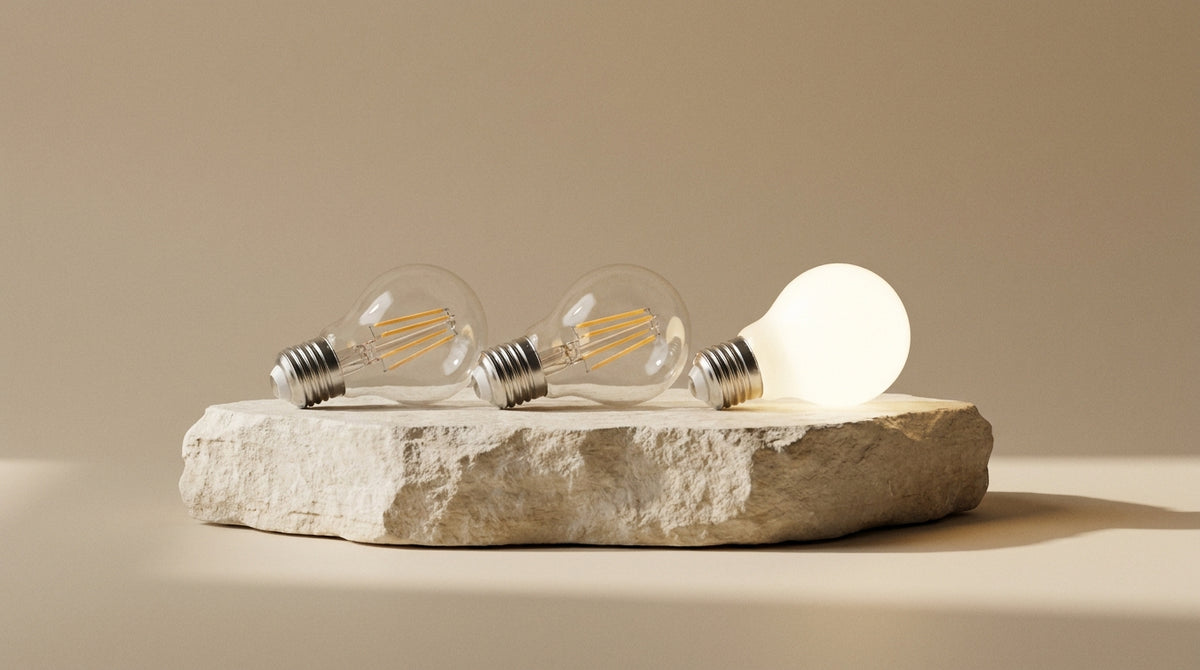
Remove the bulb in place and read the cap marked on its socket: E27 on a floor lamp or a pendant, GU10 on a recessed spotlight, E14 or G9 on a small accent light. Then choose a warm white LED, dimmable if the fixture allows it, and calibrate the lumens according to the size of the living room.
Which bulb should you choose for a living room?
Read the cap on the socket or on the old bulb, then buy the matching LED. Four formats cover almost every living room: E27 on pendants and floor lamps, E14 and G9 on accent lights, GU10 on recessed spotlights. No bulb screws onto two different caps, unless you use an adapter.
A living room is lit point by point, never bulb by bulb: that is the method followed by our living room lighting project, where each source is chosen according to how the area is used.
| Cap | Where you find it in a living room | What you screw into it |
|---|---|---|
| E27 | Pendant, floor lamp, wall light, ceiling light | Filament LED or classic LED |
| E14 | Accent lamp, compact wall light | Small-format E14 LED |
| G9 | Globe, compact designer fixture | Two-pin G9 LED |
| GU10 | Recessed spotlight, track, adjustable wall light | Directional GU10 LED |
Each cap comes in several colour temperatures. The living room bulbs collection brings together 124 references as of 5 October 2026, sorted by cap and by shade.
Telling the E27, E14 and GU10 caps apart without getting it wrong
A cap is measured in millimetres, and a tape measure is enough to decide. The details of the spacings are in our guide on bulb cap sizes.
- E27: wide 27 mm thread, the most common in living rooms
- E14: the same thread, thinner, for compact fixtures
- G9: two thin pins, reserved for small volumes
- GU10: two wide pins, for adjustable spotlights
- B22: bayonet, found on older fixtures
In the replacement aisle, E27 cap bulbs alone cover pendants, floor lamps and ceiling lights.
Filament LED or classic LED: which should you choose?
A filament bulb shows its diodes, a classic one hides them behind a diffuser. On an open pendant or a metal cage, the filament brings back the look of an old bulb without the consumption that goes with it. On a recessed spotlight, a tightly focused GU10 LED isolates a reading corner instead of lighting the whole room.
The rarer formats are reviewed in our article on the different types of bulbs.
If the hesitation is about the fixture rather than the bulb, the reviews published on the Designix Google listing remain freely available before you order.
What bulb wattage for a living room?
Forget watts and look at lumens: allow around a hundred lumens per square metre for ambience, and double that over a reading area. An 8 W LED gives as much light as an old 60 W bulb.
Watt, lumen and lux: what each word means
Watt measures the energy consumed, lumen the light emitted, lux the light received at a specific spot.
- Watt: electricity consumption, inherited from the filament bulb
- Lumen: light emitted by the bulb, the figure to compare before buying
- Lux: lumens received per square metre, so the comfort you feel
Two bulbs of the same wattage can differ twofold in light output. Our article to understand lumens explains why.
How many lumens for a living room?
- Ambience: around a hundred lumens per square metre
- Reading or working: double that, concentrated on an armchair or a desk
- Combining: three average sources are better than one very strong source
The case of a dark living room
Dark walls absorb light: for the same surface, you need more lumens than between light walls. In a dark living room, multiply the sources rather than the wattage of a single one.
The calculation depends on the surface, the height and the colour of the walls. Our guide on what bulb wattage for a living room sets out the method area by area.
Before ordering, have the cap and the intensity your fixture needs checked: the team replies within a day, and you can have your choice validated before buying.
Living room bulbs: the Designix selection


What is the best light for a living room?
Three sources are better than one powerful one: a ceiling light or a pendant for broad lighting, a low fixture near the sofa, a small lamp for accent. In the evening, one or two sources are enough, and that is what makes a living room restful where a single ceiling light flattens everything.
One source or three: the right balance
- Main source: ceiling light or pendant, for moving around and welcoming guests
- Low source: floor lamp or table lamp, for the sofa
- Accent source: wall light or small spotlight, for a painting or a bookshelf
- In the evening: switch off the ceiling light and keep the other two
The low fixture, the light you keep in the evening
Light placed at eye level illuminates without dazzling: that is why a living room floor lamp near the sofa makes the room softer than a ceiling light switched on alone. The shade matters as much as the bulb it houses; a tightly woven fabric diffuses while clear glass directs.
Which lighting point in your living room do you want to equip first?
What colour is ideal for living room lighting?
Warm white, around 2700 K, remains the reference for a living room: it flatters wood, fabrics and skin tones. A reading area can go up to 3000 K for a sharper rendering. Above 3500 K, the room takes on an office tint, hardly compatible with an evening in.
2700 K and 3000 K: where to place each
| Temperature | Rendering | Where to use it in a living room |
|---|---|---|
| 2700 K | Warm white, golden tone | Pendant, floor lamp, ambience wall light |
| 3000 K | Sharper warm white | Reading spotlight, bookshelf, desk corner |
| 4000 K and above | Neutral to cool white | Best kept for utility rooms |
Our article on warm or cool light details what each level changes in the colours of the wall.
Staying at 2700 K throughout the living room almost never disappoints, and 2700K bulbs cover most ambience needs.
Warm white on living room materials
Warm white flatters wood, linen, wool and rattan, where a neutral white dulls them. On a grey or deep blue wall, it warms the room instead of darkening it. A pendant and a floor lamp in the same living room therefore benefit from sharing the same temperature.
How do you match a modern bulb to the style of the living room?
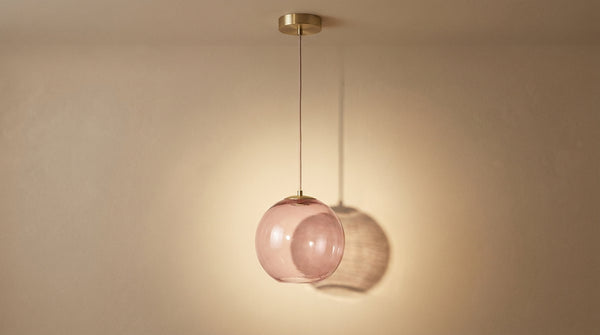
When the bulb stays visible, it becomes an object: smoked glass globe under an open pendant, amber filament in a metal cage, small opal globe on a wall light. Shape, finish and glass colour then matter as much as colour temperature.
Visible bulbs as objects
A pendant without a shade exposes the bulb, so choose a beautiful one. XXL decorative bulbs take on this role, with ball, oval or tube shapes that structure the empty space above a table.
Smart bulb or dimmer: the real question
A dimmer adjusts the intensity from the wall switch, provided the bulb is dimmable and the dimmer is LED-compatible; otherwise the bulb buzzes or switches off. A smart bulb does the same from a phone, with scenes and colours as a bonus.
The choice therefore comes down to use: the subject is covered in our article on the dimmable or variable bulb.
On a floor lamp or a pendant, dimmable E27 bulbs are enough to create three moods with a single source.
In stock · shipping costs shown at checkout · up to 30% off in your cart
Ready to turn inspiration into reality?
Tell us about your room, your style and your budget, and we will show you the pieces that truly suit your project.
Get guidance in 30 seconds →