Yellow lighting fixture: the colour of the object or of the bulb?
This article is also available in French: Luminaire jaune
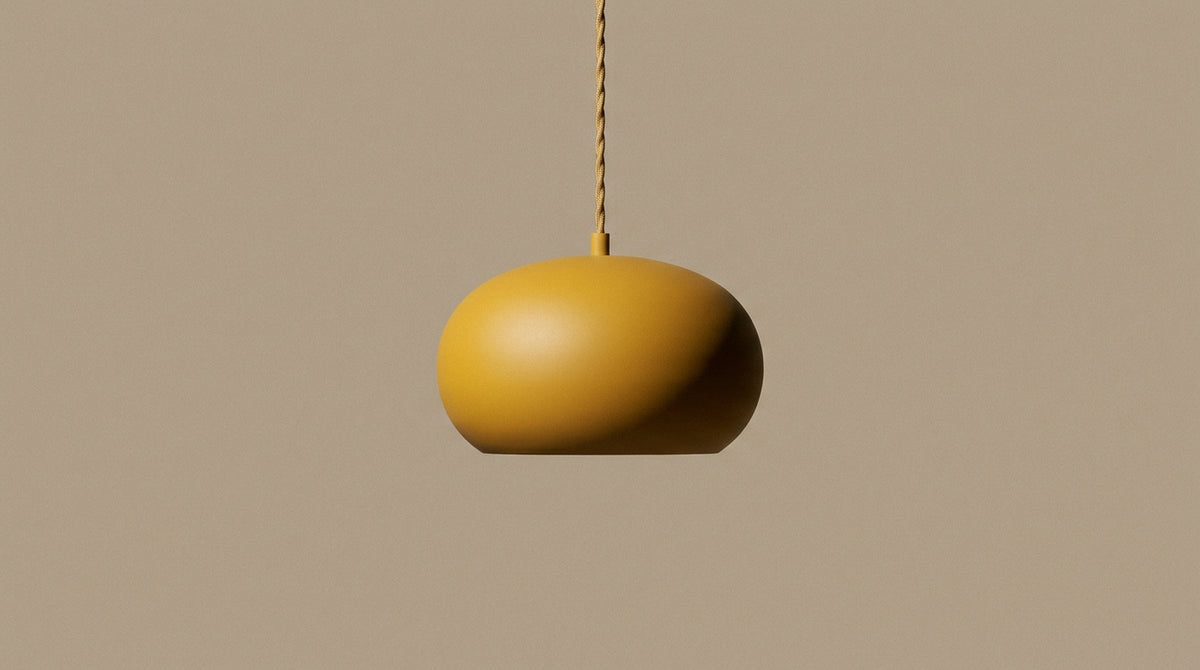
Answer one question before anything else: does the yellow come from the object or from the bulb? A mustard shade over a 2700 K bulb gives an amber room; the same shade over 4000 K looks dull. Choose the bulb temperature before the colour of the fixture.
Why yellow light?
Yellow light corresponds to a low colour temperature, between 2200 K and 3000 K. It warms wood, fabric and skin, and is less tiring for the eye in the evening. The yellow of a shade does not create that warmth: it filters the light and absorbs part of it.
Yellow lighting fixture: the colour of the object or of the bulb?
Both matter, at different moments. The colour of the fixture decides what the room shows when switched off, the bulb temperature what it becomes when switched on. Across a sample of 250 references from our catalogue on 20 November 2026, the most declared colours are black (56%), gold (54%), white (43%) and beige (15%). No yellow in that leading quartet: it works as an accent on one or two pieces, and stands out quickly in a selection of design lighting fixtures sorted by shape and by mounting.
Mustard yellow, butter yellow or pale yellow: which shade?
Mustard holds the room, butter yellow lightens it, pale yellow lets it breathe.
- Mustard yellow: dense and matte, it absorbs a lot of light, so plan for a bulb generous in lumens
- Butter yellow: soft, it suits bedrooms and rooms without natural light
- Pale yellow: almost neutral when off, it lets the colour of the light do the work
- Golden yellow: close to brass, it pairs with light woods
Is 4000 K a warm white or a yellow?
Neither. 4000 K is a neutral white, which some manufacturers classify as cool white. Yellow starts below 3000 K and settles firmly at 2700 K. Behind a yellow shade, a 4000 K bulb dulls the colour instead of bringing it out.
| Temperature | Result on a yellow shade | Room |
|---|---|---|
| 2700 K | Deep amber, the yellow saturates | Living room, bedroom |
| 3000 K | Clean yellow, no orange cast | Hallway, dining room |
| 4000 K | Washed-out yellow, leaning green | Avoid under a coloured shade |
To compare the two families in a real room, the article on white or yellow light details the results.
And if you go for a warm bulb, 2700 K bulbs are the safest starting point. The question of warm or cool light depends less on the kelvin than on the colour of the walls that receive it.
How to choose a yellow lighting fixture?
Choose the shape first, the colour next, the light last. A pendant above a table, a wall light in a hallway and a floor lamp in a corner do not answer the same need. The colour only reads well if the fixture is in the right place.
A yellow pendant, and the shapes that last
Of the 238 product pages in our sample that declare a mounting, pendants come first (42%), ahead of wall-mounted (38%) and surface-mounted (12%). They win because they set the light at table height, not at ceiling height.
- Ball or globe: outlasts trends and suits a matte yellow
- Tube: long format, it marks out an island or a counter
- Dome: concentrates the flow downwards, the right choice above a worktop
- Fabric shade: diffuses without glare and filters the colour
Unsure about the diameter? The article on pendant lighting works it out from the floor area.
Wall-mounted models free up the floor: a yellow wall light placed at 1.70 m lights a hallway without cluttering it.
For neighbouring shades, a gold lighting fixture plays the same warm card with more reflections.
Yellow fixture in the bedroom: which light temperature at bedtime?
Aim for 2700 K and a low-power bulb, between 5 W and 8 W in LED. Above 3000 K, light delays falling asleep and the yellow of the shade loses its effect. A dimmer is enough to lower the light at the end of the evening without changing the bulb.
A yellow bedside lamp with a fabric shade gives a soft halo; a metal model bounces light back and lights more sharply.
Which fixture for a living room?
One good-sized yellow fixture, plus two low light sources. Yellow tires when it fills the whole room, it structures when it sits on a single piece. A warm living room lighting scheme is built on three heights, never on a single central point.
Yellow and blue: the contrast that works
Yellow and blue do not cancel each other out: that is what makes them readable together.
- Grey blue: yellow gains sharpness against it
- Navy blue: keep yellow for the fixtures, not the walls
- Pale blue: works with butter yellow, never with gold
For a warmer pairing, an orange lighting fixture plays the same role with less contrast.
Which fixture above a rectangular table?
A long pendant, with one or two suspension points, never a round centred chandelier. The bottom of the fixture sits 75 cm above the tabletop, and the length follows that of the table.
Over a 180 cm tabletop, allow a 90 cm to 120 cm pendant, or two 40 cm pendants spaced 60 cm apart. A yellow floor lamp in the corner completes the setup and frees the table.
Pendants and yellow lamps from the selection
 Pendant light | Interlacia
 Pendant light | Nivara
 Pendant light | Ysandre
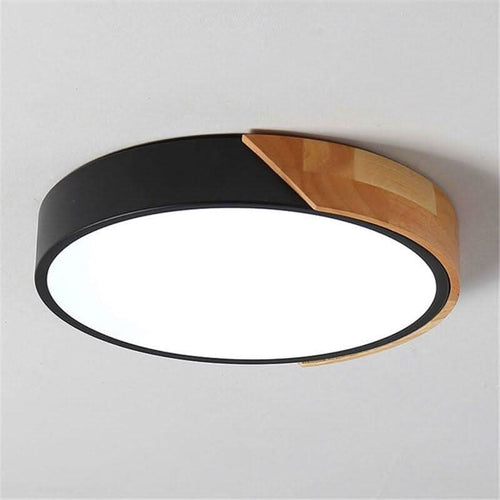
 Ceiling light | Bruna
 Living room floor lamp | Hyra
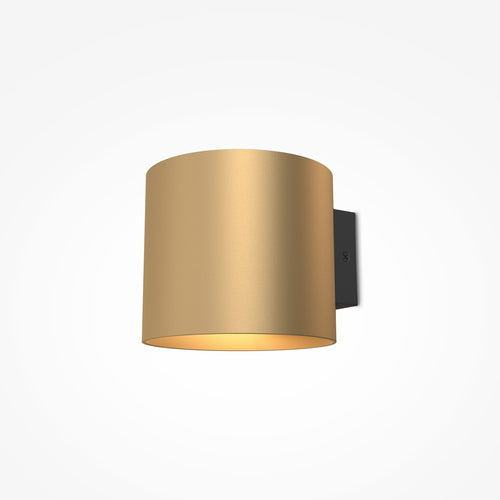
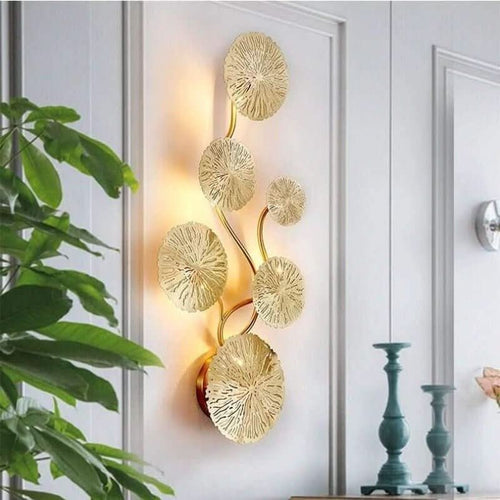
 Wall light | Sveva
See the whole selection: Alternative to Luminaire.fr: design lighting shop | Designix
If you already know which room the yellow should go in, the selection of design lighting fixtures can be browsed by shape and by mounting, without filling in a form.
Which room should the yellow make its entrance in?
Where to buy a yellow lighting fixture?
From a specialist that publishes its product pages in full: mounting, socket, protection rating, warranty. A yellow fixture is judged switched on, so the material of the shade and the bulb temperature must be written down plainly. Our selection counts 53,960 references on 20 November 2026.
The price of a yellow lighting fixture and what drives the bill
It is not the colour that costs, it is the mounting and the material. A yellow painted in series on metal stays affordable; a dyed shade and a doubled socket change the bill.
- Material: metal on 82% of the sample, glass 38%, aluminium 32%
- Mounting: a pendant needs a hook, a wall light a back box
- Bulb: often not included, to budget separately
If you are hesitating between two formats for the same room, take the time to describe your room to us: floor area, ceiling height, wall colour.
Warranty, IP rating and socket: the three lines to check
Of the 250 product pages sampled on 20 November 2026, 94% declare an IP20 and 85% a 2-year warranty. The E27 socket comes first (26%) ahead of LED modules (22%), which leaves the choice of bulb open, including a yellow filament bulb. IP44 only concerns the bathroom.
Reviews left by buyers can be read on Designix's Google listing.
In stock · shipping costs shown at checkout · up to 30% off in your cart
Ready to turn inspiration into reality?
Tell us about your room, your style and your budget, and we will show you the pieces that truly suit your project.
Get guidance in 30 seconds →