Bulb types: choosing the right base and light
This article is also available in French: Les différents types d'ampoules : guide complet
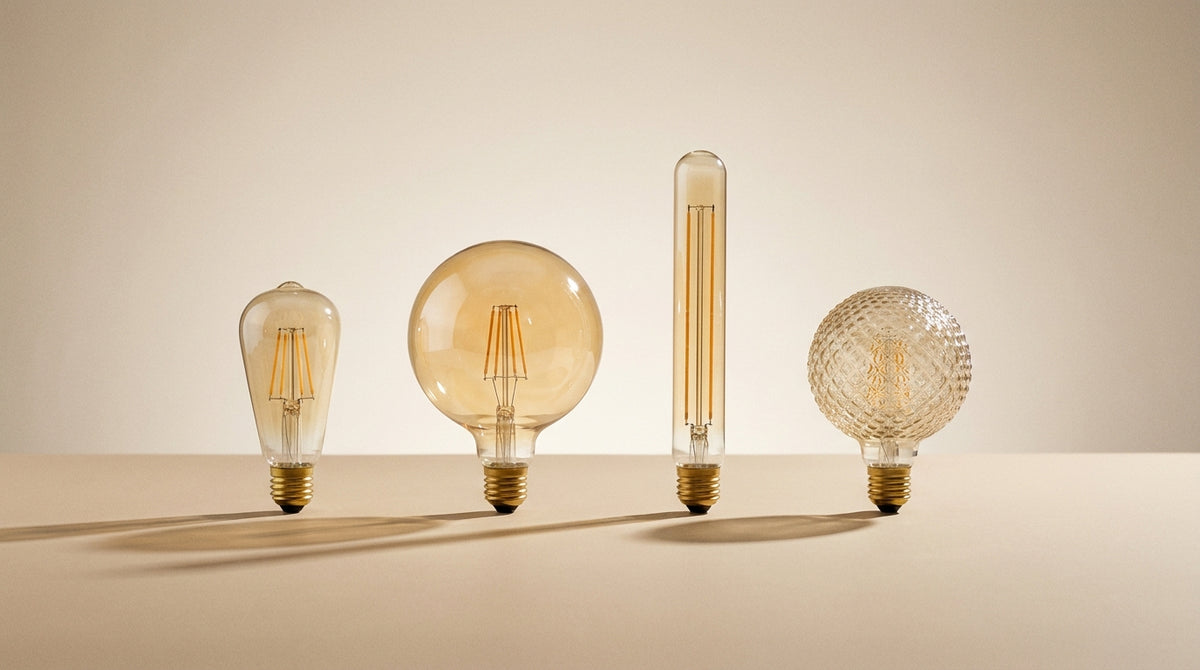
Take out the dead bulb and read the inscription engraved just above the thread: E27, E14, G9 or G4. That is the base, and it alone decides whether the replacement will fit the socket. Note it down before anything else, then look for the light: lumens for quantity, kelvins for tint.
What are the 4 types of bulbs?
Four families have followed one another: incandescent, halogen, compact fluorescent and LED. The first three have left the shelves, the last has taken them over. In a survey of 33 bulbs from our catalogue as of 30 September 2026, LED technology is stated on 100% of the references: the choice is therefore no longer between technologies.
| Family | What it brings | What it costs |
|---|---|---|
| Incandescent | Immediate warm light, simple base | Heat, consumption, withdrawn from European shelves |
| Halogen | Clear rendering, G4 and G9 bases still common | Heats up a lot, short lifespan |
| Compact fluorescent | Reduced consumption | Slow start-up, contains mercury |
| LED | All tints, all shapes, little heat | Very uneven quality from one model to another |
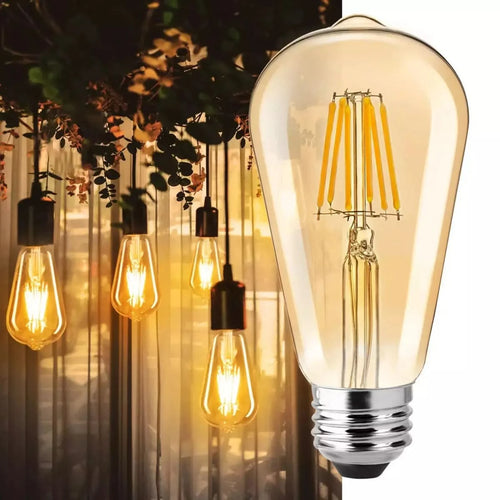
Shape matters as much as technology. Our collection of design bulbs has 282 references as of 30 September 2026, and glass dominates: in the same survey of 33 references, it accounts for 61% of materials, ahead of the tube shape at 27% and the globe at 24%.
Why has LED taken over everything?
Because it alone can do everything: tiny in a G4, warm in a dining room pendant, powerful without scorching a fabric lampshade. The principle is worth knowing, how an LED works comes down to one sentence: a junction converts current into light, with no filament to burn out.
How to compare two bulbs on the shelf?
Four values are enough, and none of them is the wattage displayed in large print.
- Lumens: the amount of light, the only figure that tells you whether the room will be bright enough.
- Kelvins: the tint, from 2,700 K (warm white) to 4,000 K (neutral white).
- Watts: the consumption, to read after the lumens.
- Base and protection rating: fitting into the socket, and use in a damp room.
Rather than cross-checking four spec sheets in the shop, the LED bulb comparison table puts these values side by side.
How to identify the right base without getting it wrong?
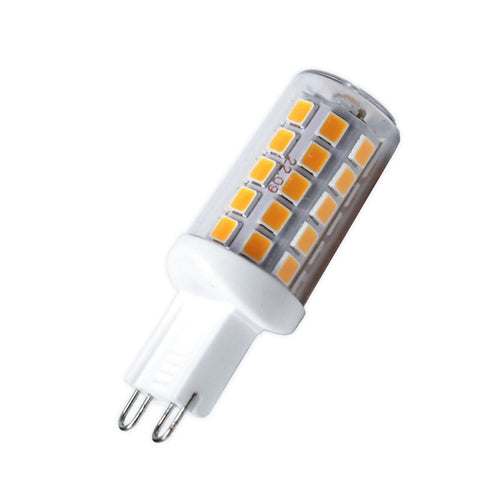
Look for the small-print inscription on the base, or look at the socket: a large screw thread is an E27; a small one, an E14; two thick pins, a G9; two fine pins, a G4. These four formats cover most of what is sold today.
Where to read the base on the bulb and on the socket?
On the bulb, the inscription runs around the collar, above the thread or between the two pins. When the heat has erased it, measure the socket: 27 mm in diameter for an E27, 14 mm for an E14. The size and shape of the base are two different things, and identifying the right base saves you from ordering the wrong reference.
E27, E14, G9, G4: which one to choose?
The base is read on the light fitting, never on the dead bulb, because that one may sometimes have been replaced by an approximate model. Of the 33 references surveyed in our catalogue as of 30 September 2026, E27 accounts for 42%, G9 for 27%, G4 for 24% and E14 for 15%.
- E27: the large screw thread of ceiling lights, pendants and floor lamps, with the widest choice of shapes, including our E27 base bulbs.
- E14: the small screw thread of bedside lamps and slim wall lights.
- G9: two pins, very common on pendants and wall lights.
- G4: fine pins, reserved for spotlights and small low-voltage light fittings.
If you are still hesitating between two bases in front of your light fitting, simply send us a photo of the socket: it is the shortest route to tell us about your case.
Which bulb for which room?
The living room and the bedroom call for warm light, around 2,700 K. The kitchen and the bathroom need a more neutral white, between 3,000 and 4,000 K, for clear reading. The hallway wants a steady flow, with no shadow areas. The room decides the tint, the use decides the lumens.
What colour temperature in each room?
In the living room, it is better to multiply warm points than to switch on a single large ceiling light: two or three sources at 2,700 K, one of which can be dimmed in the evening. White or yellow light helps you decide when the room faces due south or due north.
Above a table, the light should come down low and wide. A dining room chandelier with several sockets accepts bulbs spread out and can be set with a dimmer.
The kitchen works in neutral white, under an LED ceiling light that casts no shadow on the worktops.
In the bedroom, two sources are better than one: a discreet ceiling point, and a bedroom wall light at the bedside, at shoulder height, for reading without waking the other person.
What are the 3 types of lighting?
Ambient lighting floods the room, task lighting illuminates a specific task, accent lighting highlights an object or a wall. A successful room combines all three, with separate levels rather than a single switch.
- Ambient: ceiling light or pendant, wide flow, often dimmable.
- Task: reading wall light, desk lamp, under-cabinet spotlights.
- Accent: a bulb meant to be looked at, chosen according to the colour temperature room by room.
One point often forgotten in the bathroom: of the 33 references surveyed in our catalogue as of 30 September 2026, the IP20 protection rating is stated on 100% of them. IP20 means no protection against splashes. A decorative glass bulb therefore has no place in the shower zone, even in a very bright room.
Which bulb are you actually missing?
Design bulbs: the shop selection


Halogen, compact fluorescent, incandescent: what can you still buy today?
Very little. Incandescent and halogen have left European shelves, compact fluorescent survives in residual stocks. The useful question is no longer what you can buy, but how to convert an old light fitting without replacing it.
The conversion depends on the original base. A 40 W halogen G9 is replaced by an LED G9 of the same shape: less heat in the lampshade, lower consumption. Power equivalences and shape pitfalls are detailed in replacing a halogen bulb with an LED.
Old light fittings are not to be thrown away, though. A glass light fitting with an E14 socket now accepts an LED filament whose rendering remains identical.
Of the 33 references surveyed in our catalogue as of 30 September 2026, 73% are guaranteed for 2 years and 27% for 5 years. For a model already installed, help and after-sales service provide information on compatibility and spare parts.
- Incandescent: withdrawn from shelves, to be replaced without regret.
- Halogen: G4 and G9 bases still present in installed light fittings.
- Compact fluorescent: still in stock at some retailers, slow start-up.
- LED: the only family to remember for a replacement today.
On the same subject
In stock · shipping costs shown at checkout · up to 30% off in your cart

Ready to turn inspiration into reality?
Tell us about your room, your style and your budget, and we will show you the pieces that truly suit your project.
Get guidance in 30 seconds →