Lumens: what they are and how to choose the right light
This article is also available in French: Lumens c'est quoi
Read the lumen count on the packaging before you look at the watts. A lumen measures the light a bulb actually emits, not the energy it consumes. Then check the area of your room: it is this pairing, lumens and square metres, that decides whether your lighting will be right.
What exactly is a lumen?
A lumen (lm) measures luminous flux, the total amount of visible light a source emits in all directions. It is the only value that tells you whether a bulb gives strong or weak light. Watts, on the other hand, only describe electricity consumption.
What does lm mean on a bulb box?
lm is short for lumen. A bulb marked 806 lm promises the same light as an old 60 W bulb. The higher the figure, the more light the source gives. At equal illuminance, a designer light fitting with a large diffuser needs more lumens than a directional spotlight, because it spreads its light across the whole room.
Lumens and lux: what is the difference in a room?
A lux is one lumen received on one square metre. The lumen describes what comes out of the bulb, the lux what arrives on your table or your book. The same light fitting therefore gives far more lux in a bedroom than in a 30 m² living room, as detailed in our article on the difference between lux and lumens.
- lm: the flux emitted, the value used for choosing
- lx: the flux received on a surface, what the eye perceives
- W: electricity consumption, with no direct link to light
- lm/W: efficiency, the higher it is, the less the bulb consumes
How many lumens do you need per room?
Allow 100 to 150 lumens per m² for general lighting, and up to 250 in a kitchen or bathroom. Multiply by the area, then spread the total across two or three sources. A 25 m² living room therefore needs 2,500 to 3,800 lm, never a single point on the ceiling.
How many lumens per m²: start with the area
A 25 m² living room aiming for 130 lm/m² needs 3,250 lm. A pendant with three 806 lm bulbs provides 2,418, and a floor lamp adding another 806 brings the total to 3,224. A single 3,000 lm bulb in the centre of the ceiling would give the same figure, with one lit wall and three dark corners. The calculation is set out in detail in our guide on how many lumens per m².
Projector lumens: what is different
A video projector often states its lumens in ANSI, measured at nine points on the image. 3,000 ANSI lumens on a 100 inch screen produce far fewer lux than a 3,000 lm bulb in the same room. The larger the image, the more the light is diluted.
| Room | Area | Target total |
|---|---|---|
| Living room | 25 m² | 2,500 to 3,800 lm |
| Kitchen | 10 m² | 2,000 to 2,500 lm |
| Bedroom | 14 m² | 1,400 to 2,100 lm |
| Bathroom | 6 m² | 1,200 to 1,500 lm |
- 100 to 150 lm/m² for general lighting in a living room or bedroom
- 200 to 250 lm/m² in a kitchen, including a strong point above the worktop
- IP44 minimum for sources close to a water point
- Two or three sources rather than one, to avoid shadow areas
A bedroom chandelier is judged on the light it sends down to the floor.
Above a table, a dining room chandelier is chosen first for its width relative to the tabletop.
Do 1000 lumens light a room well?
Yes in a bedroom, an office or a small living room: 1,000 lm comfortably cover 8 to 10 m² and are enough for reading. In a 30 m² room, the same value feels weak when it comes from a single source.
Do 200 lumens light a room well?
For atmosphere, yes: night light, hallway wall light, accent light behind a sofa. For working or cooking, no. 200 lm corresponds to a small decorative bulb, not a main source.
What is 500 lumens?
500 lm is the level of a 5 to 6 W LED bulb, the equivalent of an old 40 W bulb. Fine as a single source, perfect in a bedside lamp. On a GU10 base, the same value lights a worktop strongly, because the beam stays focused: the types of bulbs therefore change the result as much as the figure.
- 200 lm: atmosphere, night light, hallway
- 500 lm: bedside lamp, small bedroom, office
- 800 lm: the old 60 W, for a medium room
- 1,000 lm and more: living room, worktop, bathroom
In a living room, the need becomes clearer zone by zone: our article on which bulb wattage for the living room sets out the calculation in detail.
How many watts is 800 lumens?
Allow 8 to 10 W in LED, around 60 W in incandescent and 15 W in halogen. 800 lm remains the reference value on packaging, inherited from the 60 W filament bulb. The ratio is not fixed: it depends on efficiency, expressed in lumens per watt.
How many lumens does a 60 W bulb have?
Between 700 and 800 lm depending on the model. To get that light back, look for an 8 to 10 W LED stating 806 lm on an E27 base. On an E14 base, the same value exists in a smaller format, intended for bedside tables. Our selection of LED bulbs states the flux on each product page.
Lumen to watt table: why it is no longer reliable
These tables date from a time when all bulbs had the same efficiency. Today an LED runs at around 90 to 100 lm/W, a halogen at 15, an incandescent at 12. Use them as a conversion reference, not as a basis for choosing.
| Technology | Consumption | Stated flux | Efficiency |
|---|---|---|---|
| Incandescent | 60 W | 700 lm | 12 lm/W |
| Halogen | 42 W | 630 lm | 15 lm/W |
| LED | 9 W | 806 lm | 90 lm/W |
Colour temperature matters as much as flux: a 2700 K bulb wraps a living room, a 4000 K one wakes up a kitchen. This choice is detailed in our guide white or yellow light.
- 8 to 10 W in LED for 800 lm
- 60 W in incandescent for the same light
- E27: large screw base, the most common
- GU10: bayonet base of directional spotlights
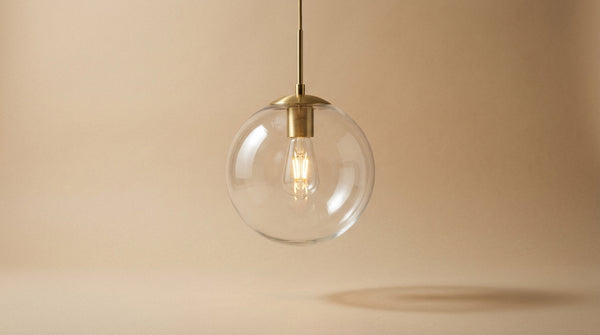
- G9: small pin base of glass pendants
Which lumen output should you choose?
Start from the use, not the wattage. Add up the lumens needed for your area, choose the colour temperature according to the atmosphere, then spread the total across two or three sources. A dimmer lets you adjust afterwards: 3,000 lm at full power can be reduced to 800 lm for a dinner.
- Area: multiply the m² by 100 to 250 lm depending on the room
- Distribution: two or three sources are better than a single point on the ceiling
- Colour temperature: 2700 K in the evening, 3000 to 4000 K for working
- Dimming: check the bulb is compatible with the dimmer, otherwise it will flicker
A flat LED ceiling light sends its light down to the floor and needs fewer lumens than a pendant with an opaque shade.
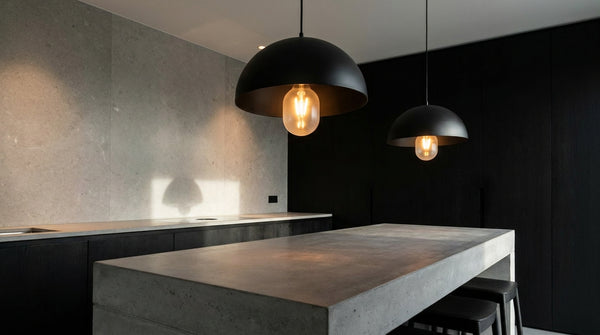
In a kitchen, a kitchen pendant hung above an island both lights and structures the room.
An adjustable wall light often replaces a third ceiling point and concentrates light where you read.
Between two options, compare lumens, colour temperature and base first: our guide to choosing the most suitable lighting sets out this method room by room.
If you would rather start from a plan of your room than from an isolated figure, write to us: we will tell you what total lumens to aim for and which light fitting will deliver it, via our page to talk to a Designix adviser.
In stock · shipping costs shown at checkout · up to 30% off in your cart


Ready to turn inspiration into reality?
Tell us about your room, your style and your budget, and we will show you the pieces that truly suit your project.
Get guidance in 30 seconds →