Dimmable or variable light bulb: how to choose the right one
This article is also available in French: Dimmable ou variable Quelle Ampoule choisir
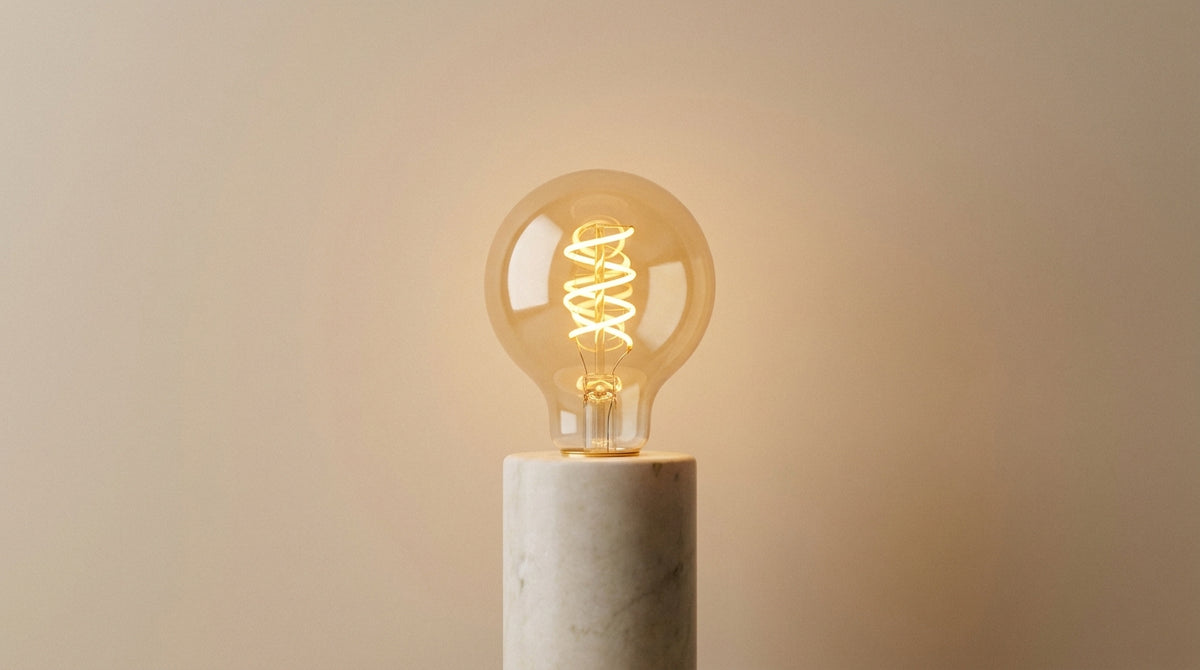
Dimmable and variable mean the same bulb: a source whose brightness you adjust. To vary it, you need a compatible dimmer and the words "dimmable" or "variable intensity" on the packaging. Without that pair, the bulb stays fixed, or flickers on a mismatched dimmer.
Does a dimmable bulb work without a dimmer?
Yes, a dimmable bulb lights up on a standard switch, but it stays at full power: it only varies when connected to a dimmer. Conversely, a non-dimmable bulb placed on a dimmer flickers, buzzes or ages quickly. The pairing of a variable bulb with a compatible dimmer remains the only real way to modulate light.
That variation changes how a room is used: bright light for cooking, a soft glow in the evening. Our variable intensity bulbs bring together models designed for this adjustment, without the flicker of repurposed standard bulbs.
An ordinary bulb, by contrast, knows only two states, on or off, whatever switch is in place.
To understand bases and technologies before buying, our guide to the different types of bulbs sorts out E27, E14 and GU10.
What is the difference between a dimmable and a non-dimmable LED bulb?
The difference lies in the internal circuit. A dimmable LED contains a driver that accepts the voltage drop from a dimmer and adjusts the light smoothly. A non-dimmable LED keeps fixed electronics: on a dimmer, it blinks, heats up or refuses low levels. Only the wording on the box tells them apart at a glance.
At full power, both versions light the same, with the same LED technology and the same colour temperature. Our LED bulbs cover both families, dimmable and standard.
Nothing distinguishes them on the bulb itself: the box remains the reliable source, never the look of the glass or the base.
Also check the format before ordering: an E27 does not screw into an E14 socket. Our guide to the bulb base details the common formats.
Our variable intensity bulbs
 Ampoule à Filament E27 | Éclat Doré
 15 ampoules LED Vintage Rondes E27 Blanc Chaud
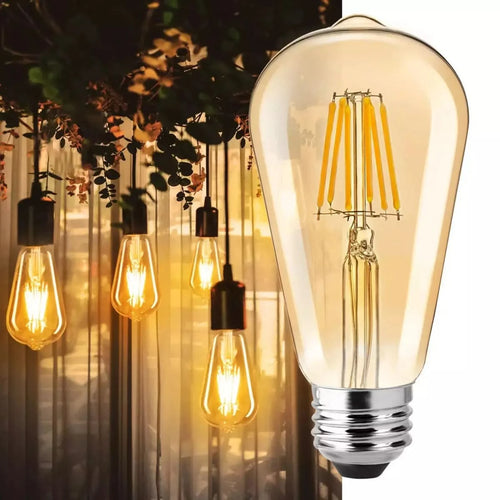
 15 Ampoules Dimmable E27 Filament Blanc Chaud
See the whole selection: Dimmable Bulb, Variable Intensity Bulb, LED Dimmer Bulb
How do you know if a bulb is compatible with a dimmer?
Read the packaging: the words "dimmable" or "variable intensity" must appear, often with a dimmer pictogram. Then check the minimum load of your LED dimmer, because an old model designed for halogen may not go low enough for a few watts of LED. Below the threshold, the light flickers.
A dimmer shows a power range, for example from 5 to 300 W. Add up the watts of your bulbs: below the minimum, they waver; above the maximum, the dimmer overheats.
If the wording is missing or ambiguous, a dimmer lamp already paired settles the question: bulb and dimmer are tested together there.
A buzzing at low brightness signals an incompatibility, not a faulty bulb. It is the driver that cannot handle the requested variation.
Unsure about compatibility between your dimmer and the bulb you have in mind? Better to ask an advisor before buying than to return a flickering bulb.
Buyers of the selection comment on it: the Designix Google listing gathers those reviews if you are still hesitating.
Does a dimmable bulb use less energy?
Yes, but only when you lower the brightness. At full power, a dimmable LED uses as much as its non-dimmable equivalent. Halved, it draws fewer watts and lasts longer, since heat remains the enemy of LEDs. The gain therefore comes from use, not from the bulb alone.
The dimmer then becomes a setting tool: low light for a film, brighter for reading. Our article on ambient lighting shows how to dose it room by room.
For a living room, a pendant or a floor lamp with adjustable intensity transforms the evening; these dimmable formats appear in the shop's design lighting range.
What do you want to be able to dim at home?
"Dimmable" on its own, what does it mean?
"Dimmable" comes from the English to dim, to lower the light: it is the exact synonym of "variable intensity". The word refers to any bulb whose luminous power can be modulated, from full brightness to night light. A product without this wording is fixed: it turns on and off, nothing more.
On our product pages, this intensity variation is shown with the E27 base, LED technology, IP20 rating, CE certification and 2-year warranty, all markers that make the purchase safer.
The variable intensity bulb selection in our catalogue counts 6 references as of 24 September 2026, a tight choice designed for local advice in Vaulx-en-Velin rather than an endless catalogue.
One last installation point: if an LED blinks once fitted, the instructions for wiring an LED rule out the most common causes of flicker.
On the same topic
In stock · shipping costs shown at checkout · up to 30% off in your cart

Ready to turn inspiration into reality?
Tell us about your room, your style and your budget, and we will show you the pieces that truly suit your project.
Get guidance in 30 seconds →