
XXL decorative bulbs: which color temperature per room
This article is also available in French: Ampoules décoratives XXL température de couleur par pièce

The same large filament bulb can warm up a living room or cool down a kitchen, without ever needing to change it. Everything depends on its color temperature, measured in Kelvin, and this is decided room by room.
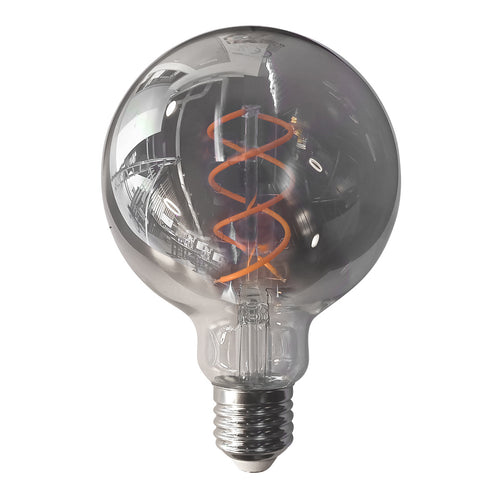
On these XXL models with an exposed filament, the bulb doesn't just sit under a lampshade: it is the object you look at. Our decorative filament bulbs therefore play as much on the light as on the silhouette of the glass and the visible base.
When the bulb takes on this role, the rest of the decorative lighting fixture fades into the background. One question remains: which hue for which room? Here is the guide, without any unnecessary theory.
Which light color should you choose for each room?
Reserve warm white (2700K to 3000K) for relaxation areas, like the living room and bedroom, for an amber, restful light. Switch to neutral white (4000K) where you are active: kitchen, bathroom, office, for a clear and accurate rendering. Cool white (6000K) remains marginal for residential use.
The logic is simple: the more an activity requires precision, the higher you go in Kelvin. This principle is applied room by room, as detailed in our guide to lighting every room.
| Room | Temperature | Desired effect |
|---|---|---|
| Living room | 2700K to 3000K | Warmth, relaxation, reading |
| Bedroom | 2700K | Cozy, bedtime |
| Kitchen | 4000K | Clarity for workspaces |
| Bathroom | 4000K | Accurate mirror rendering |
| Office | 4000K | Concentration, screen reading |
In the kitchen and office, power matters just as much as the hue: aim for enough lumens on the countertop. Conversely, a bedroom is satisfied with low power, almost like a night light. To ensure you don't make a mistake, our method for calculating the necessary lighting provides the benchmarks in watts and lumens.
This room-by-room approach also structures our catalog. Based on 219 items listed as of September 19, 2026, the "Living room" feature is mentioned on 87% of product pages and "Bedroom" on 73%, a sign that warm hues dominate living spaces.
Still unsure about which hue will really suit your room? Our decor consultants can help you decide in just a few minutes.
Which room are you looking for your XXL decorative bulb for?
Is 3000K good lighting for a living room?
Yes, 3000K is ideal for a living room. This warm white hue creates an enveloping atmosphere without the saturated yellow of 2700K, while still maintaining enough clarity for reading or hosting guests. On a large filament bulb, it enhances the amber glass and the design of the base.
The XXL filament then becomes a decorative piece in its own right, hung bare or in a cluster above the sofa. It is the most direct way to create a warm atmosphere without multiplying light sources.
- 2700K for a very cozy, candle-like cocoon.
- 3000K to stay warm while maintaining legibility.
To transition from dinner to movie night, choose a dimmable bulb. Based on our 219 references as of September 19, 2026, dimming is listed as "Yes" on 26% of the product pages; our guide on dimmable bulbs explains how to pair them with the right dimmer switch.
Our XXL decorative filament bulbs
 Glass globe pendant light, modern gold and black design | Celestial Sphere
 Danish pendant light | Cocoon
 Gold tree pendant light, LED branch chandelier | Sylvan Glow
 Modern black and gold wall sconce for living room | Gravity
 Pendant light | Lotus
 Wine glass pendant light | Wine Spirit
See the full selection: Decor by Room, Living Space Planning, Decor Ideas
What is the difference between 2700K and 4000K?
2700K produces a warm white light, amber and restful, similar to traditional incandescent bulbs. 4000K provides a neutral white, more vivid and color-accurate. The former relaxes a living area, while the latter energizes a workspace. This 1300 Kelvin difference changes the entire atmosphere.
Beyond that, 6000K shifts into cool, bluish white, reserved for garages or workshops. The difference between 4000K and 6000K is distinct: the former remains comfortable indoors, while the latter quickly causes eye fatigue in the evening. To decide based on your rooms, see our comparison of white vs. yellow light.
Which LED bulb won't hurt your eyes?
An LED bulb that is comfortable for the eyes features a moderate hue (2700K to 4000K), flicker-free output, and, ideally, dimmable intensity. Avoid 6000K cool white for direct lighting in the evening. Being able to dim the light eliminates aggressive contrast in a dark room.
Reliability can be checked on the product page. Of our 219 references as of September 19, 2026, 90% feature the CE mark and 90% include a 2-year warranty. The E27 base, present in 24% of the list, remains the standard size for large filament bulbs; our guide to bulb types and bases helps you verify your socket's compatibility.
- A hue between 2700K and 4000K, never cool white for direct lighting.
- Dimmable intensity to soften the room at nightfall.
- An exposed filament diffused by amber glass, softer than a bare LED.
And are 4000K LEDs dangerous? No, this neutral white is equivalent to temperate daylight and poses no risk during normal home use. Vigilance should be directed toward intense, prolonged cool white light, not a decorative bulb in a living room or kitchen.
Before choosing, many buyers look at user reviews. The Designix Google page contains verifiable reviews with a single click, and our selection continues to be commented on by customers.
In stock · shipping costs shown at checkout · up to 30% off in your cart

Ready to turn inspiration into reality?
Tell us about your room, your style and your budget, and we will show you the pieces that truly suit your project.
Get guidance in 30 seconds →


