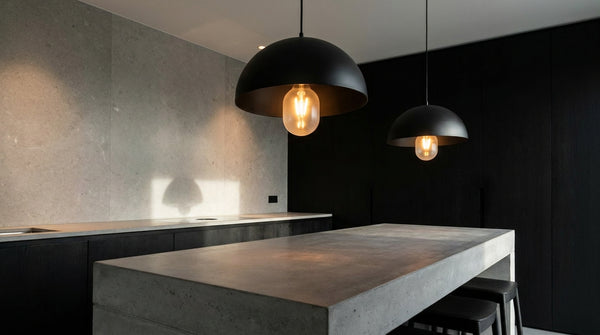
Warm or cool light: the difference, room by room
This article is also available in French: Difference lumiere chaude et froide
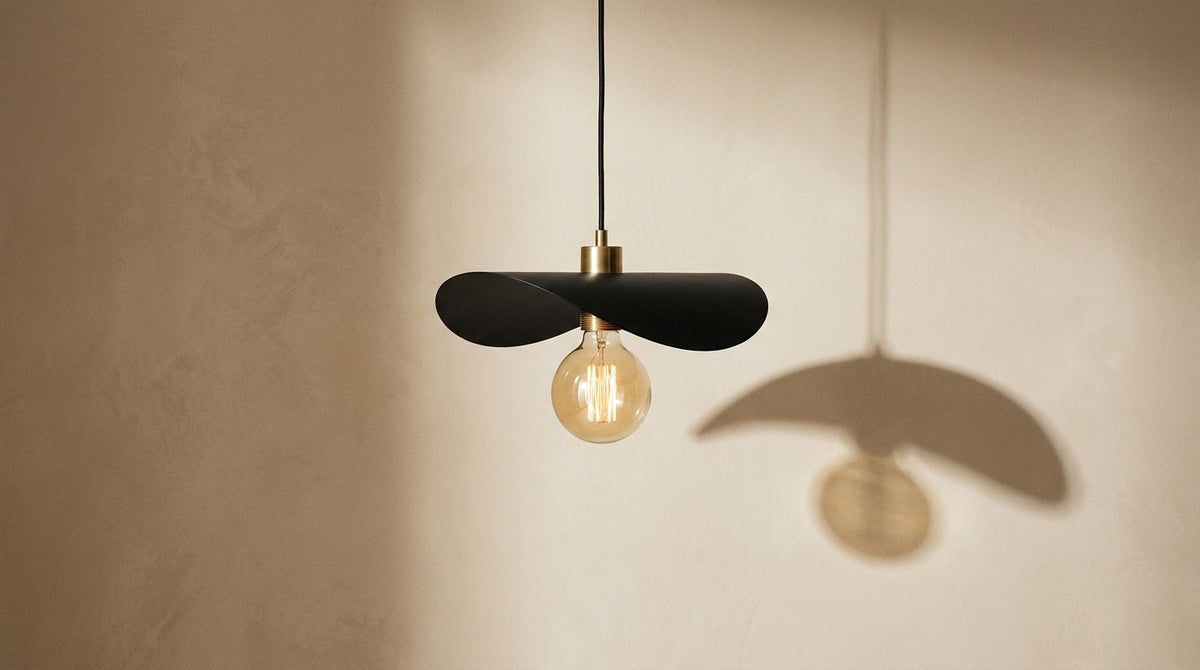
Think in kelvins: below 3000 K, light leans towards orange-yellow; above 4000 K, it leans towards bluish white. The real decision is made at the bulb base. In a survey of 250 references from our catalogue as of 29 September 2026, 31% have an E27 base, meaning a removable bulb that you choose separately.
What is the difference between warm white and cool white?
Warm white, from 2200 to 3000 K, leans towards the orange-yellow of a candle. Cool white, from 4000 to 6500 K, leans towards the bluish white of an overcast sky. Between the two sits neutral white, around 3500 K. The difference can be measured, but it is your eye that decides.
The boundary is less clear-cut than it looks: two bulbs rated at the same kelvin can render differently. Our article on white or yellow light explains how to read a label without relying on the number alone.
From what kelvin is a light considered warm?
Up to and including 3000 K, everyone says "warm". Above 4000 K, no one does. In between lies the zone where opinions diverge, and where a living room and main room renovation is decided by the rendered result rather than the catalogue.
Why do two bulbs of the same kelvin not render the same?
The shade filters. A glass diffuser or a glass pendant softens the hue, a black or gold shade warms it further. The stated kelvin is that of the bare bulb, not that of your room.
- 2200 to 2700 K: candle, night light, reading corner
- 3000 K: standard warm white, living room and bedroom
- 4000 K: neutral white, worktop and mirror
- 5000 to 6500 K: cool white, garage, outdoor
Is colour temperature chosen by room or by bulb base?
By the bulb base. The room sets the intention, the bulb sets the colour. In a survey of 250 references from our catalogue as of 29 September 2026, 31% have an E27 base, 14% an E14 and 12% a GU10: in most cases, the temperature is decided when buying the bulb, not the light fixture.
How to check the bulb base before buying?
Remove the bulb in place and read the marking on the base, or measure the diameter: 27 mm for E27, 14 mm for E14, two pins for a GU10. Two minutes are enough to know which E27 bulb to order without getting it wrong.
Warm or cool LED bulb: which one gets it right?
Neither in absolute terms, since the same reference often exists in both shades. In this survey, 205 of 250 listings, or 82%, mention LED: the choice of temperature remains open in almost all formats. Our guide to bulb types and kelvins serves as a reference before ordering.
| Bulb base | Share of survey | What it changes |
|---|---|---|
| E27 | 31% | The widest choice of bulbs and temperatures |
| Integrated LED | 18% | Temperature fixed at the time of buying the fixture |
| E14 | 14% | Bedside lamps and wall lights, smaller bulbs |
| GU10 | 12% | Directional spotlights, narrow beam |
A designer light fixture is therefore chosen for its shape and its bulb base, not for its temperature. In this same survey of 250 references, the 2-year warranty and CE certification are declared on 100% of listings, and buyer reviews remain visible on Designix's Google listing.
If you would rather look at your room with us than guess the bulb base from a photo, tell us about your project and we will start from your interior.
Fixtures ready to take your bulb
 Barn 3-light ceiling light, black and gold, Premium
 Barn 3-light ceiling light, black, Premium
 Gravity 6-light pendant, black, opal glass
 Barn 3-light ceiling light, black
 Aurora Borealis Wall Light | Rian
 Wood and black wall light | Elegant Fusion
See the whole selection: Alternative Laurie Lumière: your new lighting destination | Designix
Warm or cool for the kitchen, living room and bathroom?
Warm wherever you settle: living room, dining room, bedroom. Neutral to cool on what you look at closely: worktop, mirror, hallway. Cool light serves precision, warm light serves comfort. The rest depends on the time of day and the distance between your eyes and the source.
Warm or cool white kitchen: where to place each temperature?
Above the island, a kitchen pendant in 2700 to 3000 K lights the meal without being harsh. On the worktop, 4000 K makes textures readable and blades sharp. Two temperatures in the same room work very well if the eye never sees them together.
Warm or cool light bathroom: the mirror case
In front of the mirror, aim for 4000 K: 2700 K yellows the complexion, 6000 K makes it look washed out. The rest of the room tolerates warm light, and our bathroom lighting selection covers both registers. In the survey of 250 references from our catalogue as of 29 September 2026, 94% are declared IP20: a wet room is treated separately.
Above a table, a dining room chandelier in 2700 K gives that golden halo that keeps guests at the table. It is also the room where cool white is noticed most quickly: at 4000 K, faces take on a grey tint that no one can explain.
- Living room: 2700 K for ambience, 3000 K for reading
- Dining room: 2700 K above the table
- Kitchen: 4000 K on the worktop, 3000 K for meals
- Bathroom: 4000 K at the mirror, 2700 K elsewhere
Which room are you looking for light in?
What light for a bedside lamp and rested eyes?
Warm, and dimmable if possible: 2200 to 2700 K, an intensity you can reduce, and a source kept out of your direct line of sight. It is this combination that rests the eye in the evening, not the bulb brand.
Which LED bulb does not hurt your eyes?
A 2700 K bulb whose light passes through a diffuser, never a bare source pointed at the bed. Cool white, richer in blue, requires the eye to make an accommodation effort at the end of the day. The mechanism is detailed in our article on blue light.
Warm or cool light bedroom: what to choose for sleeping?
Warm, and adjustable. An adult bedroom wall light frees up the bedside table and places the source at shoulder height, out of the eye line.
Our guide to the bulb for a bedroom details wattages by use. Of the 110 listings in the survey of 250 references from our catalogue as of 29 September 2026 that declare this field, 28% state dimmability: this is the criterion to look at before kelvin.
How to avoid two colour temperatures in the same room?
One temperature per field of view. If you see a 4000 K ceiling light and a 2700 K lamp at the same time, the eye compares, the room looks dull and both sources lose. Mixing is tolerated from one room to another, never within the same gaze.
One temperature per field of view
Standing in the centre of the living room, scan the room: everything in the frame should share the same family. A 3000 K LED ceiling light and a 2700 K table lamp coexist smoothly. The same ceiling light in 4000 K produces a bluish patch on the ceiling while the lamp casts a yellow circle on the floor.
And if I want to vary the mood?
Vary the intensity, not the temperature. A dimmable bulb keeps the same hue and changes the level: that is what takes a room from dinner to evening without changing anything.
What remains is to check compatibility between the dimmer and the bulb, which our article on dimmable LED details.
In stock · shipping costs shown at checkout · up to 30% off in your cart


Ready to turn inspiration into reality?
Tell us about your room, your style and your budget, and we will show you the pieces that truly suit your project.
Get guidance in 30 seconds →