
GU10 bulbs
This selection is also available in our French store: Ampoules GU10








- Tracked delivery to your country Tracked delivery
- Secure payment at checkout Multiple payment methods
- 14 days to change your mind 14-day returns
- Secure payment Secure payment
Not sure of your style? Find it in 30 seconds
A few questions, and we will show you the pieces made for you.
Frequently asked questions
How do I choose the right product?
What are the delivery times?
Can I return an item?
Can I pay in instalments?
An interior that reflects who you are
Carefully selected pieces, shipped from our warehouses. Our team advises you before you buy, so you choose with confidence.
- Tracked delivery
- Pay in instalments, where available
- 14 days to change your mind
- Advice & showroom in Lyon, France
Start by choosing the light temperature for the room, then the wattage: in this collection of GU10 bulbs, warm white from 2700 to 3500 K covers most models and suits the living room, bedroom and hallway. The GU10 base twists a quarter turn into a bayonet socket, runs on 230 V without a transformer, and fits a recessed spotlight or a wall light.
What is a GU10 LED bulb and where should you use it?
A GU10 bulb twists a quarter turn into a bayonet socket, runs on 230 V without a transformer. Almost every model in this collection is LED, and the models documented as IP20 suit recessed spotlights and wall lights in dry rooms such as the living room, kitchen, hallway or bedroom.
GU10 LED bulbs: what the LED technology changes
An LED switches on instantly, gives off little heat and uses less power than a halogen for the same feeling of light. It does more than light a room: it draws a crisp cone on the ceiling that structures the space. Almost this entire selection is made up of LED bulbs, and the other technologies can be found in the full range of bulbs with a base.
Classic shape or GU10 reflector bulb: which to choose
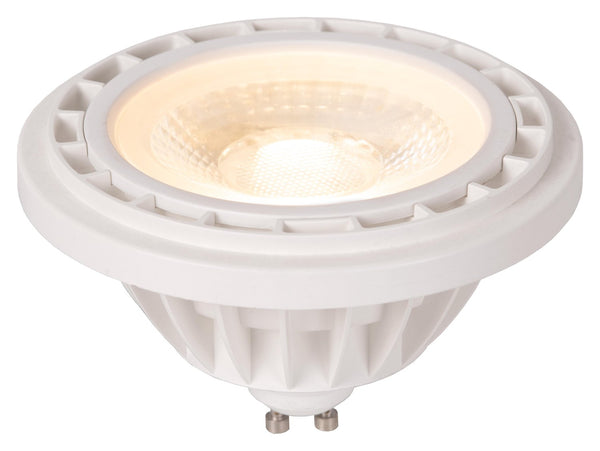
The classic shape spreads light widely, the reflector sends it downwards instead of letting it spread. Choose the reflector above a worktop or to highlight a wall, and the classic shape in a hallway or a room where you want a softer, more enveloping light. The black 12 W reflector shows this directed light well.
| Criterion | Value in the collection | What it means |
|---|---|---|
| Technology | LED on almost every model | Less consumption and heat than a halogen |
| Wattages | 3 W, 5 W, 7 W, 10 W and 12 W | From simple accent light to a spotlight that has to reach far |
| Temperatures | Warm white 2700 to 3500 K, neutral white 3500 to 4500 K | A warm mood or a more neutral rendering depending on the room |
| Ingress protection | IP20 | Dry indoor rooms, away from splashes |
| Dimmer | Compatible on a large part of the models | To be paired with a real dimmer that accepts LED loads |
| Shapes | Classic models and reflector versions | The reflector directs light downwards |
Which GU10 bulbs give the most light?
Everything depends on the luminous flux stated on the packaging, not only on the wattage. In this collection, the most powerful models are the 12 W GU10s, including a reflector version that concentrates light downwards: useful for lighting a worktop or a wall.
Lumens or watts: the right way to compare two bulbs
Watt indicates consumption, lumen the light emitted. Two bulbs of the same wattage may therefore not light the same way. At equal flux, an LED beats a halogen for far fewer watts, and it is the flux that decides whether a spotlight reaches far enough. For dimmable models, see the dimmable LED bulbs.
Wide beam or directed reflector: what changes on the ceiling
A wide beam floods, a reflector concentrates. Above a worktop, a 12 W GU10 LED in reflector form avoids multiplying light points: the light falls where you work. In a hallway or on a wall, a classic version is often enough and costs less to run than a halogen.
What gives more light, cool white or warm white?
Cool white appears brighter at equal flux, but it does not light more: it is the same amount of light, perceived differently. This collection is split between warm white from 2700 to 3500 K, the majority, and neutral white from 3500 to 4500 K, closer to a daylight rendering.
Cool white GU10 bulbs: what the term really covers
The term covers anything leaning towards 3500 to 4500 K, often a neutral rendering rather than a bluish one. For a more golden mood, look at the 2700 K bulbs. One step up, the 3000 K models keep a soft warmth while giving a little more crispness.
Warm white 2700 K: the light of relaxation rooms
In a bedroom or a living room in the evening, warm white rests the eye and brings out materials. It is the choice of bedroom bulbs, where you want a low, non-frontal light. In the kitchen, keep a neutral white instead: it renders colours more accurately on a worktop.
How to choose the wattage of a GU10 LED bulb?
A GU10 LED bulb needs far fewer watts than a halogen for the same use: the two figures are therefore not compared directly. In this collection, wattages range from 3 W to 12 W, with a majority of 5 W models, and a dimmer is possible on a large part of them.
GU10 50 W bulbs: what does that figure still mean?
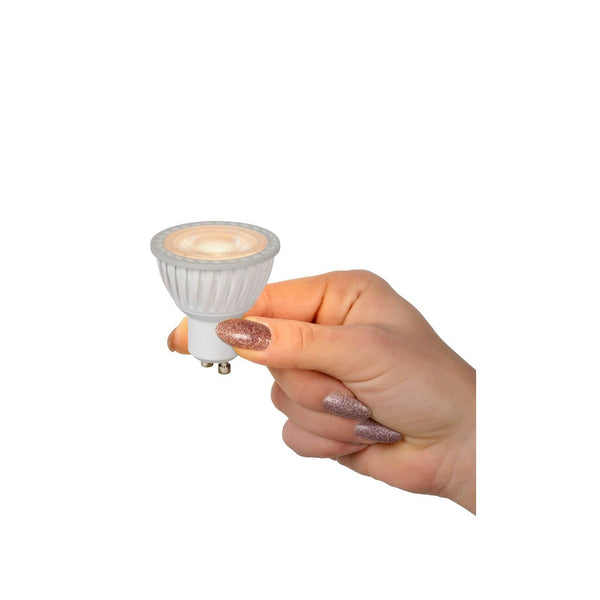
50 W, or 40 W, is the marker of the old halogen generation with a GU10 base. In LED, the same use is covered with just a few watts. No fixed conversion exists, so rely on the flux stated on the product page rather than on an equivalence found online. The 7 W GU10 illustrates this mid-range.
Why lumens matter more than watts when choosing
A high flux corresponds to a source that lights a whole room, not to a directed spotlight: you do not expect that from a GU10 used as accent light. Conversely, a lower flux is enough for a wall, a passage or a worktop. Voltage and base markers are gathered in the 220 V LED bulbs.
If your project changes base along the way, compare with the large E27 base, the small E14 base or the G4 and G9 bulbs: the light rendering stays close, only the socket changes.
What GU10 lighting for a 20 m2 room?
In 20 m2, it is better to light with several light points spread out than with a single central source: GU10 spotlights around the perimeter or above the worktop, completed by an ambient light. Then set the temperature: warm white for living and dining, neutral white for work areas.
Spread the light points rather than concentrating everything
Treat the perimeter for the back of the room, the worktop for the task, and the passage for moving around without lighting the whole room. Three or four well-placed points are worth more than a single ceiling light in the centre. Living room bulbs lend themselves to this distribution, with a lower light in the evening.
Lumens or kelvins: what you adjust according to the room's use
The amount of light sets comfort, the temperature sets the mood. You raise the flux on a work area and lower it on a relaxation corner, without changing the base. To match spotlights and decorative fixtures, start from the whole lighting range.
Dimmable GU10 bulbs: how to check it will work at home
The bulb and the dimmer must be compatible: most GU10s in this collection accept a dimmer, provided the switch is a real dimmer and not a simple two-way switch. Also check that the dimmer accepts LED loads, which are lower than with a halogen.
Connected GU10 bulb or dimmable GU10 bulb: the difference
A connected bulb is controlled from an app, often with brightness and temperature adjustment. A dimmable bulb is adjusted at the wall, with the existing switch, without a network or a phone. The two actions do not necessarily combine: it is better to choose one of the two uses before buying.
Replacing a halogen with an LED on an existing dimmer
The dimmer already in place was often designed for power-hungry lamps. With a lower LED load, it may buzz or fail to go down low. In that case, change the dimmer for a model designed for LEDs, and stay with a compatible reference such as the 7 W GU10 bulb.
How to wire 3 bulbs in parallel?
Wiring three bulbs in parallel means feeding each socket separately on the same line: live to live, neutral to neutral, in successive branches and never in series. A series connection would break the circuit as soon as one bulb is removed. GU10s run on 230 V, so without a transformer, and each socket keeps the same voltage. Switch off the breaker before working, identify the two wires by their colour, then check that no socket remains live after switching off.
Where to place GU10 spotlights room by room?
In a hallway, living room, bedroom, kitchen or dining room, a GU10 spotlight lights a precise area rather than a whole room. It is used to highlight a worktop, a wall or a passage; the bedroom and living room call for a warm white, work areas a neutral white.
Bedroom, living room, hallway: aim for an accent light
In these rooms, the spotlight completes a general light without replacing it. Aim it at a wall or the floor rather than at the bed, and plan a dimmer to lower the intensity in the evening. Modern design bulbs find their place in a hallway or an entrance.
Kitchen and dining room: lighting worktops and the table
Above a worktop, a reflector model in neutral white makes food readable and the gesture safe. Above the table, come down a tone with a warm white and a downward beam, to light the plates without lighting like an office. Glass bulbs suit exposed pendants, where the bulb remains visible.
| Place | What you expect from the light | Criteria to look at |
|---|---|---|
| Hallway | Light a passage without glare | Directed beam, warm white, moderate wattage |
| Living room | Mood and accent lighting | Warm white, dimmer if the light is adjusted in the evening |
| Bedroom | Soft light, never frontal | Warm white, spotlight aimed at the wall or floor |
| Kitchen | See clearly on the worktop | Neutral white, reflector model, IP20 away from splashes |
| Dining room | Highlight the table without lighting it like an office | Warm white, downward beam |
Choose your temperature, then your wattage, and order
Decide the temperature according to the room, then the wattage according to what the spotlight must light: a 5 W in warm white covers most accent uses, a 12 W in reflector takes over on work areas. Once you have found the model, add it to the basket from its product page, which lists the base, the ingress protection and dimmer compatibility. Find all the references in our lighting collections.
Secure payment, tracked delivery and returns: the Designix customer service remains available if any doubt remains about a base or a compatibility. Order your 7 W GU10 bulbs or your 12 W GU10 LED now and equip your spotlights in one go.
Frequently asked questions about GU10 bulbs
Is 2000 lumens a lot?
The lumen measures the amount of light emitted. 2000 lumens is a high flux: you find it on sources that light a whole room rather than a precise point. A GU10 bulb most often serves as accent lighting or a directed spotlight, at more modest fluxes.
Is 400 lumens a lot?
400 lumens correspond to an accent light, not to general room lighting. It is the order of magnitude of a spotlight aimed at a wall, a worktop or a passage. To read comfortably or light a large table, it is better to multiply the light points.
Do 1000 lumens light well?
1000 lumens are enough to light a work area or a small room, provided the light is well directed. Perception also depends on colour: a neutral white appears brighter than a warm white of the same flux. The height and orientation of the spotlight matter as much as the figure.
What is the wattage of an LED bulb?
There is no single wattage: an LED uses far less than a halogen for a comparable rendering. In this collection, GU10 LED bulbs range from 3 W to 12 W, most around 5 W, and serve both as accent lighting and as a stronger spotlight.
Are all GU10 bulbs compatible with a dimmer?
No: compatibility is checked model by model. In this collection, a large part of the GU10 LED bulbs accept a dimmer, but this remains stated on the product page. The switch must also be a real dimmer designed for LED loads.




