
Recessed wooden spotlights
This selection is also available in our French store: Spots encastrables en bois


- Tracked delivery to your country Tracked delivery
- Secure payment at checkout Multiple payment methods
- 14 days to change your mind 14-day returns
- Secure payment Secure payment
Not sure of your style? Find it in 30 seconds
A few questions, and we will show you the pieces made for you.
Frequently asked questions
How do I choose the right light output?
At what height should the light be installed?
What type of bulb?
Compatible with LEDs and dimmers?
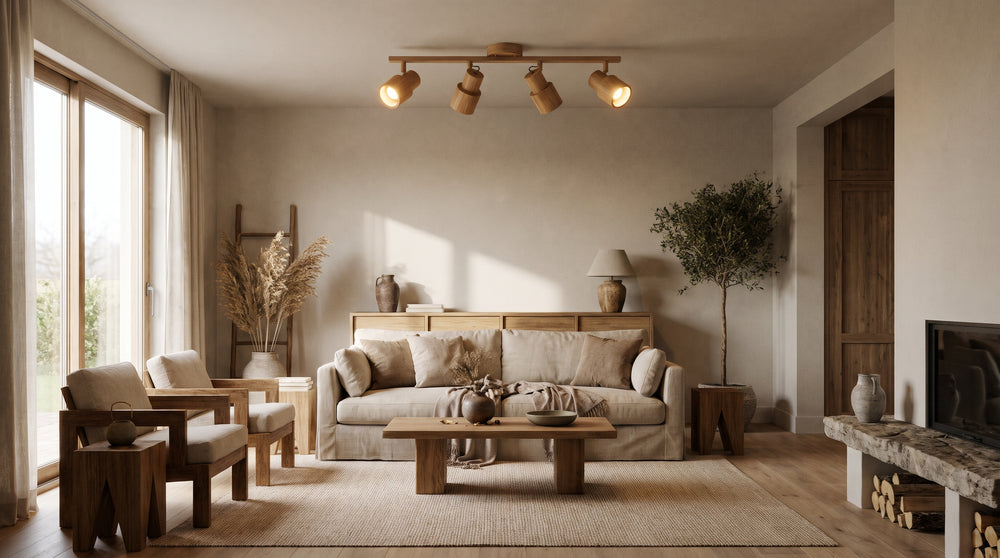
Light changes everything
From statement chandeliers to discreet wall lights, we help you choose the right brightness, height and style for every room.
- Tracked delivery
- Pay in instalments, where available
- 14 days to change your mind
- Advice & showroom in Lyon, France
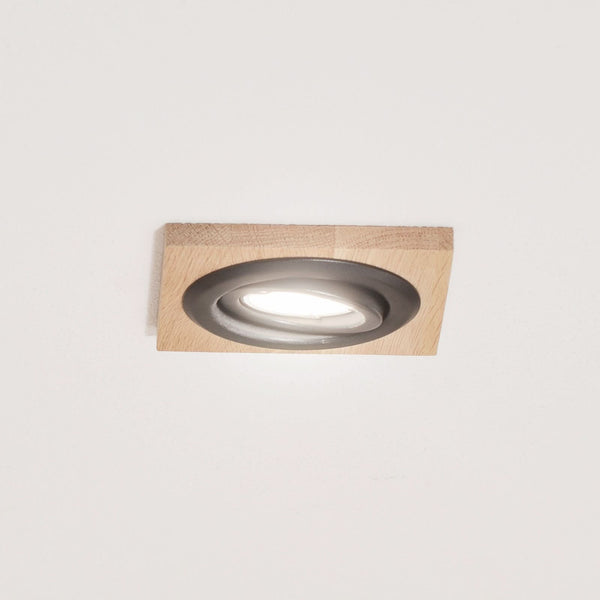
Plan on three or four points per living area rather than a single fixture, and align them with the furniture you want to light. A wood recessed spotlight sits in the ceiling, leaves only a warm trim ring showing and continues the beams, joinery and furniture of the room.
What is a wood recessed spotlight and what light does it give?
The fixture disappears into the surface: only the trim ring shows. The beam points down, narrows or widens depending on the model, and the source stays invisible from the floor. A single spotlight is not enough to light a whole room: it marks a point, highlights a material, accompanies other lighting. In a series it becomes a wash of light.
Wood recessed spotlight: ceiling or wall?
The ceiling is the usual case: the spotlight lights vertically, without casting shadows on faces. On a wall, it becomes a grazing accent that reveals the texture of a cladding or a wood plank. In both cases, the recess in the surface is prepared before finishing, not after.
What wood changes in the rendering of light
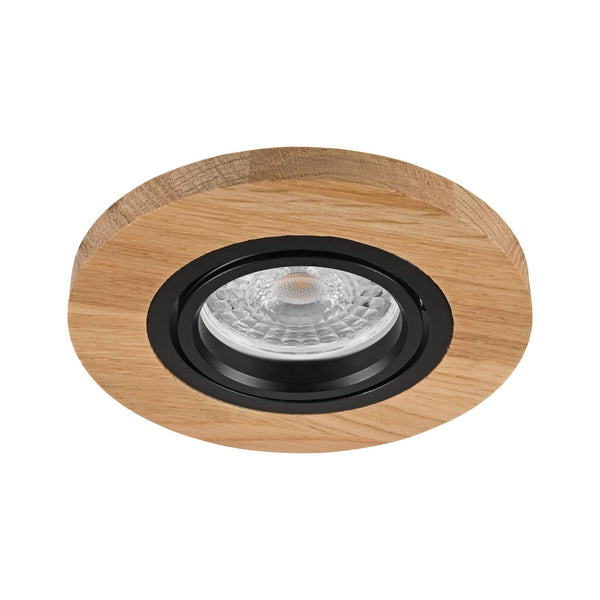
A light wood trim ring reflects light downwards without cooling it and blends into a painted ceiling. Dark wood accentuates contrast: the light point stands out, the light seems lower and more enveloping. This continuity of material with beams and doors avoids the break in effect that a white ring can produce on a panelled ceiling. To compare the families, browse the wood spotlight family and the rest of our full lighting range.
| Source type | What it implies | What to check on the spec sheet |
|---|---|---|
| Integrated LED | Nothing to replace, lifespan tied to the fixture | Colour temperature and compatible dimmer |
| GU10 socket | Replaceable source, free choice of bulb | Cap, maximum permitted wattage, dimmability |
| GU5.3 socket | Compact format for small-diameter spotlights | Transformer type and dimmer compatibility |
Where to install a wood recessed spotlight in the home?
Three uses come up again and again: highlighting in the living room, working in the kitchen, guiding in the hallway. Each room calls for a different light, so a different model. In very damp rooms, check the protection rating on the spec sheet before drilling, and prefer a dry zone: wood does not cope well with stagnant moisture.
Wood recessed spotlight above a worktop
The point goes in front of you, not behind you, otherwise your shadow falls on the chopping board. Two or three spotlights aligned over the worktop are enough, set away from the wall to avoid a bright patch. See the recessed spotlights for the kitchen and their LED kitchen version.
Lighting a hallway or wooden staircase
Here you want a guide, not performance: a regular rhythm every two to three metres, a narrow beam, low intensity. Dark wood or black blends into the half-light and avoids overly visible white points. The spotlights dedicated to hallways and the recessed spotlights for the living room cover both ends of the need.
| Room or use | Type of light sought | Recommended finish | Point to check |
|---|---|---|---|
| Living room and lounge | Soft wash and wall accent | Light wood, white, discreet gold | Alignment with furniture |
| Kitchen | Worktop lighting | Light wood or metal | Position above the worktop, not behind you |
| Hallway and staircase | Guide markers | Dark wood or black | Regular rhythm, no glare |
| Sheltered wood terrace | Accent and marking | Dark wood | Protection rating and water drainage |
| Low or sloped ceiling | Grazing light | All finishes | Recess depth and cut-out diameter |
How to arrange spotlights in the ceiling?
Start from uses, not from a grid: mark out the table, the worktop, the circulation, then place the remaining points symmetrically. Regular spacing is enough to create a wash of light, and aligning with the joinery makes the installation readable. One point fewer is better than a badly placed spotlight.
How to arrange spotlights in a living room
Two rows parallel to the main wall, or a central row doubled with accents on the walls you want to highlight. The distance to the wall is adjusted by eye on the actual beam, with the light on, before drilling. An adjustable model can then correct a gap of a few centimetres: see the adjustable models.
The trap of spotlights too close to the wall
A spotlight stuck against the wall casts a visible cone high on the wall and leaves the bottom in shadow. Move the point back, tilt it, or replace it with a wall light. On a feature ceiling, spotlights with a crafted design accept being seen and become a pattern in their own right.
Wood recessed ceiling spotlight: which format for a low ceiling or a slope?
On a low ceiling, every centimetre of depth counts. Choose an ultra-flat model whose recess depth stays below the available thickness, and check the cut-out diameter before any drilling. On a slope, the round ultra-flat format dominates because it follows the angle without creating a hard shadow.
Wood recessed ceiling spotlight: the depth to check
The product sheet gives two values that decide everything: the recess depth and the cut-out diameter. Measure the actual thickness of the ceiling or panelling, add the space for the cable, compare. A ceiling in a lost loft leaves more latitude than a ceiling on joists. For a low-ceiling living room, the LED spotlights for the living room offer compact formats.
Round, square: which trim ring format to choose?
Round fades away and suits regular ceilings. Square aligns with existing straight lines and stands out more. In a light room, white finishes blend into the paint and leave the wood of the furniture as the only accent.
Wood terrace recessed spotlights: what to check before drilling
Choose a spotlight whose protection rating suits outdoor use, and position it in a zone that does not hold water. The plank must be able to move: keep a clearance and avoid drilling right at the edge of an end. Outside a shelter, follow the fixture's spec sheet strictly, without extrapolating.
Wood recessed spotlight in a terrace plank
Drill in the centre of a plank, never on the joint, to keep material on each side. Water must drain: a slight slope and a housing that does not form a bowl. The cable runs under the plank, in a conduit, and goes up to an accessible connection point. See the recessed outdoor spotlights.
Covered or open-air terrace: the IP rating question
A high IP rating indicates reinforced protection against water and dust; under a canopy, the need is lower than in direct rain. Wood, however, remains the weak point: a trim ring that sits in moisture turns grey and swells. To direct the beam towards a bed or a facade, compare the adjustable outdoor versions.
Fixed, adjustable or dimmable: which version to choose?
Fixed gives a uniform wash and never needs adjusting. Adjustable is aimed after installation and is used to target a wall, a picture or a worktop. A dimmer lowers the intensity in the evening, provided the source and the circuit keep up: check on the spec sheet, otherwise the setting will not work.
| Version | What it changes | Where it is useful |
|---|---|---|
| Fixed | Set beam, nothing to adjust | Regular ceiling, uniform wash |
| Adjustable | The beam is aimed after installation | Wall, picture, worktop, corner |
| Dimmable | Intensity adjusts to the moment | Living room in the evening, bedroom, adaptable room |
| Adjustable and dimmable | Direction and intensity adjustable | Evolving room, scenographic lighting |
To combine both, look at the adjustable LED versions and the models with a dimmer built into the LED.
How to match a wood spotlight with the room's finish?
Light wood matches light joinery, white walls and natural textiles. Dark wood goes better with black, metal and deep shades. Gold brings a visible touch without changing the light. Two finishes maximum on the same ceiling stay readable.
Light wood or dark wood: what to pair it with?
A Scandinavian living room takes light wood, off-white and linen. An industrial room prefers dark wood and black: see the black version. A hallway or a reading corner can take a stronger point with the gold colourway.
Mixing wood, metal and colour without overloading
Keep the same family of shades from one end of the ceiling to the other and reserve contrast for a single zone. Brushed metal sits well with a medium wood, provided it stays discreet: browse the metal spotlights if you are looking for that pairing. In warm white, generally around 2700 to 3000 K, the light stays consistent with wood.
How to install and maintain a wood recessed spotlight?
Mark the location, cut the power, drill at the indicated cut-out diameter, run the cable then fix the spotlight according to its system. Maintenance is limited to dry dusting and a non-abrasive cloth on the wood. If in doubt about the connection, call an electrician.
Drilling a wood ceiling for a spotlight
A hole saw of the right diameter, a pilot hole to stop the bit slipping, slow drilling to avoid splintering the fibre on the way out. Check what is behind before drilling: joist, conduit, insulation. The spotlight then clips or screws in, without forcing the trim ring.
Cleaning a wood trim ring without damaging it
Soft cloth, dry or barely damp, never abrasive products or a greasy sponge. Tighten the fitting if the spotlight moves in its housing, and cut the power before any work on the electrical part. To widen your search, go back to our lighting catalogue.
Frequently asked questions
How to arrange spotlights in the ceiling?
Place spotlights based on uses: above the worktop, the table or along the circulation, then distribute the remaining points symmetrically. Avoid placing a spotlight against a wall, which creates a bright patch. Fewer well-placed points are better than a tight grid.
Can recessed spotlights be installed in a wood terrace?
Yes, provided you choose a spotlight whose protection rating suits outdoor use and position it in a zone that does not hold water. The plank must be able to move: keep a clearance and avoid drilling right at the edge of an end. Outside a shelter, follow the fixture's spec sheet.
Wood recessed ceiling spotlight: what depth to allow?
The recess depth must stay below the thickness available in the ceiling, especially on a low ceiling or a slope where an ultra-flat model is chosen. The cut-out diameter must match the surface. These two values appear on the product sheet and are checked before drilling.
What is the difference between a fixed and an adjustable wood recessed spotlight?
A fixed spotlight diffuses along the axis where it is installed and suits a regular wash of light. An adjustable one is set after installation to target a wall, a picture or a worktop, which corrects an approximate position. The look on the ceiling stays the same, only the direction changes.
Do you need a special bulb for a wood recessed spotlight?
It all depends on the intended source: a model with integrated LED takes no bulb, whereas a spotlight with a GU10 or GU5.3 socket is replaceable. In that case, respect the cap and maximum wattage indicated on the spec sheet, and check compatibility with a dimmer if the installation has one.
Ordering from Designix
Choosing a spotlight comes down to three values read on the spec sheet: the cut-out diameter, the recess depth and the source type. Once these are confirmed, the finish settles the rest. Secure payment, tracked delivery, returns and Designix customer service accompany the order, and the team answers if a dimension still needs confirming before drilling.




