
E27 LED filament bulbs
This selection is also available in our French store: Ampoules LED à filament E27









- Tracked delivery to your country Tracked delivery
- Secure payment at checkout Multiple payment methods
- 14 days to change your mind 14-day returns
- Secure payment Secure payment
Not sure of your style? Find it in 30 seconds
A few questions, and we will show you the pieces made for you.
Frequently asked questions
How do I choose the right product?
What are the delivery times?
Can I return an item?
Can I pay in instalments?

An interior that reflects who you are
Carefully selected pieces, shipped from our warehouses. Our team advises you before you buy, so you choose with confidence.
- Tracked delivery
- Pay in instalments, where available
- 14 days to change your mind
- Advice & showroom in Lyon, France
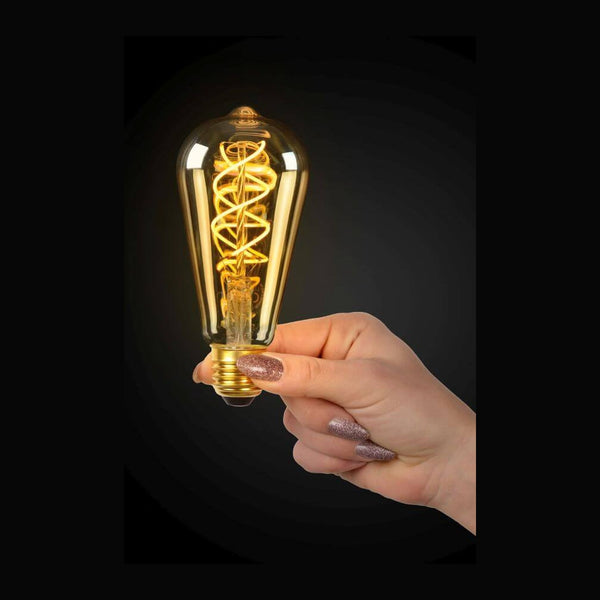
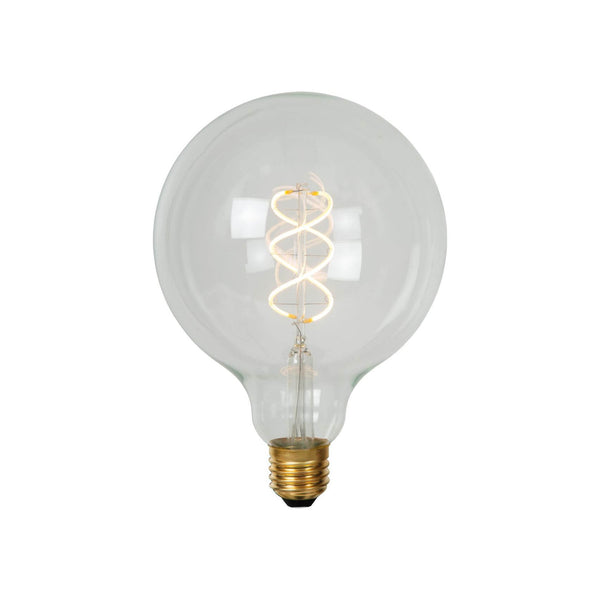
An E27 filament LED bulb screws into a standard screw socket and shows its filaments behind clear glass. This entire selection lights in warm white, between 2700 and 3500 K, with a glass body and an identical E27 base on every model.
What is an E27 filament LED bulb and what light does it give?
An E27 filament LED bulb screws into a standard screw base and shows its filaments behind clear glass. The whole selection lights in warm white, between 2700 and 3500 K, a rendering close to the incandescent bulb, with a glass body complemented by metal, aluminium, brass or iron depending on the model, and an IP20 protection rating.
Warm white E27 filament LED bulb: what the 2700-3500 K shade changes
A shade of 2700 to 3500 K leans golden: faces stay natural, wood and fabrics do not turn blue, and in the evening the room warms up instead of flattening out. This is the shade you expect from a bulb in a living room or bedroom, and that of the E27 filament bulb as well as the other references in the selection. To compare with nearby renderings, the 2700K shade and the 3000K rendering give two useful reference points.
Visible filament and glass: why the bulb stands out when lit
The filament stands out clearly behind the glass, off as well as on: on a wall light or a pendant with an exposed socket, the lamp is part of the decor. Glass equips every model, with metal, aluminium or brass dressing the socket and the base. Find these finishes in the glass bulbs and the filament bulbs of the shop.
Which E27 filament bulb to choose depending on the room?
In the living room, a globe format of 5 x 12.5 cm or 6.5 x 14 cm fills a ceiling light or a chandelier; above a table, the 5 x 12.5 cm in 16 W works well. Bedroom and kitchen make do with the 4.5 x 9 cm in 3 W, and the small 3.5 x 10 cm suits compact lights and sheltered areas.
| Format (diameter x height) | Power | Model | Recommended rooms | Finishes |
|---|---|---|---|---|
| 3.5 x 10 cm | 1 W or 2 W | Unbreakable E27 filament outdoor bulbs | Sheltered outdoor, compact light | Black, gold or white |
| 4.5 x 9 cm | 3 W | 15 dimmable E27 filament warm white bulbs | Bedroom, kitchen, living room, dining room | Gold or white |
| 5 x 12.5 cm | 16 W | 4 retro E27 amber filament 16 W bulbs, old-world glow | Living room, dining room | Gold or black |
| 6.5 x 14 cm | 6 W | E27 filament bulb golden glow | Living room, large light | Beige, gold or silver |
E27 filament LED bulb for a living room: which format for the ceiling light or chandelier
Measure the socket and the free space around it before ordering: a globe that is too wide touches the edge of the diffuser. On a central ceiling light, the large 6.5 x 14 cm format takes up space and gives a broad light; on a multi-arm chandelier, several small formats spread the light better. Living room lighting is often played out with two or three points rather than one very strong one.
Dining room, bedroom, kitchen: what size above the table
A pendant above a table accepts the 5 x 12.5 cm in 16 W, which lights the tablecloth without dazzling the guests. In a bedroom, the 4.5 x 9 cm in 3 W is enough for a wall light or a small pendant, and bedroom bulbs are chosen on this basis. In the kitchen, the same format in white fits anywhere under a compact ceiling light.
In which light should you screw an E27 filament LED bulb?
The E27 base equips most ceiling lights, chandeliers and wall lights: a filament bulb screws in without an adapter. For a living room ceiling light, prefer a large 6.5 x 14 cm format; for a wall light, stay with a small 3.5 x 10 cm or 4.5 x 9 cm format, more discreet.
Modern LED ceiling light: which filament bulb to light the living room well
A ceiling light with an exposed socket makes the most of a large globe: the E27 filament bulb golden glow in 6.5 x 14 cm fills the volume and shows its filament. If the light has a diffuser, the shape matters less than the bulk: measure, then screw in. The rest of the Designix lighting follows the same screw socket logic.
LED chandelier and modern LED wall light: multiply the light points
On a chandelier, count one bulb per socket and keep the same model everywhere: a uniform light is better than a mix of shades. For wall lights, the 4.5 x 9 cm in 3 W goes unnoticed and lights just what is needed. The E27 base bulbs of the selection screw onto both supports without adaptation.
LED ceiling lighting: how to avoid dark areas
Spread several sources rather than a single very powerful one, and keep the same light temperature on all points. A central ceiling light completed by two wall lights covers a living room without leaving a dark corner. Browse all our lights to match the supports before choosing the bulbs.
E27 filament LED bulb dimmable: how to avoid mistakes?
Not all bulbs in this selection are dimmable: only some are designed for dimming. Check the mention on the product page before buying, and use a dimmer compatible with LED bulbs. A non-dimmable bulb installed on a dimmer does not adjust properly.
E27 filament LED bulb dimmable: check the bulb and the dimmer
Two checks, in this order: the model page, then the dimmer page. The dimmable E27 warm white bulbs in 4.5 x 9 cm are advertised for dimming and cover living room, bedroom, kitchen and dining room. For a dimmer setup, also compare with the dimmable E27 and the dimmable LED bulbs of the shop.
Non-dimmable bulb on a dimmer: what happens in practice
The brightness does not go down smoothly, or starts flickering at low intensity: the dimmer is not made for this model. In that case, replace the bulb with a reference designed for dimming rather than the dimmer. The format also matters: a wider globe changes the silhouette of the light.
Power, dimensions, finishes: how to read the page of an E27 filament bulb?
An E27 filament bulb is chosen first by its dimensions: 3.5 x 10 cm, 4.5 x 9 cm, 5 x 12.5 cm or 6.5 x 14 cm. Powers range from 1 to 16 W depending on the model. The finish, gold, white, black, silver or beige, stands out especially once the bulb is lit.
E27 filament LED bulb 2W and 16W: from the most compact to the brightest
The small formats in 1 or 2 W target compact lights and sheltered spots; the 3 W equips wall lights and ceiling lights in secondary rooms. The 16 W arms the large globes above a table, like the 16 W amber retro bulbs. In between, the 6 W remains a good compromise for a living room ceiling light.
Should you look for an E27 filament LED bulb 100W?
This selection does not offer that power: the models range from 1 to 16 W, which already covers a ceiling light, a chandelier or a wall light. The power stated on the page is enough to compare models with each other, with an identical E27 base. The E27 LED bulbs are read on these same criteria.
Warm white, neutral white, cool white: which temperature for your room?
This selection only lights in warm white, between 2700 and 3500 K: a golden light that warms a living room, a bedroom or a dining room. For a neutral white or a cool white, you need to change bulb family; the nearby warm shade collections allow you to compare renderings.
E27 filament LED bulb 4000K or neutral white: where to look
A 4000 K or neutral white rendering is not part of this selection: it stays on warm white. If the room calls for a cooler rendering, turn to another family, keeping the same E27 base so as not to change the light. The bulb catalogue groups the different types available.
Why warm white remains the choice for the living room and bedroom
In the evening, a golden light rests the eye and relaxes the room; it is the historic rendering of incandescence, which the filament imitates. In a living room or bedroom, the warm shade goes with wood, textiles and matte paints. The amber colours and the retro bulbs accentuate this rendering even more.
Do LED bulbs consume a lot?
The bulbs in this selection show powers of 1, 2, 3, 6 or 16 W: consumption corresponds to that value during one hour of lighting. An E27 filament LED bulb therefore requires much less than an incandescent bulb for comparable lighting, and the whole selection is guaranteed for two years.
1 W, 3 W, 6 W, 16 W: what power says about consumption
The stated power is the consumption while lit: a 3 W bulb consumes 3 W as long as it lights. A large 16 W format consumes more, but remains in low orders of magnitude, which explains why you leave a lamp on without thinking about it. See the LED bulbs to place the powers in relation to each other.
Two-year warranty on the whole selection: what is covered
The two-year warranty applies to each model in the selection, whatever the format or finish. In case of a problem, the Designix customer service takes over. The unbreakable E27 bulbs 1 and 2 W follow the same coverage, like the rest of the lighting sold on the site.
How to install and maintain an E27 filament LED bulb?
The bulb is screwed in by hand onto the E27 base, with the light switched off, without forcing on the glass. As the whole selection is IP20, these bulbs are intended for indoor and sheltered spots, not for direct exposure to rain or water splashes.
Screwing in an E27 bulb: the gestures and mistakes to avoid
Switch off the light, screw in until contact without tightening further: it is the hand that holds the glass, never a tool. Glass is cleaned with a soft, dry cloth, with the power off, without abrasive product. For outdoor use, look instead at the outdoor bulbs, designed for those spots.
IP20 and damp rooms: what the bulb withstands
IP20 means the bulb is protected against solid bodies larger than 12.5 mm, but not against water: no exposed bathroom, no unsheltered terrace. In a damp room, keep the light closed and away from splashes. Also check that the socket of your support is indeed an E27 before ordering, as on the E14 and E27 bulbs of the shop.
All models in this selection come down to three points: measure the socket, choose the format, check the finish. Secure payment, tracked delivery, returns and Designix customer service accompany every order. Once you have identified your format, open the model page and add it to the cart.
Where can I find cool white LED bulbs?
This selection only offers warm white, between 2700 and 3500 K. For a neutral or cool white, you need to look at another bulb family: the nearby warm shade collections allow you to compare the renderings closest to these.
Which E27 filament bulb for a living room LED ceiling light?
In a living room ceiling light, aim for a large globe format: 6.5 x 14 cm in 6 W or 5 x 12.5 cm in 16 W. The warm white filament warms the room. Check that the ceiling light socket is indeed a screw E27.
How to light a living room LED chandelier with filament bulbs?
A chandelier accepts several E27 bulbs: count one bulb per socket and keep the same model everywhere for a uniform light. The 5 x 12.5 cm in 16 W or the 4.5 x 9 cm in 3 W fit depending on the size of the sockets and the height of the chandelier.
Which bulb to choose for a modern LED wall light?
For a wall light, a small format goes unnoticed: 3.5 x 10 cm in 1 or 2 W, or 4.5 x 9 cm in 3 W. The E27 base screws in directly. In warm white, the wall light lights without dazzling and stays consistent with the rest of the living room.
Are E27 filament LED bulbs 4000K or neutral white available?
No: this selection only lights in warm white, between 2700 and 3500 K. A 4000 K or neutral white rendering corresponds to another bulb family. The nearby warm shade collections remain the closest for comparing renderings.




