Spotlight tube
This selection is also available in our French store: Spot tube




- Tracked delivery to your country Tracked delivery
- Secure payment at checkout Multiple payment methods
- 14 days to change your mind 14-day returns
- Secure payment Secure payment
Not sure of your style? Find it in 30 seconds
A few questions, and we will show you the pieces made for you.
Frequently asked questions
How do I choose the right product?
What are the delivery times?
Can I return an item?
Can I pay in instalments?

An interior that reflects who you are
Carefully selected pieces, shipped from our warehouses. Our team advises you before you buy, so you choose with confidence.
- Tracked delivery
- Pay in instalments, where available
- 14 days to change your mind
- Advice & showroom in Lyon, France
Start by measuring the clear height under the ceiling and identifying the area to light: a tube light fitting is surface mounted and sends light straight down to the floor. Then choose a GU10 socket if you want to pick your own bulb, or an integrated LED if you would rather not think about it again.
What is a tube light fitting and where should it go?
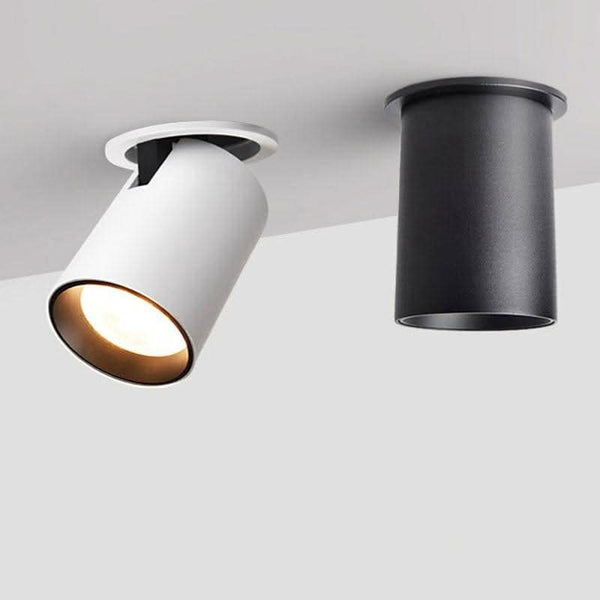
A tube light fitting is recognisable by its slim cylindrical body, fixed to the ceiling, sending light down towards the floor. It comes with a replaceable GU10 bulb or an integrated LED, in aluminium or acrylic, in white, black, black and gold finishes, with IP20 protection that makes it suitable for dry rooms in the home.
The ceiling tube light fitting, a slim cylinder and a question of height
The body rarely drops more than a few centimetres, but the range goes from 5.2 cm on the frosted model to 30 cm on the longest one. That height is not a detail: it decides the distance between the light source and the lit surface, and therefore how soft the result looks. A low ceiling struggles with a long cylinder, while a large room needs one to stop the light from staying stuck up high. The collection covers kitchen, living room, hallway, entrance and dressing room, always with the same IP20 protection rating and a two year warranty.
Kitchen, hallway, entrance, dressing room: where this spotlight works
In a hallway, it marks the route from one end to the other without taking up wall space. In an entrance, it lights the floor and signals arrival. In a dressing room, it shows the colours of clothes without casting shadows. In a kitchen, it sits above the worktop. To go further on these uses, browse ceiling spotlights and spotlights designed for the worktop. The frosted tube light fitting, 5.2 cm high, suits passageways, with its diffuser that softens the light.
GU10 tube light fitting or integrated LED tube light: what is the difference and which should you choose?
A GU10 tube light fitting takes a bulb you choose and replace, with models rated up to 50 W max per bulb. An integrated LED tube light has its own built in source, at 9 W or 12 W, in neutral white from 3500 to 4500 K. The first leaves the colour temperature up to you, the second simplifies installation.
GU10 tube light fitting, a bulb you choose and replace
This is the flexible option: the day you want to move from warm white to a crisper white, you change the bulb, not the fitting. Rated wattages vary by model, 15, 25 or 50 W max per bulb, which leaves room for a room that needs stronger light. Compare GU10 spotlights with replaceable bulbs and, if you are also looking to cover another room, the integrated LED models.
LED tube light, a built in source in neutral white
Here there is nothing to choose or replace: the source is inside the fitting, at 9 W or 12 W, in a neutral white between 3500 and 4500 K, bright enough to work under and soft enough for a living room. This is the format that works when you want a consistent line on the ceiling, without worrying about bulb compatibility. The white 12 W LED tube light is the simplest example.
| Criterion | GU10 tube light fitting | Integrated LED |
|---|---|---|
| Bulb | Replaceable | Built in source |
| Rated wattage | 15, 25 or 50 W max per bulb depending on model | 9 W or 12 W depending on model |
| Light temperature | Chosen with the bulb | Neutral white from 3500 to 4500 K |
| Colours | White, black, black and gold, black and wood, frosted and white | White, black and white |
| Material | Aluminium | Aluminium, acrylic or metal |
| Maintenance | Change the bulb, keep the fitting | Replace the fitting |
How many spotlights in a kitchen and what distance between two ceiling spotlights?
There is no fixed number: you start from the areas to light, the worktop and the upper cabinets in a kitchen, then align the points. The spacing between two ceiling spotlights depends on the available height and on the beam of the bulb: the light should stay continuous, with no gaps and no pointless overlap.
Start from the work areas rather than the number of points
First identify what needs to be seen: the chopping board, the hob, the sink, the contents of the upper cabinets. Each useful area deserves its own point, on axis, rather than an even scatter that lights nothing in particular. Two well placed points beat four badly spread ones. LED spotlights for kitchens gather the formats suited to this work, and modern models for kitchens play the same card with a more defined silhouette.
Set the spacing according to height and beam
The higher the ceiling, the wider the cones of light spread before they reach the worktop, and the more the spacing can open up. With a low ceiling, bring the points closer so the discs of light still meet on the surface. Test with a single bulb in place before drilling the whole line: you will see where the light actually falls.
Ceiling spotlight layout for a living room: how should you spread the points in a lounge?
In a living room, the layout starts from use: one point for the sofa, one or two for the coffee table, keeping a regular line so the ceiling still reads clearly. In an open plan lounge, separate the TV corner from the dining corner rather than scattering spotlights at random.
Modern living room ceiling spotlight, aligned lines rather than scattered points
The ceiling reads like a plan: one row on the axis of the sofa, another above the coffee table, and nothing in between. The eye follows these lines without noticing them, whereas an isolated point draws attention. To build a complete lighting scheme rather than a single line, also look at LED spotlights for living rooms and models with a more contemporary design.
Living room and lounge spotlight, separating the sofa corner from the dining corner
In an open room, two lines beat a blanket of points: one above the relaxation area, one above the table. Large cylinders then come into their own, like the 30 cm high tube light fitting, which brings the light down without crushing it. To aim the beam at a wall or a bookcase, a tilting model changes everything: see how to tilt the beam with an adjustable spotlight, or the adjustable LED spotlights.
How do you change the bulb in an adjustable or recessed spotlight?
On a GU10 tube light fitting, switch off the power, let the bulb cool, then release it from the socket and replace it with a bulb of the same cap, without exceeding the maximum wattage stated for the model. On an LED tube light, the source is built in: it cannot be replaced.
Changing the bulb in an adjustable spotlight without disturbing the aim
Note the direction of the beam before touching it, then hold the head with one hand and the bulb with the other: the rotation happens on the socket, not on the joint. A new GU10 bulb goes in without force, cap aligned. If the model belongs to the dimmable spotlights range, check that the new bulb supports dimming.
How to change the bulb in a recessed ceiling spotlight
The principle is the same, but there is less room for your hand. Switch off the power at the breaker, let it cool, take the bulb out of its socket by twisting or pulling depending on the model, then fit a bulb with the same cap. If you are hesitating between the two mountings, compare moving to a recessed spotlight with the surface mounted format before committing.
How do you wire spotlights in series or in parallel?
In parallel, each spotlight receives the same voltage and keeps working if another point goes out: this is the wiring that suits a line of ceiling spotlights. In series, the points share the voltage, which is not suitable. Have the diagram checked before closing the boxes.
Wiring spotlights in parallel, each point stays independent
Each fitting is fed from the same supply, like a row of sockets. If one bulb blows, the others stay on and fault finding stays simple. This is the usual wiring for a kitchen or hallway line, the one used by most of the spotlight families we offer.
Wiring spotlights in series, why this setup does not suit a ceiling
In series, the voltage is divided between the points: each spotlight receives less, the light weakens and the whole set goes out as soon as one element fails. This wiring has no place on a domestic lighting line. Leave the connection to an electrician, especially if you are adding a dimmer or if the line is long.
Which size and colour of tube light fitting should you choose for each room?
A low ceiling is happy with a short tube light fitting, 5 to 6 cm high, while a large room takes a 20 to 30 cm cylinder that brings the light down without crushing it. White blends into the ceiling, black draws the line, gold adds a single accent.
Short tube light fitting or long tube light fitting, height creates the effect
The short format stays discreet and suits passageways, entrances and rooms with a low ceiling. The long format places the source closer to the lit surface, which reduces glare and gives a softer light above a table or a sofa. In between, intermediate heights of 10 to 13 cm cover most living spaces.
| Model in the collection | Height | Footprint | Socket | Rated wattage |
|---|---|---|---|---|
| Frosted Tube ceiling spotlight | 5.2 cm | Ø 6.8 cm, 7.8 cm wide | GU10 | 50 W max per bulb |
| Black and white LED Tube ceiling spotlight | 6.4 cm | 8.8 cm wide | LED | 9 W |
| White LED Tube ceiling spotlight | 10.2 cm | 7.9 cm wide | LED | 12 W |
| Noria LED spotlight | 11.6 cm | Adjustable cylinder | LED | 12 W |
| Black and gold Tube ceiling spotlight | 20 cm | 5.8 cm wide | GU10 | 15 W max per bulb |
| Tube ceiling spotlight, L 6 cm, H 30 cm | 30 cm | 6 cm wide | GU10 | 50 W max per bulb |
Black, white or gold finish, what the finish changes on the ceiling
White disappears on a light ceiling, the choice for discreet lines: see sticking with a white finish. Black, found on most of our models, draws the silhouette and underlines an aligned row, which a black finish choice allows. Black and gold, rarer, is reserved for a single point that should stand out. For a consistent ceiling, one finish per room remains the safest bet; the more graphic pieces in the design selection happily play that card.
Tube light fitting, recessed spotlight, spotlight track or wall light: what are the differences?
A tube light fitting is surface mounted on the ceiling, a recessed spotlight sits flush inside it, a spotlight track lines up several of them and a wall light goes on the wall. A spotlight lights a precise area with a narrow beam, a floodlight reaches further and wider.
Recessed tube light fitting or surface mounted tube light fitting
The surface mounted model is visible, can be moved and installs without cutting a large hole in the ceiling. The recessed one sits flush and is forgotten, at the cost of a cut out and a heavier installation. The choice often comes down to the ceiling itself: a concrete or slab ceiling suits the surface format better. Recessed LED solutions cover the other option.
Spotlight or floodlight, the beam makes the difference
The narrow beam of a spotlight lights a precise surface, which suits a worktop or a passageway. A floodlight lights wider and is used in a large room or outdoors. On a track, several points are grouped and aimed separately: that is the role of a spotlight track. For outdoors, references designed for damp conditions are better, such as outdoor spotlights, just as a wet room needs specific protection, from the bathroom spotlights range. All of our ranges can be found in the full lighting range.
Frequently asked questions
What are the different types of spotlights?
There is the surface mounted ceiling spotlight, such as the tube light fitting, the recessed spotlight that sits flush, the adjustable spotlight with a tilting head, the track spotlight that groups several points, and two families of sources: the replaceable GU10 bulb and the integrated LED.
What is the difference between a spotlight and a floodlight?
A spotlight concentrates light on a precise area with a narrow beam; a floodlight lights wider and reaches further. On an interior ceiling, a tube light fitting marks a route or highlights a worktop, while a floodlight is reserved for large rooms and outdoor use.
Can you change a recessed LED ceiling spotlight?
On an LED tube light, the source is built into the fitting, at 9 W or 12 W depending on the model: there is no bulb to change. Replacement means changing the whole fitting, and the selection is covered by a two year warranty.
Black tube light fitting or white tube light fitting, which should you choose?
White blends into a light ceiling and stays discreet; black draws the silhouette of the spotlight and underlines a graphic line, especially on a white ceiling. The collection also offers a black and gold model and a frosted and white model, in aluminium or acrylic.
Ceiling spotlight spacing, how do you avoid dark areas?
The spacing between two spotlights depends on the ceiling height and the beam of the bulb. Bring the points closer as long as the cones of light meet on the surface to be lit, space them out when the light becomes too dense, and align them on the same line.
How to choose your tube light fitting in three checks
Measure the clear height under the ceiling, note the most useful area of the room, then decide whether you want to replace a bulb one day or never think about it again. Those three answers rule out most mistakes before you even look at the finishes.
The socket comes first: GU10 if you like changing the light temperature, integrated LED if you want the same light for years. Then the protection rating: IP20 in dry rooms, more near water. Finally, think about consistency of finishes between rooms that connect, a hallway and its entrance for example. It is the kind of detail that shows immediately once everything is installed.
Ordering from Designix
Secure payment, tracked delivery, returns, and a Designix customer service team you can reach if a size or a socket leaves you unsure. One last tip before you confirm: note the ceiling height and the colour of the surface, two pieces of information that decide which model to choose.
The 5.2 cm frosted tube light fitting for a low ceiling, the 30 cm tube light fitting for a large room, the 12 W LED tube light so you never change a bulb again: there is enough here to kit out a whole room. To compare the full range before choosing, browse the complete lighting range.