
Ceramic ceiling lights
This selection is also available in our French store: Plafonniers en céramique


- Tracked delivery to your country Tracked delivery
- Secure payment at checkout Multiple payment methods
- 14 days to change your mind 14-day returns
- Secure payment Secure payment
Not sure of your style? Find it in 30 seconds
A few questions, and we will show you the pieces made for you.
Frequently asked questions
How do I choose the right product?
What are the delivery times?
Can I return an item?
Can I pay in instalments?

An interior that reflects who you are
Carefully selected pieces, shipped from our warehouses. Our team advises you before you buy, so you choose with confidence.
- Tracked delivery
- Pay in instalments, where available
- 14 days to change your mind
- Advice & showroom in Lyon, France
A ceramic ceiling light is chosen on three points: the diameter of the diffuser, the colour temperature and the protection rating when the room is damp. Fired and then glazed ceramic reflects light instead of letting it pass through, which gives a soft, enveloping light, with no visible source from the floor, suited to the living room as well as the hallway.
What is a ceramic ceiling light?
A ceramic ceiling light is a fixture fixed to the ceiling whose body or diffuser is made of fired clay, often glazed. Unlike glass, ceramic does not let light pass through: it diffuses or reflects it, which gives an enveloping light and a source that stays invisible from the room. The material is worked in faience, stoneware or porcelain depending on the desired finish.
White ceramic light, matt or glossy
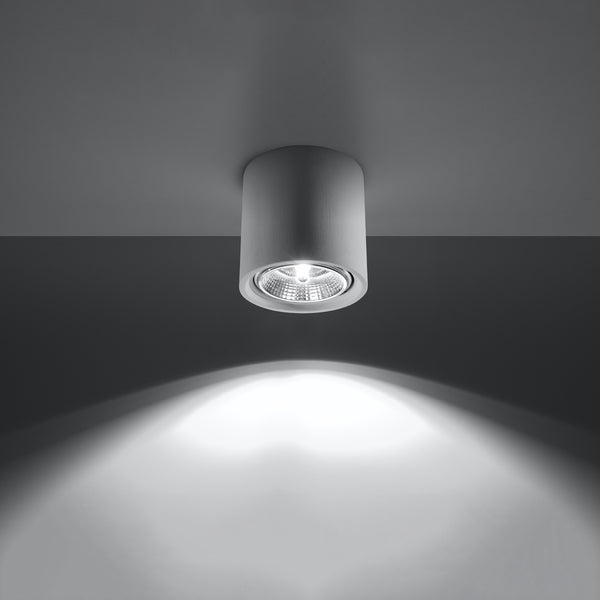
The glaze decides the finish. A glossy glaze reflects light and brightens the room; a matt glaze absorbs part of it and gives a softer light; raw, unglazed ceramic stays more textured and more matt. The shade matters too: a white ceramic light brightens a low ceiling, a darker version stands out more. The white LED ceiling lights show what a light shade looks like on a ceiling. As for shapes, the white formats and modern lines stick to simple volumes.
Ceramic chandelier or ceiling light, what is the difference?
A ceiling light is fixed directly to the ceiling, often in a flat format, and lights the room widely. A ceramic chandelier hangs from a suspension, with one or more light points, and is placed rather above a table or in an open hallway. The choice therefore depends on the available height and the use: lighting the whole room, or focusing the light on a specific spot.
Which type of ceramic ceiling light should I choose for each room?
The type is chosen on ceiling height and the use of the room, not on the material alone. A flat model fits anywhere under a low ceiling, a large diffuser suits the living room, and a damp room requires a model whose protection rating appears on the product sheet.
| Room | What matters first | Recommended ceramic | To check on the product sheet |
|---|---|---|---|
| Living room | Wide diffusion and adjustable light | Large diffuser, matt or glossy glaze | Dimensions, wattage, dimmer compatibility |
| Bedroom | Soft, non-glaring light | Round format, light shade | Colour temperature, luminous flux |
| Kitchen | Even lighting above the worktops | Flat model, easy-to-clean glaze | Protection rating, wattage |
| Bathroom | Moisture resistance | Glossy glazed ceramic | Protection rating shown on the sheet |
| Hallway and toilets | Compact format, small footprint | Flat ceiling light, small diameter | Height of the fixture below the ceiling |
Ceramic kitchen ceiling light, what matters
In the kitchen, the light must fall without casting shadows on the worktops. A flat model, with a smooth glaze that wipes clean in one go, limits maintenance. The kitchen lighting details the suitable formats. At equal wattage, even diffusion across the whole surface matters more than a flux concentrated in the centre of the room.
Which ceramic ceiling light for a bathroom?
In the bathroom, the material alone is not enough: it is the protection rating on the product sheet that indicates resistance to moisture and splashes. A flat ceiling light, fixed to the ceiling outside the shower area, is less exposed to steam. A glossy glaze cleans better than a raw surface. For small spaces, also look at the models for toilets, whose compact formats suit these narrow rooms.
Which ceiling light lights my room well?
A ceiling light lights well when its luminous flux matches the surface and the use: even light for moving around, stronger above a worktop or a desk. You go by the wattage and flux shown on the product sheet, then by the colour temperature. The diffusion specific to ceramic avoids the hot spots of an exposed source.
Room surface and use above all
A hallway of a few square metres does not have the same needs as a through living room. For moving around, a wide, low-contrast light is enough. For reading, working or cooking, the lighting must fall on the area concerned. A workstation requires even light: the ceiling lights for offices favour a neutral shade, with no dark zone in the middle of the surface.
A dimmer to adjust the mood
A dimmable ceiling light lets you go from a bright light during the day to a low mood in the evening, without changing the fixture. This is useful in the living room, where uses follow one another throughout the day. The dimmable ceiling lights gather the compatible models; before ordering, check that the wall switch is suitable, otherwise the dimming will not work.
Cool white or warm white: which colour temperature should I choose?
Warm white, around 2700 to 3000 K, leans towards orange-yellow and suits relaxation areas. Neutral white, close to 4000 K, is the whitest without turning blue. Above 5000 K, the light becomes cold and more stimulating. The shade of the glaze changes the perceived finish, never the amount of light emitted.
| Colour temperature | Finish | Suitable rooms | Point to watch |
|---|---|---|---|
| Around 2700 to 3000 K | Warm white, orange-yellow shade | Bedroom, living room, reading corner | May look yellow on white ceramic |
| Around 4000 K | Neutral white, neither yellow nor blue | Kitchen, office, hallway | Perceived finish colder in the evening |
| 5000 K and above | Cool white, bluish shade | Utility room, garage | Less restful for the eyes |
Is 4000 K white or yellow?
4000 K corresponds to a neutral white: neither yellow like a warm white at 2700 or 3000 K, nor bluish like a cool white. It is the finish closest to covered daylight, often chosen in the kitchen, the office and the hallway. On white ceramic, it stays neutral; on a golden glaze, it slightly warms the room.
What is the most restful light for the eyes?
For rest, a warm light around 2700 to 3000 K, with no visible flicker and no direct glare, is the most comfortable for reading or falling asleep. A ceramic ceiling light with a closed diffuser reduces glare because it does not expose the source. The bedroom ceiling lights favour these shades, and the white shades for bedrooms stay discreet once switched off.
What are the drawbacks of ceramic?
Ceramic is heavier than a fabric or metal shade, which requires a solid fixing point and a ceiling support in good condition. It remains sensitive to knocks on the edges and corners, and a glazed piece may also vary slightly in shade compared with another, which shows when several lights share the same ceiling. In return, the material lasts and the glaze cleans easily. To compare approaches, browse all our lights.
What are the trendiest lights for the living room in 2026?
In the living room, white ceramic, round shapes and combinations with wood or black metal remain the most visible directions. The trend is towards large-format ceiling lights, with a warm, subdued light, often dimmable to adjust the lighting according to the time of day. A ceramic ceiling light finds its place there: it brings a material and a soft diffusion, where metal reflects light and wood warms the room. The ceiling lights for the living room give an idea of current formats. As for finishes, the golden finishes warm a light glaze without dating it.
How do I install and maintain a ceramic ceiling light?
Switch off the power at the circuit breaker, check the solidity of the ceiling fixing point, then connect and screw the fixture in place, taking the weight of the ceramic into account. For maintenance, a soft, slightly damp cloth is enough, on a cold fixture.
How do I fix a ceramic ceiling light to the ceiling?
Switch off the power at the circuit breaker and check that the ceiling support holds under load: ceramic weighs more than a light shade. Identify the conductors, connect them following the colour markings, then present the fixture and screw it on without forcing on the glaze. With two people, the operation is simpler: one holds the piece while the other tightens. For a hallway or a circulation area, the hallway ceiling lights are fitted the same way, in a flat format.
How do I clean a glazed ceramic ceiling light?
A soft, slightly damp cloth removes dust and marks. Avoid abrasive products and scouring pads, which scratch the glaze and dull the surface. Switch off the power before any intervention and wait until the fixture is cold. Raw, unglazed ceramic is dusted dry, without water.
How do I match a ceramic ceiling light with the rest of the room?
Three rules are enough: the colour of the light must talk with the wall and the furniture, the finish of the glaze must follow the level of finish in the room, and the visible metal (collar, screws, suspension) must match the handles and the other lights. Keep a single strong point per room: it is the one that draws the eye on the ceiling.
Which ceramic colour for a living room or a bedroom?
In a light living room, a white ceramic light blends into the ceiling and lets the light do the work; a darker version creates a deliberate contrast. In the bedroom, stay with a light shade and a matt glaze, which reflect less light. The black ceiling lights for living rooms illustrate the effect of a dark contrast on the ceiling.
Ceramic ceiling light and metal ceiling light, how do I decide?
Metal reflects light and marks a sharper style; ceramic diffuses it and softens the room. In an interior with clean lines, the black metal ceiling lights hold the contrast. In a softer interior, ceramic takes over. The two coexist well if the metal of the finishes echoes that of the other lights, and if the shades stay in the same family. For a living room with a natural feel, the wooden ceiling lights for the living room show a third way, warmer. Complete the comparison with modern-style LED ceiling lights before deciding.
Frequently asked questions
What is the best light for a bathroom?
In the bathroom, the light is chosen above all on its resistance to moisture and steam: it is the protection rating shown on the product sheet that confirms it, more than the material alone. A flat ceiling light, fixed to the ceiling outside the shower area, limits exposure to water.
Which colour lights the most?
It is not the colour of the light that lights the most, but the colour temperature of the source: at equal wattage, a cool white around 5000 K appears brighter than a warm white, even though it diffuses the same amount of light. The colour of the light mainly affects the finish of the room.
What is the difference between a ceiling light and a ceramic chandelier?
A ceiling light is fixed directly to the ceiling, often in a flat format, and lights the room widely. A chandelier hangs from a suspension, with one or more light points, and is placed rather above a table or in an open hallway.
How do I clean a glazed ceramic ceiling light?
On glazed ceramic, a soft, slightly damp cloth is enough for dust and marks; avoid abrasive products and scouring pads that scratch the glaze. Switch off the power at the circuit breaker before any intervention, and wait until the fixture is cold.
What are the drawbacks of ceramic?
Ceramic is heavier than a fabric or metal shade, which requires a solid fixing, and it remains sensitive to knocks on the edges and corners. Its glazed shade may vary slightly from one piece to another, which shows on the same ceiling.
Choosing, ordering and fitting
The right reflex: first note the surface of the room and the use, then choose the colour temperature, and only then the format and the shade of the glaze. To go further into styles, compare the designer LED models and the modern-style LED ceiling lights available in our Designix lighting catalogue.
Secure payment, tracked delivery, returns and Designix customer service: you order, you receive, and you can come back to us if a format does not suit once fitted.




