Hallway wall light: the right light on the right wall
This article is also available in French: Applique murale couloir
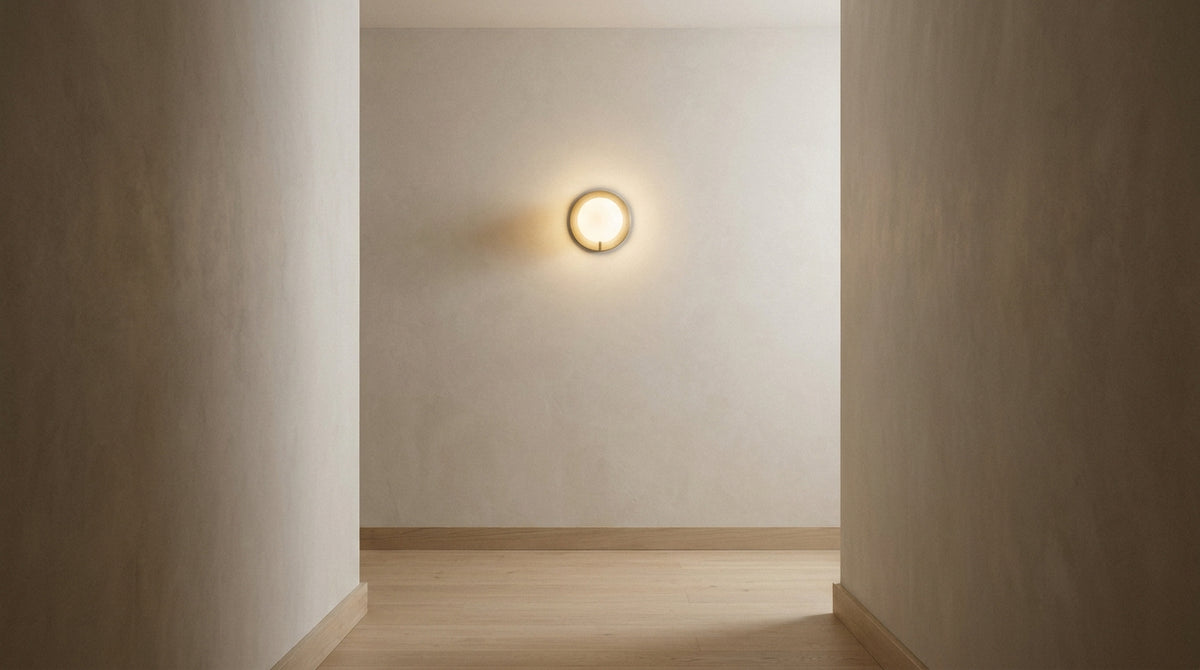
Allow one wall light every 1.50 to 2 m in a hallway, mounted 1.60 m from the floor, and aim the beam downwards or as a wall wash rather than straight into people's faces. Three light points are enough over four metres, four to five beyond that. Projection then decides: the narrower the hallway, the flatter the wall light should stay.
A badly lit hallway is one you walk through without seeing it, and it is often the last room to be redone. The hallway wall lights collection holds 12,835 references as of 9 November 2026, enough to treat an 80 cm hallway like a 12 m gallery, with the same constraint of clearance on both sides.
How many wall lights do you need in a hallway?
One wall light every 1.50 to 2 m of wall, starting 30 cm from the corner. A 4 m hallway needs three, an 8 m hallway five to six. The distance is measured between the centres of the fittings, not between their edges, and the last point can sit further from the end wall without the eye noticing.
How should you distribute the light points along a long hallway?
The rule of even spacing matters more than the number. A long hallway breaks into visual sections: two wall lights near the entrance, two by the middle door, two towards the exit. This break avoids the runway effect.
| Hallway length | Light points | Spacing between centres |
|---|---|---|
| Under 3 m | 2 | 1.50 m |
| 3 to 5 m | 3 | 1.80 m |
| 5 to 8 m | 4 to 5 | 2 m |
| Over 8 m | 2 sets of 4 | 2 m, with a break in the middle |
Is one wall light enough for a short hallway?
Yes, if it lights both ends. Place it at mid-length and choose a model that projects up and down, or one that is adjustable on two axes. A ceiling light complements this well when the width exceeds 1.20 m: our selection of hallway ceiling lights details the cases where the wall is no longer enough.
For a complete project covering the entrance, hallway and staircase in one go, an entrance, hallway and staircase lighting project avoids multiplying orders and mismatched colour temperatures from one zone to the next.
At what height should you mount a wall light in a hallway?
Mount the centre of the diffuser between 1.60 m and 1.90 m from the floor, slightly above eye level. Below 1.50 m, the wall light dazzles when seated and stays within reach of the hand. Above 1.95 m, the light grazes the ceiling and the wall loses its relief.
Should the height be the same everywhere in the hallway?
Yes, on a straight hallway, with no visible exception. A wall light 5 cm higher than its neighbour is immediately noticeable, the eye lines up light points effortlessly. Two useful tolerances: the height can rise above a low piece of furniture, and drop to 1.40 m above a wide skirting board or a handrail.
How should you direct the light?
A hallway reads better with a narrow beam aimed downwards than with a broad halo. A wall wash, slightly offset upwards, visually widens the space. The values to remember: 2700 K for a cosy feel, 3000 K on a light wall where you want crispness, and an E27 or G9 socket if you want to change the bulb without taking the wall light down.
Heights, mounting reference points and cases with walls of varying height are detailed in our article on the ideal height for a wall light.
If your hallway is longer than four metres, working out the number of wall lights takes two minutes with an adviser: describe your hallway and leave with the right number of light points. Simply talk to an adviser about your hallway.
Which wall light for a narrow hallway with no window?
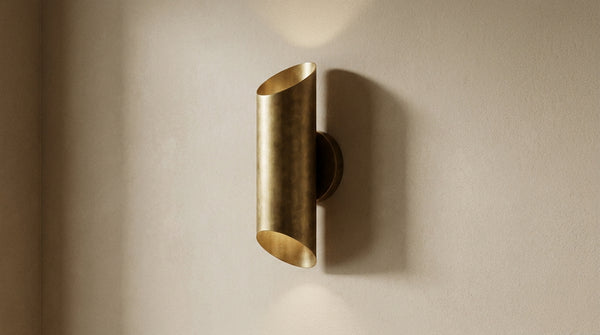
Aim for less than 12 cm of projection in a hallway 90 cm wide, and a beam directed downwards. A flat model or an LED tube grazes the wall without casting a shadow as you pass. In a windowless hallway, go up a notch in power and switch to 3000 K rather than 2700 K.
What is the maximum projection in a narrow hallway?
Take half the clear passage width as the absolute maximum. A 90 cm hallway takes 15 cm of projection, a 75 cm hallway stays under 10 cm. Low-profile shapes and flush-mounted tubes settle the question on their own, as our article on lighting for a narrow hallway shows.
What light for a hallway with no window?
With no natural light, the hallway needs a continuous flow rather than patches. Two or three low-power wall lights are better than a single strong one, because the eye looks for the line, not the source. An integrated LED wall light settles the question of changing bulbs in a space where you do not climb on a stepladder. And in a dry hallway, IP20 is enough: in a survey of 120 references from our catalogue on 9 November 2026, 97% carry this protection rating.
Diffusion options, wall colours and the pitfalls of a windowless hallway are covered in our guide on the hallway with no window.
Which hallway do you need to light?
Can you install a hallway wall light without wiring or drilling?
Yes, with a rechargeable or battery-powered wall light fixed with an adhesive pad or two small plugs. You then light a waypoint, not a whole hallway: the power stays limited and recharging comes round regularly. It is the right answer in rented accommodation, on solid concrete or in front of a door you do not want to drill.
What difference does a rechargeable wall light make?
It removes the cable, and therefore the wall chasing and the channel. In return, it has to be recharged or taken down for charging, and its output stays modest. In a hallway, reserve it for areas with no accessible conduit: secondary entrance, under the stairs, blind corner between two doors. The cordless wall lights collection gathers these self-contained models.
And if the wall cannot be drilled?
A plasterboard wall holds a lightweight wall light with suitable plugs, a tiled or concrete wall requires drilling with a hammer drill. When no fixing is possible, the adhesive plate remains an option for models under one kilo. Fixing details are explained in our guide to installing a wall light without drilling.
Hallway wall lights: the selection


Which style to choose: modern, vintage, black or gold?
Matte black remains the safest choice, it holds the wall without weighing it down. Gold warms a dark hallway, white blends in, opal glass diffuses without dazzling. In a survey of 120 references from our catalogue on 9 November 2026, 55% are black and 72% are metal.
Which colours really dominate hallway wall lights?
Black comes far ahead, followed by gold, white and beige. This hierarchy is no accident: a hallway lacks light, and therefore contrast, and a dark wall light stands out better than a pale one on a pale wall.
| Finish | What it gives | Where it works |
|---|---|---|
| Matte black | A crisp, almost graphic line | Pale wall, contemporary hallway |
| Gold or brass | A warm accent, a material presence | Dark hallway, 1930s to 1970s decor |
| White | Disappearing into the wall | Narrow hallway, low ceiling |
| Opal glass | A soft, diffused light with no hot spot | Through hallway, bedroom nearby |
How should you match the wall light to the rest of the hallway?
Pick up the dominant material of the hallway: parquet and wood panelling call for brass or wood, a polished concrete floor takes black steel. The modern wall lights for hallways cover clean lines and simple volumes. For a more lived-in look, a black metal wall light remains the safe bet, while a gold wall light brings the relief a bare wall does not give. The lines rising this year are gathered in our watch on the 2026 wall light trend.
The hallway is the first room you walk through and the last you light. A well-chosen wall light changes less the decoration than the way you look at the wall: that is what our article on wall lighting that transforms a wall is about.
In stock · shipping costs shown at checkout · up to 30% off in your cart


Ready to turn inspiration into reality?
Tell us about your room, your style and your budget, and we will show you the pieces that truly suit your project.
Get guidance in 30 seconds →