
Perfect lighting: the guide to lighting every room correctly
This article is also available in French: Comment Trouver l'Éclairage parfait pour Votre Intérieur
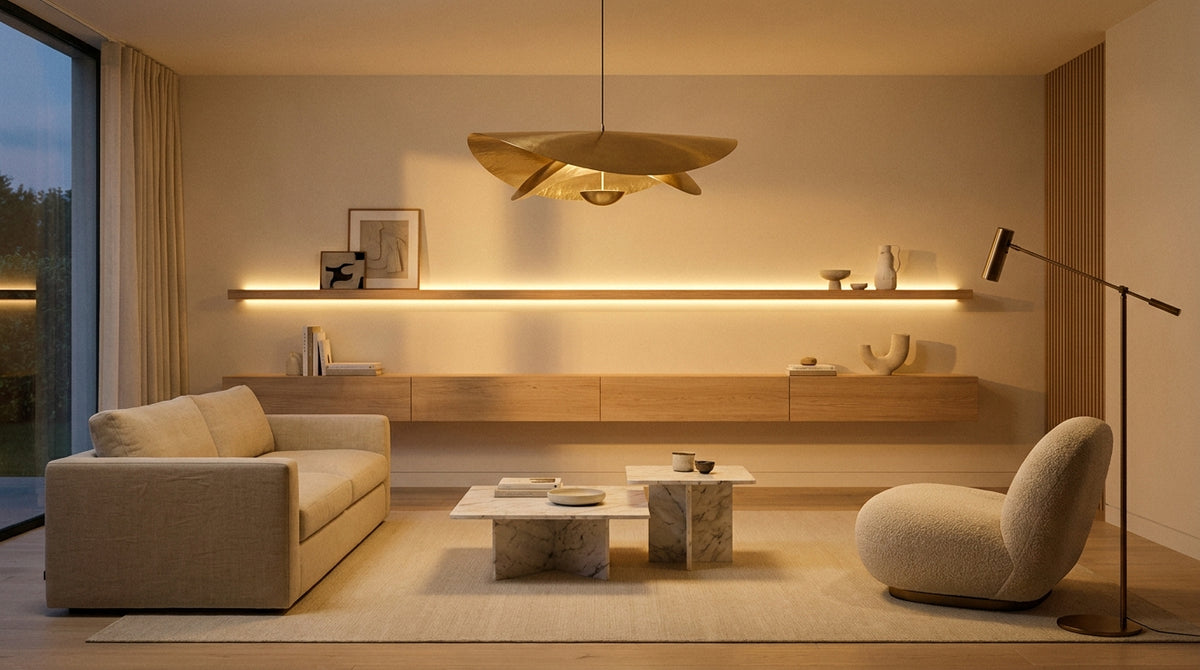
A well-furnished room can still feel dull if its lighting falls flat. The culprit is almost always the same: a single central ceiling light, expected to do it all, which flattens volumes and tires the eyes. The solution lies in a simple method: layering three levels of light (general, task, and accent), then adapting it room by room.
This logic applies to every space, from the living room to the bedroom. Before making multiple purchases, it is better to understand the role of each source, then choose the right lighting fixture for each one.
Why is a single ceiling light never enough?
Because a single source on the ceiling diffuses a flat and uniform light, with no depth or comfort zone. It casts harsh shadows under the face and leaves corners in the dark. A pleasant interior combines several focal points, at different heights, each with a precise function.
The first layer, known as general lighting, ensures background brightness. This is the role of ambient lighting, that soft glow that fills the room without creating contrast.
A ceiling light remains useful as a base, provided you choose one that diffuses well. A dimmable LED ceiling light avoids the cold effect of a single tube and can be adjusted according to the time of day.
How to layer the three levels of light?
By adding three levels instead of one. The general layer lights the whole area, the task layer targets activity zones (reading, cooking, office), and the accent layer highlights a wall, a plant, or a frame. Each layer is best controlled independently, ideally using a dimmer.
Task lighting brings a precise flow to where the eye is working: desk lamps, reading sconces, or strips under upper kitchen cabinets. Without it, the general layer is rarely enough for prolonged activity.
Finally, there is accent lighting, more theatrical, which highlights a texture or an object with a narrow beam, often mounted in GU10. It is this third layer that gives a room its character.
Which color temperature for which room?
Use warm white (2700 to 3000 K) in relaxation areas, living rooms, and bedrooms, for an enveloping atmosphere. A more neutral white (3500 to 4000 K) is best for kitchens and bathrooms, where you need clear visibility. The rule: warm to rest, neutral to act.
The choice between white or yellow light completely changes the feel of a space, even with the same surface area and power.
In a living room, creating a warm atmosphere with light involves several distributed warm sources, rather than a single cold point on the ceiling.
Check the base before buying: E27 for large sources, G9 or GU10 for spots and accentuation. Knowing how to choose your bulbs well saves you from unpleasant surprises regarding color upon unboxing.
How many light points should you plan, room by room?
Count at least three sources per living area: one general, one or two for tasks, and one for accent. A living room often requires four to five. The right benchmark is not the number of watts, but the number of focal points distributed at various heights.
Each space has its constraints, and the guide to lighting every room details the needs of a hallway, an entryway, or a bedroom.
Which room are you looking to light first?
The living room concentrates the most uses: reading, entertaining, watching a screen. A central living room light fixture for the base, a floor lamp near the sofa, and two accent lights are enough to cover every moment of the day.
Our designer lighting fixtures to compose your setup
 ASTRO white LED 3000K wall light
 ASTRO brown LED 4000K wall light
 ASTRO LED 3000K wall light
 FINT LED 4000K pendant light
 FINT LED 3000K pendant light
 KLOVER brown ceiling light
See the entire selection: Living Room Lighting: modern and designer for your interior
Based on a survey of 244 pendant lights from our catalog on September 14, 2026, 58% are for pendant mounting and 25% for wall mounting, providing plenty of options to play with heights and angles. The Living Room Lighting collection counts 14,617 references as of September 14, 2026, across all styles.
71% of that same survey offer a 5-year warranty, a useful durability benchmark when equipping an entire room. For the rest, the Designix Google profile remains the updated public source.
In damp rooms, aim for the IP44 rating: it only applies to 7% of this survey, a point to check before any purchase for a bathroom.
To size things without excess or shortfall, the most reliable method remains to calculate the quantity of light according to the surface area and the actual use of the room.
Need a clear view for your own room? Our decor advisors will help you compose the right lighting for your interior; personalized advice can be requested directly at the Vaulx-en-Velin workshop.
Finally, in a home without a central point, you can perfectly well light a room without a ceiling light by relying on floor lamps, table lamps, and wall sconces.
On the same topic
In stock · shipping costs shown at checkout · up to 30% off in your cart


Ready to turn inspiration into reality?
Tell us about your room, your style and your budget, and we will show you the pieces that truly suit your project.
Get guidance in 30 seconds →


