Brass dining room light: height, size and finishes
This article is also available in French: Luminaire laiton salle à manger
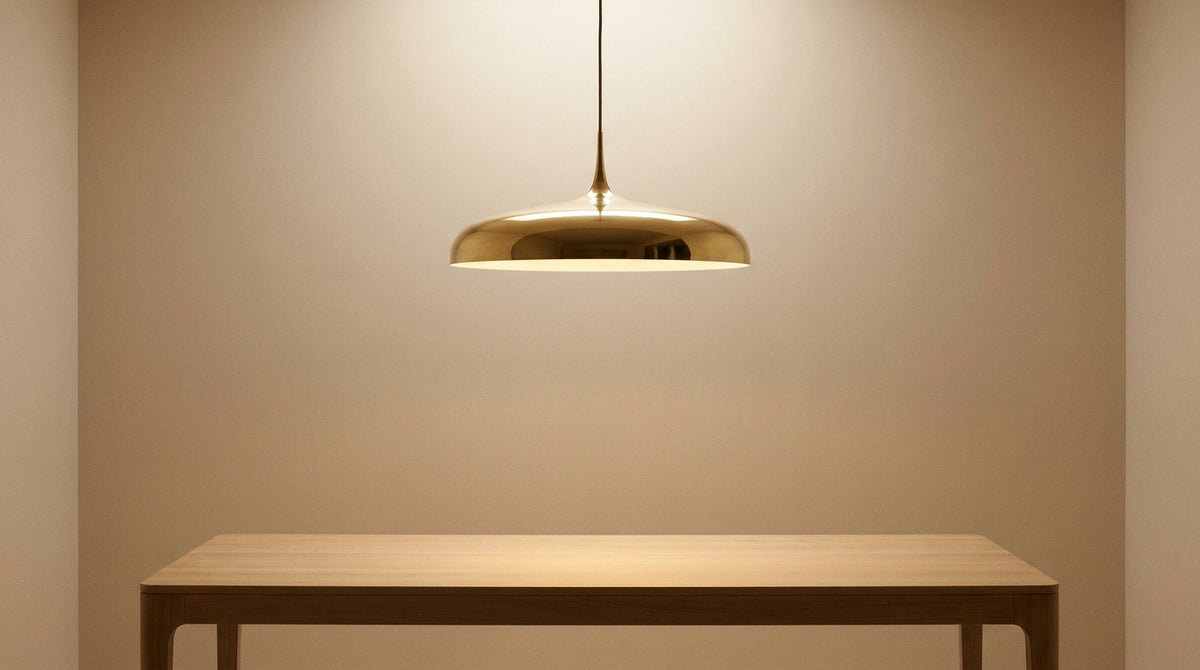
Allow 75 to 80 cm between the bottom of the light and the tabletop, then a diameter equal to one third of the table width: 60 cm for a 180 cm table. On a 2.50 m ceiling, the lowest point then sits about 1.70 m above the floor. Two measurements are enough, the rest is a matter of choice.
At what height should you hang a brass light above the table?
Between 75 and 80 cm from the tabletop to the lowest point. This distance works for a table 75 cm high and a standard ceiling. It keeps the light source close to the meal without blocking the gaze of the person sitting opposite.
A dining room lighting plan often comes down to ten centimetres: hung too high, the brass lights the whole room and leaves the plates in flat light.
What difference does a light hung too low or too high make?
- 75 to 80 cm: the comfort zone, the source stays out of direct sight
- Under 70 cm: the light takes over the centre of the table and blocks eye contact
- Over 90 cm: the light spreads out, the tabletop loses its highlight and the room is lit for nothing
- High ceiling: lengthen the chain or cable, do not raise the light
How do you adapt the height to the table and the model?
A high table or a kitchen island calls for lowering the lowest point, otherwise the light hits people's shoulders. A chandelier with wide arms needs a few extra centimetres compared with a simple pendant, so the arms stay above heads.
For a reception table, a well-centred dining room chandelier is better than a pendant adjusted to the millimetre in an empty room. The house's lighting advice details these adjustments room by room.
Then there is width: that is what decides the diameter.
What diameter should you choose for a brass pendant?
One third of the table width. For 180 cm, aim for a 60 cm diameter; for 120 cm, 40 cm. On a round table, the light stays under half the tabletop diameter, otherwise it visually overflows.
| Table width | Recommended diameter | Solution |
|---|---|---|
| 120 cm | 40 cm | one pendant |
| 160 cm | 50 cm | one pendant |
| 180 cm | 60 cm | one wide pendant |
| 220 cm and more | 2 × 35 cm | two or three aligned points |
Two or three pendants: what spacing should you use?
- Constant gap between each lowest point, never a tight pair and a third one far away
- 45 to 60 cm between two lowest points to keep the tabletop evenly lit
- Table edges: leave at least 30 cm between the first light and the end
- 220 cm table: two pendants are often enough, three clutter the line of sight
Does a large diameter give more light?
No. The diameter fills the visual space, the amount of light comes from the number of sources and their power. A large pendant with a single bulb gives less light than a trio of small models. A dining room light is therefore chosen in two steps: the footprint, then the lighting.
Pendant, chandelier or ceiling light: which type for a dining room?
A pendant to direct the light onto the tabletop, a chandelier when the ceiling height allows it, a ceiling light when height is lacking. The decisive factor is not style but the distance available between the ceiling and the table.
Pendant or chandelier: which lights a table better?
- Pendant: a focused beam on the tabletop, ideal for dining without glare
- Chandelier: several sources, a strong presence, best kept for tall rooms
- Multiple pendants: the right answer for a long table or a workshop feel
- Brass: the warm finish that warms up a white or grey interior without dulling it
A dining room pendant is adjusted by height, a chandelier is chosen by volume. If you are still unsure, the dining room chandelier has its own rules of proportion.
When does a ceiling light become the right choice?
With a low ceiling, under 2.40 m, a pendant ends up dropping into your line of sight. A flush-mounted model spreads light differently and frees up the table. A brass ceiling light keeps the warmth of the metal without using up the available height.
To compare the three families in person, the dining room lighting collection brings pendants, chandeliers and ceiling lights together in one place.
Brass pendants and chandeliers for the dining room


Polished, brushed or aged brass: which finish should you choose?
Polished reflects the light and makes the table look bigger, brushed softens the reflections without killing them, aged embraces the patina. The choice depends on the atmosphere of the room and the time you are willing to spend on care.
| Finish | Look | Care |
|---|---|---|
| Polished | mirror-like, bright highlights | soft cloth, visible fingerprints |
| Brushed | matte satin, fine grain | very forgiving, marks barely visible |
| Aged | dark patina in the recesses | no abrasive products |
How can you spot fake brass before buying?
- Weight: solid brass surprises you in the hand, gilded zamak stays light
- Recesses: on an aged finish, the patina settles in the corners, not on the edges
- Wear: electroplated gold reveals the lighter metal as soon as it flakes
- Fittings: screws consistent with the stated metal, not gilded plastic
The subject deserves more than a glance at a photo: the article on fake brass chandeliers details the checkpoints. Our selection is also reviewed by buyers, and the Designix Google listing can be checked in one click.
Out of 163 references in our catalogue on 12 November 2026, 77% are guaranteed for 5 years and 23% for two years. The time covers the finish.
How do you care for a brass light?
- Dry microfibre cloth once a month, that is the essential part of the work
- Warm water and mild soap for varnished brass, never alcohol
- No abrasives or steel wool, they scratch brushed finishes and even out aged ones
- Patina: it builds up slowly on raw brass, it is a choice, not a defect
A brass wall light follows the same steps as a pendant. The Brass Wall Light collection also has 1738 references on 12 November 2026, enough to complete a wall without breaking the unity of the metal.
Which bulb should you put in a brass light?
The base first: out of 163 references in our catalogue on 12 November 2026, 34% are G9 and 29% E27. Then the temperature, 2700 K for a warm light that flatters wood, stone and brass itself.
G9 or E27: how do you decide?
- G9: compact base, common on small pendants and chandeliers with slim arms
- E27: a wider choice of powers and shapes, easier to replace
- Integrated LED: nothing to change, the light looks after itself
- Check: read the base on the product page before ordering a bulb
G9 bulbs cover most small brass lights, and 2700 K bulbs give the warm look expected under a metal shade.
What power for dining without glare?
Aim for light directed at the tabletop, not at the eyes. A dimmer remains the best investment: it lets you go from a dinner to an evening without changing the bulb. The bulb power guide for a dining room helps avoid oversizing.
To confirm the socket and the power, contact a Designix advisor: the showroom address, 12 chemin Maurice Ferréol in Vaulx-en-Velin, lets you see the brass under its real light before ordering.
In stock · shipping costs shown at checkout · up to 30% off in your cart


Ready to turn inspiration into reality?
Tell us about your room, your style and your budget, and we will show you the pieces that truly suit your project.
Get guidance in 30 seconds →