Ambient lighting: definition, role, and settings
This article is also available in French: Qu'est ce que l'éclairage d'ambiance

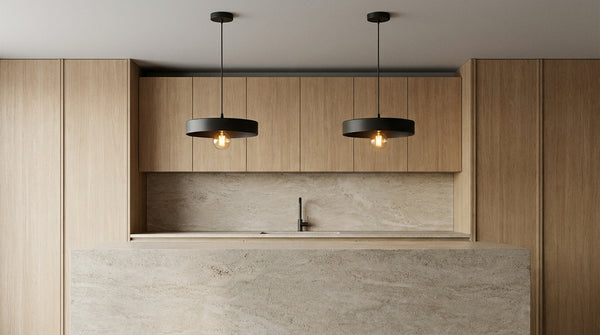
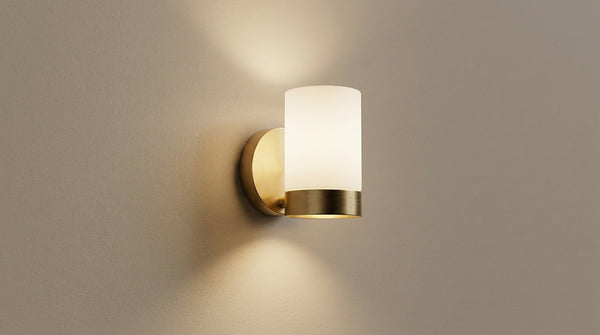
Multiply 3 to 4 soft, indirect sources, a floor lamp, a wall light, a table lamp on a piece of furniture, set between 2700 and 3000 K, rather than a single central ceiling light. Add a dimmer to adjust the intensity according to the time of day. It is this layering of low lights that creates the atmosphere, not the power.
What is ambient lighting?
Ambient lighting is the soft, diffuse background light that gives a room its atmosphere without serving a specific task. It relies on several small indirect sources in warm tones, distributed at different heights, and not on a single light point on the ceiling. Its role: to soften the space and smooth out harsh shadows.
Across the 23578 references in our lighting collection as of 24 September 2026, the logic remains the same whatever the style: a living room adds up light sources instead of concentrating a single one.
Direct or indirect lighting: what is the difference?
Direct lighting projects light onto a specific area, a worktop, a page. Indirect lighting bounces light onto a wall or the ceiling, which diffuses it as a soft wash. The atmosphere is born from this reflected light, without glare or harsh contrast.
Even light, without harsh shadow areas
Spreading light at eye level removes cast shadows and the famous ceiling-light effect that flattens a room. Each source fills the shadow left by the previous one. The result: an enveloping clarity, more restful in the evening, as shown in the benefits of soft lighting in the living room.
Why favour warm tones?
A low colour temperature, between 2700 and 3000 K, leans towards yellow and relaxes the eye. Above 4000 K, light becomes white and clinical, better reserved for the kitchen or the office. To decide according to the room, compare white or yellow light.
What are the 3 types of lighting?
There are three types: ambient lighting, the general background light; functional lighting, also called task lighting, for reading, cooking or working; and accent lighting, which highlights an object, a wall or a picture. A successful interior layers them: ambient sets the scene, functional serves the use, accent adds relief.
Ambient lighting: the background light
It is the base layer, the one that makes a room liveable as soon as you walk in. Floor lamps, wall lights and LED strips carry it better than a ceiling light alone, because they diffuse instead of flattening.
Functional lighting: seeing to act
It lights a precise action without dazzling the rest of the room. An adjustable desk lamp or an under-cabinet strip in the kitchen follow this logic, detailed in task lighting.
Accent lighting: creating relief
A narrow beam directed at a work of art, a niche or a plant creates depth and guides the eye. It is the decorative touch that distinguishes a simply lit room from a staged one, as explained in accent lighting.
How to get ambient lighting right at home
Plan for 3 to 4 indirect sources at different heights, set between 2700 and 3000 K. Put a dimmer on at least one of them. Check the IP20 rating, valid for a dry interior. Aim for the total lumens suited to the surface area rather than the power of a central point.
For the low source, a floor lamp aimed at the wall remains the simplest piece to add, without drilling or running a cable.
Our lights for successful ambient lighting
 Suspension Luminaire Naturel | Erel
 Dallas Suspension luminaire doré
 Puntes Suspension luminaire doré
 Erich Suspension luminaire argenté
 Lustre Chic et Moderne | Lueur Fluxion
 Erich Suspension luminaire doré
See the whole selection: Lighting, Home Lighting, Online Lighting Store
Getting indirect ceiling lighting right
An LED strip placed on a cornice or in a light cove bounces light onto the ceiling, which diffuses it without a visible hot spot. This solution lights an entire room with soft light, an approach developed in lighting a room without a ceiling light.
Creating an LED atmosphere in the bedroom
In the bedroom, two bedside reading lights and a strip behind the headboard are enough to create a cocoon. Stay below 2700 K in the evening to prepare for sleep. Other settings are gathered for creating a warm atmosphere with light.
Choosing the right dimmer
A dimmer turns a single source into several atmospheres depending on the time of day. Careful: not all bulbs accept one. Out of a sample of 250 references in our catalogue as of 24 September 2026, only 26% state dimming capability; so check compatibility before buying, as the guide reminds you for choosing a dimmable bulb.
Unsure about the number of light points for your room? Ask for personalised advice before choosing your sources.
On the safety side, the same sample of 250 references as of 24 September 2026 shows 94% of models rated IP20, reserved for dry interiors, 96% guaranteed for 2 years and 100% CE certified. Each pendant light in the selection is reviewed by buyers, whose feedback you can read on the store's Google listing.
In which room do you want to create your ambient lighting?
In stock · shipping costs shown at checkout · up to 30% off in your cart
Ready to turn inspiration into reality?
Tell us about your room, your style and your budget, and we will show you the pieces that truly suit your project.
Get guidance in 30 seconds →