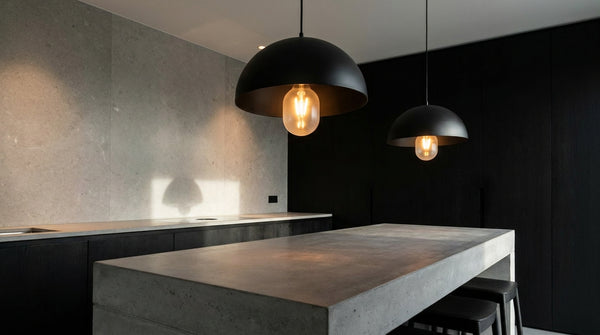
Choosing your light bulbs: the ultimate guide to getting it right
This article is also available in French: Le choix des ampoules guide complet pour ne plus se tromper
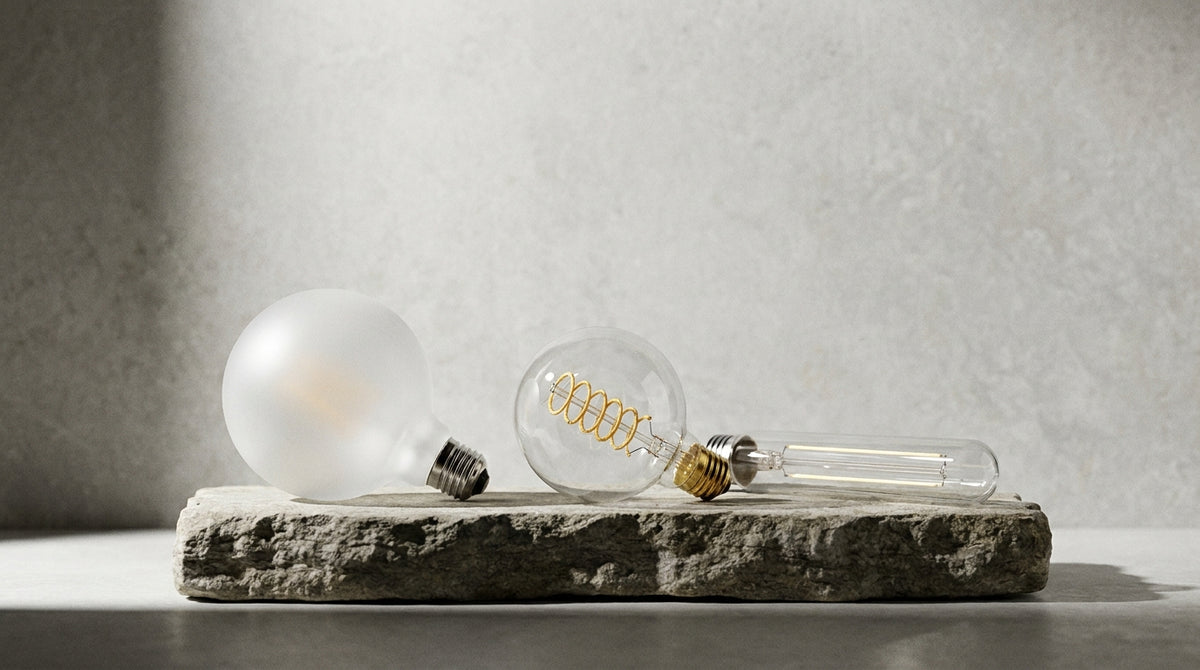
Unscrew the bulb currently in place and note its base before anything else: E27, E14, G9 or G4, it is the base that decides what can be screwed or clipped into the socket. Then aim for the amount of light in lumens, then the colour in kelvins. Three reference points, in that order, and the bulb aisle stops being a headache.
How do you know which bulb to choose?
Note the base on the light fitting's socket, then the useful light output in lumens, and the colour temperature last. Wattage no longer tells you about brightness since LED: it only measures what the bulb consumes. Two models of the same power can light a room very differently.
Our selection of LED bulbs covers the bases you come across in a home, from the large screw base to the small pins of recessed spotlights.
The base is read on the socket, not on the old bulb
A screw base unscrews, a pin base comes out by pulling straight. The bulb base size is measured in millimetres, 27 for an E27, 14 for an E14, and it cannot be guessed from the diameter of the globe.
Design bulbs to find by base, shape and temperature


Once the format is found, what remains is the look. A filament design bulb on a pendant without a shade becomes a visible object even when switched off. The Design Bulbs collection has 282 references as of 5 October 2026.
The three-step method: base, lumens, colour
First light it well, then light it enough. Our guide on how many lumens per m² gives a reliable order of magnitude, to be adjusted according to wall colour and mounting height.
An unreadable base on an old light fitting, a socket with no marking? You can write to us from the contact page with a photo: we will reply with the exact reference to order.
What are the 4 main types of bulb?
Incandescent, halogen, compact fluorescent and LED. Only LED remains a reasonable choice today: it uses the least for the light produced, lasts the longest and comes in every base. The other three families survive to get an old light fitting working again or to recover a very warm tint.
What distinguishes the four families
- Incandescent: immediate start, warm light, energy largely lost as heat.
- Halogen: same principle, whiter rendering, bulb burning to the touch.
- Compact fluorescent: reduced consumption, slow warm-up, mercury to be recycled.
- LED: instant start, low consumption, longest service life.
To place each technology and its uses, our guide on the different types of bulbs details the special cases.
Why LED has taken the place of the others
The question of which bulb consumes the least now has only one answer, provided you compare light output and not just the stated power.
Do not confuse the two units: lumens say what the bulb emits, lux what a surface receives. The difference between lux and lumens explains why the same bulb dazzles under a tight shade and seems weak when placed high.
In practice, replacing a halogen bulb with an LED requires no tools as long as the base is identical.
Which bases are there, and which one goes in which light fitting?
E27 and E14 screw in, G9 and G4 push in, GU10 clips in with a quarter turn. The large E27 fits pendants, ceiling lights and floor lamps, the small E14 bedside lamps and wall lights, the G9 and G4 slim light fittings, the GU10 adjustable recessed spotlights.
In a survey of 33 design bulbs in our catalogue as of 5 October 2026, 42 % have an E27 base, 27 % a G9, 24 % a G4 and 15 % an E14. A reference can declare several bases, so these shares do not add up.
E27 and E14, the two screw bases
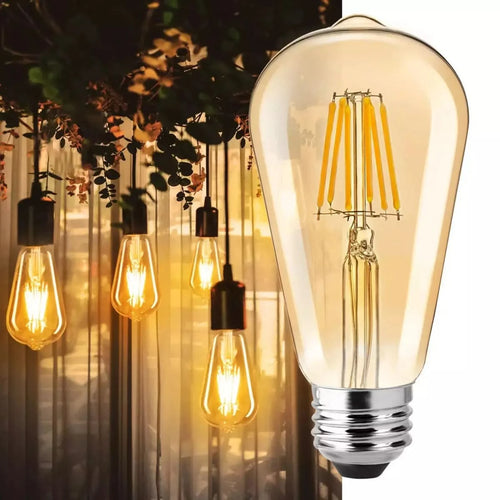
Our E27 base bulb range covers the powers a living room needs, from the discreet model to the exposed filament. The small E14 follows exactly the same rules, with an extra space constraint.
G9, G4 and GU10, the pin bases
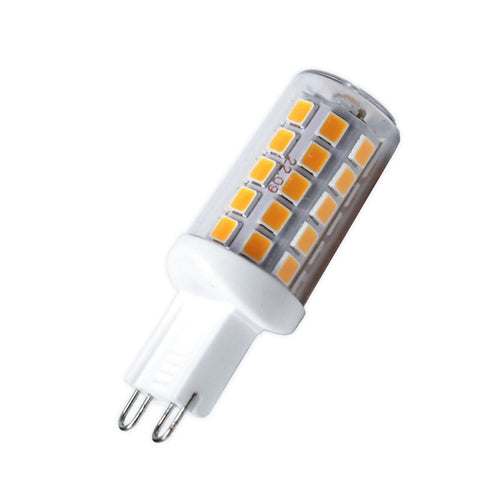
G9 bulbs bring slim light fittings to life, where a screw socket would not fit. The G4, even smaller, is found on low voltage spotlights: its pins bend at the slightest awkward movement.
This is where the choice of design light fitting matters as much as that of the bulb. A fixture with a short socket leaves little room, and it is often the bulb that is wrongly blamed.
The classic base mistakes
- Forced base: an E14 screwed into an E27 sits badly and heats up on contact.
- Globe too long: the bulb touches the shade and heat builds up.
- Bent G4 pins: they straighten poorly and contact becomes unreliable.
- Non-dimmable bulb: behind a dimmer, it buzzes or switches off in steps.
On a narrow bedside table, a small E14 LED bulb solves the problem before it exists.
Which light fitting are you going to equip?
What are the drawbacks of LED bulbs?
Three real faults: flicker on low-end models, poor colour rendering that flattens warm tints, and incompatibility with some old dimmers. None is specific to LED: they come from the quality of the product or of the installation.
Flicker, dimmer and colour rendering
A decent LED bulb does not flicker and lets wood and fabrics keep their tint. A bare, highly directional source, on the other hand, tires the eye: a diffuser or indirect light solves this.
The dimmer remains the most frequent trap. Pick from our dimmable bulbs rather than testing at random.
The details of compatibility, including minimum load, are covered in our guide on dimmable or variable bulbs.
What our product pages say
On the same survey of 33 design bulbs as of 5 October 2026, 73 % show a 2-year warranty and 27 % a 5-year warranty. All 33 declare CE certification, LED technology and an IP20 protection rating: none goes in a damp room. For a bathroom, aim for IP44 bulbs.
The Designix Google listing remains one click away if you want to see who answers you before ordering.
How do you choose the colour temperature room by room?
Stay between 2700 K and 3000 K in living areas. The living room and the bedroom call for 2700 K, a warm light that rests the eye; the kitchen and circulation areas take 3000 K, more neutral, when a worktop needs to be read. Beyond that, you leave the home.
Warm light or cool light: the kelvin reference
The kelvin describes the tint, not the power. Our article on white or yellow light details the thresholds, room by room, to avoid the hospital waiting room look.
A single temperature per room?
No, and that is where the result changes everything. A lighting project for a living room combines three sources: an indirect wash, a pendant above the table, a reading lamp. Same tint everywhere, different intensities.
In stock · shipping costs shown at checkout · up to 30% off in your cart

Ready to turn inspiration into reality?
Tell us about your room, your style and your budget, and we will show you the pieces that truly suit your project.
Get guidance in 30 seconds →