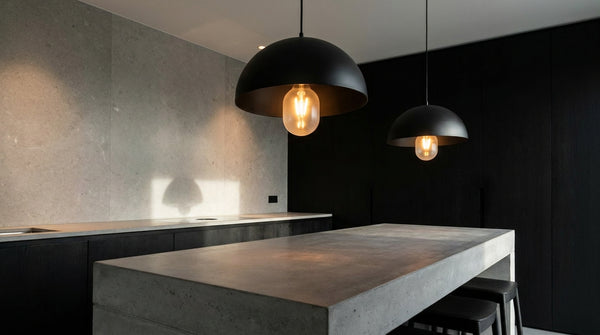
Task lighting: lighting every daily task properly
This article is also available in French: Zoom sur l'Éclairage de Tâche: Lumière et Fonction
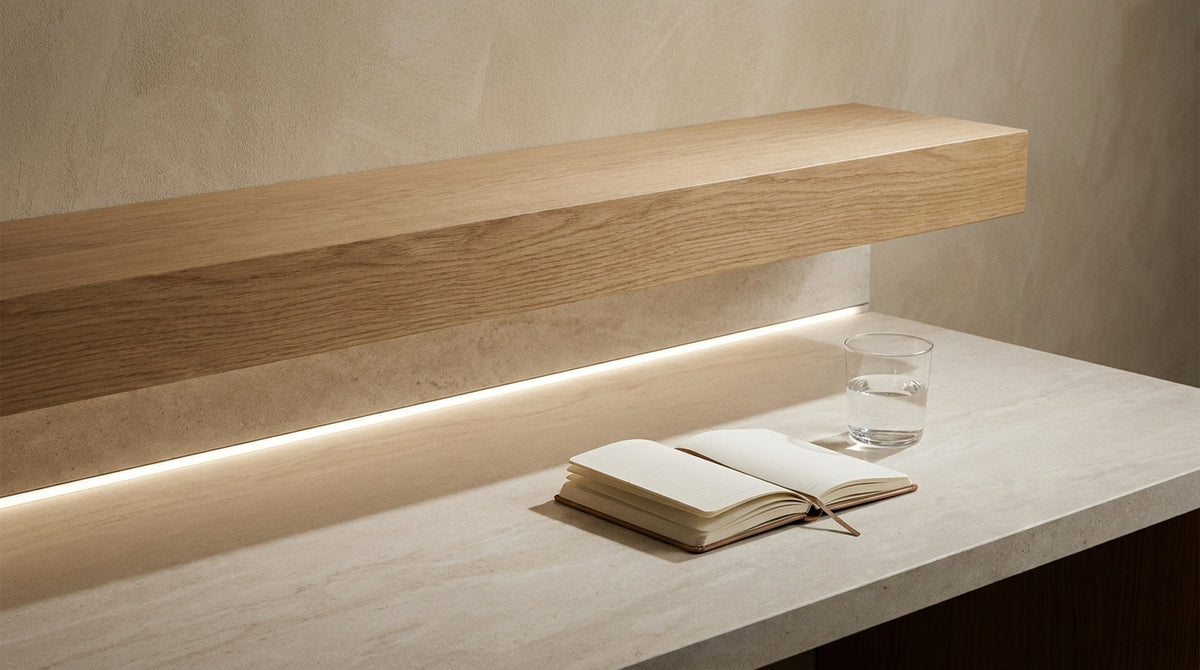
Aim for three sources, not one. A wide ceiling wash for ambience, a focused source 50-60 cm above the surface, on the opposite side from your writing hand, and a third to erase body shadow. Task lighting is judged in lux on the zone, never in lumens for the whole room.
What is task lighting, and how does it differ from ambience?
Task lighting illuminates a precise surface for a precise activity: reading, writing, cooking, working on screen. It sits near the zone concerned, can be aimed, and adds to the ambience that fills the room. Three layers coexist in a well-lit interior, and none replaces the others.
Ambient lighting, accent lighting, task lighting: the difference in one sentence
Ambience sets the general level and sits high. Accent highlights a material or an object. Task serves a gesture and sits a few tens of centimetres from it.
- Ambience: high, diffuse source, 2 700 K, never aimed at the eyes.
- Accent: tight beam, close to the wall, to graze the material.
- Task: adjustable source, at worktop height.
- Combining: three sources beat one source three times as powerful.
In our selection of light fittings, each listing states the mounting: pendant, wall, table or surface-mounted. That single detail tells you whether the model can hang low without getting in the way.
Why ceiling light is never enough for a precise task
A ceiling light illuminates the floor and walls, not the page. Your body comes between the source and the surface, and it is your shadow that lights the work. A well-diffused LED ceiling light holds the ambience without solving this: its flux arrives from too high.
The further away the source, the wider and softer the cast shadow, and the more the eye compensates. That is why pleasant ambient lighting in the evening is still not enough for writing.
Drawing attention to an object does not solve the problem either. Highlighting a wall creates relief, it does not light a page.
How much light do you really need on a work zone?
Aim for 300 to 500 lux on the zone itself: the book, the chopping board, the keyboard. Measure where the gesture happens, not in the middle of the room. Below that, the eye strains; above it, the paper glares and tires you just as much.
Judge a task in lux on the zone, not in lumens for the room
A lumen is a quantity emitted, a lux a quantity received. A 2 000-lumen ceiling light that sends most of its flux to the floor leaves only a fraction on the surface. Distance and orientation decide the rest.
- Precise work: 300 to 500 lux on the gesture.
- Circulation: 100 to 150 lux to walk without bumping into things.
- Rest: 50 to 100 lux at the back of the room.
Hence the value of a close source. At 50 cm from the surface, a modest lamp does better than a powerful ceiling light installed at 2.40 m. The full reasoning comes from combining the layers: estimating the amount of lighting a room needs before choosing the work source.
What 250 listings in our catalogue say about sockets
Across a survey of 250 references in our catalogue as of 30 September 2026, the socket is stated on 225 listings. E27 accounts for 30 % of the survey: in most cases, changing the bulb needs no tools. The IP20 rating is stated on 94 % of the 250 listings, and the 2-year warranty on 94 % as well.
Dimming, on the other hand, appears on only 98 listings, with "Yes" in 24 % of cases and "No" in 16 %. In other words, the dimmable lamp you picture is not necessarily dimmable. The catalogue holds 25 950 references on that same date: nobody knows its contents by heart, so the product listing settles it better than a memory of a shop. To check who you are dealing with, the company's Google listing shows its current rating and reviews.
How do you light a kitchen worktop without leaving shadows?
Light the surface, not the room. A strip fixed under the wall unit puts the light about fifty centimetres from the worktop, in front of your hands, and removes the shadow cast by the ceiling. Two rules are enough: the front edge of the unit, and sealing.
Strip under a wall unit: the right distance
Fix the strip near the front edge, not at the back against the wall. Set too far back, it grazes the surface and lights only the splashback: you see the wall, not the onions.
| Solution | What it lights | What to watch |
|---|---|---|
| Strip under a wall unit | The surface, straight ahead of your hands | Front edge of the unit, IP44 near the sink |
| Pendant above an island | The surface and the floor around | Hang it at eye height, no lower |
| Splashback wall light | The zone between surface and wall | Aim at the surface, never at the eyes |
Colour temperature is chosen at the same time: 3 000 to 4 000 K for chopping, warmer for sitting down to eat. Our guide to kitchen lighting details this split between layers.
IP44 near the sink: what it changes
The protection rating describes resistance to water and dust. IP44 handles the splashes a worktop produces every day; IP20 does not. In our survey of 250 references as of 30 September 2026, IP20 is stated on 94 % of listings and IP44 on 2 %. A sealed strip therefore has to be sought out, not picked at random.
Choosing between warm white and cool white is decided at that point too: white or yellow light, how to decide depending on the room and the time of day. Above an island, a kitchen pendant hangs at eye height and carries the general level.
If your worktop ends in a corner, if a beam crosses the ceiling or if the wall is stone, no standard height settles it. In that case, describe your work area to us: we reply with the reference that fits it, not with a catalogue.
Task lighting: the Designix selection
 Basic form gold pendant light
 Basic form gold pendant light
 Basic form gold pendant light
 Velora brown outdoor light
 Bobi 2-light black pendant
 Gentor 4-light white pendant
See the whole selection: Light fittings, Home lighting, Online lighting store
What light for reading, writing or working on screen?
Place the source to the side, at page or shoulder height, never behind you. Light coming from behind casts the shadow of your head on the book. On screen, it adds glare on the panel, and the eye does the rest of the tiring.
Place the light to the side, never behind you
For a right-hander, the source goes on the left, and vice versa. An opaque shade on the face side and open on the page side does this job without glare.
- Height: bottom of the shade at page level, not above the eyes.
- Side: opposite your writing hand.
- Screen: never facing the panel, never in your line of sight.
- Orientation: adjustable, the position changes with the task.
An articulated desk lamp handles this better than a fixed model. For reading in an armchair, the arm is what counts: a floor lamp with an adjustable reading head lights the book and leaves the room in half-light.
Dimmer: what our survey states
A dimmer changes everything at a work station: bright for reading, soft for finishing a film. It is also the least documented feature in our listings. In the survey of 250 references as of 30 September 2026, dimming is stated on only 98 listings, "Yes" in 24 % of cases and "No" in 16 %. A reading lamp is therefore chosen on the listing, not on visual impression.
Where do you need light to do something precise?
Can you light a task without drilling or running cable?
Yes, provided you accept recharging or staying near a socket. A wall light plugged into an existing socket, a rechargeable table lamp, a battery model: three solutions set up a work station without touching the wall.
Wall lights and rechargeable lamps
An adjustable wall light fits in a few minutes if a socket is already there. It clears the surface and lights without taking up a single centimetre.
- Adjustable wall light: the arm pivots, the light follows the page.
- Rechargeable: no chasing, but a recharge to plan for.
- Existing socket: visible cable to tidy or discreet trunking.
- No drilling: table models spare the painted wall.
The choice of an adjustable wall light ranges from the discreet model to the sculptural format. For a more striking interior, wall lights with a strong design hold their place on the wall while serving reading.
The case of rooms without a ceiling light
A room with no ceiling point is composed differently: a high indirect source for ambience, a low source for the task. Our survey of 30 September 2026 shows wall mounting on 32 % of the 250 listings and pendant on 46 %: wall solutions exist. The full reasoning is in our guide to lighting a room without a ceiling light.
In stock · shipping costs shown at checkout · up to 30% off in your cart
Ready to turn inspiration into reality?
Tell us about your room, your style and your budget, and we will show you the pieces that truly suit your project.
Get guidance in 30 seconds →