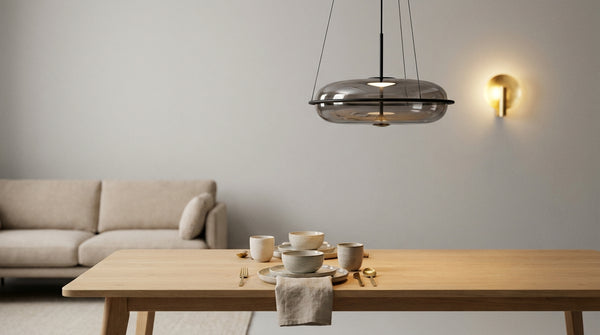
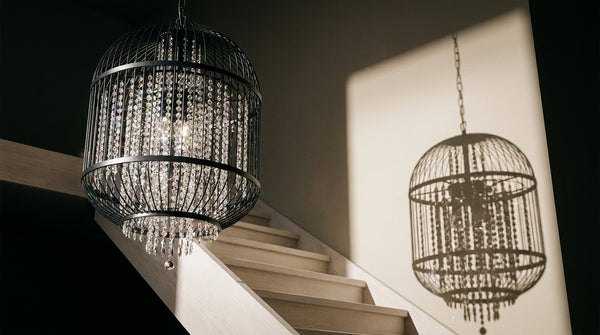
Caring for a chandelier or pendant light: the right touch
This article is also available in French: Comment entretenir vos lustres et suspensions lumineuses pour une illumination

The essentials
Dust dry every three months with a microfibre glove: it is the gesture that gives the most light for the least risk. Then clean thoroughly once a year, material by material. Never immerse a light fixture and never open a sealed LED module.
How often should you care for a chandelier or a pendant light?
Plan for a dry dusting every three months, and a full clean once a year, preferably before winter. A chandelier gets dirty mainly from dust clinging to the globes and drops, rarely from grime. Ten minutes are enough, as long as the gesture stays gentle.
Dust is not visible from the sofa, it is visible on the walls. It lays a grey film on the globes, and that film eats part of the light you are already paying for. That is also why light that does you good starts with a dusting.
When the look does not come back after cleaning, there is no point rubbing harder: it is the fixture you need to look at. A clear glass chandelier cleans in a minute, a model with glued drops takes twenty, every time.
The sign that tells you it is time
- A grey film on the globes, visible from the doorway.
- Dry insects in the cup, often the first sign.
- Light that leans yellow even though the bulb is white.
- A blackened cord near the diffuser: there, you stop cleaning and start checking.
- A smell of hot dust in the minutes after switching on.
The case of integrated LED fixtures: nothing to dismantle, but one precaution
On a survey of 96 references in our catalogue as of 30 September 2026, 77 of the 96 listings state an LED technology. These fixtures no longer come apart to change a bulb: you dust them from the outside. A recent pendant light is happy with this gesture once a season.
The module itself is not rinsed and not soaked. The cloth stays barely damp, and a soft brush goes further than a jet of water. Models with a socket can still be changed bulb by bulb, which simplifies everything.
Be careful with devices controlled by a dimmer. Dimmable LED means an electronic module: no water, not even a drop.
How do you wash a light fixture globe?
Remove the globe if the manufacturer has provided for it, wash it in warm water with a drop of washing-up liquid, rinse and dry immediately with a microfibre cloth. A glass globe can be soaked. A glued crystal globe cannot: no household alcohol, no white vinegar.
Glass, crystal, acrylic: three different gestures
| Material | Right gesture | To avoid |
|---|---|---|
| Glass | Warm water, a drop of washing-up liquid, immediate microfibre drying | Abrasive sponge, temperature shock between hot water and a cold draught |
| Glued crystal | Barely damp lint-free cloth, piece by piece | Immersion, dishwasher, alcohol, white vinegar |
| Acrylic | Warm water, soft cloth, immediate drying | Alcohol, solvent, dry cloth that charges dust with static electricity |
What leaves a mark, and why
A white mark on a globe is not a material defect, it is limescale. Tap water dries in the air and leaves its salts on the glass. Dry within the minute and the problem does not exist.
On a fabric lampshade, the logic reverses: water marks, dust comes off dry. A textile that is simply dusty gets dusted, a yellowed textile is treated differently.
The difference lies in the cause of the yellowing, often light and candle smoke more than dirt. A yellowed fabric lampshade is worked in zones, never in the bathtub.
If cleaning no longer restores the original shine, the question is no longer care but choosing a fixture whose glass cleans in one gesture: browse our selection of glass light fixtures.
What is the lifespan of an LED chandelier?
An LED fixture generally lasts several years, but its lifespan depends above all on the heat it dissipates. Dust and confinement damage the module long before the diodes give out. A dusted device therefore lives longer than a powerful one.
Which light fixture should you care for first at home?
What lowers brightness ahead of time
- A clogged heat sink: heat stays in the module and the electronics age faster.
- A poorly matched dimmer: power surges tire the board.
- A damp room: the IP20 rating is stated on 98% of the 30 September 2026 survey, so a living room or a bedroom, not a bathroom.
- A more powerful bulb than the fixture's listing provides for.
Socket bulb or sealed module: two kinds of care
A socket bulb can be replaced, a sealed module cannot. On the same survey, E27 and E14 sockets remain common, so many devices can still be repaired with an E27 socket bulb and a cloth.
The sealed module, for its part, requires a single gesture: dust the visible face without dismantling anything. Two minutes, once a season, and the brightness does not move.
When the module has lost its whiteness, no cloth will bring it back. Two reasonable options then remain: change the device, or start again with a modern chandelier whose parts come apart one by one.
When care is no longer enough: repair or replace?
You repair when the part is accessible: bulb, socket, cord, switch. You replace when the LED module is sealed, when the glass is cracked or when the metal is pitted. In between, one cloth too many can cost more than the device.
The cases where cleaning does more damage
- A sealed LED module opened with a screwdriver: the seal goes, and so does the warranty.
- A glued crystal immersed: the glue turns white and the drops fall one by one.
- A gilded metal rubbed with vinegar: the gilding comes off the surface.
- An old varnish wiped with alcohol: the protective layer disappears, and so does the patina.
What the 2-year warranty covers, and what it does not
The 2-year warranty is stated on 100% of the 30 September 2026 survey. It covers manufacturing defects, an LED module that fails or a socket that holds poorly. It does not cover immersion, abrasive products, dismantling the module or dropping. In case of doubt, it is better to describe the problem before acting: our help and after-sales service guides the diagnosis.
Repairing a light fixture yourself remains possible, provided you know which part is involved and do not force it. The most common cases are detailed in repairing a light fixture.
If you are still hesitating between restoring and buying new, the Designix Google listing gathers buyer feedback, updated continuously.
Light fixtures that clean in one gesture
 Pendant Light | Lotus
 White glass pendant light | Glowing Sphere
 Baby Room Chandelier | Caro
 Bedroom Wall Light | Glass Ball
 Art Deco Monkey Wall Light | Oryn
 Ball Table Lamp | Orion
See the whole selection: Original Light Fixtures: Pendant Lights and Chandeliers with Unique Design
What are the tricks to make a room brighter?
Clean first, buy afterwards. A dusted globe gives more light than a more powerful bulb, because it no longer sends back a grey film. If that is not enough, play with the wall colour and the suspension height before changing everything.
A clean fixture lights more than a more powerful bulb
A stronger bulb in a dirty diffuser lights strongly and badly. The power goes up, the light stays veiled, and the effect on the room does not follow. The gestures that truly change the feel of an interior are detailed in making a room brighter.
Three settings to check before buying
- Height: above a table, the pendant sits at eye level, not flush with the tabletop.
- Socket: E27 or E14 keep the bulb replaceable, simpler to care for than a sealed module.
- Dimming: precious in the living room in the evening, provided the bulb and the dimmer are matched.
On this last point, a device designed for dimming avoids many disappointments. Our selection of LED ceiling lights can be browsed by room and by style, from the living room to the hallway.
Three gestures are enough to keep this level of brightness from one season to the next. Here they are, in the order they are practised.
On the same subject
In stock · shipping costs shown at checkout · up to 30% off in your cart

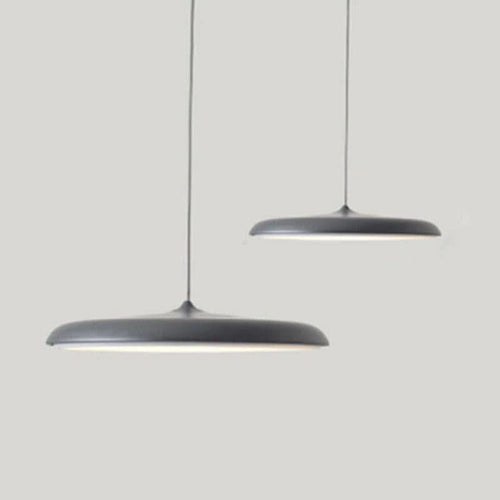

Ready to turn inspiration into reality?
Tell us about your room, your style and your budget, and we will show you the pieces that truly suit your project.
Get guidance in 30 seconds →