Crystal cage chandelier for stairwells: light that rises
This article is also available in French: Lustre cristal cage escalier
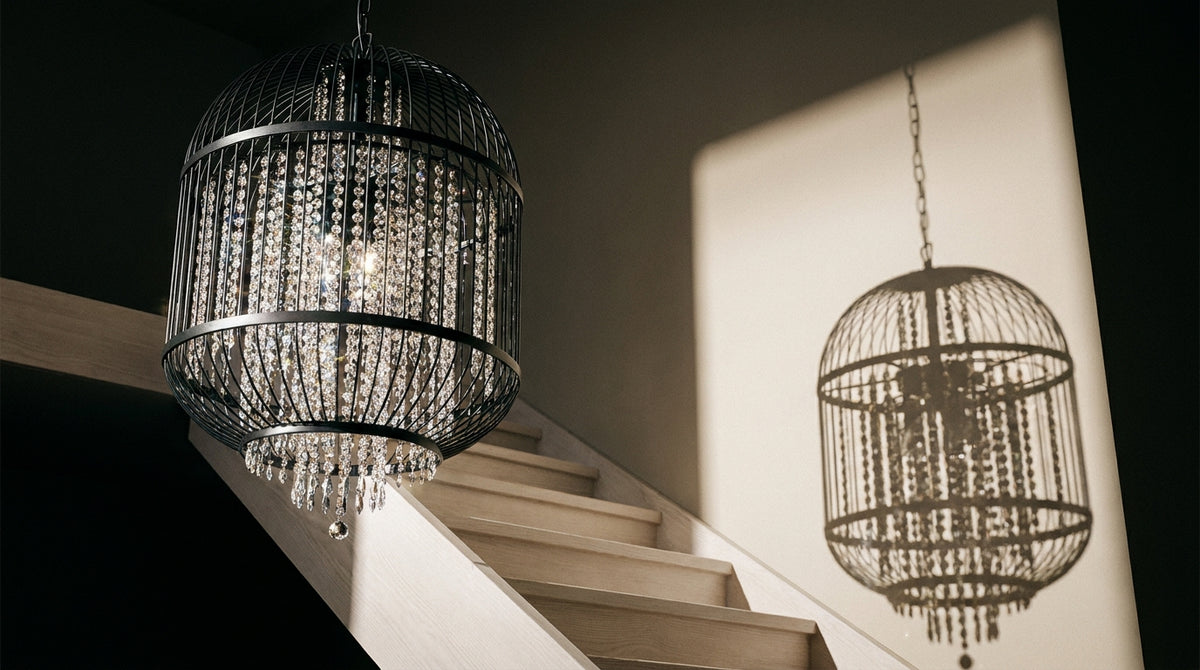
Hang the chandelier at the highest point of the stairwell, with the bottom of the fixture at least 2.10 m above the steps it overlooks. Allow 40 to 60 cm in diameter for a straight staircase, 30 to 40 cm for a spiral one. And check the support before choosing the style: the weight of the crystal decides.
Which crystal cage chandelier for which staircase?
A straight staircase takes a wide, low model, 50 to 60 cm in diameter, which reads well in the sightline from the hall. A spiral staircase calls for the opposite: 30 to 40 cm and a vertical silhouette, otherwise the cage grazes the handrail on every climb. The diameter is calculated from the width of the stairwell opening, not from the ceiling height.
Straight staircase: which cage width should you choose?
Measure the width of your stairwell opening, then subtract 60 cm. The result gives the maximum diameter of the chandelier. A 1.20 m landing takes a cage of 55 to 60 cm, a 90 cm opening is content with 40 cm.
- 50 to 60 cm for an opening of 1.20 m and more, with enough visual distance from the hall
- 40 cm for a narrow opening, the silhouette stays readable without invading the passage
- About 80 cm of drop between the ceiling and the top of the cage, so the crystal hangs freely
- A round or spherical shape rather than a square one, it forgives slightly off-centre openings
The calculation of drop height and diameter is detailed in this guide to choosing a chandelier, dimensions and styles, useful when the opening is not square.
Spiral staircase: which format fits without touching the handrail?
On a spiral staircase, the cage turns around a narrow void. A model over 40 cm in diameter catches the handrail on the way up, and the cast shadow slides across the walls with every step. A narrow, tall stairwell cage pendant solves the problem: it descends into the void, not into the traffic.
- 30 to 40 cm in diameter, never more on a central column
- Vertical silhouette such as a spiral or tube, which makes use of the free height
- A single strong light source rather than six small ones, the light is less lost in the cage
- Centred fixing on the column, to avoid swaying as people pass
| Staircase type | Recommended diameter | Shape | Drop below ceiling |
|---|---|---|---|
| Straight, wide opening | 50 to 60 cm | Wide, round cage | 70 to 90 cm |
| Straight, narrow opening | 40 cm | Tall, spiral cage | 80 to 100 cm |
| Spiral | 30 to 40 cm | Vertical, narrow | 90 to 110 cm |
Our staircase lighting collection counts 8,608 references as of 19 November 2026, which leaves room to find the exact diameter without compromising on the frame. For a reception room or an entrance, the chandelier is chosen on these same dimensions, often with a more generous crystal.
Crystal cage chandeliers for stairwells


At what height should a chandelier be hung in a stairwell?
The bottom of the fixture sits at least 2.10 m above the nose of the steps, 2.30 m if the staircase is used every day. Lower, you graze it on the way up with an armful of laundry. Higher, the light stays trapped in the stairwell opening and no longer reaches the first steps.
The height above the steps, how do you measure it?
The measurement is taken directly below the fixture, step by step, never from the landing. A staircase that rises 18 cm per step shifts the dimension by almost 40 cm between the top and the bottom of the light source.
- 2.10 m minimum between the nose of the step and the bottom of the crystal
- 2.30 m on a busy staircase, with children or carried loads
- A tape measure held vertically, not an eyeball estimate from the hall
- The highest point of the staircase as the reference, it is the one that governs
The guidelines on chandeliers and ceiling height complete this calculation when the stairwell is shallow.
And when the ceiling is very high?
Beyond 4 m, an 80 cm drop is no longer enough: the crystal is lost in the volume and only lights the ceiling. You need either to bring the cage down to 2.10 m from the floor with a longer chain or rod, or to add a low-level light source.
- A longer rod that brings the crystal into the field of view from the steps
- A dimmer to lower the intensity in the evening and avoid glare upstairs
- A low wall light to light the first steps without switching on the cage
- Several G9 sockets, more flattering than a single strong bulb in a large volume
The case of stairwells spanning more than two floors is covered in our article on the high-ceiling chandelier, with lowering solutions.
If your stairwell has a particular shape, spiral, narrow landing, off-centre opening, describe it to us: we will tell you which drop and which diameter will fit without touching the handrail.
Why crystal changes the light in a stairwell
Crystal does not shine, it diffracts. Each facet sends the beam back and breaks it into short flashes, visible from the bottom of the staircase. In an opening without a window, this diffraction projects the light onto the side walls and brings it down to the first steps.
What diffraction does to the gloom
A stairwell is a shaft: light from the ceiling does not reach the floor. A crystal chandelier corrects this flaw poorly in lumens, but very well in perception, because the flashes are seen from below, exactly the angle of the eye as you climb.
- The facets create secondary points of light on the walls, which make the stairwell feel larger
- The G9 socket dominates this type of installation, at 45% in a survey of 42 references from our catalogue as of 19 November 2026
- IP20 concerns 93% of that same survey: an indoor chandelier, not to be exposed outdoors
- A warm bulb around 2700 K makes the crystal look deeper than a cool white
The details of sizes and cuts can be read in our article on the crystal light fixture.
Gold, black or brass: the frame matters as much as the crystal
The frame decides the colour of the flashes. A gold cage warms the light, a black cage outlines it and gives contrast on a white wall, brass sends back a cooler, sharper sparkle.
| Frame | Effect on the light | Where it works |
|---|---|---|
| Gold | Warms the flashes, yellow halo | Lime render, stone, light wood |
| Black | Outlines the cage, marked contrast | White walls, concrete, metal staircase |
| Brass | Reflects without gilding, sharp sparkle | Dark wood steps, iron handrail |
A modern crystal pendant often plays the card of a fine, almost graphic cage, where the crystal remains the only decorative element.
How to hang it without pulling the ceiling down
The hook must hold in the structure, never in the plaster. On a concrete slab, a mechanical anchor is enough. On a plasterboard ceiling, you need to reach a joist or fit a through-going ceiling rose. A crystal cage chandelier weighs more than its volume suggests.
Hook, ceiling rose or DCL box: which to choose?
A simple hook suits small models, up to a few kilos. Beyond that, the ceiling rose spreads the load over several points and the DCL box provides both the fixing and the electrical connection.
- Hook with mechanical anchor on a solid slab, the most direct
- Through-going ceiling rose when the ceiling is plasterboard and the joist is badly placed
- DCL box for a clean installation, with two fixing points
- Never a toggle anchor alone under a heavy crystal, the load works over time
The step-by-step method to hang a chandelier details the drilling and the power cut-off.
What the weight of the crystal demands of the support
A suspended crystal works in tension at its top point, with a slight sway as you climb the stairs. The support must therefore absorb this movement, not just the static mass.
- Locate the joist before drilling, with a metal and wood detector
- Double the fixing point if the fixture exceeds what the plate accepts
- Leave 5 mm of slack in the chain, so the crystal does not become taut
- Check the tightness after a few weeks, the sway loosens it
To light the steps themselves, staircase lighting relies on low-level lights and a sensor, not on the chandelier alone. A staircase wall light placed 90 cm from the nose of the step changes the perception of the descent, and wall lights for staircases are chosen in the same range of finishes as the cage. If you are still unsure about installation, our guide on how to fit a chandelier covers every step.
How to maintain a crystal chandelier on a staircase
A dry dusting every six to eight weeks is enough, with a soft feather duster or a microfibre cloth, facet by facet. Water and alcohol-based products dull the polish and leave marks. A chandelier that only half lights up almost always comes from the socket, not the crystal.
The dusting that is enough
In a stairwell, dust rises with the warm air and settles on the top of the pieces. It is this face, invisible from the hall, that clouds the crystal first.
- Every 6 to 8 weeks, a soft-bristled duster, without dismantling
- A damp microfibre cloth only on the metal frames
- A stable step ladder placed on the landing, never on a narrow step
- The bulb changed before it blackens the socket, so you do not have to clean twice
When the crystal really does tarnish
A tarnished crystal is not dirty: it is scaled or scratched. The limescale from an over-wet cloth leaves a white film that diffuses light poorly, and too much pressure when cleaning matts the edges.
- Water that is too hard leaves a veil on the facets, to be wiped off straight away
- Alcohol-based products attack gold and lacquered frames
- A chandelier over ten years old is best given a piece-by-piece cleaning
- The 2-year warranty covers 95% of the survey of 42 references from our catalogue as of 19 November 2026, CE certification 100%
The full procedure, with the products to avoid, is described in our article on cleaning a crystal chandelier. The Designix Google listing remains available if you want to check the company before entrusting us with your project: the listing is online.
In stock · shipping costs shown at checkout · up to 30% off in your cart
Ready to turn inspiration into reality?
Tell us about your room, your style and your budget, and we will show you the pieces that truly suit your project.
Get guidance in 30 seconds →