How to make a room brighter: 5 levers that work
This article is also available in French: Comment rendre une pièce plus lumineuse

Light in three layers before you repaint: a general source on the ceiling, a wall light at mid-height, a floor lamp in the blind corner. Allow 30 lumens per m² for circulation, 100 for reading. Three light points placed at three different heights change a room far more reliably than a pot of white paint.
How do you light a room in three layers?
Layer three levels rather than adding one more fixture. A general layer on the ceiling, a middle layer at eye height with a wall light or spotlight, a low layer with a floor lamp or table lamp. Each level lights a different zone of the gaze and removes hard shadows.
On a living room and living space renovation, this is the first job to open: moving a light point requires fewer drill holes than a full redo of the walls. If the room is structurally dark, the method gets more complicated, and lighting a dark room often calls for one more source than planned.
Which source for which layer?
The general layer carries circulation, the middle layer serves reading and work, the low layer creates the evening mood.
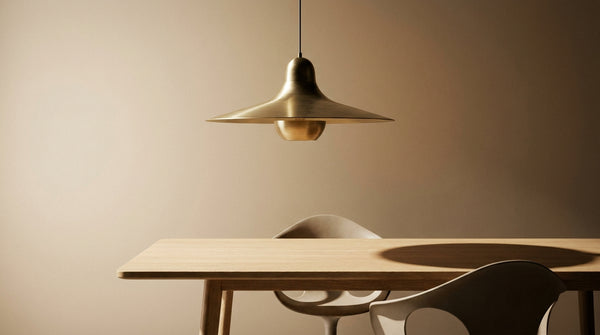
- Ceiling light or pendant: the general layer, at least 2.20 m from the floor
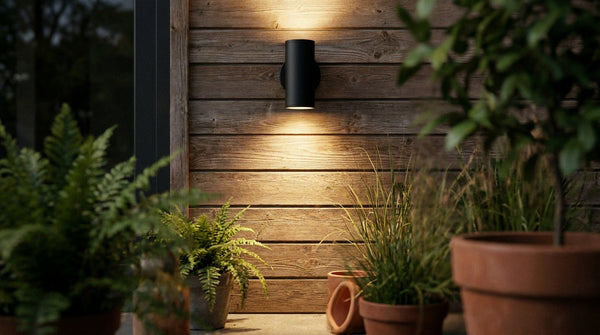
- Wall light: at 1.50 m from the floor, for reading seated or lighting a worktop
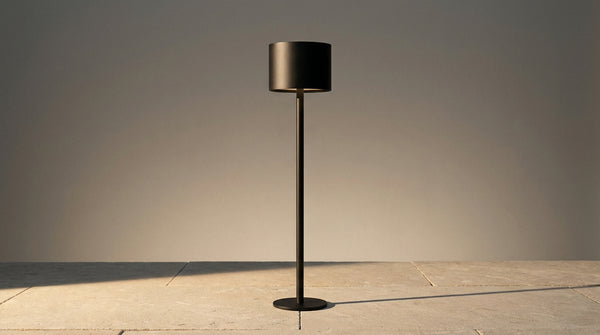
- Floor lamp: the corner the ceiling never reaches
- Table lamp: the table, the windowsill, the extra light
A wall light often replaces two spotlights and avoids running a track across the ceiling. In a survey of 219 listings in our catalogue as of 29 September 2026, 36% state wall mounting and 31% suspended mounting: the wall is the best-supplied category, so the easiest to complete afterwards.
How many lumens should you allow per surface area?
Allow 30 lumens per m² for circulation, 100 for reading or dining, 200 on a worktop. A 20 m² room therefore needs around 2,000 lumens combined to live comfortably.
| Use | Lumens per m² | 20 m² room |
|---|---|---|
| Circulating, tidying | 30 | 600 lm |
| Relaxing, meals | 100 | 2,000 lm |
| Reading, kitchen | 200 | 4,000 lm |
This total is spread across the three layers, never on a single source. The detailed calculation, room by room, is in our guide on number of lumens per m².
Once the total is known, the choice comes down to silhouette and material rather than the stated wattage. That is where a collection of designer lighting helps you decide: glass, metal, sphere or tube, each shape projects a different light.
Which colour can make a room brighter?
Matte white, first of all, reflects most of the light it receives. A warm off-white, a very light beige or a pearl grey come just behind. The lighter and more matte the shade, the more it redistributes light in the room instead of absorbing it.
A paint colour for a bright living room is not chosen from a colour chart but on site, looking at the wall at midday then at 7 pm, under the living room lighting switched on.
Walls, ceiling: what really reflects
The ceiling reflects more than the walls because it receives light upwards. Painting it matte white rather than a dark shade amounts to gaining an extra source, without touching the electrical installation.
For the ceiling, the matte or satin finish is chosen according to ceiling height, and it changes the look of the ceiling light.
Shades to avoid in a room with little exposure
- Anthracite grey and black: absorb light and flatten volumes
- Terracotta and rust: warm things up, but eat the north light
- Midnight blue: superb in a large, well-exposed room, stifling elsewhere
- Cool pure white: hardens shadows and cools the whole room
How do you bring light into a dark room?
Add a low source before touching the walls, then multiply light surfaces. A floor lamp aimed at the ceiling sends indirect light that lights the whole room without glare. Two well-placed mirrors and a light sheer complete the setup.
The fixtures that really light a dark room


How do you make a north-facing room brighter?
A north-facing room receives cold, steady light, without fluctuations. So you have to compensate in intensity, not in warmth.
- 100 lumens per m²: aim for the top of the range, the exposure does not forgive savings
- Low source aimed upwards: the light bounces off the ceiling
- Mirror facing the window: it doubles the opening without moving it
- Light matte shades on the wall facing the window
A floor lamp placed near the window, aimed at the back wall, diffuses better than a central ceiling light.
In line with the opening, a pendant light in glass or white metal spreads light more evenly than a single point.
Mirrors and sheers: where to place them
The mirror goes facing the window, never beside it: it is the angle of incidence that decides what it reflects.
To place mirrors, remember the rule: a large format facing the opening, a smaller one on the perpendicular wall. A thin sheer lets more light through than a lined curtain: choose the thickness according to exposure, and let the living room lighting take over in the evening.
If your room combines several handicaps (north exposure, low ceiling, a single central source), the quickest is often to talk about it before buying: describe your room to the team via the talk about your project page and come away with a lighting plan rather than one more lamp.
Which colour temperature should you choose?
2700 K for the living room and bedroom, 3000 K for the kitchen and office, 4000 K reserved for work rooms. The higher the number, the more the light leans towards cold white. Temperature matters as much as wattage, and is chosen by use.
Living room and bedroom: evening light
Stay at 2700 K in relaxation rooms, and place two sources rather than one so you can lower one without switching off the other.
The comparison white or yellow light details the nuances before ordering bulbs in bulk.
Kitchen and office: work light
Move to 3000 K under the wall units and on the worktop. A well-sized LED ceiling light covers this layer without multiplying spotlights.
- 3000 K: worktop, office, bathroom
- 2700 K: living room, bedroom, dining room
- 4000 K: workshop, garage, utility room
- Bases: GU10 for a directional spotlight, E27 for a pendant, E14 for a small wall light
How do you go from a lit room to a pleasant room?
By varying the intensity rather than switching everything on. A well-lit room at 8 pm becomes aggressive at 11 pm if nothing can be lowered. Add a dimmer on at least one source per room and keep a low source for the evening.
In the same survey of 219 listings in our catalogue as of 29 September 2026, 27% state dimming: check this mention before buying, it is not a given. Dimmable bulbs are chosen at the same time as the fixture, never afterwards.
Where should you install a dimmer first?
On the most used source in the evening: the pendant above the table, then the living room floor lamp. The central ceiling light comes last, because it is rarely switched on alone.
What really changes at 11 pm
- Dimmer on the table pendant and the floor lamp
- Low source alone after 10 pm, set low
- Compatible bulb: a non-dimmable LED buzzes on a dimmer
Our Decoration by Room collection counts 30,326 references as of 29 September 2026, and the question comes up on every project. Two or three trials are better than a perfect calculation: our advice and inspiration give the starting points. When doubt persists between two models, the Designix Google listing and its recent reviews remain the simplest reference.
Where does the lack of light come from in your home?
In stock · shipping costs shown at checkout · up to 30% off in your cart


Ready to turn inspiration into reality?
Tell us about your room, your style and your budget, and we will show you the pieces that truly suit your project.
Get guidance in 30 seconds →