Repairing a light fixture: the diagnosis that avoids replacement
This article is also available in French: Réparer luminaire
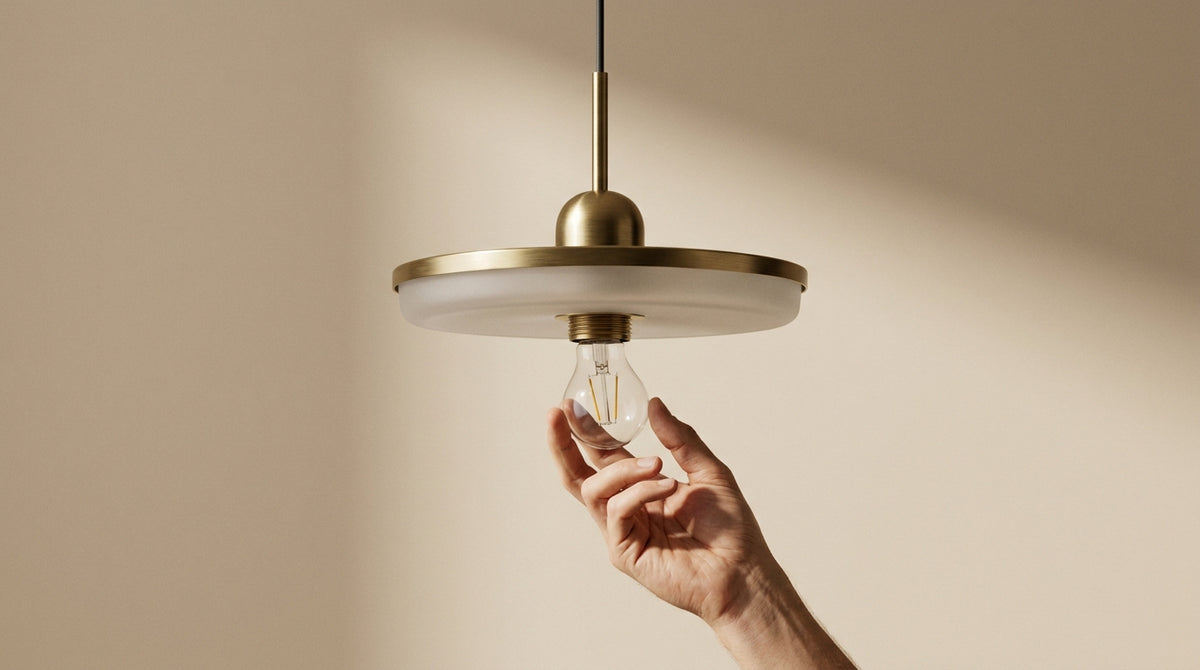
Switch off the circuit at the breaker, then test the bulb in another fixture. If it lights up elsewhere, the fault is in the socket, the driver or the wiring. If it stays dark, replace it. Then check the socket, its blackened contacts, its cracks: past that point, repair is no longer worth it.
What should I do if my light fixture no longer works?
Always follow the same order: bulb, socket, switch, wiring. A bulb that works elsewhere rules out the most common cause and points to the socket or the driver. Three checks are enough to know whether the part can be repaired or whether replacement is the only reasonable option.
How do I know whether the problem comes from the bulb or the fixture?
Test the bulb in another room, that is the only way to tell the two apart. A filament or LED module that stays dark elsewhere is dead, the fixture is not at fault. Conversely, a bulb that lights up in another socket points to yours.
- Bulb: it lights up elsewhere, your fixture is innocent
- Socket: blackened contacts, socket that crackles or turns freely
- Switch: control poorly matched to an LED, no longer cuts the current
- Wiring: bare wire, loose connector block, cross-section too small for the power
When the fault hits a central fixture, it is often the right moment to rethink the room layout. Our living room and family room lighting project starts from how the room is used before choosing models.
Why is a flickering LED lamp not necessarily dead?
Flickering almost always comes from the current, not the module. An incompatible dimmer, a tired driver or a loose contact produce this regular pulsing, while the LED itself remains intact.
Follow the test order described in our article on the flickering LED lamp before condemning the part.
The case of the halogen floor lamp
On a halogen floor lamp, the typical fault is still a burnt-out bulb or a socket cooked by the heat. The repair is simple, but the fixture still heats up and uses just as much power.
When the structure holds and only the efficiency is failing, an LED floor lamp changes reading comfort without touching the rest of the living room.
How do I take down a light fixture without breaking anything?
Switch off the breaker, then unscrew the diffuser or the central screw. Let the socket hang by its wires instead of pulling on it. On a ceiling light, support the weight with one hand and disconnect with the other: a broken frosted glass is not easily replaced.
How do I remove the ceiling light cover?
Three systems are found: the central screw, the bayonet quarter turn and side clips. The movement is done without force, never with a screwdriver to pry. Our guide to taking down a ceiling light covers each case with the right tools.
- Switch off at the breaker and check there is no current
- Locate the fixing and support the diffuser before unscrewing
- Turn a quarter turn, then release the side clips
- Note the order of the wires before disconnecting
- Lay the parts flat on a cloth, socket facing up
If the fixture is to go back on the ceiling, a new diffuser is sometimes enough to modernise the room. An LED ceiling light settles the question in a single fitting, with no bulb to buy afterwards.
What should I check before taking it down?
A part comes down cleanly if the body holds, if the screws are not seized by corrosion and if the glass is not cracked. At the slightest doubt, take a photo and stop there.
What are the different types of sockets, and which one can be replaced?
A socket can be replaced in most cases. It is identified by its base, E27, E14, B22, GU10 or G9, and it is sold separately from the body. Integrated LED is the exception: sealed into the fixture, it cannot be removed and requires changing the whole part.
How do I read my socket before ordering?
Two pieces of information are enough: the base diameter and the type of contact. The rest is checked on the fixture label.
| Base | Where it is found | Replacement |
|---|---|---|
| E27 | Chandeliers, pendants, floor lamps | Standard bulb |
| E14 | Bedside lamps, small chandeliers | Standard bulb |
| GU10 | Adjustable spotlights | Standard bulb |
| G9 | Fixtures with a glass diffuser | Standard bulb |
| Integrated LED | Panels, bars, slim panels | Sealed module, nothing to screw in |
Of 250 references recorded in our catalogue on 5 October 2026, the E27 base is declared on 26% of the listings, the LED mention on 21%, E14 on 14% and GU10 on 11% (characteristic declared on 222 of the 250 listings). The screw base therefore remains the safe choice when in doubt.
If any doubt remains about the diameter, our guide to bulb base sizes covers the dimensions and the ordering pitfalls.
When should I look at the driver?
The driver is the power supply for the LED module. When it wears out, the light flickers, comes on dimly or not at all, while the socket is sound. Read it on the label: output voltage, current, then cable cross-section.
For a project, ranges are read by use, IP20 in dry interiors and IP44 in damp rooms, on our professional area.
How do I change an integrated LED bulb?
No bulb screws into a sealed module, there is no socket. Only an external driver can sometimes be replaced, with identical specifications.
Our guide to changing an integrated LED bulb explains the cases where the attempt makes sense, and those where the fixture is lost.
Repair or replace: when is repair no longer worth it?
Repair stops when the original part no longer exists, when the body is cracked or when the LED is sealed. Below that, we repair: bulb, socket, driver, switch. Beyond that, we replace, and it is often the chance to gain in lighting comfort.
What signs announce a light fixture at the end of its life?
- Cracked body: the glass or metal is no longer guaranteed to hold
- Burnt or cracked socket: the contact becomes unreliable
- Sealed module: no part is sold separately
- Discontinued reference: no more diffuser or replacement arm
| Situation | Repair | Replace |
|---|---|---|
| Standard E27 or E14 socket | Yes, part sold separately | No |
| Sealed LED module | Rarely, driver only | Yes |
| Cracked or corroded body | No | Yes |
| Original part not found | Custom made, uncertain | Yes |
What do you really gain by replacing?
A new part brings stable efficiency, a chosen colour temperature and a warranty. Replacement above all puts an end to repeated failures on the same fixture.
When repair is no longer worth it: the selection to see
 Pendant light | Bravara
 Pendant light | Harmonie Florale
 Pendant light | Mirdanissa
 Ceiling light | Dorica
 Ceiling light | Cylira
 Living room floor lamp | Foglia
See the whole selection: Alternative to Luminaire.fr: designer lighting shop | Designix
There is no shortage of choice: the Alternative to Luminaire.fr collection has 21,689 references as of 5 October 2026. Our selection of designer lighting covers both the discreet ceiling light and the pendant that structures a room.
Above a table, a dining room chandelier redraws the axis of the room better than a ceiling light placed at random.
If doubt remains after these checks, write to us via contact us before ordering: three photos are enough to tell you whether the part can be repaired or replaced.
Where can I get an old light fixture repaired when living near Lyon?
For an old piece, look for a blacksmith or a lighting restoration workshop rather than a standard electrician. These workshops remake a socket, straighten an arm, replace a diffuser. First check that the piece can be taken apart and that the body is not weakened.
What should I do with an original part that cannot be found?
Before concluding that it cannot be found, check whether an equivalent exists in another finish or another size. Many discontinued ranges leave compatible parts in circulation. Our help and after-sales guides the search from the reference and a photo.
How do I clean an old chandelier without damaging the patina?
A soft cloth, warm water and a neutral soap, never an abrasive product or vinegar on brass. Dust the crystals one by one, without immersing them. Our method for maintaining a chandelier or pendant covers old metals and glass.
When the gilding is gone and the hardware is missing, restoration becomes lengthy. A contemporary chandelier then takes over the axis of the room without touching the ceiling.
Repairing an old lamp: who should I entrust the piece to?
A workshop is judged on its work and its public reviews. Ask for before and after photos before leaving the piece. If the whole is too damaged, new wall lights take over the role without reopening the wall.
To locate the company before ordering, the Google listing for the business gathers published reviews, verifiable in one click.
In stock · shipping costs shown at checkout · up to 30% off in your cart


Ready to turn inspiration into reality?
Tell us about your room, your style and your budget, and we will show you the pieces that truly suit your project.
Get guidance in 30 seconds →